
( a continuation of a thread of excerpts from an article. The previous one is here.)

The pictures are all by that hoary old mystic, William Blake.
One book of the Bible tries to examine the issue of pain and suffering in the world issue more than any other – the book of Job. It is a difficult book, with many questions unanswered about its origins. Some say the book was written down around the time of Abraham, or Jacob, perhaps by Job himself. Other say the book is much later, perhaps written by a great poet, such as Isaiah. Some of the style of the writing may be in keeping with the time of David and Solomon.
There is also divided opinion as to whether there was an actual historical figure called Job, or whether this was rather a didactic poem, prophetically inspired to shine light on some truths about God. It is clearly a historic book from the outset, but Hebrew scholars have often seen the story as a parable.
What of the story?
Job was a good man – rich in family and possessions, and a benefactor to the poor and needy. He had it all, and had already lived a long and prosperous life before the tale begins. Then, for some reason, God allowed the Devil to test Job, so that the Devil could see that Job’s goodness was not dependent on God’s blessing. Firstly, the Devil was given power over Job’s property. He lost all his cattle, then his sheep, and finally his camels. Then a cruel desert wind blew on the house of his eldest son and it fell, killing all his sons and daughters who had gathered to eat together.
Job tore his clothes in grief, but had this to say,
“Naked I came out of my mother’s womb, and naked I will leave this world behind. The Lord gives, and the Lord takes away. Blessed be the name of the Lord.”
Next the Devil was given permission to attack Job directly, and Job contracted some dreadful skin disease. He sat in the ashes of his life, and was forced to scrape at his sores with a broken pot to try to get relief. In despair, his wife tells him to “curse God, and die.” But Job says, “We receive from God all that is good, why should he not also send trouble?”
Job then gets a visit from three old friends. They sat with Job in silence for seven days, pondering his fate, searching for wisdom. What was God doing? Then, in turn, they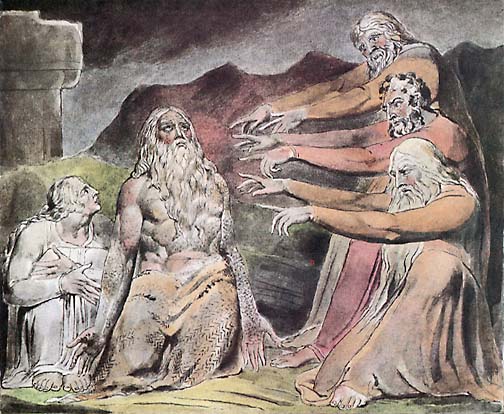 spoke. First Job was accused of harbouring some secret sin – any man who had experienced the misfortune that he had must have done much to deserve it. Job should repent and throw himself on the mercy of God, who was correcting his ways. But Job can only protest that his punishment is more than his crime.
Job’s friends start to list the glories of God – who can fathom the mysteries of God? And Job’s replies become more and more bitter, and angry. Who can blame him?
“…so man wastes away like something rotten; like a garment eaten by moths. Man born of woman is of few days and full of trouble. He springs up like a flower and withers away; like a fleeting shadow, he does not endure. Will God fix his eye upon such a one? Will you bring him before you for judgment? Who can bring what is pure from what is impure? No-one! Man’s days are determined; you have decreed the number of his months and have set limits he cannot exceed. So look away from him and let him alone till he has put in his time like a hired hand.” (Ch. 14)
And from the comfort of respectability, Job’s friends continue to caution him against his rash words, but he becomes less tolerant of their self- righteousness. The whole story begins to read like a court room drama, with God being accused of crimes against humanity.
 Then, step forward a younger man, Elihu, angry with Job for justifying himself against God, and angry at the others for their inability to bring Job to his senses. He speaks bravely about the wonders of God, and suggests that suffering might be put upon man to keep him from greater sin, and for moral betterment. Elihu speaks well and is obviously a good man, but his words ring just as hollow as mine seem to when I too try to explain human suffering.
Suddenly, into the story steps God. It is almost as if he can hold himself back no longer. God offers no explanations; rather he bursts out question after question;
“Where were you when I made the world?”
“Have you ever given orders to the morning or shown the dawn its place?”
“Can you raise yourself to the clouds and cover yourself with springs of water?”
“Will the one who contends with the Almighty correct him?”
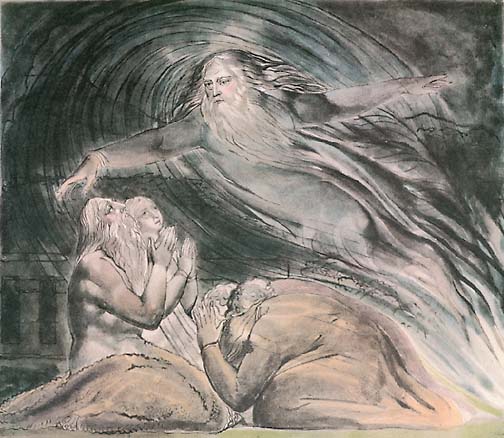
And Job does what we all must do. He falls on his face and says, “I am unworthy. How can I reply to you?” “My ears had heard you, but now I have seen you. Therefore I despise myself, and repent in dust and ashes.” Job saw God, in all his glory, in all his power and splendour, and lived.
God corrects Job’s comforters (but Elihu is not mentioned) and restores Job. He lives for another 140 years, old enough to see his great-grandchildren prosper.
As I look back at this story – it is all there. Sin and the fall of man, greed and man’s injustice, the test that comes to us through pain. Writ large is an eternal perspective, and a God who through it all, still loves, still wants to be close to us. Also, however, is the God of mystery. He did not answer the why questions apart from using who questions of his own in reply. He is God.
At the end of my searching, reviewing and wrestling, I still can not answer the questions of why there is pain and suffering and starvation in this world. I have some clues, and perhaps like Elihu, I can gain some part of the truth. But ultimately, God is God. Who am I to presume to understand? Like Job, we live our lives in the shadow of the wings of the Almighty. We search for meaning and for significance, and many of us have found this in part through relationship and encounters with God – but ultimately, I think, we all walk towards wonderful (and at times unfathomable) mystery.
All the wonderful images were pinched from here.

 this fragile tent
