

Emphasis is all.
I had a conversation tonight with my friend Nick. We were talking about some planning he was getting into for a programme of Bible study for young people. He was talking about the need to get into the basics of Christianity, and how many of the young people (and some of the older ones) had very little basic knowledge of the tenets of our faith.
I thought about this for a while, and genuinely wondered about what these tenets were- and what I would teach young people if I was in Nicks shoes.
The ’emerging’ conversation has shaken loose a lot of fixed positions for me. It has helped me see that a lot of the things I held to be basic building blocks for faith were perhaps not always so solid- but rather required robust examination. It made me wonder again about an approach to faith that started with one small group of people telling another larger one what it needed to know- facts and figures of faith that they needed to internalise in order to be a proper Christian.
In my discussion with Nick, I found myself making the following statement-
“I think we modern Christians made two particular mistakes in our attempts to engage with God.
- We overvalued the Bible- wanting it to provide for us a textbook that creates a Christian, in the same way that a blueprint could make a balsa wood model plane.
- We overvalued the need to get our doctrine sorted- the finding and adopting of correct positions in relation to all aspects of faith.
That is not to say that these things are not both wonderful and important- but simply that we over-emphasised them- making them perhaps the only way that Christians could discover God. In order to make this stick, we had to pretend that there was only one way to read and understand the words, and to suppress all less tangible and less ‘objective’ spirituality- rendering it untrustworthy and dangerous.
Sure, the Charismatic movement came along and added a whole new experiential encounter with the power and wonder of God, but ultimately, I would argue that the modern Protestant faith was grounded on the two points above.”
This statement is shot through with faultlines, but I think, on the whole, I stand by what I said.
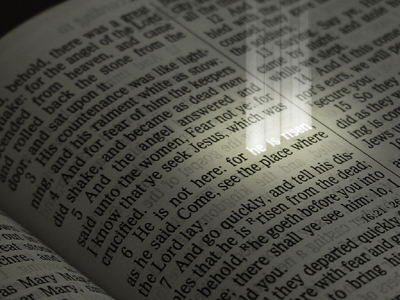
If I am right (and many would strongly disagree!) does it matter?
Does it matter as we seek to engage with young people? Do they not just need to be given some basic truth before we get all post modern and mystical? Perhaps they do. Perhaps the trampoline bouncing that Rob Bell talks about as an image of theology can only really begin once we have set up the trampoline.
But alongside the importance of the written words of the Bible, and the need to establish doctrinal beginnings- I think I would gently suggest that the emergent conversation might challenge us to add in other emphases too. Because people of faith have always encountered God through many other means.
So I am convinced that rightness of doctrine is not the precursor to being acceptable to God. It may be a consequence of this, but as far as I can see, God seems to tolerate a fairly wide spectrum.
And the Bible is wonderful- but many have lived lives in the name of Christ but have never seen one- either because they could not read, or because the canon of scripture as we know it today simply did not exist, or because the Bible was not available to them.
So what other ways to encounter God should be emphasised?
Perhaps we can only start by looking back to the spirituality of pre-moderns, and use this as a set of goggles to consider our own culture. There is much there that we would reject, and count our blessings that we are this side of the reformation- but still…
We see people seeking to engage with God through living encounters– through hardship, pilgrimage and through community. We see lives of service and humility. We see the importance of shared ritual and engagement with God in the passing of seasons and in connection to every day experience.
So might we learn from this as we seek to encounter God in our new changing context? Might we learn again the vitality and meaningfulness of the mundane, and the wonder of small adventures in which the wind of the Spirit blows us into the path of all sorts of opportunities to be shaped and changed?
The Bible will continue to be a gift to our new generations. There will be others too.
 this fragile tent
you can be pretty sure you’ve made God in your own image when He feels the same way you do about everything
You mean he doesn’t??!
Pingback: Digging a lot » Blog Archive » what if…number 32
Pingback: Digging a lot » Blog Archive » what if….number 32