
The history of Protestantism is littered with division and conflict.
Reformation of what has already been reformed.
Schisms of schisms.
Battles over whose truth is truer and whose understanding of scripture is most enlightened.
The legacy of these truth wars can be seen in the countless Protestant descriptive labels/denominations. Here are but a few as they occur to me;
Lutherans, Wesleyans, Reformed Weslyans, Methodists, Free Methodists, Primative Methodists, Baptists, Southern Baptists, Reformed, United Reformed, Assemblies of God, Anglican, Church of Scotland, Episcopal, Quaker, Shaker, Amish, Menonite, etc etc.
This list is in part a noble one. We have learned much from the men and women of God who have celebrated faith within these organisations. Such variety speaks of the freedom that people felt to follow after God in the way they understood him, away from the central powerful control of older forms of religion. It also is a story of fervency, of revival, of movements of the Spirit across whole communities, of great leaders who were bold and true.
But there is a dark side, measured by truth promoted over love and grace, and in a serial fracturing of the unity of the Spirit. Such division can be seismic in terms of the violence done to community in the name of Jesus.
I wonder if this kind of spiritual development can become addictive and even infectious. Almost as if all new Protestant church movements carry a destructive gene within their DNA…
Scotland has had more than a fair share of this splintering and fragmenting. Take the recent very public difficulties seen in the Free Church of Scotland, which splintered as recently as 2000.
I have used this picture before- taken in a small West of Scotland town about 7-8 years ago. Two churches so close that they are almost touching- but separated by a chasm of doctrine. I should add the proviso that I do not know either of these churches, and the image may miscommunicate entirely. But I think it makes a valid point about a certain characteristic of Protestantism…
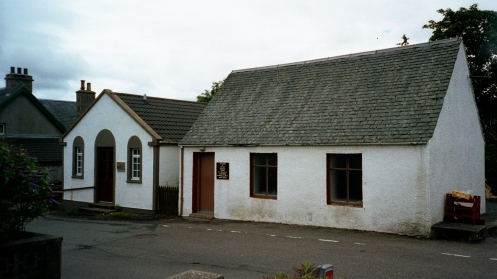
How did we come to this, we followers of Jesus?
How did Agents of the Kingdom of God, sent out into a broken world to form revolutionary cells characterised by love, somehow sign up instead to be driven towards such segregated exclusivity?
Is this more about psychology than it is about theology? Our tendency to seek a point of expansion and accomplishment, and to measure it against others around us- elevating ourselves by finding others wanting.
I wrote this poem in an attempt to understand these things in myself-
Diplomacy
We meet and move about one another
Probing, exploring borders
Negotiating
Presenting our petition
And revealing this badge of office-
Sewn on sleeves whilst our hearts stay hidden
Revealing carefully edited glimpses
Of whom we want to be
But are not yet.Then begins the measuring
Of the size of armies
The bore of canon
And the reach of your rockets
As we carefully deploy our camouflaged troops
To occupy the high ground
To hide uncertainty behind
A cloak of accomplishment
And capability.Sometimes it seems that who I am is only revealed
In understanding what you are not
In seeing you
And finding you wanting
In mapping out your strongholds
And avoiding them
And raising up my tattered flag
Above this uncomfortable alliance.
Why is this important now?
Because I think that this is a real challenge to those of us who are part of the ’emerging church’ discussion, particularly here in Scotland. Some questions-
Is ’emerging church’ just another Protestant reformation- another fractious denomination in the storming and the forming- throwing stones at those whose truth is not our truth, looking around and finding others wanting.
Or are we a break from modernist Protestantism- a more generous, open, embracing movement that seeks unity, not uniformity and is willing to learn humility and to value the other.
Are we Protestant at all? Where are the emerging Catholics?
If something new and hopeful continues to emerge, in all its flawed beauty- how do we(or even SHOULD we) nurture and sustain whatever we become without following a familiar pattern of splinter and schism?
From my point of view, the story is mixed.
Emerging church has no form and no structure- at least in Scotland. It is not a descriptive definition of any way of doing church- rather it is a loose affiliation of malcontents and hopefuls, defining themselves rather by the fact that they are prepared to question and seek.
And because we are human, friction is inevitable. People compete for prominence, and justify themselves by the rightness of their cause, or the small success of their activity.
But brothers and sisters- I find myself longing for something else. Something a little more of the Kingdom, and a lot less of the Empire.
Something characterised by tolerance and love. (Even as I am intolerant and unloving.)
On forgiveness rather than defensiveness. (Even as I defend and find it hard to forgive.)
Of a willingness to enjoy one another without the need to compete. (Even as my own insecurity drives me to do the opposite.)
And a determination to see community as the origin and the means for all things- with one another and with Jesus. And that the quality of these interactions should become the measure of our success. (Even with my own history of broken community, and the wounds I carry because of this.)
This is the church I long to see emerging.
I have not desire to be part of another schism.
 this fragile tent
hi chris
well you know my thoughts on sectarianism its still one of scotlands biggest unconfessed sins… my thought is also are we creating another church… the simpler option is NO CHURCH AS CHURCH
but I dont think people are ready for that yet….
Hi Ali
Sectarianism- I was using this word in a broader sense- the I-am-better-than-you kind of thing. In this context, church aint the issue, WE are!
And I suppose still- Jesus said the church was his bride. So it depends what you mean by ‘church’ I think. As I understand our past discussions, no church still means church, but just different? Free and not dependent on religious hierarchies.
Cheers
C
just came upon your site. as an ex UK protestant, married to an irish catholic wife, with 2 confused yet Spring Harvest loving kids (12 & 9), I do wonder….so thanks for your thoughts too !
Hi Alan!
Like the look of your wish4fairtrade site! May well sample some of your wares…
‘confused yet Spring Harvest loving kids’- we have worried a lot about the consequence of our current way of doing church on the kids. Ours are confused too! I hope that some of our passion for Jesus is communicated though.
I suppose we grew up with a tradition in which we kids attended a million boring church services in the hope that if we were dipped into a Christian solution often enough some crystals of faith will grow somewhere that might have a lasting effect. For some of us, it worked. For many it did not!
We have tried to bring ritual into our home- to mark transitions and seasons of faith, and to share life with others. But it remains to be seen what long term effect this has on their lives.
‘Emerging church’ (whatever this is!) has allowed me to think out of the box, and I am very grateful for those who led me to ask questions and find different solutions. But I do not think that these questions (or the solutions!) are new.
So blessings to you and yours Alan, and thanks for the comment.
Cheers
Chris