
The swine flu outbreak in Dunoon continues- more cases confirmed today. The Dunoon rumour mill has had a field day. I have really enjoyed hearing all the different versions of the same stories- you hear them in the queues at supermarkets, in the street, and in offices.
It is difficult to know whether we are over reacting, or under reacting. The school kids who have been told to go home, and not to associate with others are clearly ignoring this advice en masse- apart from my daughter, much to her disgust! I even heard about one girl in her year working as a waitress! I kid you not! Although, this being Dunoon, this story may well not be true.
The jokes have started too- the obvious ones are football related- the judgement of God on all Rangers fans, or the fact that God is a Celtic supporter, and has contaminated Ibrox to ensure that they win something next year. ( The link here, in case you missed it, is the fact that the outbreak here is linked to a bus full of Rangers supporters who travelled together from Dunoon.)
Then there have been the rather more pompous jokes about links to other plagues through history-
It did remind me of the story of the village of Eyam in Derbyshire close to where Michaela and I grew up. The story of the sacrifice made by the villagers there had entered into folklore to such an extent that it was the destination of many a school trip.
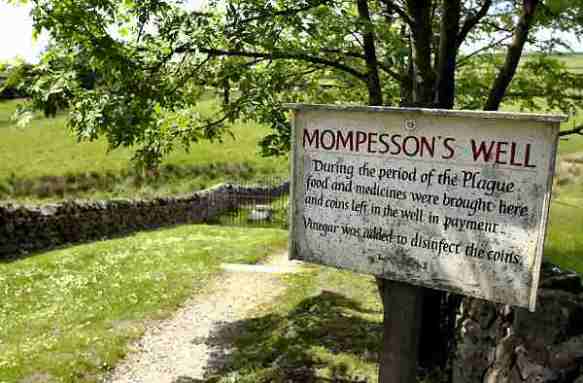
Here is the story as told here.
Eyam, a village in Derbyshire, was also badly affected by the great plauge of 1665 even though the disease is most associated with its impact on London. The sacrifices made by the villages of Eyam may well have saved cities in northern England from the worst of the plague.
At the time of the plague, the village had a population of about 350. The most important person in the village was the church leader – William Mompesson.
In the summer of 1665, the village tailor received a parcel of material from his supplier in London. This parcel contained the fleas that caused the plague. The tailor was dead from the plague within one week of receiving his parcel. By the end of September, five more villagers had died. Twenty three died in October.
Some of the villagers suggested that they should flee the village for the nearby city of Sheffield. Mompesson persuaded them not to do this as he feared that they would spread the plague into the north of England that had more or less escaped the worst of it. In fact, the village decided to cut itself off from the outside would. They effectively agreed to quarantine themselves even though it would mean death for many of them.
The village was supplied with food by those who lived outside of the village. People brought supplies and left them at the parish stones that marked the start of Eyam. The villages left money in a water trough filled with vinegar to steralise the coins left in them. In this way, Eyam was not left to starve to death. Those who supplied the food did not come into contact with the villagers.
Eyam continued to be hit by the plague in 1666. The rector, Mompesson, had to bury his own family in the churchyard of Eyam. His wife died in August 1666. He decided to hold his services outside to reduce the chances of people catching the disease.
Eyam Church where plague victims are buried
By November 1666, the plague was considered at an end. 260 out of 350 had died in the village but their sacrifice may well have saved many thousands of lives in the north of England. Mompesson did survive. He wrote towards the end of the village’s ordeal:
Now, blessed be God, all our fears are over for none have died of the plague since the eleventh of October and the pest-houses have long been empty.

How would Mompesson fare if he tried to persuade we Dunoon folk to close up the borders and sit out the infection, burying our dead as we went?
Not very well I suspect. But then again- who knows, we Brits tend to be at out best at times of adversity, or so we like to think.
 this fragile tent