

Today’s offering from my faithful radio travelling companion- radio 4- was a discussion about one of the earliest surviving images of Jesus, which was the subject of a wonderful programme called ‘A history of the world in 100 objects‘.
This image was discovered not in Israel, or in Rome, but rather in the unlikely environs of Hinton St Mary, Dorset, by a local Blacksmith in 1963. It was laid down as part of a mosaic floor around 350 AD to decorate part of a building that some say was dining room, others believe may have been a chapel. It is a crude image, existing alongside pagan images of characters from Roman mythology, Bellerophon killing the Chimera. The idea of putting images of Jesus on the floor that we could then walk over was outlawed soon after- but by then the Romans had abandoned their colony in far off Britain and pulled back to warmer climes- which is how it survived.
The image dates from a time around 40 years after Roman Emperor Constantine converted to Christianity, and suddenly a faith that had been persecuted and forced underground became the state religion- and so the powerful and affluent began to wear their faith like a badge of success and favour. Western culture (and the church) has been struggling with this unholy allegiance ever since.
The image sets me thinking about how we come to develop an image of the face of Jesus. We have no contemporary descriptions- and the only thing approaching a description in the Bible comes from long before the birth of Jesus in the words to the prophet Isaiah…
He grew up before him like a tender shoot, and like a root out of dry ground. He had no beauty or majesty to attract us to him, nothing in his appearance that we should desire him.
Isaiah 53:2
What we are left with are images (like the one from Hinton St Mary) that arise out of a particular context. The face of Jesus is then employed as a means of somehow making more real our own ideas, hopes and prejudices about him. They mirror our failing, fumbling theology…
The rich traditions of iconography are deliberate about using such images as part of Spiritual discipline- something that has always been rather alien to my slightly colourless Protestant background.
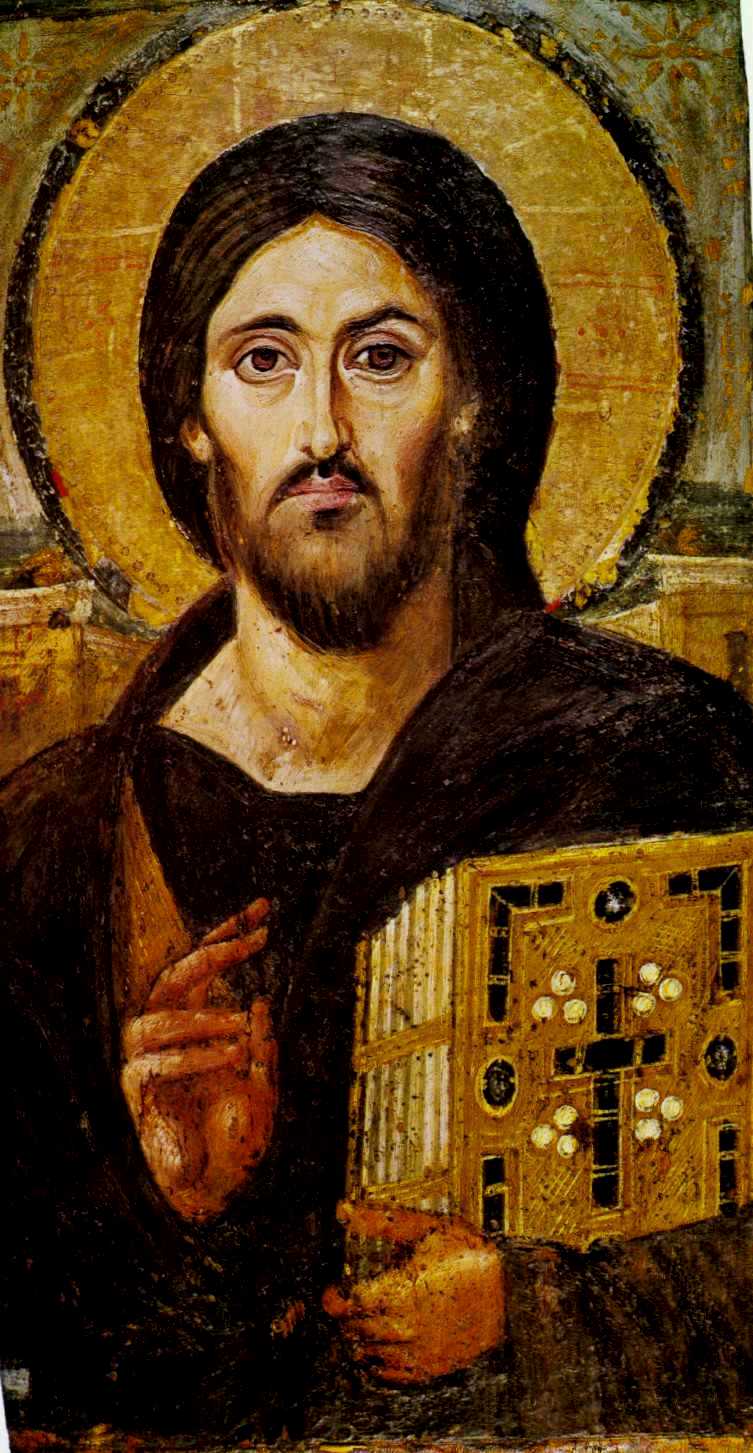
(The oldest icon of Christ Pantocrator,encaustic on panel, c. 6th century (Saint Catherine’s Monastery, Mount Sinai).)
The tradition that I come from does talk a lot about ‘The face of Jesus’ however- often in the context of rather sickly choruses. Here the face of Jesus in conjured up as a kind of shining radiant king looking down in love from on high.
For the rather unimaginative chorus writer- ‘face’ also conveniently rhymes with ‘grace’…
A much better example of this comes from one of my favourite Christian songwriters- Mark Heard, who sadly died in 1992. Here it is-
If I ever get to see Your face
And if You will spare me
I know that my allegiance to the human race
Will not ensnare meIf I ever get to know Your mind
And I survive it
I’m sure that I will leave a way of life behind
I won’t revive itLord, You know I need Your love so bad
I hardly even have the strength
To take Your handIf I ever get to hear Your voice
And I can take it
I’m certain that I will listen
To the better choice
And I will make itWritten by Mark Heard
© 1981 Bug and Bear Music
 this fragile tent
Very nice blog post. Being Eastern Orthodox I have to say that it’s not the accuracy of the image that we are looking at, but the eternal reality of what lies beyond the image. Icons are a necessary part of Orthodox theology, stemming from the Seventh Ecumenical Council in 787. They confirm Christ’s humanity just as His Divinity/humanity was later again challenged in 451.
Once again, I enjoyed reading what you had to say on the subject.
Thanks for your thoughts Jeff…
I feel deeply respectful of those who enter into a deeper understanding of God through iconography, whilst confessing that it is not an experience I have really had. The images have a mystical beauty for me, but I presume that like all spiritual disciplines, what is required is the acquiring of the discipline through practice!
One thing that occurs to me about the song lyrics that I posted are the my theology has come a long way since I first listened to the song. As I read them again, I wonder if they are quite right. They seem to suggest that an encounter with Jesus will suck us away from our humanity- making us holy in the sense of being REMOVED from the world. But perhaps the opposite might be true. We might become much more present here- much more fully engaged with the place we are part of?
Either way- good to hear from you…
Chris