
Mark Berry recently told me that his community (Safespace, Telford) had a patron saint- St Brendan.
It had never previously occurred to me that a patron saint would be useful, sensible or even possible- but in the moment I idly confessed to slightly feeling the lack of a personal saint…
I am not quite sure what they are for however. Some people believe that saints intercede for them in heaven- a kind of word in God’s ear from someone on the inside. I do not mean to be dismissive of other people’s faith, but this makes little sense to me.
However, I began a little journey of discovery on my holiday recently, enquiring into some of those old Anglo Saxon saints. In a trip round Whitby Abbey, you trip over them after all.
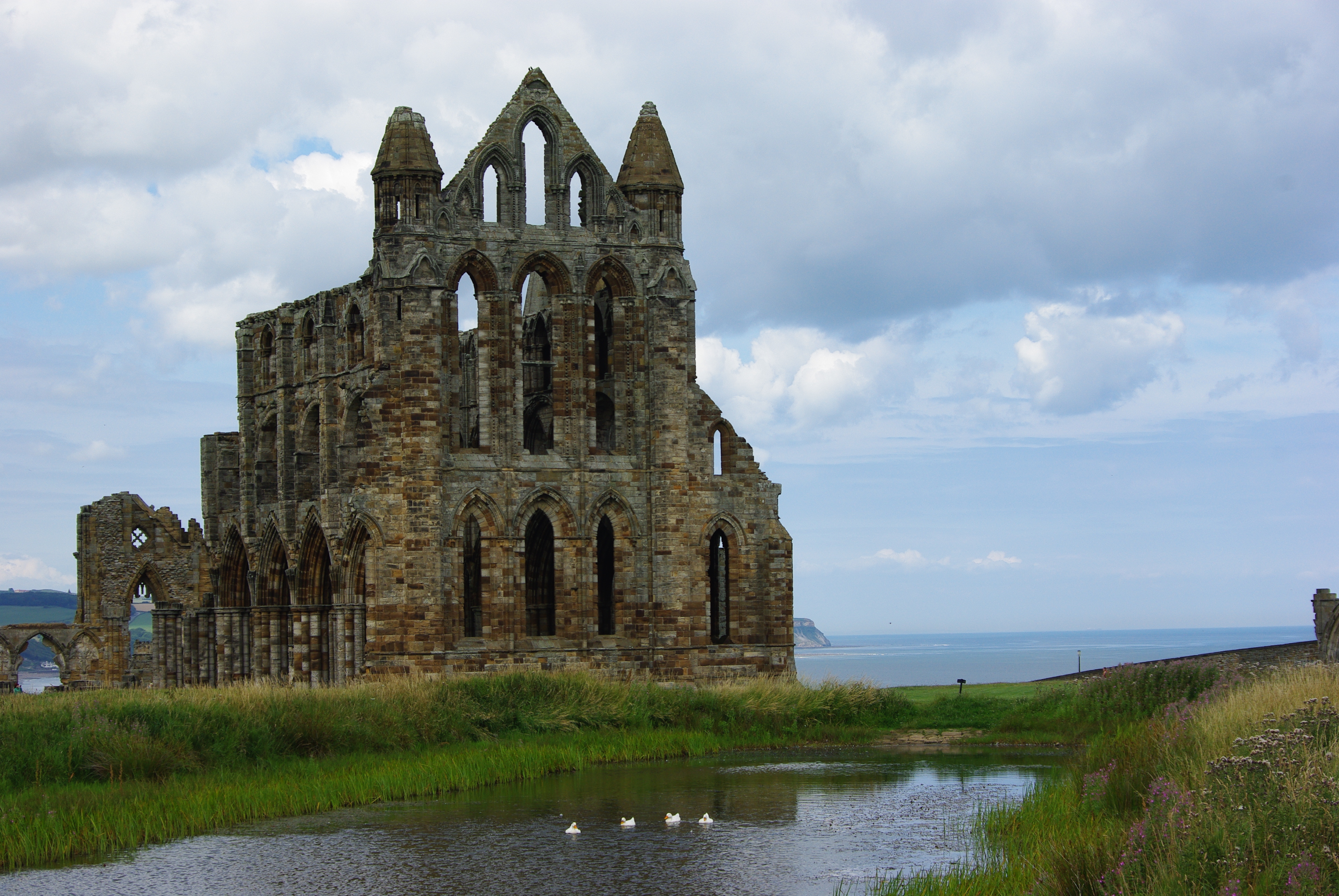
Whitby Abbey was founded (or perhaps organised by) Hilda in 657. All I knew about her and her times, I learned fromthis book–

It is a good book- history made real, with some good earthy bodice ripping (if the Anglo Saxon’s wore bodices.) Certainly worth a place in the suitcase if you are away on holiday. But it is Melvin Bragg’s take on the times- information is pretty sketchy after all.
Melvin Bragg did a programme on Hilda’s influence on his wonderful ‘In our time’ programme- well worth a listen here.
What is clear is that Hilda was a pagan who converted to Christianity aged 13 along with a whole Kingdom. There is a fantastic story about how this came about- her own father had been on the wrong side of some dynastic troubles and ended up poisoned, and so Hilda, a princess of royal blood sought refuge at the court of King Edwin in Northumbria. Edwin came under the influence of Christian missionaries, and asked his whole court to come to a consensus as to whether they should convert to Christianity. One of his courtiers is recorded as asking the court to imagine a sparrow flying into the great hall and finding itself surrounded by the glories of court. The suggestion was that we too are sparrows, living a short life amid much uncertainty- and here was a faith that promised an eternal relationship with the divine…
They converted, along with Hilda.
The venerable Bede, author of The Ecclesiastical History of the English People around 731 is our main source of information about Hilda. Bede probably met people who knew her.
Bede describes Hilda as a woman of great energy, who was a skilled administrator and teacher. She gained such a reputation for wisdom that kings and princes sought her advice. Considering all the fuss at the moment in the Church of England over women Bishops (and the Pope preposterous pronunciations about women priests being a sin along side child abuse) it is interesting to note that Hilda presided over two houses- one male and one female. She was part of a tradition of royal princesses who became leaders of holy houses all along the north east coast of England- wherever a river met the sea.
Hilda’s kindness and leadership seemed to allow others to flourish in learning and leadership- 5 of her monks went on to be bishops in the Anglo Saxon church. She was also well enough thought of that her house became the site of the famous Synod of Whitby, where the date of Easter was debated, and many believe the power of Rome finally overcame the Celtic churches.
She also had a concern for ordinary folk such as Cædmon, however. He was a herder at the monastery, who was inspired in a dream to sing verses in praise of God. Hilda recognized his gift and encouraged him to develop it.
Although Hilda must have had a strong character she inspired affection. As Bede writes, “All who knew her called her mother because of her outstanding devotion and grace”.

The stories of lives of faith lived out in these ancient times are fascinating. The accounts are not history as we understand it- rather they are seeking to inspire and encourage devotion.
Hilda, because of her support of Caedmon , Hilda is regarded as the patron saint of Poets everywhere.
Everywhere- and here…
 this fragile tent