
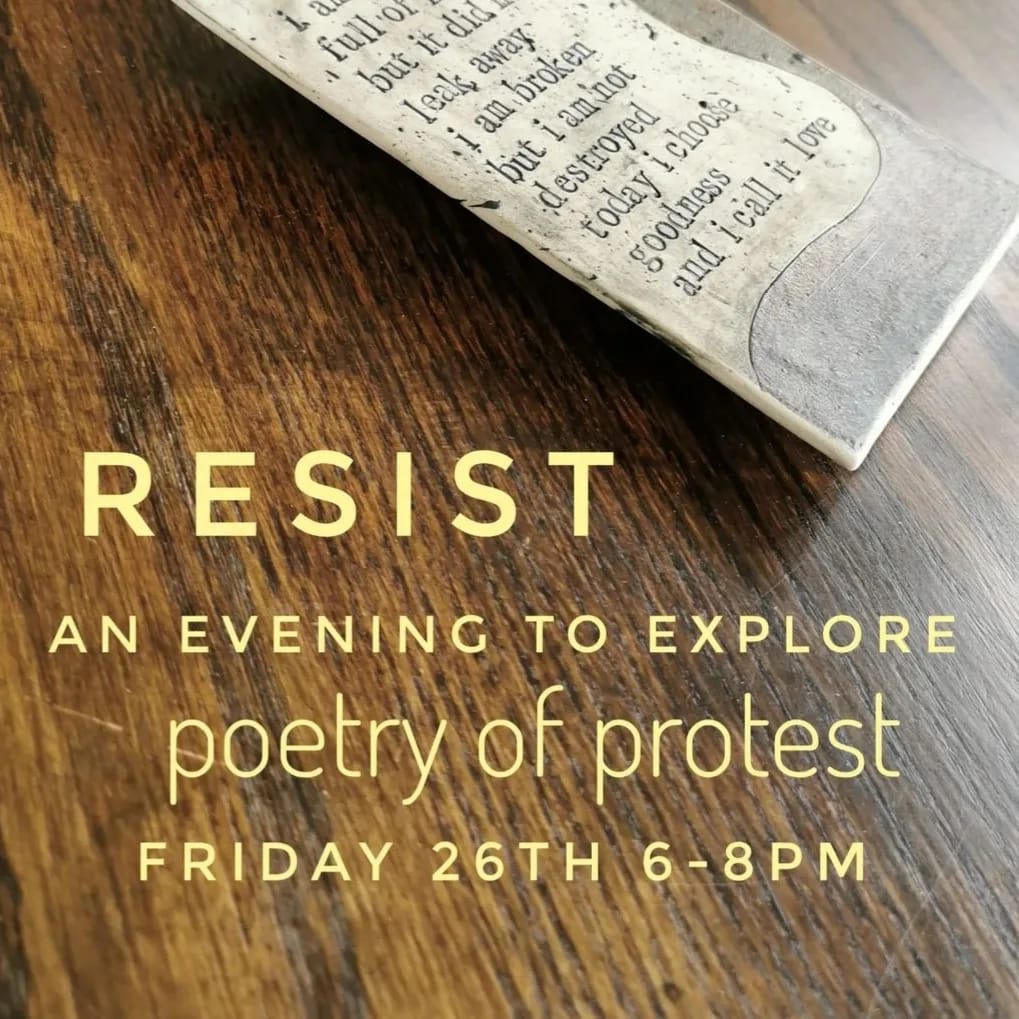
I am just getting over a nasty dose of the old Covid and starting to look forward to running a pop-up shop in a lovely space over the water- McGilps.
The shop is a way for us to showcase our pottery to an increasingly art-interested Inverclyde. This will be our second time in McGilps, and last time I loved it. So many good conversations, and we sold some work, allowing us to continue doing what we do. Alsongside this trading, we have also tried to put on a couple of events, including a poetry reading or two.
In fact, the poetry evenings are starting to take a rather lovely shape. I choose a theme, then spend a long time gathering poems. I always start with a few favourites (including some of my own) but then the discoveries begin, though internet searches or dips into half-forgotten books.
The trick then is to make people feel welcome, comfortable and safe. This cannot be guaranteed despite our best effort, as the chemistry of a human gathering is partially imported and not fully manufactured in the moment. The last McGilps gathering was special though- one of those evenings which live on in the spirit long afterwards.
Next Thursday evening, we go again. You are invited. It will be free this time (last time we charged twenty quid, but it felt wrong to charge for such a beautiful space) although we will take donations for the Amos Trust.
This time we ill be exploring poems of protest and resistance. I have written a lot of these, perhaps too many. Poetry always seems to give important voice to oppressed people. The thing is however, protest poems are not just strident protest, not just the calling out of the powerful and the politics of justice. To illustrate my point, I offer you a teasers of one of the poems I hope we will read on Thursday. It may seem long, but it won’t when you read it.
.
What He Thought
.
We were supposed to do a job in Italy
and, full of our feeling for
ourselves (our sense of being
Poets from America) we went
from Rome to Fano, met
the mayor, mulled
a couple matters over (what’s
a cheap date, they asked us; what’s
flat drink). Among Italian literati
we could recognize our counterparts:
the academic, the apologist,
the arrogant, the amorous,
the brazen and the glib—and there was one
administrator (the conservative), in suit
of regulation gray, who like a good tour guide
with measured pace and uninflected tone narrated
sights and histories the hired van hauled us past.
Of all, he was the most politic and least poetic,
so it seemed. Our last few days in Rome
(when all but three of the New World Bards had flown)
I found a book of poems this
unprepossessing one had written: it was there
in the pensione room (a room he’d recommended)
where it must have been abandoned by
the German visitor (was there a bus of them?)
to whom he had inscribed and dated it a month before.
I couldn’t read Italian, either, so I put the book
back into the wardrobe’s dark. We last Americans
were due to leave tomorrow. For our parting evening then
our host chose something in a family restaurant, and there
we sat and chatted, sat and chewed,
till, sensible it was our last
big chance to be poetic, make
our mark, one of us asked
“What’s poetry?”
Is it the fruits and vegetables and
marketplace of Campo dei Fiori, or
the statue there?” Because I was
the glib one, I identified the answer
instantly, I didn’t have to think—”The truth
is both, it’s both,” I blurted out. But that
was easy. That was easiest to say. What followed
taught me something about difficulty,
for our underestimated host spoke out,
all of a sudden, with a rising passion, and he said:
The statue represents Giordano Bruno,
brought to be burned in the public square
because of his offense against
authority, which is to say
the Church. His crime was his belief
the universe does not revolve around
the human being: God is no
fixed point or central government, but rather is
poured in waves through all things. All things
move. “If God is not the soul itself, He is
the soul of the soul of the world.” Such was
his heresy. The day they brought him
forth to die, they feared he might
incite the crowd (the man was famous
for his eloquence). And so his captors
placed upon his face
an iron mask, in which
he could not speak. That’s
how they burned him. That is how
he died: without a word, in front
of everyone.
And poetry—
(we’d all
put down our forks by now, to listen to
the man in gray; he went on
softly)—
poetry is what
he thought, but did not say.
Heather McHugh, “What He Thought”, from Hinge & Sign: Poems 1968-1993 © 1994 by Heather McHugh and reprinted by permission of Wesleyan University Press. http://www.wesleyan.edu/wespress
 this fragile tent