
The Bible Society commissioned a survey from Yougov – a legitimate and credible polling organisation – which they claim ‘busts the myth of church decline’.
You can download the full survey here.
Here are the headline claims, using the somewhat bombastic language from the Bible Society itself.
Key findings from The Quiet Revival
Co-author of The Quiet Revival Dr Rhiannon McAleer says the report shows that what people believe about Church decline is no longer true. ‘These are striking findings that completely reverse the widely held assumption that the Church in England and Wales is in terminal decline,’ she said.
‘While some traditional denominations continue to face challenges, we’ve seen significant, broad-based growth among most expressions of Church – particularly in Roman Catholicism and Pentecostalism. There are now over 2 million more people attending church than there were six years ago.’
More men than women go to church
The Quiet Revival shows that men (13 per cent) are more likely to attend church than women (10 per cent). And as well church decline being reversed, the Church is also becoming more ethnically diverse, with one in five people (19 per cent) coming from an ethnic minority. Close to half of young Black people aged 18–34 (47 per cent) are now attending church at least monthly, according to The Quiet Revival.
It’s also great to see that Bible reading and confidence in the Bible have increased as well as church growth. Some 67 per cent of churchgoing Christians read the Bible at least weekly outside church.
This is the key statistic. It would seem to point to a massic uplift in church going, particularly in the 18-24 range. Young men now seem four times more likely to go to church than pre pandemic – at least according to this survey.
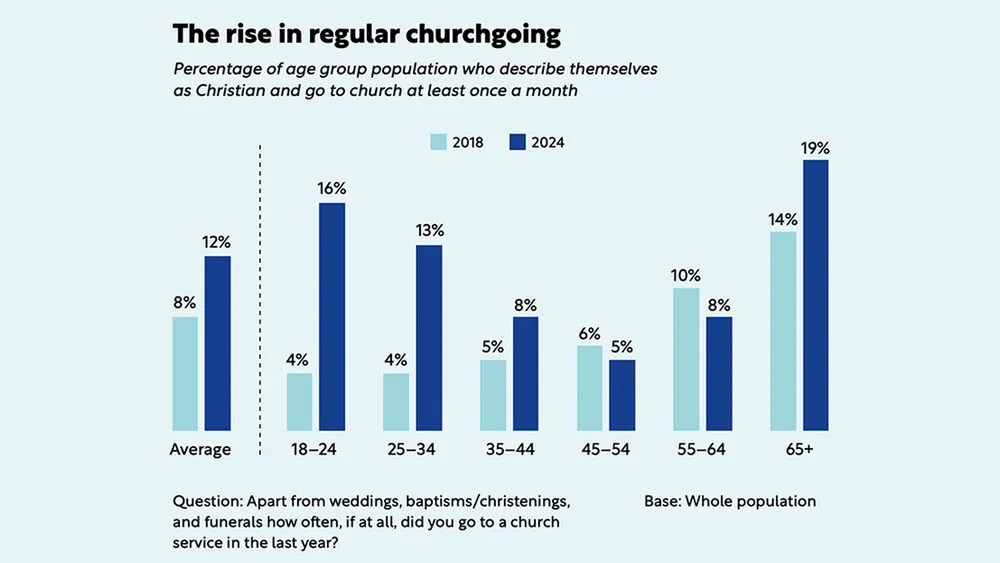
(For the statistics geeks, the actual data collected by the survey is here.)
This rather startling survey has been greeted by some with incredulity. It seems to be describing a trend that has reversed a decades long decline in church attendance in the UK. Many have greeted it with rejoicing. Could this really be true?
There have already been webinars and conferences that are using the term ‘quiet revival’ to describe what people are claiming as a ‘move of God.’ The lesson, it is claimed, is that this is the beginning of an awakening of spiritual seeking in younger generations, and evidence of the fact that yound men in particular are searching for meaning.
This all sounds like a good thing, right?
We might not have noticed it, but are we seeing an actual revival?
So why do I feel a deep sense of scepticism? Is this just my post-church cynicism? I am on record as having very mixed feelings about the word ‘revival’ (this from 11 years ago for example) after being previously part of expressions of religion that saw this as the only valid aim of Christian activity.
I think it is much more than that, however. A long time ago I was a social science graduate, and if we had come accross a piece of research or a survey that had suggested a social phenomenon that was different to all other sources of data, we would have immediately placed it on the ‘need more examination’ pile. We would have to look at other sources of evidence and test any conclusions that might be made by exposing them to wider scrutiny and comparison. One survey is never enough to declare a brand new social trend…
…particularly when other sources of information seem to directly contradict this survey.
For example, the British Social Attitudes Survey – the largest and most authorative survey of social trends in the UK – found no evidence of an increase of religious attendence, noting instead a continual decline.
It seems I am not alone in my sceptism. More or Less, the BBC radio 4 programme that explains – and sometimes debunks – numbers and statistics used in public life spent some time examing this issue today- it is well worth a listen.
Next, let me point you to this excellent piece on The Church Mouse Blog.
Here is how the Church Mouse frames the problem some of us have with this survey;
The most extraordinary claim is that, in the past six years (i.e., since just before the pandemic), the Church in England and Wales, across all denominations, has grown by more than half, from a total of 3.7 million regular worshippers to 5.8 million. The report says that it is largely the young who are driving this, in contradiction to our previous assumption that every generation is less religious than their parents.
The evidence for these claims comes from a large survey undertaken by a highly respected polling organisation, YouGov, that whether they had attended a church in the past month, among other questions. The same question set and methodology six years previously reveals a 56% increase in attendance.
And none of us noticed.
The Church Mouse goes on to say this.
Some of the churches where the Bible Society reported significant growth actually count the number of people who walk through their doors, and the numbers don’t match.
The most robust data set by a UK denomination is from the Church of England. Each church counts the number of worshippers during the same period each year, and the numbers are compiled to create a robust, consistent data set. The data shows that over the past six years, the Church has shrunk by between 10-20%, depending on how you count it…
…The same methodology can be applied to the data for the Catholic Church, the next largest denomination. The report said that it has grown from 23% of attendees in 2018 to 31% in 2024, meaning it would have grown from around 850,000 regular attendees in 2018 to 1.8 million in 2024, spectacular growth of almost a million regular worshippers.
The Catholic Church in England and Wales reported regular mass attendance down around 20% from pre-pandemic levels, to 555,000 in 2023 from 702,000 in 2019.
Between them, these two denominations have reportedly grown their regular attendance by almost 1.5m people, out of the total reported growth (According to the Bible society survey) of 2.1m, or over 70% of the total growth. But Church attendance data simply does not back that up.

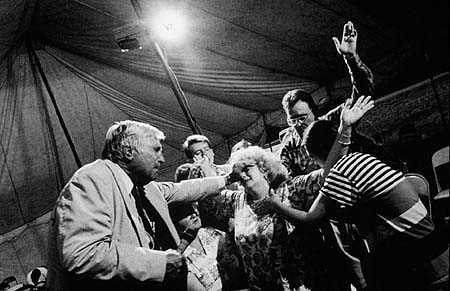
Is this all hot air intended to inflate church ego? (Sorry, could not resist in relation to the photo above.)
The simple answer is that we do not know.
But either way we need to explain why this survey is so different. Here are the possible reasons for this as I see them just now.
Data collection problems/survey bias
Yougov knows its business, but rougue findings from one-off polls and surveys are certainly possible.
Many have pointed out that saying you go to church is not actually the same thing as going to church, and people do seem to exagerate their church attendence. Might the fact that apparently more people have exagerated their attendence in itself be an indication of church being a more desirable option?
Or perhaps there was an error in earlier surveys, and in pew numbers collected by churches? All of them? Over decades?
Timescale
Has the survey picked up sometihng interesting that has happened in the last year? has the decline flattened out? Is there a new trend? The comparison figure of actual numbers collected by churches are all earlier. This seem implausable but…
What does ‘church attendance’ actually mean?
Must we include the many on-line expressions of faith – apps, streaming, etc etc? If so, perhaps people are now exposed to wider digital forms of church and so are including these in their answer?
What about Churches that don’t collect or publish stats?
Perhaps the increase is all in the non conformist, independent churches? There is other evidence that some of these are indeed growing, particularly independent and evangelical churches. The trouble is, this is from a lower base, and the Bible Society survey asked people to list their religious affiliation- leading to the claim of growth in mainline churches that simply is not evidenced by other sources.
Young men?
I have a slight discomfort about this, in that there appear to be other trends happening in that age group. There’s a growing divide between young men and women, with men increasingly drawn to conservative, traditionalist or right-wing political movements (while women tend to lean more liberal.) This trend, linked ot the influence of ‘Celebrity Christians’ such as Jordan Peterson is not one that I find comfort in. Might this be the reason for young men apparently seeing Church in a more positive light? The attraction here might then be narrow moral certainty rather than the teachings of Jesus.

My conclusions then…
This survey is interesting, but we need to treat it with a great degree of caution. There are major difficulties with drawing any conclusions based on this one survey, and the Bible Society itself has used language and great fanfare that I find highly questionable.
Whatever is going on is not revival.
It might hint at a change to come, but only time will tell.
 this fragile tent
Pingback: Church leavers research project- be part of the response! | this fragile tent
Pingback: Proost - Church leavers research project- be part of the response!·