
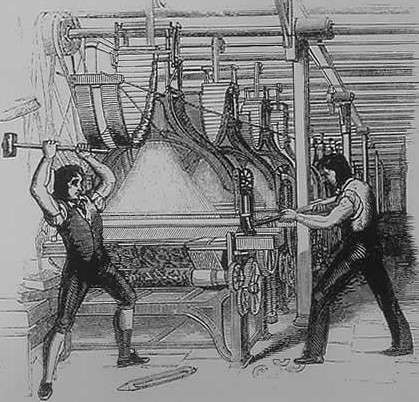
Great programme on radio 4 today- The Luddite Lament–
In The Luddite Lament, the award winning folk singer John Tams looks back at the machine breakers of the 19th century, through the prism of the songs they inspired.
Two hundred years ago parts of Britain were on the brink of rebellion – and you could be imprisoned for singing a song. There were said to be more troops on the border of Yorkshire and Lancashire than on the Continent with Wellington. The reason? Men armed with hammers, pikes and even guns were attacking mills in protest at the introduction of new machinery. Luddism began in the Midlands in 1811 and swept northwards to Yorkshire and then Lancashire.
In many ways this is the historical context that I emerged from- northern industrial Albion. I was born in Nottinghamshire, amongst the old mill and mining towns, before moving to live in Lancashire- on Fox Lane, front line of the old technological industrial transformation. The Step Houses opposite from my old house were built as weavers cottages, purchased by families through perhaps the worlds first Mutual Friendly Society. They flourished, until the coming of the machines that could replace all that artistry and skill with a powered weaving frames.
There is a rumour that my old local pub was used as a courthouse and prison to house some of the rioters before their transportation to Australia.
The Luddites are a footnote in history, most remembered as a name used as a term of abuse. This tends to be the fate of failed revolutionaries, particularly working class ones. They tried to break the frames that others would place around them- but this was a battle that the mill owners and the power mongers could never afford to let them win.
Perhaps the only part of the stories of these people who fought to preserve their way of life that has been preserved are the handful of songs– mentioned in the programme above.
The machines that swept aside the Luddites ushered in global industrial capitalism, but by the time I was growing up, the machines had moved on. A new surge of greed resulted in the destruction of more communities- history was being reframed as Thatcherism swept the north of all its heavy industry. We had our own Luddites, in the form of the National Union of Mineworkers. They too tried to weild Enoch’s hammer but they could not break the frame either. It broke them.
We do well to remember our history, and our songs- particularly when they tell the stories of the powerless and disenfranchised, at times when the weight of industrial-military power is used to aid the greed of the few.
General Ludd's Triumph.
.
No more chant your old rhymes about bold Robin Hood
His feats I do little admire.
I'll sing the achievements of General Ludd,
Now the hero of Nottinghamshire.
Brave Ludd was to measures of violence unused
Till his sufferings became so severe,
That at last to defend his own interests he roused,
And for the great fight did prepare.

The guilty may fear but no vengeance he aims
At the honest man's life or estate;
His wrath is entirely confined to wide frames
And to those that old prices abate.
Those engines of mischief were sentenced to die
By unanimous vote of the trade,
And Ludd who can all opposition defy
Was the grand executioner made.

And when in the work he destruction employs,
Himself to no method confines;
By fire and by water he gets them destroyed,
For the elements aid his designs.
Whether guarded by soldiers along the highway,
Or closely secured in a room,
He shivers them up by night and by day
and nothing can soften their doom.

He may censure great Ludd's disrespect for the laws,
Who ne'er for a moment reflects
That foul imposition alone was the cause
Which produced these unhappy efrects.
Let the haughty the humble no longer oppress,
Then shall Ludd sheathe his conquering sword;
His grievances instantly meet with redress,
Then peace shall be quickly restored.

Let the wise and the great lend their aid and advice
Nor e'er their assistance withdraw,
Till full-fashioned work at the old-fashioned price
Is established by custom and law.
Then the trade when this arduous contest is o'er
Shall raise in full splendour its head;
And colting and cutting and squaring no more
Shall deprive honest workmen of bread.
This one was probably written in (or at least about) the town of Sutton in Ashfield, where I was born-
Ye kind-hearted souls, pray attend to our song,
And hear this true story which shall not be long;
Framework knitters of Sutton, how ill they are used,
And by the bag-masters how sorely abused.
Chorus
Derry down, down, down derry down
They’ve bated the wages so low for our workThat to gain half maintainence we slave like a Turk;
When we ask for our money comes paper and string,
Dear beef and bad mutton or some suchlike thing.
Chorus
Bad weights and bad measures are frequently used–Oppressive extortion–thus sorely abused;
Insulted and robbed, too–we mention no names–
But pluck up our spirits and bowl in their frames.
Chorus
Good people, oh pity our terrible case,Pray take no offence though we visit this place;
We crave your assistance and pray for our foes,
Oh may they find mercy when this life we lose.
Chorus
 this fragile tent