
Oh Braverman, Braverman, Braverman…
The more astute commentators have pointed out that the (very nasty) political game behind the victimisation of the most vulnerable people in our society relates to who might be the next leader of the Conservative party, God help is all…
Braverman’s brand of toxicity has traction, and her strategy seems to be to make as big a splash as she can in order to rile up the far right of her party. The more unpleasant she is towards the old ‘enemies’ (scroungers, benefits cheats, liberal protestors, environmentalists etc.) the better. In these polarised times, this may well be a winning strategy, but at what cost?
Street sleeping has increased by 75% since 2010, even using the rather ludicrous official statistics.
I have been chewing over Braverman’s comments and the mostly (frustratingly) weak and thoughtless response to them in the media. You know the sort of thing- a panel discussion in which a Tory politician spouts stories about ‘begging scams’ and experts from homeless charities try to talk about the unsexy messy work of trying to help people off the streets. There are some exceptions;
Lord Bird says so many things that resonated with me, including his suggestion that street sleeping is an indictment on the failure of services and social policies. A phrase I have used previously is that they are our ‘litmus people’. They show us what we are.
I have some experience in this area because of my background as a social worker, mental health practitioner and manager of heath and social care services. I have met many people who have previously been, or were currently, living on the streets. Not one of them did so as a ‘lifestyle choice’ (whatever that actually means.)
Social policy has never been a perfect science (my undergraduate degree was in applied social policy), but at best, it is evidence-based and carefully shaped by both history and international comparison. Since Thatcher, we have pretty much abandoned this approach. Acedemic research has been mostly ignored – by the right as being too liberat, by the left as being unpalatable to middle English taxi drivers and suburban pensioners. We stopped seeking to understand society-wide shifts and instead placed our emphasis on individuals.
During the Blair years, this meant a focus on education, as if the poor could be socially engineered away via the classroom. The subsequent Conservative led governments have taken the Thatcher lesson much further, weaponising individualism by suggesting that all poverty, all vagrancy, all homelessness is the result of individual failings, choices, or character flaws. This justified a period of austerity during which social services, funding to voluntary groups and local authority support was slashed. The message has been underlined by increasingly punitive policies to police/sanction benefits claimants, or to stop people claiming housing benefit for properties with too many bedrooms.
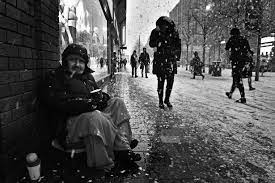
When considering the wider causes of individual distress, it is almost never appropriate to make what is general specific.
Or to put it another way, we can point to a number of societal factors that might explain the rise in homelessness in the UK;
- The rise in cost of living, having particular impact on low income households
- Soaring rents and unafordable homes for first time buyers
- Chronic housing shortage, including supported living environments
- The sqeeze of benefits, increase in sanctions, the bedroom tax
- Underfunded addictions services due to austerity cuts
- Underfunded mental health services due to austerity cuts
- A voluntary sector expected to pick up the slack, but also underfunded
- A job market dominated at the bottom end by insecure poorly paid employment
To this list we have to also add a number of potential individual factors;
- Childhood trauma,
- Poverty leading to erosion of resillience
- Addiction
- Mental health problems
- Divorce, bereavement, family breakdown
- Uncontrolled debt
- Prisoners struggling to adapt after release
- Ex servicemen with PTSD
- Refugees not allowed to work
- Bad judgement, mistakes made
- Bad luck
This begins to describe the complexity of factors that might lead to someone ending up sleeping in a tent on the street. Each individual story takes place in a context that is to a lesser or greater degree helpful. The presense or absence of individual vulnerabilities tells us little before the fact.
Do you think Braverman knows all this? I suspect she does.
 this fragile tent
Hi Chris – can you explain this sentence a bit further please? I’m not sure I understand ‘ The presense or absence of individual vulnerabilities tells us little before the fact.’
Thanks!
rob
I do not proof read Rob, i just let fly a stream of consciousness! i think I was just meaning that the increase in homelessness is because of the wider societal problems not because suddenly we have more people with individual issues. Or perhaps those individual problems are always secondary to the context they emerge within.