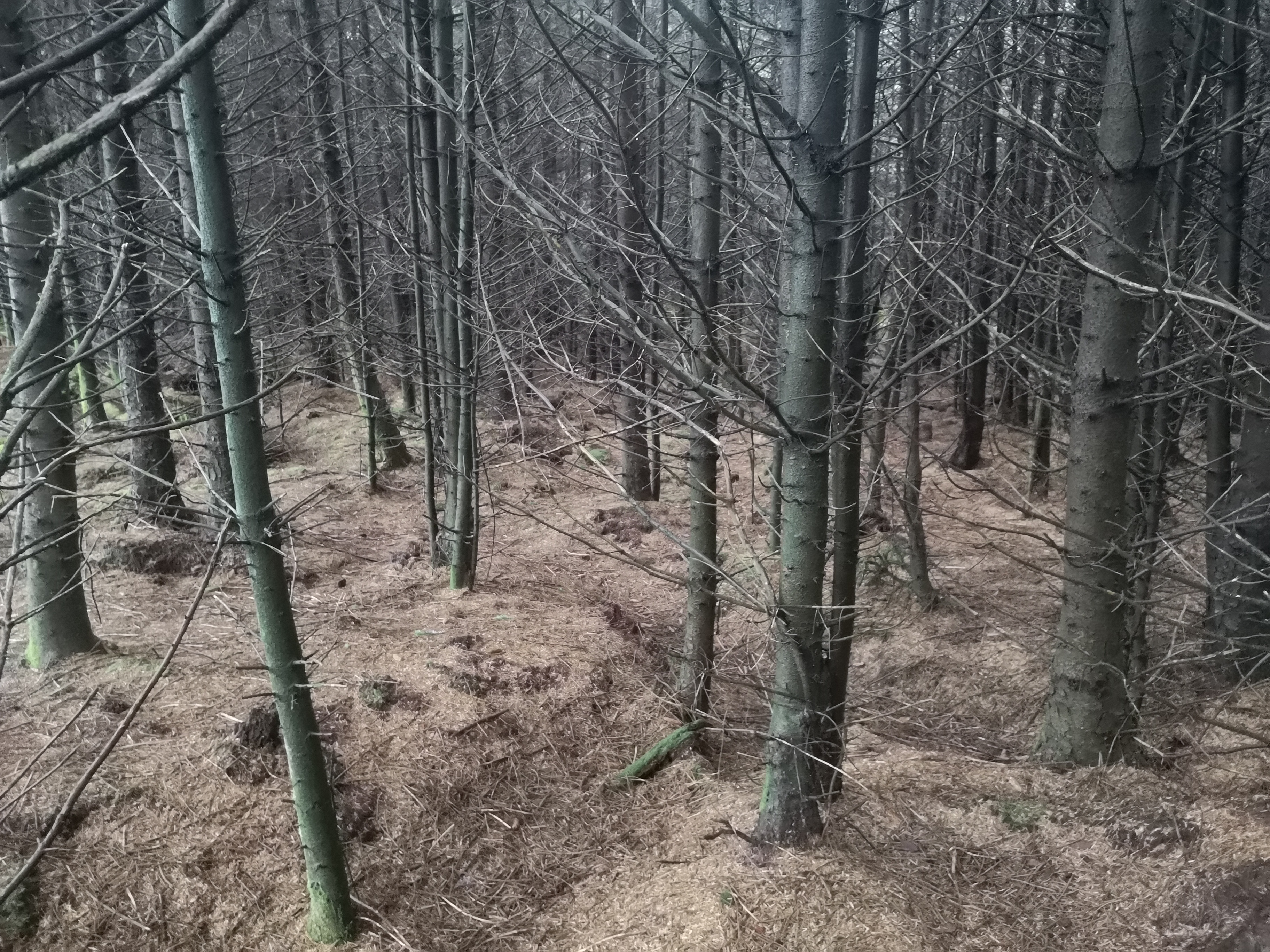
This is a photo of a spring ‘forest’ – one of the sitka plantations up above where we live.
If ever you have entered one of these plantations – and they are not hard to find – then you will know what strange places they are. Nothing grows at ground level, not even the ubiquitous invasive rhododendron, because all light is excluded. You have to crouch down low to make any kind of progress, as the only creatures that live in here are deer, who have nibbled to their head height. Ticks and midges proliferate, but very little else.
And they are almost silent, as if birds know better. As if (almost) everything that breathes… knows better.
I am thankful that there is a growing movement of people in Scotland who see these vast plantations as what they are – green deserts, made only for the profit. At such a cost to the natural ecosystems that they are destroying. At a time when we need our artists to raise their prophetic voices, we have this;
regular readers of this blog may remember me writing about these issues before, so here is what Alexander Chapman Campbell has to say about the inspiration for this haunting music (from here)
It seems to me that this way of producing timber, and of relating to trees, is simply a habit. We don’t need to improve the process, we need to chuck it out altogether. To reduce a forest to simply an economical process does trees a massive disservice. Through our mechanical inventions we’ve been able to reduce the old concept of a forest – with all its associated beauty, depth and mystery – to a crop, with tragic consequences both for humans and nature.
I wonder if any experiments have been done where a person’s brain is monitored while walking through the avenues of sitka spruce, and then compare this to the same person walking through a diverse area of woodland. But even without the science, I feel it’s obvious; humans are stripped of something vital in these plantations, as much as nature is.
Diverse, mixed-aged forest in Norway
Alternatives are possible. They’re demonstrated all over the world, and even in some places within the UK. You only have to walk through Norway to realise that things can be different; the persuasive rhetoric coming from those running our forestry operations suddenly loses its credibility. In the five weeks that I spent walking from Oslo to Trondheim I was able to experience a completely different kind of wood to most found in the UK. In places the forest was ancient, and protected, in others it was managed for timber, but in a way that didn’t strip it of its richness, its depth and its life.
According to the GWM1 (global wood markets info) in 2022 Norway became the largest exporter of softwood logs to the EU. The UK, in contrast, can only supply about 20% of its own timber and imports the rest. So, despite our intensive production approach we still find ourselves falling far short of being self-sustaining.
Norway is a much bigger country with a different rural history, which has left it with much larger tracts of forest. But the point is that alternatives are possible. In the glen where I live there is a forester who works for a company that largely practises an approach to forestry known as Continuous Cover Forestry, also known as Close-to-Nature Forest Management – a more sensitive and holistic approach to producing timber, and which is gathering traction. She was explaining to me that the economic benefits of large scale operations, with its associated clear-felling, is not as ‘clear-cut’ as we are sometimes led to believe.
We are creative, intelligent beings, able to find ways of supplying our needs without impoverishing the earth. It simply takes a strong will to make it happen, and in 2024 I believe the UK is still a long way from achieving the healthy relationship between humans and trees that we all desperately need.
If you’re interested in any further reading, here’s a very recent, and hopefully significant, report by the Royal Society Of Edinburgh. Published in 2024 it follows a two year enquiry, and is calling for a “radical rethink of tree planting in Scotland”: Read The Report
3 thoughts on “In the dark belly of the green desert…”
You reminded me of a poem l wrote years back at Dhanakosa Stump Insult on injuryYou sit your flesh on meAnd count my ringsAs if mere numbersCan sum up my life I have seen so muchOf your insane trajectoryOne hundred yearsHas brought our earthTo a season of decay And you know nothingYou who set us upIn mass planted anonymityFor paper to wipe arsesFlat packs to display shite For all your books have failedAnd now you thinkYou can live without usDigital toys now spread your lies Yes leave us out of itWe’ll grow on togetherIn wild green witnessTo your story’s end Yahoo Mail: Search, organise, conquer
To create these places, the wet spaghnum moss filled lands were deep ploughed to drain the brown waters faster, downhill and far away from the precious crop. Let them deal with the drowning below in the lowlands.
The softwood produced is lower quality as it is fast grown. Strength comes from slow grown wood with its dense annular rings. These forests produce wood that is grown for quantity and profit. Annular rings are so far apart that strength has been sacrificed on the hills of economies of scale.


 this fragile tent
You reminded me of a poem l wrote years back at Dhanakosa Stump Insult on injuryYou sit your flesh on meAnd count my ringsAs if mere numbersCan sum up my life I have seen so muchOf your insane trajectoryOne hundred yearsHas brought our earthTo a season of decay And you know nothingYou who set us upIn mass planted anonymityFor paper to wipe arsesFlat packs to display shite For all your books have failedAnd now you thinkYou can live without usDigital toys now spread your lies Yes leave us out of itWe’ll grow on togetherIn wild green witnessTo your story’s end Yahoo Mail: Search, organise, conquer
To create these places, the wet spaghnum moss filled lands were deep ploughed to drain the brown waters faster, downhill and far away from the precious crop. Let them deal with the drowning below in the lowlands.
The softwood produced is lower quality as it is fast grown. Strength comes from slow grown wood with its dense annular rings. These forests produce wood that is grown for quantity and profit. Annular rings are so far apart that strength has been sacrificed on the hills of economies of scale.
Amen brother