
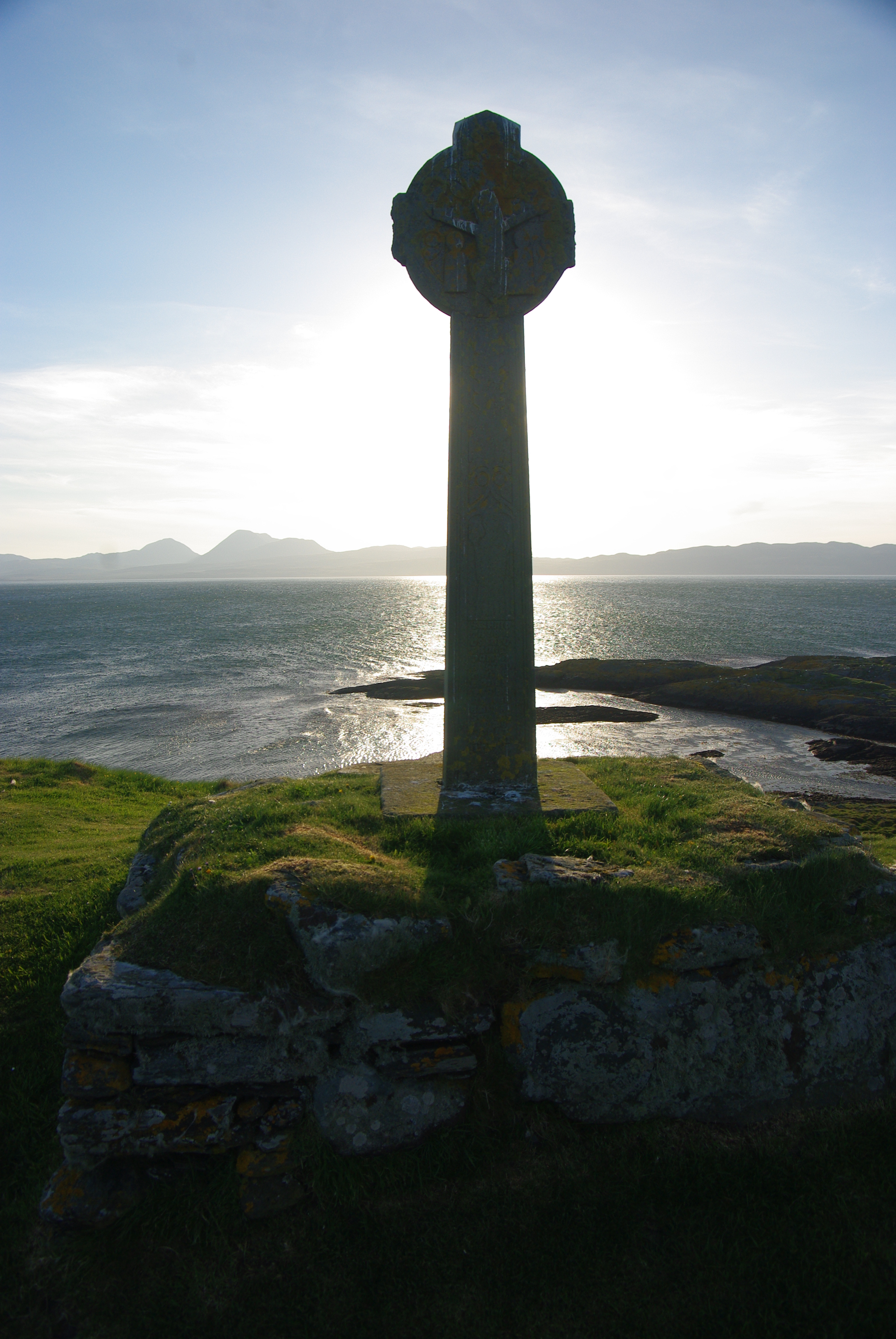
For a while now, I have been feeling the joy of spiritual adventure in what has been described as ‘The Celtic tradition’. I can feel some of you rolling your eyes already – I get why, because I once would have done the same. Am I going soft in my old age, finally succumbing to that half of me that is Irish, land of fairies, holy wells and bog saints? Perhaps I am.
I grew up in a Christian world in which ‘Celtic’ meant singing worship songs with tin whistles with everything else unchanged. It was about style, not substance ; a marketing ploy, not a serious spiritual path. It was the opposite of serious learning because it was concerned with myth and legend at best, or romantic projections from people who had no real idea what the Celtic Church (if such a thing ever existed!) really was within its own context.
We have also tended to simplify history in ways that suit the story we want to tell. The ‘Celtic’ church then becomes understood as morally good and pure,a magical institution that is a supporter of women and woodlands, a lover of wild geese and the promoter of religious freedom. The Roman Church which overwhelmed it (booooooo!) is by contrast the evil interloper, with its insistence on authority and adherence to doctrines invented by Empire. (It is perhaps worth noting that perhaps this simplification hides some truth.)
It is without doubt that this thing that we call the Celtic Christian tradition is a modern creation – a slippery construct that lacks historical or theological rigour or seriousness. Perhap then it is useful only in the broadest sense to describe something that mostly we can only guess or infer. The danger here then is that we use it to tell which ever story we want to tell. This is certainly the way I used to see things. I stood back from it, safe on my intellectual ledge of knowing.
Perhaps this is a good time to introduce this interview, between our very own Ruth Harvey (Iona Community leader) and author/Celtic expert Professor Ian Bradley.
Professor Bradley is erudite, deeply immersed in his subject and despite his reluctance to use label of Celtic Christianity, he clearly remains sympathetic to some of the tradition. There is much we can learn from him and his deep historical knowledge. Why then do I find myself disatisfied with this interview? What right have I, with my limited learning and perspective, to feel somethere deep in my soul that he might be missing the point, to be looking at trees and failing to see the forest?
It is perhaps ironic that Bradley does not see the Celtic tradition – at least in its early historical sense – as being particularly concerned with deep connection to the wild, even if he acknowledges that this is very much present in the later writings. This lack of early evidence is important to him, but I have two issues with this.
1. The writings that survive have been filtered through the religion of colonisation and empire, and from within the monastic establishments. What we know of the pagan pre-Christian knowng that Chistianity assimilated and ultimately replaced has been almost completely lost.
2. Arguably, the place where this kind of knowing lived on was through folk traditions and cultural memories, but this kind of knowledge does not respond well to historical examination of the kind used within acedemic institutions and is therefore too easy to dismiss.
So now we come to a second video. (I hope you have time to watch them both in full.)
Are JP Newell and Paul Bradley even talking about the same thing? Two late-life white men, offering us such different perspectives. It feels like they are looking at the same source material and reaching totally different conclusions. Surely one of them must be right and the other wrong?
Perhaps not.
One approach is that of the Academy, of historical process and rational discourse based on what can be evidenced through documentation and record – after all Professor Bradley’s review of ‘Sacred Earth Sacred Soul’ suggests he has a dim view of some of the historical work in the Newell’s books – not least his chapter on Pelagius. Perhaps too that many of the criticisms I made above might be leveled at this book, and many Newell’s wider views.
Meanwhile, the other approach is one of the poet, the guru, the spiritual seeker. Source material here comes through inspiration, through deep listening to what feels true in the human soul, or what can be gleaned from the teaching of others who have explored what Newell believes to be the wider Celtic tradition. Newell sees this tradition as a radical anti-empire form of deep sacred resistence that never went away, despite the best efforts of institution and academy. It is the truth of the small people, the women, those out on the fringes, those who still feel the ebb and flow ot tide and season- th kind of religion that white upper class men have always rejected.

Here is my tentative conclusion. Perhaps what is being described here is NOT a theological block of learning, but rather a remnant stream of deep indigenous consciousness, which has been carried through myth and traditions out on the celtic fringes, then rediscovered serially by small marginalised people throughout history. It is not possible to classify as we might other doctrinal streams because it is not doctrinal, rather it is instinctive, mysterious yet somehow recognisable when we catch glimpses of it.
After all, Newell points out that we never needed the institution to tell us what was right, because we carry the divine within us, and when we encounter that which is good, we feel a soul-deep ‘YES’.
He points to the suppressed outrage we feel against ideas like original sin – that pernicious religious technology that enslaved so many for so long – and the YES we feel when we discover alternatives such as original goodness of the kind suggested by Celtic teachers such as Pelagius,
Is he right? Have you ever felt something similar?
I hope I am not being overly simplistic if I suggest that Bradley and Newell might embody a polarity that has always been present within the Christian tradition between the priest and the poet/prophet. One side is drawn to order, to the keeping of safe community within a long tradition. The other seeks the elusive other through the beautiful mess of what we are. One builds knowledge and belonging structure, the other sees their limitations and always wants to explore beyond them.
The problem then (particularly for those who live a lot of time in their heads like I do) is that we often need a language scaffolding to allow us to understand and engage. There are those who can live only in the mystical realm, but I need words. In a previous post, I tried to describe some parts of what I was discovering like this;
We celebrate the Cosmic Christ, the God who loves things by becoming them (with a nod to the writings of Richard Rohr and his grounding in the Fransican tradition.) Christ might also be a word which means ‘another name for everything’.
Christ the substance through which all things have their being. S/he might be understood as the shared am-ness of all things. Through Christ we are interwoven and connected to all created things both human and non-human. Through Christ we are drawn to be lovers of the earth not because we are ascendent, but because we are included and interdependent.
Learning from the Celtic tradition, this same Christ is the very ground of our being, the truest deepest part of our personhood and our shared humanity. Sin is that which prevents us from being our truest selves, and this can be seen both in our individual lives and our collective brokenness.
This might mean that we discover Christ in our own souls not by addition, but by subtraction (with a nod to the wisdom of Meister Eckhart) by finding our way through all the mess, trauma and bad choices through to what was there all along, waiting for rediscovery and re-connection.
Remarkably, the story of Jesus (the historical Christ rather than the Cosmic Christ) suggests that god has been revealed not only through nature (the first incarnation) but through taking on flesh (the second incarnation) The life and death of Jesus is a deep call towards sacrificial love towards our human and non-human neighbours.
Christ taught a gospel of grace, in which we remember that the god who is the light behind our light and the soul within our souls knows our woundedness, and waits for us to journey towards her. A Christ who no longer is the deserter of earth, but an example of its greatest lover. A Jesus who is no longer a supra-human ‘other’, but rather one of ‘us’.
After the Celtic tradition, we seek to take our place in world where nature is the gift of being, but grace is the gift of wellbeing.
In other words, we enter the Kingdom of God (which the historical Jesus called us to take our part within) which is way to describe a non-dual, engaged way to collaborate in the service of healing, peace-making and acts of love towards the world, with a particular emphasis on those parts of the human and non-human world that are broken, enslaved, endangered or subject to injustice.
I think we can trace this polarity between the two approaches to spirituality – the poet and the priest – through church history but also through the words of the Bible, one third of which are… poetry.
I have to confess that I see both the world and my experience of the divine through the medium of poetry. I am longing for mystery and deep music, not for facts or evidence trails. I have spent too long in the shadows of the academy and institution and have seen the way they inadvertantly and overtly become tools of power, used by the powerful.
Does this mean that I think that Newell is ‘right’ and Bradley ‘wrong’? Is one ‘true’ and one ‘untrue’? Of course not – it is not that simple. Perhaps the better questions are these;
- What do you feel singing in your soul when you encounter the ideas in these videos? Are there things to which you feel a deep ‘yes’?
- Which version is the most useful in terms of liberation, healing and renewal of relationship with the divine?
It is my answers to these questions that keep me interested in the Celtic tradtion. I think we need the myth and the poetry arising still in these western fringes. We need the wild islands and the ancient remnant rain forests. We need the ancient places of pilgrimmage. We need the old stories.
We need too the diversity that seemed to be part of this old tradition – the fact that some monastic gatherings were just men, some women and some were mixed. We need local expressions and explorations that are not motivated first by conformity.
Perhaps most of all we need new (old) ways to connect us to each other and to the wider earth community that we belong to – in much the way that I tried to talk about in this post here. (In fact this piece should be read as part 2 to that post.)
We have a resource here in both versions of the Celtic story- the history, but particularly the poetry. Let’s use both.

