On our anniversary…

Today Michaela and I have been married 18 years.

18 years! Where did the time go?

But I am blessed.

Michaela- you formed the best part of me, and I love you more now, than ever…

Michaela avoids cameras- but here are a few recent photo’s…

And here is a poem- old romantic that I am.

Evolution

There’s a billion years of history
That starts in oozing slime
But it makes no sense to me
It has no human rhyme

The vastness of the universe
The emptiness of space
This has no part of me
It has no human face

If I knew the time when
All time will meet its end
All would still be meaningless
Without you my friend

For as you wake
The morning mists your eyes
And in the afternoon
The sunshine shows your smile
And as the evening slips into the night
Your hair is dancing in starlight

For Michaela 2002.

How do you love an unknowable God?

51OrdinarioA28.jpg (JPEG Image, 508×787 pixels) – Scaled (68%)

In Matthew 22, Jesus is under siege by clever people who are trying to trap him using questions that will get him into trouble. They seemed to do this quite a lot- and we all love the way that he always saw it coming, but gave answers that were far more than they expected.

This time, they were asking him about what was the most important commandment. Quite what they were trying to trap him with, who knows, but Jesus was clear that the most important commandment was to love God.

Love him with everything you are, and will be.

Love him with your heart, your head, and your wallet.

Then he said that the next commandment was to love other people as you love yourself. This loving others bit almost reads like an after-thought because if you did really love this God of ours, then it would be impossible not to get into what HE is into. It would be be a natural thing to love the things he loves. And perhaps above all things, it seems that he loves…us.

What does this mean in your life and experience? Because, if I am honest- I am not always sure what loving God means. How do you love someone who is essentially unknowable? Because no matter how big our thoughts towards God are, he is always bigger, he is always MORE.

One of the aspirations that modern Christianity has given us is the possibility of a ‘personal relationship’ with God. I suspect this would have been a startling concept for our church fathers. It is an idea that seems to domesticate God, and recast him in a role that is of our own making. Is this what it means to love God? Do we need to make his shape fit our lives- invite him into our little boxes?

I think if we did, he would come. He loves us after all. But I also think that he wants to invite us OUT into something else. It is an adventure into a kind of purple mystery. There are moments of almost painful clarity, but on the whole, it seems that what most of us experience in this search after our version of the Universe Maker is uncertainty.

Don’t get me wrong. I know people of faith who never seem to experience doubt or any weakening of their unshakable faith – sometimes in spite of huge life challenges. I can not claim to this certainty myself

But we people of faith, I think that when we say we ‘love God,’ we do so as a statement of faith and intent.

And then it begins. Two steps together, then many when we might loose rhythm. But as we continue walking- he is still there.

And the business he sets us on – I think this is the consummation of love. But it is not conditional, it is inspirational.

So may you and I catch glimpses of the love of God.

May we see him in the wonder of the sunrise,

And in the mystery of the night sky.

May we see him in the vulnerability of a small child,

And in the broken waste of a drunk down on his luck

May we learn to love

The things that he loves

And live to walk

In his shadow.

Blogged with the Flock Browser

Unitarianism and the emerging church?

Blogs are good places for controversy- I think.

But not controversy just for the sake of controversy. So forgive me if I open up the issue that appears to be the nightmare of any fundamentalist (and many liberal) Christian- the spectre of Univeralist belief systems.

I have a reason for doing this. The idea of univeralism has crossed my path a few times recently. There was Fred Hammond’s response to this blog post. Fred is a Unitarian Minister in the America’s deep south- and has an interesting blog here.

I am also back from my brother-in-laws wedding. He and Emma chose to get married in a Unitarian Chapel in their home town of Belper in Derbyshire. It was a wonderful wedding, created by Chris and Emma as a highly individual celebration of their decision to live and love together. I picked up some leaflets about the chapel, first established in 1680, and about Unitarianism itself, which left me thinking…

Then there is our local hymn-writing hero, George Matheson, the Blind Preacher of Innellan, Argyll. He is perhaps most famous for writing the wonderful hymn ‘O love that wilt not let me go’, but in his time, thousands flocked to hear his oratory power. I came across one of his other hymns recently when attending a lecture at his former church in Innellan. It gives a whole different perspective on the theological melting pot that was Victorian religion in Britain.

Gather us in, Thou Love that fillest all;
Gather our rival faiths within Thy fold;
Rend each man’s temple veil, and bid it fall,
That we may know that Thou hast been of old.

Gather us in—we worship only Thee;
In varied names we stretch a common hand;
In diverse forms a common soul we see;
In many ships we seek one spirit land.

Each sees one color of Thy rainbow light,
Each looks upon one tint and calls it heaven;
Thou art the fullness of our partial sight;
We are not perfect till we find the seven.

Thine is the mystic life great India craves;
Thine is the Parsee’s sin-destroying beam;
Thine is the Buddhist’s rest from tossing waves;
Thine is the empire of vast China’s dream.

Thine is the Roman’s strength without his pride;
Thine is the Greek’s glad world without its graves;
Thine is Judea’s law with love beside,
The truth that censures and the grace that saves.

Some seek a Father in the heav’ns above;
Some ask a human image to adore;
Some crave a spirit vast as life and love;
Within Thy mansions we have all and more.

So- Unitarianism. What do they believe? The good old BBC has a summary (see here for more.) A couple of lines stood out…

everyone has the right to seek truth and meaning for themselves, using: their intellect; their conscience and their own experience of life

the best setting for finding religious truth and meaning is a community that welcomes each individual for themselves, complete with their beliefs, doubts and questions.

It occurs to me that many of the critics of the ’emerging church’ (whatever this is, or whatever we call it now!) categorise it’s followers as essentially liberal, and sliding towards a universalist position on faith and truth. That is to say, the suggestion is that we have bought into a post-modern way of thinking that sees everything as relative to your own individual perspective- and truth itself as multi-faceted and undefinable.

And, if I am honest, there seems to be much of the Unitarian tradition that I feel in sympathy with- the point above for example.

But I remain a follower of Jesus, and things that he said and is doing through us, his faulty followers. I have reminded myself that I am not universalist in my beliefs. I may be uninterested in labeling anyone else a heretic, but when it comes down to it, I do not believe that all routes lead to God, nor that all faiths bring equal but complimentary truth.

There may yet be a point at which the Emerging Church has emerged, into something with its own unifying doctrinal statements. I hope the two above will be there, more or less complete…

Margaret Thatcher and Elvis Costello

news-graphics-2008-_661518a.jpg (JPEG Image, 350×330 pixels)

Margaret Thatcher’s daughter Carol has recently written movingly about her mother’s advancing Alzheimers Disease. THere was an interesting debate on the radio this evening concerning whether Carol should have revealed these intimate details of her mothers dementia, as her mother now lacks the ability to give her consent to this.

The spectre of old age infirmity and loss of faculties hangs over all of us. Author Terry Pratchett has been outspoken about his own dementia, and it seems to me that any publicity that raises the profile of the experience of this growing group of people is a good thing. Even better if this results in increased funding for research and development in treatment and care of older folks.

Anyone who has to visit the back wards of the oldest parts of our hospitals (where the ‘elderly acute’ wards are almost always to be found) will be aware that such places often appear to be nothing more than warehouses for amateur cadavers. Despite some wonderful staff, for most of the people who end their days there- after a referral of last resort- dignity has long gone.

But- Margaret Thatcher- vulnerable, human, just like the rest of us…

I grew up in Thatcher’s Britain. Communities I lived in where split apart by her calculated battle with the National Union of Miners, and now almost all the pits are gone. I write this sat in a car driving through Sheffield on out way down to Derbyshire to attend a family wedding. All the steel works are gone. The old industrial sites are covered with scrub, or been cleared back to make shrines to the great patron of retail parks, Margaret herself…

Were all those broken communities and broken lives necessary? Did economic reality make them inevitable, as Margaret always said? Did the Free Market really know best? History will decide, I suppose. But her status as an iconic epoch shifter is already cast in bronze.

But in the 1980’s, we knew who our enemy was. She was Satan in a twin-set. She personified everything that we rejected. It all came back to ideology- and hers was based on a selfish individualism, and an elevation of greed as an engine for social change. Or that is the way half of Britain saw it.

She inspired incredible idolatry from her followers. And generated genuine loathing from the other side of the spectrum, perhaps like no other democratic politician before or since. It is possible to understand the divisive effect she had more fully by remembering a song by Elvis Costello called ‘Tramp the dirt down.’ It included these lines;

I saw a newspaper picture from the political campaign
A woman was kissing a child, who was obviously in pain
She spills with compassion, as that young child’s
face in her hands she grips
Can you imagine all that greed and avarice
coming down on that child’s lips

Well I hope I don’t die too soon
I pray the Lord my soul to save
Oh I’ll be a good boy, I’m trying so hard to behave
Because there’s one thing I know, I’d like to live
long enough to savour
The day they finally put you in the ground

I’ll stand on your grave and tramp the dirt down

Words by Elvis Costello, from the album ‘Spike’, 1989
.


With the benefit of a few years family-raising and Brodski-quartet-consorting, the angry man of pop might regret these words now, but the point is, some of us sang along to these words with relish at the time.

So Margaret, may your end be kind.

And may those whose fate was once in your hands not wish upon your head the pain of poverty and powerlessness.

And may each one of us be worth so much more than a distant decimal point in an economist’s prediction…

Blogged with the Flock Browser

What is God doing 4- The eternal perspective, free will and Mystery…

This is a continuation of excerpts of an article on how we understand pain and suffering- which were begun following watching the film ‘God on Trial‘- see here and here and here for the others.

Free will


Following on from the point above, many would point to the fact that most of the worst disasters on the planet could never be thought of as ‘acts of God’. Wars are fought over many things, sometimes even religion, but we can not blame God for our refusal to live in peace with our brothers and sisters. War is rarely, if ever, ‘just’, and innocents always suffer.

As for famine and starvation, we tend to blame droughts and pestilence, and mass movements of people to escape disasters. But there seems little doubt that there is enough food in the world to feed everyone. It is just that we eat most of it in the rich west. Many would point out that the poor are poorer and more vulnerable following on from imperialist history and the capitalist system that perpetuates the inequality in the present day. Starvation and vulnerability to flood and many other so called natural disasters could be seen as economic problems, not natural ones. Men and women were given free will. This is the world that we made. And we blame God.

But there are still many dreadful things that happen to good people, for no apparent reason, except what sometimes seems like some kind of life lottery. Some have, some have not. Some suffer, others prosper. In the words of the writer of Ecclesiastes, “…all is meaningless…”

The eternal perspective


Many have emphasised the temporal nature of our stay on this earth- the one certainty about being born is that we are all going to die. My faith in God reminds me that whatever this life holds for me, there is more. It also teaches me that I can choose how to live my life- what I do with it, and how I use the talents, great or small, that he gave me. One day I will have to account for how I helped those suffering, sick, hungry and dirty whom God placed in front of me. Jesus said that if you do this for the least of these, then you do it for him.

There is a rich legacy of spiritual songs left behind by black slaves taken to America to work the plantations and mills of the New World. Most seem to focus on the eventual end of suffering brought on by death, and the blessing of the hereafter. Critical voices have been raised against a religion that promises good things in the by and by, whilst tolerating dreadful injustice in this world – even justifying them and giving them the sheen of respectability. This seems to be very like the ‘opium of the people’ that Marx referred to so disparagingly. We should remember, however, that the great anti-slavery reformers like Wilberforce, were also motivated by their faith in God.

Mystery
God works in mysterious ways, his wonders to perform’, or so says the old hymn. We still hear this quoted, as if to excuse all the bad things that happen in this world.

Could it be, however, that there is a hidden purpose, yet to be revealed? Perhaps there are complex webs of circumstances that might have a final wonderful outcome, and God, like a master strategist, has a great cosmic war game laid out before him, and he will have his Waterloo.

Again, there seems to be some truth in these words. Life has a way of moving on. Difficult circumstances often forge wonderful solutions, and give birth to new and beautiful things.

After a blazing forest fire there comes fresh and clean new growth. Out of war came peace and the United Nations. Out of grief and loss comes a woman giving her life to supporting others in similar circumstances. After brokenness and humility come eternal life.

We are fearfully and wonderfully made, and our capacity for resilience and adaptation is seemingly endless – particularly in situations of adversity.

We search for meaning, but “My ways are not your ways, and neither are my thoughts your thoughts, declares the Lord.” (Isaiah 55: 8).

Del’s beautiful (but absolutely pointless) machine…

Time for something to lighten the mood I reckon- after all the discussion about pain and suffering and death and gas chambers.

Check out the clip.

This old guy must have spent countless hours making this lovely thing. It is a work of rough-handed, craftsman-genius.

It has no discernible purpose. It has no obvious meaning.

He is either slightly bonkers, or a backwoods savant who deserves international recognition. Or both.

But I love the fact that we humans can create such things. Perhaps there is no higher modern art form than this one…

It breaks the earth…

African sky
Brilliant blue
With clouds improbable
Puff balls from a child’s painting
And bright green hills
With warm grass
Worming in the wind
The garments of fertility
Fecund, but fragile.

But there a man scrapes back the bright colours
Exposes the hungry rust-red soil
And in the heat, moisture escapes
Giving the air the smell of blood
Then the pick arcs and thuds deep
Turning and piling high the spoil heap
The wastage.

And at the edge of Mbana’s mothers grave
A few people gather.
Here for the food and the warm weak beer
Sadness tempered by familiarity
Grief is now a thing for children
Tears can never turn back time.

AIDS
All Innocence Dies
It breaks the Earth
It breaks the Earth.

27.2.05. Children in need, South Africa.

What is God doing 3- Pain, testing

There is a book by Philip Yancey and Dr. Paul Brand, called ‘Pain, the gift nobody wants’.

Dr Brand was a world renowned authority on leprosy, and spent his whole life working amongst the untouchables of the Indian subcontinent. What he was able to show was that leprosy was not the direct cause of the damage to skin and tissue or the loss of extremities so common in this terrible disease. Instead, this was caused by the effect of living a life unable to feel pain. Leprosy damages the central nervous system, and suddenly our sensitivity to the world around us – its sharp edges, its heat and its pressure – is removed. The end result is terrible damage. What Dr. Brand was able to show was that pain, far from being a cosmic accident, was in fact a blessing. This was revealed most clearly in the absence of pain seen in sufferers of leprosy – normality in negative.

Could it be then, that at some level, suffering is good for us? It is how we learn about ourselves, and our relationship to objects around us, and helps us to learn essential things that ensure that we do not put our bodies at risk?

This led me to thinking about whether we could apply some of this logic to the more complex human emotions – what would life be like with no suffering?

What if there was no hate?

What if there was no grief?

What if there was no anxiety and fear?

How could we know about love if we had no understanding of what the alternative is like?

If we did not feel appalling loss at the death of a loved one, what would be the value of human life?

Lepers are seen as outcasts, less than human. I wonder what the effect of being impervious to emotional pain would be like. I have come to think that the ability to suffer is one of those defining characteristics of being human.

Perhaps lepers are in fact super-human.

What is light without shade?

But it is all easy for me to get philosophical about this stuff- my skin is clear…

Testing
Others have described suffering as a test from God: a process by which our faith is put to the heat and tempered. Some would even say that what does not kill you will only make you stronger.

There seems to be some truth in this as I look around me. We learn far more about our selves and our relationship to life’s big questions during difficult times than when all is calm and peaceful. It seems that we only really turn to God in those moments when all alternatives have been tried and failed. When there is no hope left, but Him. Strangely enough, many people report a strengthening of their faith through adverse circumstances. You must know people like this, and perhaps like me marvel at their fortitude. It is almost as if pain and suffering become a bridge to allow God into the centre of people’s lives – bringing a new kind of peace and joy and certainty. Suffering itself seems for some to have redemptive power – somehow it brings the best (and the worst) from us.

But it is only a small step from accepting that God would use these circumstances for our advantage to wondering if he sent them in the first place. Is there really no other way?

What is God doing 2- Job’s comforters

( a continuation of a thread of excerpts from an article. The previous one is here.)

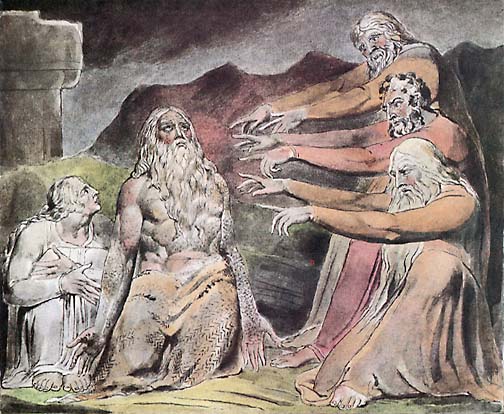
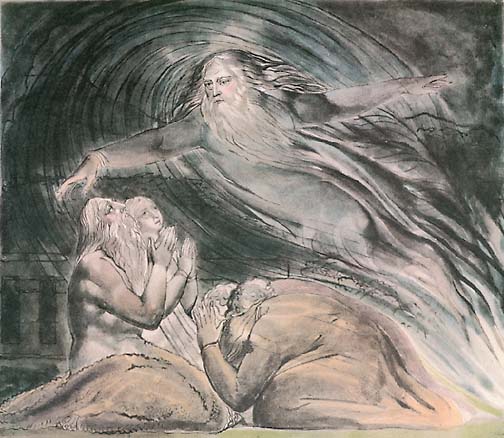
Blake's Job

The pictures are all by that hoary old mystic, William Blake.

One book of the Bible tries to examine the issue of pain and suffering in the world issue more than any other – the book of Job. It is a difficult book, with many questions unanswered about its origins. Some say the book was written down around the time of Abraham, or Jacob, perhaps by Job himself. Other say the book is much later, perhaps written by a great poet, such as Isaiah. Some of the style of the writing may be in keeping with the time of David and Solomon.

There is also divided opinion as to whether there was an actual historical figure called Job, or whether this was rather a didactic poem, prophetically inspired to shine light on some truths about God. It is clearly a historic book from the outset, but Hebrew scholars have often seen the story as a parable.

What of the story?

Job was a good man – rich in family and possessions, and a benefactor to the poor and needy. He had it all, and had already lived a long and prosperous life before the tale begins. Then, for some reason, God allowed the Devil to test Job, so that the Devil could see that Job’s goodness was not dependent on God’s blessing. Firstly, the Devil was given power over Job’s property. He lost all his cattle, then his sheep, and finally his camels. Then a cruel desert wind blew on the house of his eldest son and it fell, killing all his sons and daughters who had gathered to eat together.

Job tore his clothes in grief, but had this to say,

“Naked I came out of my mother’s womb, and naked I will leave this world behind. The Lord gives, and the Lord takes away. Blessed be the name of the Lord.”

Next the Devil was given permission to attack Job directly, and Job contracted some dreadful skin disease. He sat in the ashes of his life, and was forced to scrape at his sores with a broken pot to try to get relief. In despair, his wife tells him to “curse God, and die.” But Job says, “We receive from God all that is good, why should he not also send trouble?”

Job then gets a visit from three old friends. They sat with Job in silence for seven days, pondering his fate, searching for wisdom. What was God doing?  Then, in turn, they spoke. First Job was accused of harbouring some secret sin – any man who had experienced the misfortune that he had must have done much to deserve it. Job should repent and throw himself on the mercy of God, who was correcting his ways. But Job can only protest that his punishment is more than his crime.
Job’s friends start to list the glories of God – who can fathom the mysteries of God? And Job’s replies become more and more bitter, and angry. Who can blame him?

“…so man wastes away like something rotten; like a garment eaten by moths. Man born of woman is of few days and full of trouble. He springs up like a flower and withers away; like a fleeting shadow, he does not endure. Will God fix his eye upon such a one? Will you bring him before you for judgment? Who can bring what is pure from what is impure? No-one! Man’s days are determined; you have decreed the number of his months and have set limits he cannot exceed. So look away from him and let him alone till he has put in his time like a hired hand.” (Ch. 14)

And from the comfort of respectability, Job’s friends continue to caution him against his rash words, but he becomes less tolerant of their self- righteousness. The whole story begins to read like a court room drama, with God being accused of crimes against humanity.
Then, step forward a younger man, Elihu, angry with Job for justifying himself against God, and angry at the others for their inability to bring Job to his senses. He speaks bravely about the wonders of God, and suggests that suffering might be put upon man to keep him from greater sin, and for moral betterment. Elihu speaks well and is obviously a good man, but his words ring just as hollow as mine seem to when I too try to explain human suffering.

Suddenly, into the story steps God. It is almost as if he can hold himself back no longer. God offers no explanations; rather he bursts out question after question;

“Where were you when I made the world?”
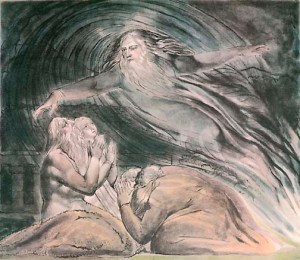
“Have you ever given orders to the morning or shown the dawn its place?”
“Can you raise yourself to the clouds and cover yourself with springs of water?”
“Will the one who contends with the Almighty correct him?”

And Job does what we all must do. He falls on his face and says, “I am unworthy. How can I reply to you?” “My ears had heard you, but now I have seen you. Therefore I despise myself, and repent in dust and ashes.” Job saw God, in all his glory, in all his power and splendour, and lived.

God corrects Job’s comforters (but Elihu is not mentioned) and restores Job. He lives for another 140 years, old enough to see his great-grandchildren prosper.

As I look back at this story – it is all there. Sin and the fall of man, greed and man’s injustice, the test that comes to us through pain. Writ large is an eternal perspective, and a God who through it all, still loves, still wants to be close to us. Also, however, is the God of mystery. He did not answer the why questions apart from using who questions of his own in reply. He is God.

At the end of my searching, reviewing and wrestling, I still can not answer the questions of why there is pain and suffering and starvation in this world. I have some clues, and perhaps like Elihu, I can gain some part of the truth. But ultimately, God is God. Who am I to presume to understand? Like Job, we live our lives in the shadow of the wings of the Almighty. We search for meaning and for significance, and many of us have found this in part through relationship and encounters with God – but ultimately, I think,  we all walk towards wonderful (and at times unfathomable) mystery.

All the wonderful images were pinched from here.

EBAY launches WorldofGood

I thought it was worth giving this new enterprise a plug. With ebay behind it, it should be successful!

Here’s the blurb;

WorldofGood.com by eBay is the world’s first online marketplace to convene thousands of People Positive and Eco Positive sellers and products all in one place, empowering you to shop in ways that align with your personal values. Respected, independent organizations verify the positive impact every product has on people and the planet. Our goal is to ensure that every choice you make here is a good one.

Check it out here.

Blogged with the Flock Browser