What is God doing? SIN

In response to the my recent post about the film ‘God on Trial’ I am going to post excerpts from an article I wrote called ‘What is God doing?’

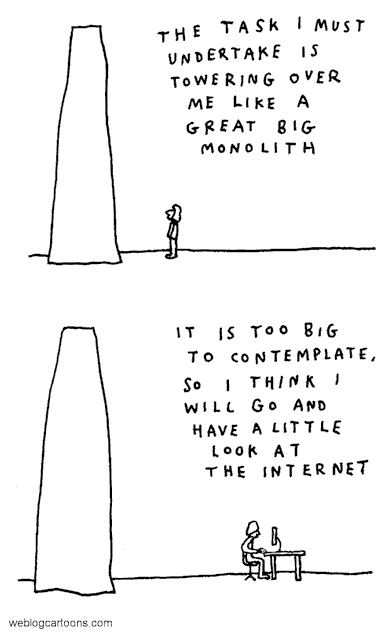
This is the big question for all of us trying to stumble through life. What is it all about? If there IS a God, what is he doing? Does he not see all the pain and suffering in the world? Why does he allow the flowering of such evil in the lives of those created in his image? How about landslides and Tsunami’s and earthquakes? So many lives snuffed out casually and with no discernible heavenly distress. What is he doing?

Some members of my family, who I love, have looked at this God of ours, and come to the conclusion that religion is all smoke and mirrors, behind which lies emptiness. Evolution brought us here, they would say, and we will leave nothing behind but a DNA chain (if we are lucky) when we end. On the few occasions I have tried to talk about this a little more with them, we have rarely got beyond the spectre of starving children. No God of love could allow such a thing, ergo there is no God. I try to reply, but even to my ears, the words sound weak, and inadequate. Because I too want to ask Him, what are you doing?

The teachings of the church over millennia have had to grapple with these same problems, and some explanations have been offered. Some of these answers now seem shallow at best, and others downright repugnant. Perhaps we should not judge too harshly those who have carried the responsibility of interpreting such mysteries for others. A simple certainty can be very seductive.

I decided to try to gather together some of the main perspectives that had been handed down to me through my own tradition – a kind of review of the arguments- a view from the anthill.

Sin

Some would say that bad things happen to people for a reason, as judgement on those who have sinned and displeased God. We can justify this statement by following the story lines of the Old Testament – evidence of a punishing and wrathful God can be found. There have been those throughout the history of the church who have used this image of God to explain famine, flood and loss in battle. More recently, through high profile disasters, voices have again been raised proclaiming Gods judgement on those outside his laws. The attack on the twin towers in Manhattan was seen as just rewards on New York’s gay community. The Tsunami was proclaimed as an attack on the largely Moslem countries found around the Indian Ocean. Sure, many non-Moslems, and non-gay people died, but they were innocent victims killed by friendly fire. I am not making this up, honestly!

A powerful school of thought, which has gained dominance, particularly in evangelical and fundamentalist circles, has increasingly seen the course of history in terms of dispensations. The world as we know it is in decline- sliding towards its inevitable destruction. It has been so bad that first God decided to remove his Holy Spirit, and eventually will remove his Church, prior to the end times, when the world will be destroyed, and replaced with Planet Earth, mark 2. The end result is a world view that sees the sinful and faulty planet as a hopeless case. The sooner we all leave it, the better. The more we isolate ourselves and live as a people set apart, the better. When bad things happen, they will be an inevitable consequence of living in a world fragmenting and falling into destruction.

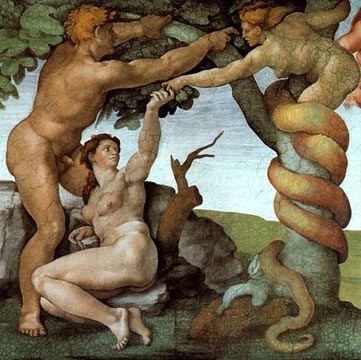
Other teachers who have studied the Bible describe a different version of the fall of man- going something like this. God made the world, and over all placed men (and women). He gave free will to his people, and when they turned from Him, all creation groaned. Everything became out of balance, distorted and discordant. From this process, rivers flood, volcanoes erupt and people fight, grab and lust- sin is let loose on all creation. God did not give up. Throughout history, he has tried to offer men and women redemption and the chance to participate with Him in a different way of being, but we live in a world untransformed and awaiting a final day when, according to the bible, Jesus will return. According to this view of history, our understanding of sin is still crucial to ideas of why bad things happen in the world, but it is about an unfolding process, not about individual guilt.

Powerful and biblical though this picture is, I still feel pangs of dissatisfaction. Does God sit next to some great cosmic scales of justice waiting for the sands to run out, watching us all running our little human races? Having the means to intervene and sort out this mess, but not the inclination?

This image of God troubles me greatly. This is a distortion of all that I have come to believe and hope for. I believe in a God who tempers anger with mercy, to such an extent that he sent his own Son to take on the sin of a fallen world. I believe in a gospel that proclaims the coming of a new Kingdom HERE and NOW, introducing the constant tension between our calling to work for good in our time, whilst living in hope for a future when all things will be made new.
Castles and boundaries…

We humans are so good at creating boundaries- in groups, and out groups. Nations states often seem to have a dependent relationship with their enemies.

We have seen the extremes of this- the walls around China, or Berlin, and now- Palestine.

This learning to love thing- it is tough.

I have commented before on how difficult living in community with others can be- how it peels you and then salts the sore bits. (See here.)

At times I think that anyone who tries to live like this is engaging in a foolish ritual, that is guaranteed to be fruitless and painful. Like squatting in spurs.

But then I see a flicker again of how things should be. A friend with an arm around another, seeming to generate warmth that is tangible. Or a relationship that has been bad, now made good… and the picture given to us in Acts 3 seems possible.

32All the believers were one in heart and mind. No one claimed that any of his possessions was his own, but they shared everything they had. 33With great power the apostles continued to testify to the resurrection of the Lord Jesus, and much grace was upon them all. 34There were no needy persons among them. For from time to time those who owned lands or houses sold them, brought the money from the sales 35and put it at the apostles’ feet, and it was distributed to anyone as he had need.

But lets never kid ourselves that this path of love is an easy one- or even an instinctive one.

our rambling old house

our rambling old house

We British people have been blessed with many good things- comparative peace, the rule of law, freedoms that others envy. Our experience of poverty and injustice is often second hand. But sometimes, our castles are seiged- just a little,,,

We live in a big old house in Dunoon, that we regard as God’s house. (Although, somewhat unfairly, the mortgage is ours!) We try to keep open doors, and offer respite to folk who need it. We use the many rooms for all sorts of different things, and for us, the house is a blessing through which we seek to bless others.

In our town there are many issues over boundaries and access to property. Our house is accessed over a rough track that goes over land owned by another property. This is no problem of itself- there are laws that deal with ‘kith and carriage’, and the requirement to maintain people’s rights of access. Our house was built in 1840, and used to be a hotel- so these are not new issues!

But there will always be some for whom this becomes a problem. We were unfortunate enough to have one of these people moving into the property over which we accessed our house. He decided that he did not like other people using his lane, and did everything he could to try to make it difficult for us, our visitors, and the other people who live up the lane.

He narrowed the entrance, and put in huge speed bumps that damaged cars. He refused to cut away obstructive trees. He blocked the lane with vehicles and refused to let our visitors in or out. He set his dog loose, and laughed when it attacked me.

Neighbours got involved in pitched battles with him, in which he threatened violence. Police and solicitors were involved. We tried our best to stay out of it all. We tried to build a relationship with him, and to speak to his wife and his young son, who would scurry on by. We worried about what sort of life they were leading in the midst of all this aggression and anger.

But living with this eats away at you. Finding a position of love and forgiveness in the shadow of such unpleasantness- this is hard.

It was a great relief to us when he moved away, to a more isolated location up country.

But this being a small town, I keep bumping into him, or his wife. He glares, and I seethe a little.

I need some Holy Spirit help… perhaps yet there will be an opportunity to show something of Jesus…

One thing that happened a couple of days ago though,was that we received a solicitors letter informing us that half of the house next door had been built on our land. It was asking us if we would give consent for the boundaries to be re-drawn.

It was an easy decision to make, and felt very good.

‘God on Trial’ film

god-on-trial.jpg (JPEG Image, 300×180 pixels)

I am sitting still stunned after watching a riveting piece of drama. The BBC has taken one of the most dreadful parts of human history and made something wonderful out of it.

God on trial‘ tells the story of jews, wrestling with God, like Jacob before them. If you missed it, you can watch again for the next 7days by visiting the BBC i player- here

This programme was a master class of writing and acting. It is centred around a group of Jews in Auchwitz who have just been selected for the gas chamber. And in angry outburst, some of them decide to put God on Trial.

The charge- breach of the contract with his Chosen People, the Jews. And the arguments went backwards and forwards. Some angry and rejecting, others clinging to faith with all of their might. Here are a selection of some of the arguments

Jews had suffered before. The point is to be a good Jew- we are being tested. Punished for sins. sons deserted faith- forgetting the scriptures.
But why punish children and old people, and good Jews because of the sins of the bad ones? Why not punish HITLER?
But this covenant is with the Jewish people- it is not personal.

In time, things become better? God is a purifying surgeon– not a punishment, but a purification? Like the flood, or the destruction of the temple by Nebuchadnezzar.  Painful, but beautiful.  A process necessary for the rebirth of Israel? A sacrifice? A Holocaust… you can hate the knife, but love the surgeon. there will be a holy remnant. they can finish the story.
Do not let them take your faith. Hitler will die but the TORAH will live. We must trust in God.

God gave us free will. We have to take responsibility for our own planet.
But there was the man who was forced to choose from one of his children- one to save. Free will? I do not want it.

“But he is here. I know he is here, even though I do not understand him. Snowdrops the first ray of sun. I felt him. That warmth. Maybe GOD is being gassed. He is suffering with us.
But who needs a god who suffers?
Maybe God needs us… maybe he is not strong after all without us
Were does all this evil come from, but where too does all this goodness come from?

The violent history of the Jewish people. God the avenging God. God who kills the first-born Egyptians, and destroyed the people of the promised land- to make room for the Israelites. Moabites, Amelakites- Is this God Just??? What was it like when God turned against these people? It was like THIS. God was not good- he was only on our side! Now he has made a new covenant with someone else!

WE cannot fathom the mind of GOd. THis will end…
BUt no no no no- this will not do- making predictions about the future. The covenant we have NOW- Psalm 81 the throne of david will last for all time and his descendants….

You have something in common with the Nazis! 100 thousand million stars. To count them 2500 years- just one galaxy! Yet all his focus is on ONE planet? One part of the planet- the Jews?? If he loved the jews so much- why did he make anything else?
It’s all about power and control. Each one with their own God.

Don’t let them take your God. He is your god, ‘even if he does not exist’.

And as brilliant minds chased ideas about God like lifelines thrown to drowning men, their appointment with the gas chambers drew closer. And in the end, they found God guilty as charged.

But then, at the end, one man cries ‘Now God is guilty- what do we do now?’

‘Now’ came the answer, ‘we pray’.

So did I.

Blogged with the Flock Browser

Rob Bell, ‘Breathe’

We have used quite a lot of Rob Bell’s ‘Nooma‘ DVDs in our group. There are about 20 of them at present- each one a little package of creative film making, Bell’s unique presentation style, and subtle reframings of things we thought we knew…

Bell’s high profile (his church is huge and his books and films are known the world over) has meant that he has also come in for a lot of criticism. For many, he is a heretic. For me, he is a man with something to say, who says it well.

I found a copy of one of the films on-line. They cost about £10 to buy, so this might be a way to enjoy one of them (in low quality, with the annoying subtitles) and find out what the fuss is about. Then you can save up and buy some for you and yours!

May it bring to you something new about the wonders of God.

Descartes, time, and God.

Time for some schoolbook philosophy!

I read something recently about the philosopher Rene Descartes – who was fascinated by what it meant to be, what it was possible to know and what could be described as truth?

Descartes decided to begin by doubting everything he possibly could – to see if he could reduce the knowable to an essential core. He found he could doubt everything – God, the existence of the world about us (which could be an elaborate deceit placed on our consciousness by some demon – a kind of precursor to The Matrix), the rules of science and gravity – all these were dependent on our perception, and perception was ultimately unreliable and subjective.

This led him to his ultimate point of truth – his own ability to ask these very questions – it was not possible to doubt this, as in order to doubt, then this too involved thought. Hence, his famous phrase, “I think, therefore, I am.

Descartes then turned his mind back to time. We live our lives in the passing of time – in a finite space. We have our beginning, and our ending, and find our existence in between. He was convinced that God was infinite – outside our understanding of time. However much we might think we know of God, we must equally realise that there is so much more. He concluded that as our experience is formed in our finite world, then the very fact that we could imagine the infinite must be proof in itself of the very existence of God – for no finite being could, of itself, think of the infinite.

Descartes thinking influenced an age. Whether or not you agree with his conclusions, the very questions he asked have dominated modernity. They are perhaps being asked again as we stand on the brink of a new age.

What am I?

What can I know, and how do I know it is true?

Perhaps for we Christians, there remains another set of questions – perhaps the greatest ones of all;

Who is God?

Can God be known?

Can God ever know me, in the vastness of this apparently infinite universe?

If so, what should be my response?

Are we all heading home anyway, one way or another?

Or is there a responsibility that we are called to – a way of life that is more vital, more blessed, more beautiful?

In the Bible, we read of generations of people of faith – from the nomadic wanderings of the people of Abraham, to the subjects of the mighty (but ultimately fragile) Roman Empire – asking these questions.

The amazing thing about all these stories was that apparently, God, as well as existing in infinite space, was also always there.

There he was, moving across the face of the waters when all was formless and void.
Walking in the garden in the quiet of the evening.
Speaking out of burning bushes (and resting on people with tongues of fire later.)
Even being willing to dwell inside a tent, or an unwanted temple building.
Ultimately, coming himself, in fragile human form. Walking amongst us, revealing something of his heart – inviting participation in a new way of being.

Then promising that the eternal will dwell within us.
That we would become temples of his Spirit – capsules containing something uncontainable, immeasurable, unfathomable.

Kind of amazing, ain’t it?

Good news in the news…

As part of our on-going study ‘Exilio’ we were encouraged to watch the media for stories about Christianity.

The point was to ask what the stories might tell us about the place of Christianity in our culture.

So, of the few examples I came across- here is a selection.

More than 10,000 Christians are living in refugee camps in the eastern Indian state of Orissa after anti-Christian violence in the area, officials say.

Govan Old Parish Church A study has been launched to find a new use for the oldest Christian settlement on the River Clyde.

Govan Old Parish Church in Glasgow will no longer be used for worship after the Church of Scotland decided to merge three local congregations.

The historic site has a burial ground dating back to the 5th Century and 31 early medieval sculptures.

Possible new uses include a museum, a performance venue and a visitor centre linked to local businesses.

Baltic

An art gallery is facing a trial at crown court over claims it displayed an indecent statue of Jesus Christ.

A private prosecution is being brought by Christian group member Emily Mapfuwa, 40, of Essex, on the grounds the statue outraged public decency.

The artwork was part of an exhibition at Gateshead’s Baltic Centre featuring several plaster figures with erections.

Terry Gilliam, Terry Jones, Graham Chapman, Eric Idle, Sue Jones-Davies (centre) , John Cleese and Michael Palin

A mayor’s plan to end her town’s ban on the 1979 Monty Python film Life of Brian are being opposed by the local vicar, who says it pokes fun at Jesus.

Sue Jones-Davies, who played Brian’s girlfriend in the movie, was amazed when she became mayor of Aberystwyth that it was still barred at the cinema.

But Reverend Canon Stuart Bell said Christians he spoke to in Ceredigion were still against it being shown.

The mayor declined to respond, but will still press for the ban to be lifted.

So what can we learn from this little collection of stories, all culled from a simple search of the BBC news pages at one particular time? The plight of the thousands of Indian Christians has made next to no impact. Other stories become ‘human interest’ titbits- included for their oddness, rather than anything of central importance.

Christendom is dead.

Which is not necessarily a bad thing.

The exciting thing is what God will do next…

The road from Colintraive

With all the optimism of the early spring
I turned the car from the road home and looked to the hill
Taking the camera more for motivation I head for the high point over the Kyle.
I feel the old excitement in the smell of wild places
All around I can almost hear the soil coming alive
The whisper of the wind in the larches sounds like blood flowing
Sap rising

And, unconcerned as my unsuitable shoes take on water,
I climb through heather and the old years dry grass
Up through ancient Gneiss outcrops
Still holding the shape of their birth in lava poured out in days so distant
That there seems no point calculating.

My feet cut into slow growing mossbanks
And scatter the stalks of bracken
And in the moment, I fear that I bring a human rhythm,
In this place unwelcome, discordant
Drowning out the stillness
Oil on water

I notice blackened heather stalks swept by fire
Perhaps lit by a smouldering cigarette last summer
And remember that this place is everywhere marked by men
Close cropped by the sheep, the land curves towards
The regimented contour crop of Spruce trees in the valley below
And half hidden, there is the evidence of older dwelling places
Now memories in the soil
Barcodes in bracken and dead nettle
Feeding on the residual richness
Leached from these poor houses
Whose people drained away.

Then perspective shifts again
To the far horizons
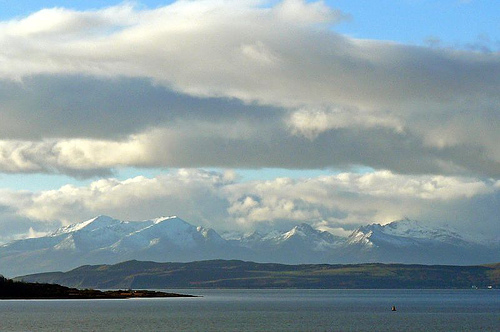
Across the sparkling Kyle lies Bute
Then beyond, Arran’s hills rise above Lochranza
Still wearing winter white against the blue sky

I stood and gloried.
Awed by things much bigger than I
By creative forces far beyond my understanding
But by Gods grace
Not beyond my reach

Blessing received, I take photographs recording only human spectral light
Then scramble back to shiny car, and head, too fast, for home
Anxious to see my loved ones
Eager for my own slice of civilisation.

2.3.05
© Chris Goan

Landmarks

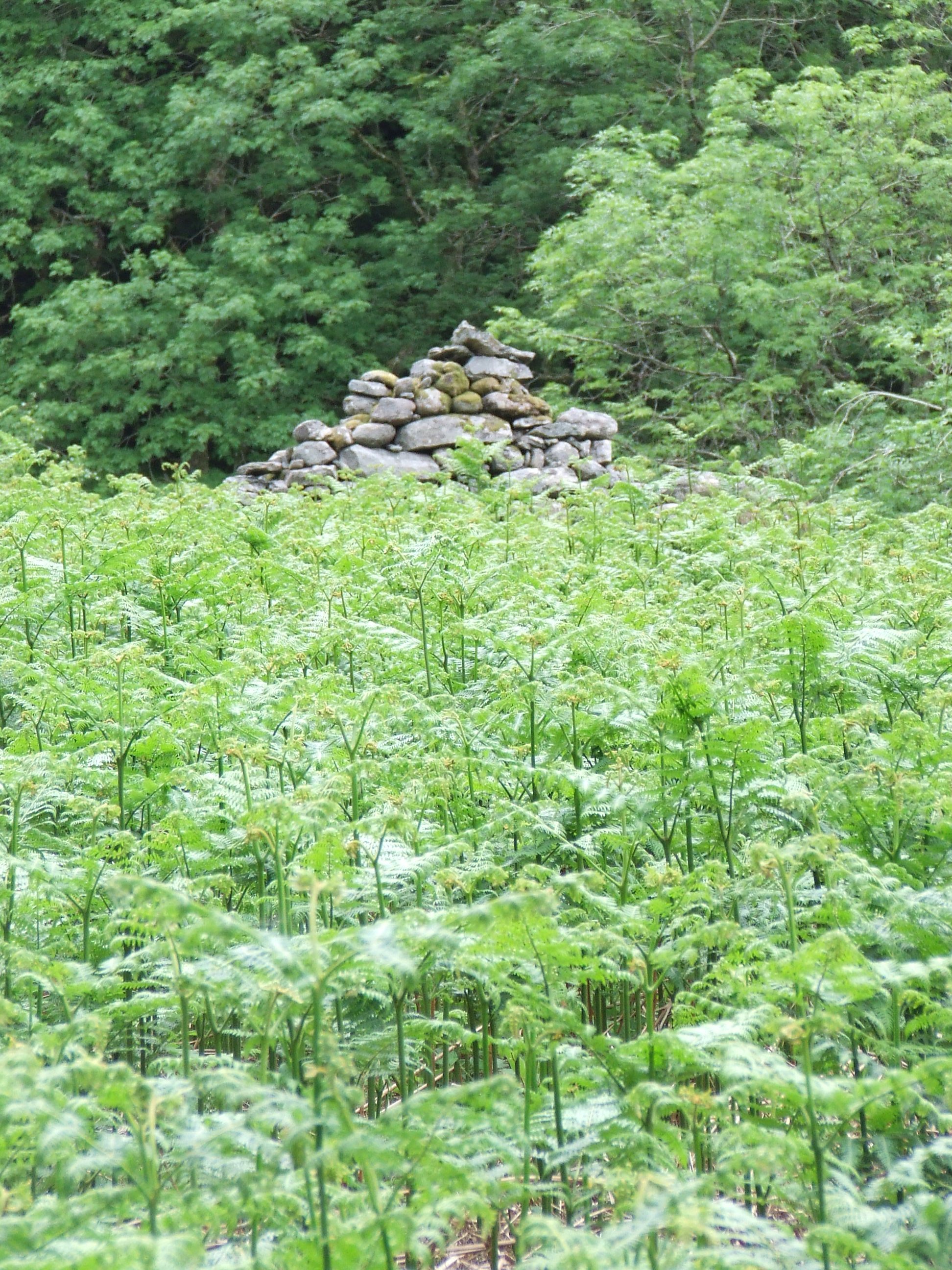
A few weeks ago, we took the canoes out to Loch Striven, round the other side of the Cowal peninsular. We paddled for a while out along the loch, until we found a landing spot next to a raised beach of soft stones. A perfect spot for a picnic.

As with all our coast line, the tide had left its usual selection of plastic, old rope and broken fish boxes on the beach- but I do not think anyone had been there for years.

William and I saw what looked like some old walls in the distance, and went off exploring.

what we found used to be someone’s house. A crofter perhaps, or a fisherman- now long gone.

Much of our small crowded planet can no longer be regarded as true wilderness. As you walk to the hills, you will almost certainly walk over a landscape marked everywhere by man.

Fields and field boundaries – some new, some ancient, shaping the subsequent developments.

Hedgerows and dry stone walls.

Old signs of settlement, perhaps still in use, perhaps now redundant, abandoned, remaining only as a growth of bracken and nettles, rising in ground fertilised by the nitrates left behind in the passing.

The very paths we walk upon have been made by the passing of other feet walking their own walk, into their own unknown uncertain futures, now past and gone.

We humans have transformed the planet in the last few thousand years of our ascendancy. Forests gone, rivers diverted. Roads made straight across mountain and valley. Many of these marks are irreversible, at least in the foreseeable future. The land may clothe them in green, but the marks will remain for thousands of years to come.

As I write, the debate about how our patterns of living might have contributed to accelerating climate change continues to rage.

Humans have been of significant influence on my islands for a mere 5000 years or so. In some parts of the world, they can trace the mark of man further, in many, much less. What a legacy we inherit from our forebears – both great, and fearful.

Our lives have been shaped by this legacy too. We stand on the shoulders of those who gave the land its present shape.

Others will stand on ours.