Religious fundamentalism and the hope of peace…

My friend and former neighour Terry sent me a link to this;

This seems to be a move to bring together different religion around a central universal higher law of compassion. Here is a quote from the Charter for compassion site;

The Charter for Compassion is a collaborative effort to build a peaceful and harmonious global community. Bringing together the voices of people from all religions, the Charter seeks to remind the world that while all faiths are not the same, they all share the core principle of compassion and the Golden Rule. The Charter will change the tenor of the conversation around religion. It will be a clarion call to the world.

The woman who appears to have been the catalyst for this move is called Karen Armstrong. It seems that she is a former Nun, who has become a controversial figure after writing about her own experience of religion, and increasingly becoming a proponent of comparative religion.

I found another clip from a TED speech that Karen Armstrong gave;

I found Karen’s point about religious people ‘preferring to be right rather than compassionate’ to be all too true.

Terry and I are chewing on this a little. Is it good, or bad, or indifferent?

Is fundamentalism always bad? I have seen Christian fundamentalism at close quarters, red in tooth and claw, and can no longer stand close to much of it. The damage that can be done in this context is great but…

I have also seen passion and fervency lead to great compassion, and acts of service and self sacrifice.

And as a follower of Jesus, I do believe him to be the place and person towards whom we are all heading. I am happy to engage with other faiths, but I would always approach them, as much as I am able, through my understanding of who Jesus is.

So what would he think of this charter?

I wonder if he would look at Karen Armstrong, see all that she is and say- ‘well done, good and faithful servant…’

What do you think? I reckon it’s time for another vote…

Three weddings and a flash of the blindingly obvious…

civil-wedding

We have been away in Staffordshire at a wedding this weekend- a friend of ours from student days called Gaynor, and it was great to see her so obviously happy and in love with her now husband, Chris. They became an ‘item’ on a trip up north to visit us, so all the better.

This is our third wedding of the year- all of them lovely, all of them very different. John and Fiona’s wedding in a idyllic highland chapel- a Christian ceremony, full of their own faith and hopes for the future. Then there was my brother-in-law Chris’s wedding to Emma in a Unitarian chapel. It was another lovely family ceremony, led very well by a minister, and a chance for them to make their commitment to one another before God and man (and woman of course.)

Gaynor and Chris’s wedding was an entirely civil affair- held in an old converted barn, presided over by a representative of the hotel, with a registrar in attendance. God was not mentioned, but I think he was as happy as we were to see them committing themselves to one another. There is something good and whole and lovely about two people finding one another and learning to love.

So- three weddings. One Christian, one Unitarian and one civil. May they all be blessed with long and happy lives together.

I found myself asking familiar questions again about the place of faith in the lives of those of us who live in 21st Century Britain.

For some time it seems the Christian church has had its place as a marker of life’s transitions- births deaths and marriages. For some (like John and Fiona) a live faith means that this is a natural decision. For others, the church offers a solemnity and tradition that also has its place.

But many others see this tradition as irrelevant to how they might live their lives. They might seek their own spiritual path outside the traditional Christian Church, like Chris and Emma. Or they might celebrate their life together with friends in a civil ceremony, like Gaynor and Chris- an honest and faithful statement that does not need church, and church has no honest part of the rest of life.

Now none of this is a surprise. For me, the decline in the centrality of the institution of church is not even necessarily a reason for mourning- although it could be argued even by those who have no faith that the loss of church as an anchor and facilitator for society is potentially problematic- as nothing else seems to be taking over. I have mentioned old Durkheim and the concept of ‘anomie’ before (here.)

cimg0216

So what about my little eureka moment? Well during the wedding, I think I found myself smacked between the eyes by a bit of an evangelical cliche.

I missed Jesus so much.

Not the Christian wedding ceremony- or church- but simply the person of Jesus.

I took me by surprise, as for some time, I have journeyed into an understanding of the Kingdom of God, and the image of God in people, that made me increasingly aware of how God is present and participating in places that we Christian’s have often regarded as Godless and secular.

But here I found myself again longing to hear the words of Jesus- longing for the words of the sermon on the mount to fall again like manna.

And for my friends to believe again in the possibility of a better way- not because it would make them (or me) better, but rather because if we set our faces to living this way, then the world could indeed be changed forever.

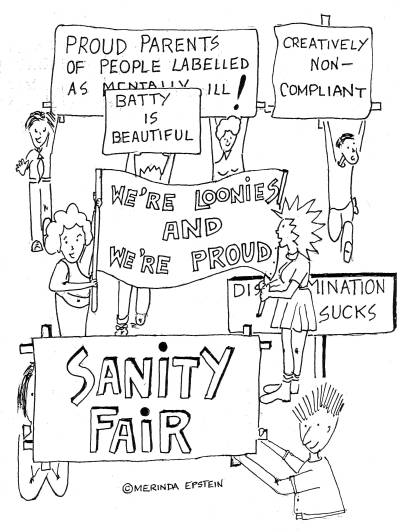
Miranda Epstein- cartoons about recovery

merinda_epstein_sanity_fair

Following on from my earlier post about mental illness stereotypes and the Mental Health Machine, I thought I would post some more of Miranda Epstein’s wonderful cartoons. Check out her site here.

I think they speak for themselves.

(Click to enlarge)

Mental illness- challenging the stereotypes.

1mad

Everyone at work is discussing the first episode of a BBC TV programme at the moment called ‘How mad are you?’

You can check this out on the BBCiplayer on this link

Now I must confess to being someone who loathes reality TV programmes- although I did watch Taransay one (Castaway?) which kicked the whole genre off in the UK. I am a sucker for anything filmed on a small Hebridean island.

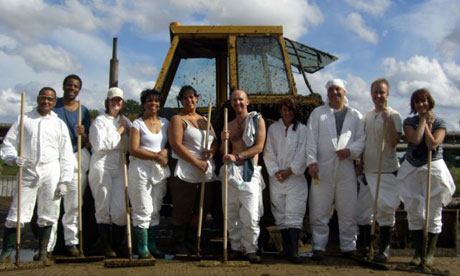
However, the idea of this one caught my interest even before I watched it. 10 people in a castle. 5 of them have diagnosed mental illnesses, the other 5 are (wait for it) ‘normal’. They all get to perform lots of tasks and batteries of tests from psychiatrists, who then have to declare who they think is mad, and who is sane.

Anything that challenges the prejudices and stereotypes about mental ill health that still prevail is great as far as I am concerned- particularly if in the process the power relationships get reversed, and the black arts of psychiatry get placed in the hot seat…

I should confess to a bias here- I have worked as a Mental Health Social worker, then as a therapist, and now as a mental health manager. I was drawn to work in this area because my faith lit in me a desire to make a difference- to seek brokenness and try to bring healing. I have been inside the Mental Health system in the UK for most of my working life- and have discovered that it can be a very frustrating and at times an infuriating experience.

At its worst the psychiatric system in this country tends to suck in people at the most vulnerable time of their lives. The next part of their experience is often about LOSS.

Loss of freedom and choice.escher_about-institution

Loss of opportunity

Loss of relationships

Loss of employment

Loss of identity

Loss of motivation

Loss of hope

Loss of self esteem

…and once these things are gone, it becomes very difficult to transcend the circumstances you find yourself in. It becomes almost impossible to escape.

Sure, the system also GIVES people things. It offers a kind of sanctuary- either the physical safety of a ward or care environment, or a more emotional/psychological kind of security given by the label- ‘depressed’, ‘schizophrenic’, ‘manic depressive’. It also offers a whole new role- that of a ‘sick’ person, who needs help from the ‘experts’ who can treat them with medication or therapy- people who can take the messy chaos of their humanity and squeeze it through a scientific colander and filter out all the bits that are not helpful. (If only huh? I think we could all do with this process about once a week…)

And all these things too become like prison bars.

There are some encouraging signs though. Some people who have carried mental health labels are starting to take back the power. This can be best seen in the ‘recovery’ movement. Check out this article on the Re-think website, or The Scottish Recovery Network site.

Recovery thinking perhaps grew out of the hearing voices network, who dared to suggest that just because people heard voices, this did not make them less human- it did not make them mad. Many people even questioned the very nature of psychiatric diagnosis- suggesting (not for the first time) that schizophrenia was nothing more than a reaction to trauma- both trauma outside the system, then more trauma within it.

The voices from the recovery movement are mostly those who have been through the system, and managed to come out the other side. They have often found themselves in conflict with the powers within system- because they speak a different language, and do not conform. Some of their rhetoric is seen as (and perhaps actually IS) downright dangerous. They no longer are interested in talking about ‘cures’ to ‘illness’- rather they seek the right to choose their own path, and their own solutions to life crises.

merinda_epstein_the_consumer

(Cartoon from here)

That is not to say people do not need help. We are surrounded by people who are damaged and vulnerable. But many of us in the system, and many others who are subject to it, are convinced it needs to change. And the ideological challenge brought to us by the Recovery movement is like light in darkness.

And so as a Christian, I reckon that this is a flavour well worth seasoning.

War- those who objected…

shotatdawn

One more post about the Great War…

I have often wondered what would have been my fate if I had been born about 60 years earlier. The Sherwood Foresters Regiment, raised around where I grew up, were decimated in several of the huge battles of the First World War- including the Battle of the Somme, where they were almost wiped out.

Eight of these men and boys were court marshaled and executed for cowardice and desertion (check out this record here, which seems even sadder than the names on war memorials that I grew up with.)

What drove men to walk towards destruction? It is a strange testament to the fragility and contradictory nature of humanity that we regard such a thing as noble, admirable whilst still valuing life (at least our own) above all things.

It is interesting to note that even in war-drunk imperial Britain in the middle of the war, there were those who were able to show a different courage, and protest.

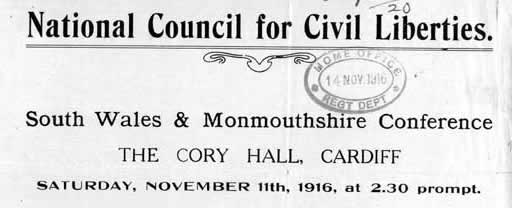
civil-liberties-poster

This protest, attended by a future Labour Prime Minister, Ramsey MacDonald, caused a near riot.

Then there were the conscientious objectors- according to the National Archive, about 16,000 of them, who refused to fight. Many spent time in prison- particularly the 1500 ‘absolutists’, who refused to participate in any activities that gave any support whatsoever to the war. Prominent in this group were the Quakers, and other Christian groups who saw the taking of human life as wrong (more info here.)

These people were loathed by the society that they were part of. They were branded as cowards and traitors. Could I have been strong enough to stand with them?

Or would I have joined up in 1915 along with my pals, answering Kitchener’s call to arms? And would my name then have been entered on a monument after the pointless slaughters of 1916?

Historical hindsight is a rather indulgent pastime, but I hope I would have been able to protest.

And I hope too that in this new and very different age, I will also be able to find inspiration in the story of 16,000 people, whose names are on no monument. What would they have made of the current conflicts in Afghanistan and Iraq?

These are not simple issues. I am not sure that there is nothing worth fighting for, but I am sure that there is no such thing as a just war…

In the words of Derek Webb, from the song ‘A man like me’ from the Hummingbird album.

I have come to give you life
And to show you how to live it
I have come to make things right
To heal their ears and show you how to forgive them

’cause i would rather die
I would rather die
I would rather die
Than to take your life
’cause how can I kill the ones I’m supposed to love
My enemies are men like me

So I will protest the sword if it’s not wielded well
’cause my enemies are men like me
Peace by way of war
Is like purity by way of fornication
It’s like telling someone murder is wrong
And then showing them by way of execution

Because my enemy is a man like me

The Sentry- Wilfred Owen

Following on from my last post, here’s a bit more of Owen’s poetry.

I have just watched a programme on Channel 4 about the excavation of a dug out near Ypres in Belgium dug in 1917. It has been clogged with the mud and bones of some of the hundreds of thousands who died there for 90 years, but was found in remarkably good order (check out here for more details.)

It made me think of this poem.

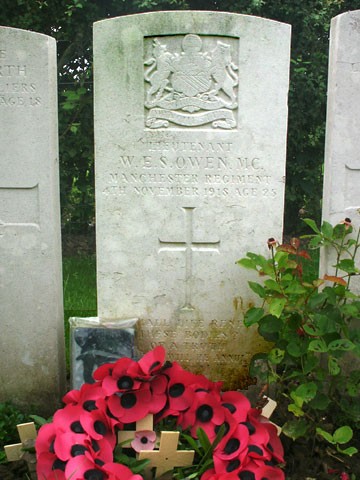
Preserved like the shadow of Owen, who died aged 25, fighting a war that he did not believe in.

For people like me, Owen speaks clearly and immediately of things unimaginable to us- but where to him everyday normality.

Our fascination for stories of war is not healthy, or at least I do not think so. For every John Wayne or Bruce Willis, or docudrama about the Third Reich- there should be 100 Wilfred Owen’s.


Blogged with the Flock Browser

Remembrance day and war poetry

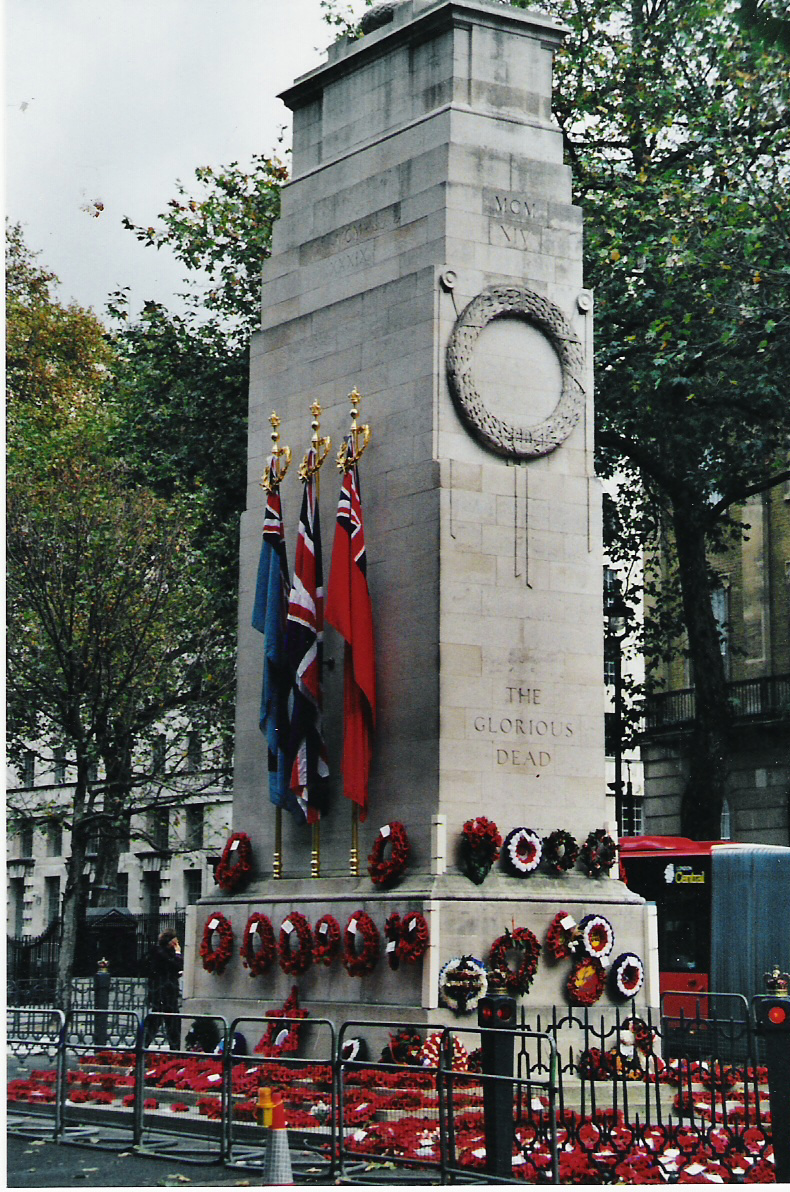
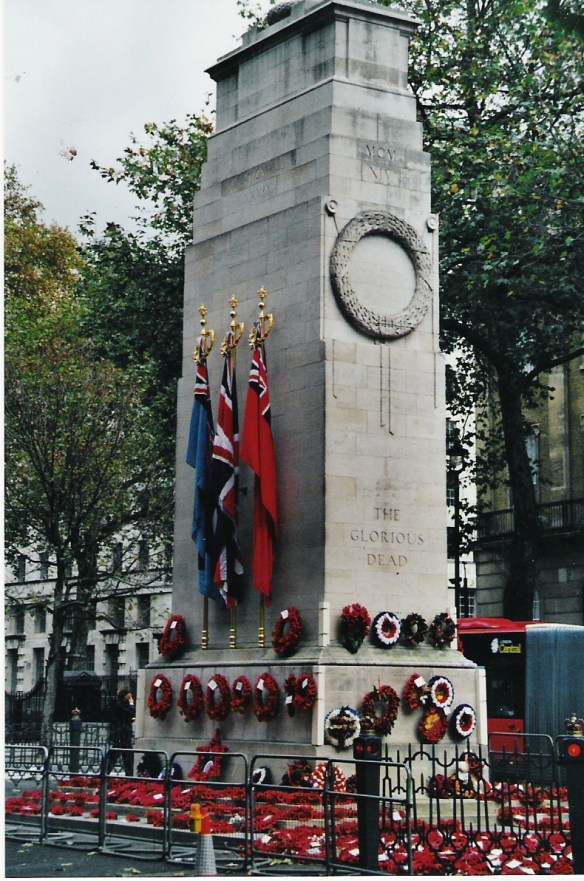
cenotaph_london

Michaela and I have just sat and listened to the Remembrance day ceremony from the Cenotaph in London. This ceremony is held every year, on the 11th hour of the 11th day of the 11th month, to honour first the dead of the ‘great war to end all wars’ (1914-1918) and then the subsequent second world war, along with all the post-empire skirmishes and border confrontations that our soldiers have died in ever since.

We were silent first through the emotional beauty of laments played by brass bands, then for the official minutes silence

I have had a mixed relationship with the ceremony. At worst, it seems to glorify and exalt the business of war. For a while, I refused to wear a red poppy, finding instead the white ones with an overtly pacifist stance to be more appropriate. It seemed to me the only response that followers of Jesus could take.

I spent some time working as a therapist in GP surgeries, and met several ex-soldiers struggling with post traumatic symptoms years after conflicts in Cypress, the Falklands or the wars in the Gulf. I heard their matter-of-fact stories of broken bodies and a culture of brotherhood, booze and easy violence that was both intensely supportive and ultimately destructive to the rest of their lives. I now wear red poppies with respect and humility.

But still, this balance between remembering those who suffered and died, whilst wanting to de-glamourise war and pursue peace- this is a hard thing to find at times.

This was highlighted too by my reaction to the front page of our local paper- the Dunoon Observer. In a creative response to Remembrance day, they printed a famous poem from the Great war on the front page. It is this one;
greatwar

In Flanders fields the poppies blow
Between the crosses, row on row,
That mark our place; and in the sky
The larks, still bravely singing, fly
Scarce heard amid the guns below.

We are the dead. Short days ago
We lived, felt dawn, saw sunset glow,
Loved, and were loved, and now we lie
In Flanders fields.

Take up our quarrel with the foe:
To you from failing hands we throw
The torch; be yours to hold it high.
If ye break faith with us who die
We shall not sleep, though poppies grow
In Flanders fields.

Lt Col John McRae


This poem was written in 1915, after a terrible battle, but still in an early part of the war, when glory still beckoned, at least for some. McRae was a staff officer, and the second verse always seemed to me to fit uneasily alongside the first. Some have called it ‘recruiting office rhetoric’- handing on the torch to others to have revenge…

But I applaud the Observer for printing poetry. I just would have preferred them to print another famous war poem- the one below.

I remember reading the first world war poets at school- Seigfreid Sassoon, and most of all, Wilfred Owen,
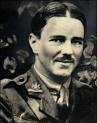
Wilfred Owen

Wilfred Owen

who was killed by a snipers bullet at just about the very end of the war. It was these men who first showed me that poetry can be something powerful. It can be healing, challenging, therapeutic, revolutionary, beautiful and harrowing- all at the same time.

This poem captures the whole thing of war for me. Here it is (with some notes pinched from here.)

DULCE ET DECORUM EST1

Bent double, like old beggars under sacks,
Knock-kneed, coughing like hags, we cursed through sludge,
Till on the haunting flares
2 we turned our backs
And towards our distant rest
3 began to trudge.
Men marched asleep. Many had lost their boots
But limped on, blood-shod. All went lame; all blind;
Drunk with fatigue; deaf even to the hoots
4
Of tired, outstripped
5 Five-Nines6 that dropped behind.

Gas!7 Gas! Quick, boys! – An ecstasy of fumbling,
Fitting the clumsy helmets
8 just in time;
But someone still was yelling out and stumbling,
And flound’ring like a man in fire or lime
9 . . .
Dim, through the misty panes
10 and thick green light,
As under a green sea, I saw him drowning.
In all my dreams, before my helpless sight,
He plunges at me, guttering,
11 choking, drowning.

If in some smothering dreams you too could pace
Behind the wagon that we flung him in,
And watch the white eyes writhing in his face,
His hanging face, like a devil’s sick of sin;
If you could hear, at every jolt, the blood
Come gargling from the froth-corrupted lungs,
Obscene as cancer, bitter as the cud
12
Of vile, incurable sores on innocent tongues,
My friend, you would not tell with such high zest
13
To children ardent
14 for some desperate glory,
The old Lie; Dulce et Decorum est
Pro patria mori.
15

8 October 1917 – March, 1918

1 DULCE ET DECORUM EST – the first words of a Latin saying (taken from an ode by Horace). The words were widely understood and often quoted at the start of the First World War. They mean “It is sweet and right.” The full saying ends the poem: Dulce et decorum est pro patria mori – it is sweet and right to die for your country. In other words, it is a wonderful and great honour to fight and die for your country

2 rockets which were sent up to burn with a brilliant glare to light up men and other targets in the area between the front lines (See illustration, page 118 of Out in the Dark.)

3 a camp away from the front line where exhausted soldiers might rest for a few days, or longer
4 the noise made by the shells rushing through the air
5 outpaced, the soldiers have struggled beyond the reach of these shells which are now falling behind them as they struggle away from the scene of battle

6 Five-Nines – 5.9 calibre explosive shells
7 poison gas. From the symptoms it would appear to be chlorine or phosgene gas. The filling of the lungs with fluid had the same effects as when a person drowned
8 the early name for gas masks
9 a white chalky substance which can burn live tissue
10 the glass in the eyepieces of the gas masks
11 Owen probably meant flickering out like a candle or gurgling like water draining down a gutter, referring to the sounds in the throat of the choking man, or it might be a sound partly like stuttering and partly like gurgling
12 normally the regurgitated grass that cows chew; here a similar looking material was issuing from the soldier’s mouth
13 high zest – idealistic enthusiasm, keenly believing in the rightness of the idea
14 keen
15 see note 1

owens-grave

The fruit of the Spirit is kindness

kindness

I was sore
Abraded by the road gravel
And you wrapped me
In a soft bed
Of kindness

I was weary from the world
And like a soothing embrocation
You took these road weary feet
And slippered them
In front of a warm fire

I failed
Again
And stared down low
Until the soft music in your voice
Brought to me possibility
That I too
Could be loved

That I too could love
In return

So may you be showered with blessings
Like blossom petals
Butterflying about you
In this beautiful breeze

kind

Sex and the internet…

freeimages.co.uk techonology images

About 10 years ago, a some friends of mine were exchanging a computer system.

The receiver of the computer had never had one before, and knew next to nothing about the internet, which, it is interesting to note, was not uncommon 10 years ago. He asked what the internet was all about.

I suggested that it was mainly about 3 things- making money, mad religion and perhaps most of all, sex.

He was most taken with the later of the three, and asked what I meant by sex.

I replied that every sexual perversion known (and a few that are not) was available at the click of a button.

Unable to resist, he asked “Like what?”

Not wanting to reveal any expertise whatsoever, I asked him for suggestions. He (rather quickly I felt) came up with sex with donkeys.

Quick as a flash, my other friend typed into the address bar http://www.donk…….. (best not complete the link just in case I lead you into temptation!)

And there is was.

Which kind of made the point. And then some.

A few months ago, in response to the hysteria around the Olympics, I posted a poem called ‘Cheerleading’ (here).

This item is the most popular one I ever wrote in terms of the ‘hits’ it receives. It has a picture of some Cheerleaders, but I can not imagine that most of the people who visit this post linger there for very long. Poetry probably amounts to a big disappointment.

Which brings me, in a round about way, to the point of this post. A question-

There is one other thing that occurs to me- the viewing of pornography is clearly something that is common to many men (and some women.) It seems at least possible that this secretive and shameful activity is as common amongst Christians as without. It is just that we are even less likely to be open and honest about it. Which will almost certainly make the activity even more secretive and compulsive.

If this is an issue with you, or you just want to protect your computer from uses that you are unhappy with- then you might like to check out X3 watch.

God the symmetrical…

symmetry

The other day we Michaela and William were having a discussion about people’s faces- I think they had been drawing faces at school. William was rather astonished that his friend had eyes that were not level- one was higher than the other. His face was not symmetrical.

Michaela suggested to him that everyone’s face was different, and no-one was perfectly symmetrical, and so Will chewed on this for a while and said

“…apart from God’s face. His must be symmetrical.”

Michaela did not know how to respond, and so made a few comments about us being made in the image of God. She later recounted the story to me with a bemused expression on her face.

This kind of left me thinking.

There is something appealing about being able to sketch a predictable, perfect shape out of our knowledge and understandings of God.

For generations people of faith have been trying to do just this. We look at our scriptures and listen to our prophets and from these glimpses of the divine, we fill out a version of God that we cast in concrete and endlessly reproduce.

The image that came into mind when thinking about the concept of a symmetrical God was one of those paper chains that you make by folding paper and cutting it to make a connected chain.

paper-chain

Is it possible that this metaphor works as a way of understanding the process of theological explorations for who God is?

We take the source material- fold it according to our particular perspective, and then make careful symmetrical cuts according to our own understanding- ensuring the inclusion of acceptable texts and that when displayed, all is orderly and connected.

The great age of modernity, with its enlightened gifts of rational systematic analysis, needed a symmetrical God more than most. We needed solid propositional concepts, measured, tested and cross referenced against scripture, which is given unassailable status as Holy, inerrant, the very Words of God.

Increasingly, the modern theological edifices, in all their apparent certainty, are being re-examined by this new generation- in many ways that is what the ’emerging church conversation’ has been all about.

And many of us are no longer interested in Symmetry- at least not as a first priority.

Who says that symmetry is perfect anyway?