So we begin lent…

Giving it up for lent?

Giving it up for lent?

Last night we celebrated the start of the lent season by getting together in The Crown in Dunoon. There were a few of us from Aoradh, along with some friends and others who had read about the event in the paper.

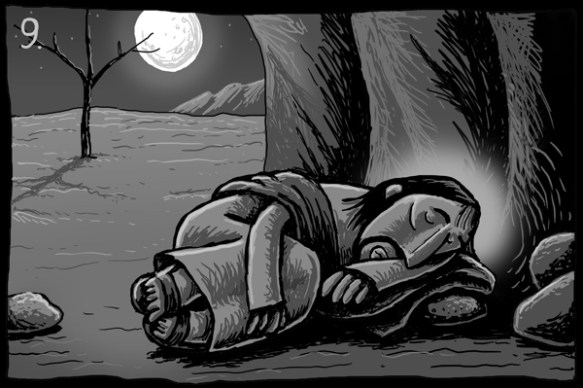
Brian from The Crown put on some pancakes, and we performed ’40’- Si Smith’s images, along with script, sound and music. We used this first last year in Kilmun village hall, also on shrove Tuesday, and it has since been part of a lent resources pack produced by the Church Mission Society. We also used a shortened version at Greenbelt festival last year. Powerful stuff.

Lent has had little significance in my Christian background, but like many others, I find myself increasingly drawn towards the rhythms given to the year by Christian festivals.

I am not sure if I will mark lent in giving up something specific. Last year, as a family we used an information pack produced by Christian Aid-  they have done something else this year here. Need to discuss tonight with the kids!

Photo’s  from last night below! (Click to enlarge.)

On-line social networking and children…

Following on from my previous post, a little more on social networking via the internet…

This morning, there was a discussion about the potential impact of the impact of Bebo, Twitter and Facebook on the minds of kids, led by Professor (Lady) Greenfield.

It echoes themes that I have heard discussed in several other places- including (oh the irony) lots of blogs and social networking platforms. The implications of these discussions for people of faith is what is of interest to me. There are threads of discussion on both the Missional Tribe platform and on Emerging Scotland.

So what does Lady Greenfield have to say?

Here are some quotes taken from a Guardian newspaper interview- the full article is here.

facebook-reaches-5th-birt-001

She told the House of Lords that children’s experiences on social networking sites “are devoid of cohesive narrative and long-term significance. As a consequence, the mid-21st century mind might almost be infantilised, characterised by short attention spans, sensationalism, inability to empathise and a shaky sense of identity”.

Arguing that social network sites are putting attention span in jeopardy, she said: “If the young brain is exposed from the outset to a world of fast action and reaction, of instant new screen images flashing up with the press of a key, such rapid interchange might accustom the brain to operate over such timescales. Perhaps when in the real world such responses are not immediately forthcoming, we will see such behaviours and call them attention-deficit disorder.

“It might be helpful to investigate whether the near total submersion of our culture in screen technologies over the last decade might in some way be linked to the threefold increase over this period in prescriptions for methylphenidate, the drug prescribed for attention-deficit hyperactivity disorder.”

She also warned against “a much more marked preference for the here-and-now, where the immediacy of an experience trumps any regard for the consequences. After all, whenever you play a computer game, you can always just play it again; everything you do is reversible. The emphasis is on the thrill of the moment, the buzz of rescuing the princess in the game. No care is given for the princess herself, for the content or for any long-term significance, because there is none. This type of activity, a disregard for consequence, can be compared with the thrill of compulsive gambling or compulsive eating.

Greenfield also warned there was a risk of loss of empathy as children read novels less. “Unlike the game to rescue the princess, where the goal is to feel rewarded, the aim of reading a book is, after all, to find out more about the princess herself.”

She said she found it strange we are “enthusiastically embracing” the possible erosion of our identity through social networking sites, since those that use such sites can lose a sense of where they themselves “finish and the outside world begins”.

She claimed that sense of identity can be eroded by “fast-paced, instant screen reactions, perhaps the next generation will define themselves by the responses of others”.

Social networking sites can provide a “constant reassurance – that you are listened to, recognised, and important”. Greenfield continued. This was coupled with a distancing from the stress of face-to-face, real-life conversation, which were “far more perilous … occur in real time, with no opportunity to think up clever or witty responses” and “require a sensitivity to voice tone, body language and perhaps even to pheromones, those sneaky molecules that we release and which others smell subconsciously”.

She said she feared “real conversation in real time may eventually give way to these sanitised and easier screen dialogues, in much the same way as killing, skinning and butchering an animal to eat has been replaced by the convenience of packages of meat on the supermarket shelf. Perhaps future generations will recoil with similar horror at the messiness, unpredictability and immediate personal involvement of a three-dimensional, real-time interaction.”

Greenfield warned: “It is hard to see how living this way on a daily basis will not result in brains, or rather minds, different from those of previous generations. We know that the human brain is exquisitely sensitive to the outside world.

Lady Greenfield may well be in a position to comment, and have some very valid points about the changing nature of childhood.

The first comment on the Guardian site under the article is worthy of reproduction though- some wag wrote That’s exactly what my mum said about reading the Beano.

The article does not list the research that fuelled Greenfields strongly expressed opinions- but it may well be that quoted in my earlier post.

But the main issue for me remains how we build real, deep, meaningful human relationships and community.

Friendship and the internet…

boots

Friendship- it just might save your life.

Not just in the obvious roped-together-climbing-up-the-Matterhorn kind of way, but in a thousand more subtle ways.

I have benefited enormously from all this on-line networking and blogging. But have long been concerned that online friendships lacked something vital to human experience. For us, they were expedient- given our somewhat isolated geographical location, but in my mind can never fully replace flesh on flesh contact.

I would go a little further (although I am hesitant to be categorical) and wonder if the real community that Jesus called us to (and modeled for us with his traveling companions) can only be experienced in close contact. I say this with some trepidation, as this kind of community is rarely comfortable, tidy or easy. I liked what Mark Berry had to say here about this.

On-line communication seems to have something of the autistic spectrum about it. It allows for the sharing of lots of informational data, but for the most part lacks the nuanced, multi-layered complexity that characterises human face to face exchanges. to extend the analogy, people who have autistic spectrum difficulties can find techniques that might help manage some of the contradictions and complications life brings to them. They might also have real strengths that are revealed in a capacity to perform some non-social tasks extremely well.

In the same way, on-line networking (such a recent phenomenon) does some things very well, and might yet develop techniques that make the interface more human. Before we rush to condemn, we should bear in mind that each step-change in communication technology has been greeted with much suspicion- the printing press, the railroads, television. These things result in change and adaption as they penetrate deeper into the human experience.

But I remain convinced that communication at a distance will never be enough. At present, I think the autistic analogy remains a good one.

jordrel-bank-2

I came across an article from the journal ‘Biologist’ the other day, which was quoted by the Dranes on their 2churchmice’s blog. It makes some startling statements.

Britons now spend approximately 50
minutes a day interacting socially with
other people (ONS, 2003). Couples now
spend less time in one another’s company
and more time at work, commuting, or in
the same house but in separate rooms using
different electronic media devices. Parents
spend less time with their children
than they did only a decade ago. Britain
has the lowest proportion of children in
all of Europe who eat with their parents
at the table. The proportion of people who
work on their own at home continues to
rise.

Britain’s disinclination for togetherness
is only equalled by her veneration of communicating
through new technologies. The
rapid proliferation of electronic media is
now making private space available in
almost every sphere of the individual’s
life. Yet this is now the most significant
contributing factor to society’s growing
physical estrangement
. Whether in or out
of the home, more people of all ages in the
UK are physically and socially disengaged
from the people around them because they
are wearing earphones, talking or texting
on a mobile telephone, or using a laptop
or Blackberry.

Does this matter?

Well the study goes on to list the benefits of close human contact and friendship. Here are some highlights;

  • Measurable genetic and immunological benefits.
  • Biological changes as a result of physical contact- hugs for example.
  • Increased incidence of cardiovascular problems in people with lower amounts of social connections.
  • Lower general morbidity associated with higher amounts of social contact.
  • A study finding lower incidences of strokes on women
  • Lower blood pressure in men, and a faster return to normal blood pressure after stress.
  • Measured differences in the narrowing of arteries.
  • The unexpected fact that if you have contact with more people, you are LESS likely to have colds.
  • Memory loss in old age declines at twice the rate in those poorly integrated.
  • General links between enhanced cognitive performance and social interaction.
  • A reduction in mortality for those who attend regular religious services! (But not just to ‘warm the pew’.)

The review ends with a description of an old study (10 years ago) which may or may not have been prescient.

While the precise mechanisms underlying
the association between social connection,
morbidity and mortality continue to be investigated,
it is clear that this is a growing
public health issue for all industrialised
countries. A decade ago, a detailed classic
study of 73 families who used the internet
for communication, The Internet Paradox,
concluded that greater use of the internet
was associated with declines in communication
between family members in the
house, declines in the size of their social
circle, and increases in their levels of depression
and loneliness. They went on to
report “both social disengagement and
worsening of mood…and limited face-toface
social interaction … poor quality of life
and diminished physical and psychological
health” (Kraut et al, 1998).

So, what can we make of all of this? The study clearly takes the view that on-line contact is not enough, and indeed may be problematic.

I still hope however, that when used well and purposefully, on-line connections might facilitate community building. This is where I still place my energy, and why I started out trying to establish this ‘Emerging Scotland’ thing…

It is almost as if we humans were made to find our highest expression in community. As if we were wired and plumbed for this.

So for now, my own conclusion is like this;

The internet is great. It gives me access to loads of great stuff (and lots of rubbish too I suppose!) It also allows me to connect with others. But it does not allow me to commune with others in the way that I think Jesus intended. In order for this to happen, the whole of me has to be engaged in this process, in all of my contorted brokenness, aware that in the joys of serving and loving will also be pain and suffering.

There is no other way.

old-hands

Words

ch11-newspaperclippings-950x1219

Words are such wonderful things.

Some of them bite. They are hard and brittle, snapping at the heels of postmen.

But others pour on you like oil, and when applied to the sore bits at just the right time, they are miraculous in their restorative power

Even the simplest of words carry within them Trojan horses of layered and hidden meaning.

In combination, they can contain all that we are. All we are for the good, but also all that we are for the bad.

Our lechery

And our lust

Our hatred

And narrow prejudice

Our grasping

And our empire building

Our war mongering

And our hard unyielding doctrines

Tears falling

Hearts breaking.

Woven from the same vowels and consonants as these things-

The tender glances of a girl who found love

The arms of a father encircling a child, growing all too fast

The crisp cotton of a woman lingering at the bedside of a dying man

Hope stoked by kindness

And creativity nurtured by praise

Life fully lived

And shared

The ancient Hebrews, in their attempt to understand God, looked for a word that might describe the presence that they half knew. God must have chuckled, because he gave them the name YHVH or YHWH, written with four consonants only; the holy unpronounceable Tetragramaton. By the time the Hebrew language evolved to include vowels, the early pronunciation of this word had been forgotten, as people had been forbidden from using this most holy precious name.

This name for God, this word for God, it was so precious, so full of unfathomable mystery, so unreachable, uncontainable, so fearful and awe inspiring- that it could not be allowed to pass the lips, but rather should rest on the soul.

I have sometimes wondered if we Christians, in becoming people of the book, have lost what it means to be people of the word.

We talk about ‘The Word of God’ as if it can be contained, categorised and shackled to our particular denomination.

But the words of the Bible, they are not easily classified. They tend to escape the butterfly net we swipe at them with. I think that was the intention behind the inspiration- not to confuse, but to draw us on into the adventure.

Emerging Scotland Ning site…

network

I have posted before about Emerging Scotland.

This began as a network on Facebook, which led to a number of meetings planned into this year.

Stewart has now set up a Ning site, here.

This seems to be a great way of taking things forward.

I started the facebook group, and have put a lot of time and thought and discussion into the possibilities of a network. A recent discussion has focussed my mind again on what my own hopes are for such a thing.

I have participated in a few on-line ventures already- the most notable being Missional Tribe, where I cross post some of my blog entries. Most of these sites start well, and things tail away as interest wanes and people move onto the next big thing- there seems to be something about the net that promotes and elevates the ephemeral, and this is both a strength and weakness. Things do not tend to last long.

Through some of these web based portals I have conversed with some interesting folk, and had some interesting discussions. One of those recurring discussions has centred around the value of all this on line blogging, twittering, facebooking and networking. Why do we do it? What purpose does it serve? Might these things really facilitate significant human and spiritual development?

Well for me, the verdict is mixed. Thomas posted a really interesting take on this here.

I think the way of the cross is finds it’s real meaning in community. And measured by the quality of that community.

And I am also well aware of the research about how the strength of our societies can be measured by the degree to which we are connected with one another. The degree to which we love and share and do the things that Jesus talked about in the sermon on the mount.

Check out this stuff on happiness

Social networking may or may not contribute to the way our society learns again the need to connect, but it is unlikely to be the complete answer.

Whatever its limitations, it also offers real possibilities. I have met people who I believe I will continue to share life with online.

Which brings me back to Emerging Scotland.

My motivation for starting the thing arose from the circumstances we found ourselves in in Dunoon. Part of a group that was mostly outside organised church, and increasingly (particularly me) feeling that the way I understood my faith was different from the mainstream faith groups in Scotland.

I began to read and read and and read- and dream of other ways of doing things.

But at the back of my mind, there has always been this need for connection- people who will hold me accountable and be accountable in return- people whose power will add to mine, and mine to theirs.

Hence, Emerging Scotland.

But I am old now- 42 after all, and so now have the answer to the meaning of life the universe and everything. So I am well aware that the formation of new things can be messy! There has been a bit of storming in the forming this week.

But I am convinced that in this new context, we need to make active decisions to walk together, not just wave at one another from across the the world wide web…

Some info and dates, Emerging Scotland and Aoradh…

tv

I thought it was worth posting some bits and pieces of information about some stuff in the pipeline… If you want to know more, then drop me a line…

Emerging Scotland stuff-

(For earlier posts relating to this group- see here and here.)

The next event planned is an open house weekend in Dunoon. For facebookers, the details are here.

Here’s the low down;

The next of the years meetings will be at Chris and Michaela’s house in Dunoon.

They live in a big old house with great views over the Clyde, lots of corners to chat/be quiet/pray/debate, and open fire, good company and a warm welcome… Posh it ain’t, but it is at it’s best when full of people.

Hopefully this will be a chance to meet up with new and old friends, share some ideas and to find out some specific stuff about what has been happening in Dunoon.

We will also use some of this time for prayer and retreat- setting up some prayer and worship stuff.

Depending on how things go, we might watch a film about new church stuff in Canada, do some music- who knows?

You are invited to come for as long as you like- an afternoon, a day or stay over for the weekend- we have quite a bit of space, and other members of Aoradh have more…

Personally, we believe that time spent sharing and making community is beautiful, and we hope you will not rush away.

Perhaps as we celebrate the Kingdom, we also build it.

Later in the year, we plan to have a family camping weekend, and other meets in an area near you! Further information to follow.

If you want to go on the e-mail circulation list, then let me know.

Aoradh events-

Wilderness weekend. We are heading to Scarba, Saturday the 2nd May till Monday the 4th- for a weekend on a desert island, exploring and pondering. This is one of a few trips planned- details here.

Local stuff in Dunoon. Our next evening at the Crown court cafe bar is Shrove Tuesday(Feb the 24th), when we will reprise ’40’- a Lent presentation around Jesus’ 40 days in the desert.

This is based around 40 images by Si Smith, and a script by me- which you can get hold of from Proost, if you want to use it, feel free to get in touch- we have soundscapes etc that we can let you have…

09

After a time, the desert seemed so big, and he, so small.

A panic rose in him. It clutched him like a hand at his throat

Who am I?

What am I?

What terrible road lies before me?

Father- my body is weak

I am a drop of water

On a rock

Under the hot desert sun

Soon I will be gone.

The answer to life the universe and everything- tomorrow!

42

Photo from Flickr- here.

So tomorrow is my birthday. Can you guess which one? Salutations and expensive gifts gratefully accepted.

For those of you do not get the reference- then this probably to your credit (but as a clue, it relates to a story from The Hitchikers guide to the galaxy. See below.)

Church attendance on the rise in the UK?

canterbury-cathedral_39564a

Well I never.

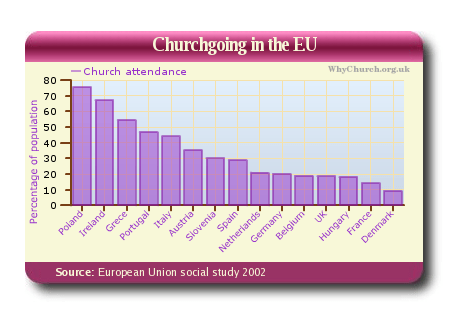
There has been a bit of a buzz around that church attendance figures in the UK are on the up! This after decades of dropping like a stone. These are the sorts of stats we have become used to (from here)

att_trend_chart

eu_church_att_chart

att_trend_chart

Of course, the picture was never simple- some individual churches are growing- the odd American imported super church, Black Pentecostal churches, and Orthodox churches- these have all been on the increase… albeit from a low base.

But statistics- they can be very misleading, so I did a bit of searching to see if I could find specific details of the studies.

The first one concerns a study done by Tearfund- mentioned in the Telegraph here.

A survey of 7,000 people by Tearfund found that 26 per cent say they went to a church service in 2008, up from 21 per cent the year before.

In addition, the proportion who say they attend church every month has risen from 13 per cent to 15 per cent, while one in 10 claim they go at least once a week, up from 9 per cent.

These are the highest figures recorded by the development agency for more than three years, contradicting research that has claimed churchgoing is in steady decline across Britain.

Young adults and pensioners are said to have taken up churchgoing in the greatest numbers, with a 10 per cent rise in attendance reported among the over-75s. Geographically, the biggest increase was seen in Wales (12 per cent).

It would mean that 7.3million adults now go to church – excluding weddings, baptisms and funerals – once a month. Official figures show that only 1.7m people attend Church of England services every month, while a further million attend weekly Mass at a Roman Catholic church.

The full details of the Tearfund study can be found on their website- here.

Another Telegraph articles makes the link with the deepening economic crisis- here.

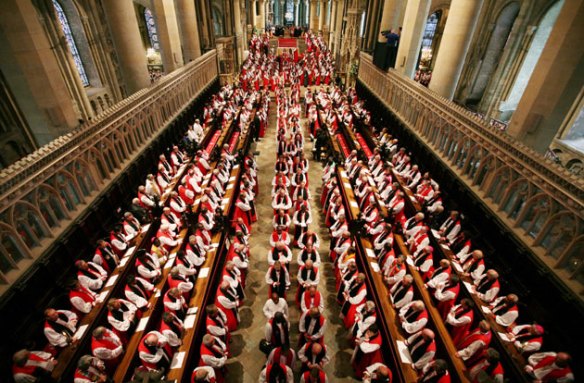
Numbers of people attending Cathedral services have been on the increase for a while- see here and here.

So what are we to make of this? One swallow does not make a summer, but the numbers quoted in the Tearfund study are significant- as is the year on year 4% Cathedral attendance increase since 2000.

I think we people of faith should pay little heed to these figures. Let us instead remember some lessons learnt when church attendance figures looked like the charts above, which I think should include some of these-

  • We can no longer expect ‘attractional’ models of church to fill the pews.
  • Church is not about sacred buildings, but about letting loose the people of faith into the towns and cities about us.
  • The new context requires new ways of interpreting the gospel, and a re-examination of how the enculturalisation of church has contributed to a lack of relevance.
  • But the old mystical/contemplative traditions have much to teach us too.
  • Faith is discovered through action and interaction, not through didactic teaching.
  • Doctrine is not the most important thing.
  • Love is.

Saul of Tarsus- he was only human… wasn’t he?

Interesting discussion in housegroup the other night.

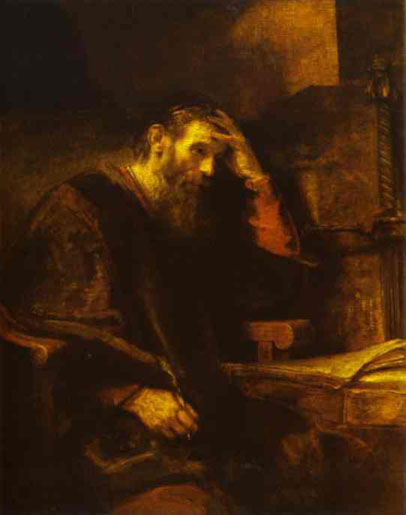
We are continuing with a study on Acts of the Apostles as part of the Exilio study, and we are up to chapters 25 and 26. It is in this passage that Paul manages to offend the Jews (again) and they get the Roman Governor to throw him into prison.
rembrandt-saint-paul-in-prison

This is not a new thing, Paul has been on the end of imprisonments and beatings in just about every town across the region. Each time, it works out for the best in the end.

But this time, when he is offered a trial, he does something he has not done before- he appeals to Caesar.

Paul was a Roman Citizen. We do not know how he acquired this status, but according to Wikipedia (so it must be true) citizenship was granted for one of the following reasons

  • Roman citizenship was granted automatically to every male child born in a legal marriage of a Roman citizen.
  • Freed slaves were given a limited form of Roman citizenship; they were still obliged in some aspects to their former owner who automatically became their patron.
  • The sons of freed slaves became full citizens.
  • Auxilia were rewarded with Roman citizenship after their term of service. Their children also became citizens.
  • Only Roman citizens could enlist in the Roman Legion. However an enlisted Roman legionary was deprived of many of his rights. He could not legally marry, and therefore all his children born during his military service were denied citizenship, unless and until he married their mother after his discharge.
  • Some individuals received Roman citizenship as a reward for outstanding service to Rome.
  • One could also buy citizenship, but at a very high price.
  • People who were from the Latin states were gradually granted citizenship.
  • Rome gradually granted citizenship to whole provinces; the third-century Constitutio Antoniniana granted it to all free male inhabitants of the Empire.

It iseems clear that in acquiring and then using  his rights as a full Roman Citizen, Paul was pulling rank. I wonder if in some way he was taking a step back- no longer being Paul, but rather reverting to Saul…

Citizenship seemed to involve swimming in some murky waters;

Roman citizenship was also used as a tool of foreign policy and control. Colonies and political allies would be granted a “minor” form of Roman citizenship, there being several graduated levels of citizenship and legal rights (the Latin Right was one of them). The promise of improved standing within the Roman “sphere of influence”, and the rivalry for standing with one’s neighbours, kept the focus of many of Rome’s neighbours and allies centered on the status quo of Roman culture, rather than trying to subvert or overthrow Rome’s influence.

The granting of citizenship to allies and the conquered was a vital step in the process of Romanization. This step was one of the most effective political tools and (at that point in history) original political ideas (perhaps one of the most important reasons for the success of Rome).

As a precursor to this, Alexander the Great had tried to “mingle” his Macedonians and other Greeks with the Persians, Egyptians, Syrians, etc in order to assimilate the people of the conquered Persian Empire, but after his death this policy was largely ignored by his successors. The idea was to assimilate, to turn a defeated and potentially rebellious enemy (or his sons) into a Roman citizen. Instead of having to wait for the unavoidable revolt of a conquered people (a tribe or a city-state) like Sparta and the conquered Helots, Rome made the “known” (conquered) world Roman.

There is the rather telling line in Acts 26 in which Festus suggests that Paul had done nothing wrong, and so would have been free to go, had he not have appealed to Caesar.

Paul was never free again after this point.

So- the question that hit me was whether in playing this political game, Paul got it wrong somehow. Perhaps he stopped relying on God, and the rollercoaster ride of following the Spirit into the missional life he was called to.

Because he was human. We easily forget this, I think as we read the accounts of his life in Acts, and as we live out doctrine based on his inspired writings. But there are enough hints of his human frailty despite the esteem in which he is described. The falling out with other people, the ‘thorn in his flesh’.

But if we can read the Roman Citizenship thing in this way- it seems harsh. Almost as if God is vengeful, merciless towards the mistakes of Paul, his faithful but imperfect servant. Is this a God you recognise?

It kind of reminds me of Pilgrims Progress, by Bunyan- a work that I have always disliked. Pilgrim has a road laid out before him, and should he step off this road- should he make the wrong turn, then he is in for trouble…

The fact is, this way of understanding the life of faith is just too deterministic. Almost as if Paul lived out a life of micro cause and effect, making choices like moving chess pieces, leading to sacred or profane consequences.

Almost as if God has mapped out a plan- a pre-determined track for each of our lives, and our task in life is to find it, and stumble along taking the utmost care to stay on this path at all costs…

footrpints

If this is not true, then how does God interact or respond to our choices? Is he just a (mostly) benign presence watching from afar as we, the ephemera, live out our little lives?

I think that this view of God neither matches the account from the Bible, nor my own experience.

I have come to believe that life is indeed about choice- decisions made in the presence of the Spirit of God, as we move through the difficult terrain of life. Some things go bad. But the Spirit is still there, still prompting and calling us on to a higher deeper way of loving others and serving the Kingdom.

And some decisions have consequences that go beyond the immediate situation. Does that mean that we can count on miraculous intervention by Angels to rescue us? I do not think so. But then again…

But if not, it is perhaps good to remember that the mission of Paul began anew- on a journey to Rome, and through the wonderful letters written to early outposts of the Kingdom that survive today.

Snow…

dscf3490

Manna

Overnight the spoors of snow had sown the fields and lined the winter branches white
It lay heavy wet, like a fragile crop that should be rushed to market
Lest it be wasted
But like manna, it has no shelf life
No possibility of air miles

And by afternoon, it is already old
And the surface of the hills, like an old mushroom
Once a splendid pregnant puffball
Is now shrunken and hollow
Leaching into the cold old ground.

dscf3492