Relational tithing- a new take on small scale community action…

Michaela and I watched this the other day- a small American group that have decided to do something simple and rather profound with 10% of their income.

I have always had a bit of a strange relationship with tithing- by which I mean the Evangelical Christian use of the word- giving your ten per cent to the great Agent in the sky (via your local church of course.) Laying down a ‘seed offering’ so that you might get so much more in return.

Giving money to the church to enable redistribution and support for people who are working with the poor- I can get that, but tithing has of course a whole different lot of baggage that goes with it- usually associated with those who need this to be a Biblical instruction so that the machinery of their institution might be oiled- salaries paid, roofs mended.

Churches do need to be funded, but if all our resources go into buildings and hierarchical salary structures then what might be left to use for things outside the establishment?

There are all sorts of potential problems of doing the things that this group have done- but I think it is really interesting…


Vodpod videos no longer available.


The spirituality of log stacking…

`

So here is my little ten part sermon based on the stacking of logs.

You can make your own analagous links.

  1. Stacking logs can not be rushed
  2. There are no machines that can stack them for you- bend your back and get stuck in
  3. Beginning carefully is very important- you will be building on these foundations
  4. Neatness is not important, but a well stocked log pile will probably be orderly
  5. Fresh air needs to circulate in, over and through the pile or the logs won’t dry, and will go stale and mouldy
  6. The rigidity and strength of a log pile comes from the closeness- the proximity- of its individual logs
  7. The big ego-bulging logs are the hardest to stack- they tend to topple and teeter and can easily bring the whole thing crashing down
  8. The smaller logs tend to be the glue that hold together the whole structure
  9. The higher you build the pile, the more unstable it will become
  10. The pile is not an end in itself- no matter how decorous. It exists to store and dry fuel that can then burn bright in service of the other

Remembering…

Yesterday was my father in law’s birthday.

Or would have been.

To remember his death in April of this year, Mary suggested we took some flowers to a place he loved. I am not really keen on those displays of flowers tied to lamp posts and benches- the ones that droop and rot into a mess of green plastic. But Mary had a much simpler idea.

So we went to a bridge over the River Eachaig, next to the lovely Uig Hall- a fine, still place where the river runs strongly around a meander and over a weir before disappearing towards the Holy Loch then the Clyde and finally the deep blue sea.

We stood in silence on the bridge, Michaela, me, the kids and Mary. That kind of stillness that is enhanced by the gentle noises around, and the feelings of pain and loss within. The whole world folds in for a while.

Then Mary threw her flower, along with a little note, into the river.

Taken by the current it moved off. Followed in line by Michaela’s, William’s and mine. It was unbearably sad, but lovely at the same time.

Emily was last to throw in her flower, and as she was standing nearer to the bank, the current took it around the meander and almost out of sight, before it snagged on the bank- a flash of yellow amongst the floating leaves.

This upset Emily- so much so that she wanted to go and fetch it somehow, although this was not practicable.

For me, this spoke volumes.

The river moves on and by, to a distant destination. But no matter how strong the flow it is hard to let go.

It is right not to let go.

Because blessed are those who mourn…

Into the wild, and Eddie Vedder…

I recently discovered the soundtrack to one of my favourite films- Sean Penn’s ‘Into the Wild’.

The film was from a book by John Krakauer of the same title, which told the true story of Christopher McCandless, who decided to quit society, and his comfortable upbringing, and disappeared into the wilderness. It tells the story of the people he met and influenced, the encounters he had with wild places, and his eventual lonely death in Alaska.

The book is an examination of the place of wilderness in our post-modern world. The film is something else- a visual feast, full of photographic cinematography and gentle simple people. It made me cry- not because of the tragic ending but because of its great humanity.

And then there is the sound track. By Pearl Jam’s lead singer Eddie Vedder.  Featuring these two great songs-

Oh it’s a mystery to me.
We have a greed, with which we have agreed…
and you think you have to want more than you need…
until you have it all, you won’t be free.

Society, you’re a crazy breed.
I hope you’re not lonely, without me.

When you want more than you have, you think you need…
and when you think more then you want, your thoughts begin to bleed.
I think I need to find a bigger place…
cause when you have more than you think, you need more space.

Giftedness in need of experience…

I am quite old.

One of the reasons that I know that I am old is by my reaction to new music. I love music, it has been one of the primary drives throughout my life. Playing music, listening to music, being moved by music. Measuring the passage of life through the meaning found in…music.

But these days, music has to be more than style. It has to be more than a trendy badge I can wear for a while. It has to have character, depth, emotion and it has to have something to say.

Now these things are very subjective, and that is the wonder of music- a scale of eight notes, arranged and then added to words can convey such variety- but for me, most talented artists need something else- they need experience.

They need to have engaged with the real dirty stuff of life.

Today, Emily dragged me in to listen to Laura Marling. I love it that she does this- she listens to loads of stuff, and if she thinks I might like it, then she is really keen to pass on the knowledge.

And she is often right- Laura Marling does a lovely version of ‘Rambling man’.

In a decade or so she might be great. Right now she is very talented.

On being thankful for harvest…

So, Autumn is fully with us.

The winds are still quite warm, but we have had a procession of storms over the last few days, interspersed with the odd burst of golden sunshine.

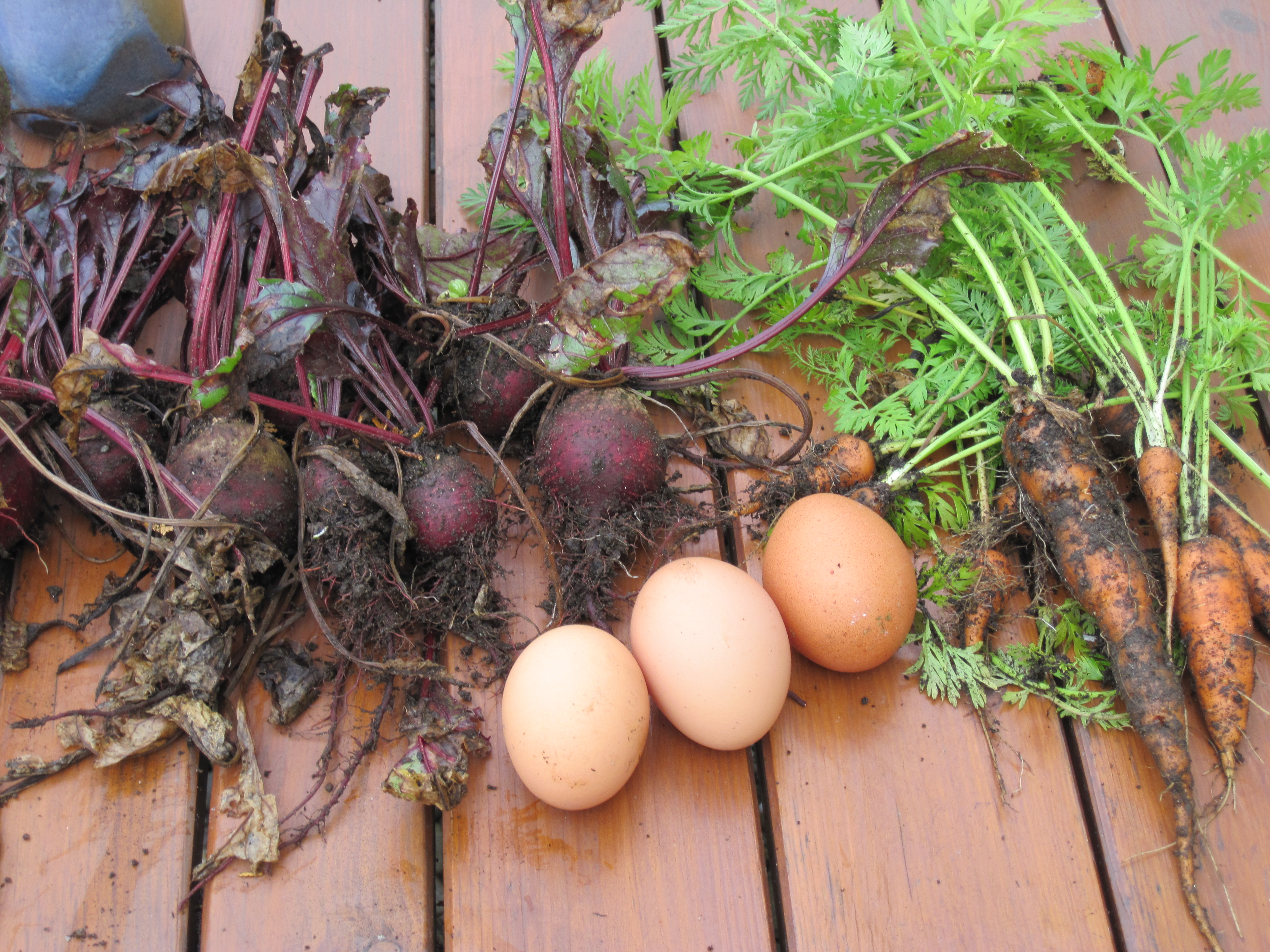
And the garden has given it’s last harvest. A few beans and some beetroot. Michaela planted some winter crops of spuds, onions and garlic- but we won’t see anything from these until next spring.

The hens continue to give us three eggs a day, but they are smaller- as the nights draw in, they are less active. Hens do not have good eyesight, and so they take themselves off to bed at dusk. Safely tucked up into their roost.

Autumn is sad season. Everything is becoming less. Everything is old and worn. And the survivors steel themselves for the harshness to come.

Even we humans, who are largely disconnected from the natural world that feeds us, are affected. We are different animals as the temperatures fall and the light disappears.

All the more reason, I reckon, to be thankful for the harvest.

To mark the time of gathering in and storing up.

A time to remember the grace still present in the resting soil, waiting and storing up energy for the year to come.

It is perhaps useful to recall the Celtic way of thinking about time- as a circle, rather than linear. The circle of the year begins on the 31st of October after the festival of Samhain or ‘Summers end’. The first period of the new year is Samonios, or ‘seed fall’, with the promise that out of darkness will come renewal, and a turning again of the circle.

Turn away.

Fresh expressions, medieval stylee…

Saw this and it made me chuckle. I think I have tried all of these options for revitalising church- before more or less settling on the last.

But lest I kid myself that I am cutting edge, lets remember that they were probably doing the same sorts of things 500 years ago.

When this video was made.
Vodpod videos no longer available.

Anthropomorphising God…

We had a lovely evening last night with our friends Susan and Steven. Our kids a great friends, and they live within an easy walking distance. We ate, shared a few glasses of wine, and laughed a lot.

And as ever, we discussed religion a little. Susan is a Buddhist, and it has been really interesting to share stories and perspectives. Sometimes it seems that we share so much, whilst at other times, the differences are stark. Michaela and I have often described how good these conversations feel though- neither of us are trying to win the other to our own perspective- rather we feel a respect and a pilgrim-companionship.

Because neither of us have all of this sorted. Perhaps the adjustment was greater for us in this regard- as we have been schooled in a kind of religion that has to pretend to have all the answers, lest we miss an opportunity for someone to come a realisation of the error of their ways. And of course, there is the spectre of hell waiting for those who do not grasp the ‘truth’.

Hmmm- am I sliding still towards syncretism and universalism? Whilst I may have a lot of difficulties with the narrow way of thinking that I describe above, I remain a Christian.

Last night, Susan commented on her experience of reading ‘The shack‘. Not one of my favourite books, I have to say- I found the extended images too laboured, and the writing a bit too overblown. However Susan’s perspective on the book was shaped by her starting point as a Buddhist- and the fact that the ‘person’ of God is not part of her experience. She would not necessarily see God as an entity, or a being- for her faith is a process of becoming.

Initially, I felt a sense of loss for my friend. Because my faith is driven most of all by a developing awareness of the person of Jesus, and the Father, communicated by the Spirit.

But later, I began to think again about what this might mean- to take a look at my belief from the perspective of an outsider- which is the great benefit of these conversations with people of a different faith.

And because I love words, I started with two words-

Personification

1. (Literary & Literary Critical Terms) the attribution of human characteristics to things, abstract ideas, etc., as for literary or artistic effect
2. (Fine Arts & Visual Arts / Art Terms) the representation of an abstract quality or idea in the form of a person, creature, etc., as in art and literature
3. a person or thing that personifies
4. a person or thing regarded as an embodiment of a quality he is the personification of optimism
.
Then there is this other word-
Anthropomorphism is the attribution of uniquely human characteristics to non-human creatures and beings, natural and supernatural phenomena, material states and objects or abstract concepts. Subjects for anthropomorphism commonly include animalsdepicted as creatures with human motivation able to reason and converse, forces ofnature such as winds or the sun, components in games, unseen or unknown sources of chance, etc. Almost anything can be subject to anthropomorphism. The term derives from a combination of Greek ἄνθρωπος (anthrōpos), human and μορφή (morphē), shapeor form.
.
I am sure that it will be obvious to most of you why these words are important to people of faith. We humans have the propensity to attribute human characteristics to inanimate objects, to animals, clouds, gadgets. We are geared to look for human resonances- and to recognise the human face almost before we are born. It is in our wiring (there we go- I just anthropomorphised my computer!)
.
So this has to raise questions as to the effect that this has on the development of religious belief, and the shape of our personal encounters with the divine.
.
Atheists might suggest that all religion grows from these human characteristics.
.
There are Christian voices that also point out how modernity has become mingled with culture to such an extent that we have remade God in our own image- a western, capitalistic, rationalistic, democratic God. My own personal pocket Jesus.
.
It is very difficult to take this Jesus out of our pocket. We tend to just put him in a different one.
.
It is perhaps interesting to make a comparison of how the different religious faiths deal with this issue of anthropomorphism- Anthropomorphism of God is rejected by Judaism and Islam, which both believe that God is beyond human limits of physical comprehension, a view which has resonance with the Gregory of Nysa’s ‘holy darkness’. The Jewish rejection of the anthropomorphism of God intensified after the advent of Christianity.
.
.
But we Christians, unlike our brothers and sisters in other faiths have continued to seek encounter God through the face of Jesus. Whatever this means…
.
What is left in me is a conviction that God became flesh and lived amongst us. And we have seen his Glory. (John 1)
.
But this incarnation is of a God who lives in us, not a personification of what we are cast heavenwards.
.
Hmmmm…


Marketa Irglova and Glen Hansard singing in the snow…

Graham posted a link about the soundtrack album from the film ‘Once’- which made me go searching, and quickly hitting Amazon to order. Listen to it, you will not be disappointed.

Glen Hansard is a face that might be familiar- front man of The Frames, and no stranger to the silver screen, having been in The Commitments all those years ago.

Marketa Irglova has a jewel of a voice, and will go far…