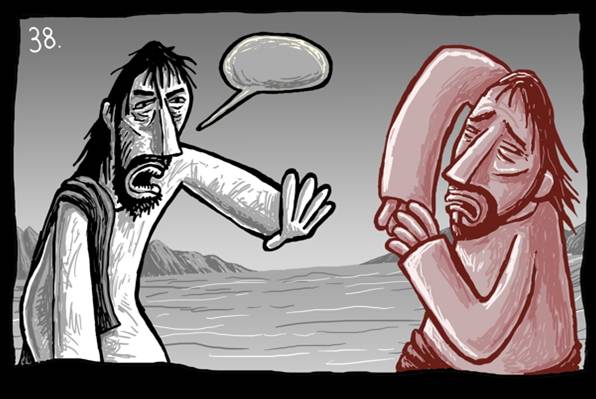
Lent 38…

ENOUGH!

I serve only one master-

The Spirit of the Sovereign Lord is on me

He has sent me to the poor and the weak to tell them the good news

He has told me that it’s time to heal the broken hearted-

Shout freedom to all captives, and to break the chains of those you have bound

Now is the time of my fathers grace

And the destruction of your plans

And the stranger

Was gone

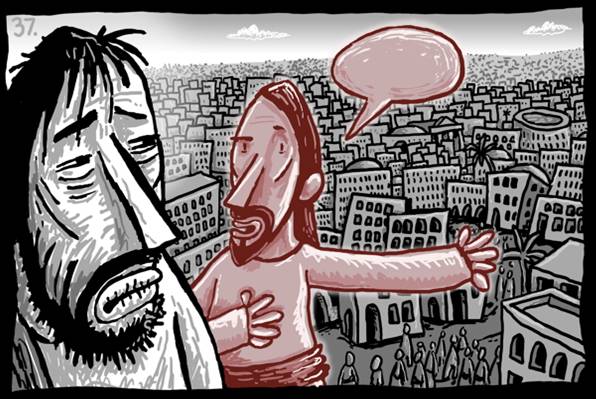
Lent 37…

With a howl of disgust the stranger turned again and took the man to a high place overlooking a huge city. So began the third attack

Look you fool- all this could be yours! You cower in the desert and but look- the whole world is at my feet!

I can give you anything you could ever want; Money, power, servants, fame, influence- are these things not necessary to complete this mission of yours?

Why not do things in style?

Why grovel in the dust when you can live like a King?

All I ask is this- do it MY way. Listen to me….

Bible nasties 3- truth and scripture…

(This is a continuation of a series of posts (here and here) asking questions about the dark passages of the Bible. Forgive me if this is all old news to you theological types- I began writing this as a review of where my own thinking is up to….)

So, we come to that truth word. I am tempted to try to deal with this as a philosophical concept- but for now, lets stick to Jesus-

 Then you will know the truth, and the truth will set you free.

John 8:32

What did Jesus mean?

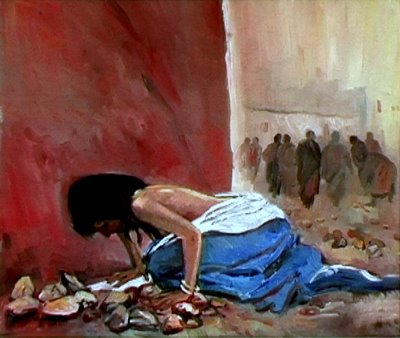
When you read the full passage, the whole thing gets even more complicated- Jesus is in the middle of one of his regular arguments with the religious hard liners- the Pharisees. Firstly they try to catch him out by bringing him a woman caught in adultery- who by law (Biblical, scriptural law that is) should be stoned to death. (Check out Deuteronomy 22:22 for example.)

Leaving aside the fact that only the woman was brought to be stoned, not the man who was the other half of the coupling, what Jesus did here was to take an absolute unequivocal law- an absolute scriptural truth- and turn it upside down and inside out. The way he did this infuriated the religious folk, and thrills us as we read the story.

Next, Jesus claims to be the Light of the World, and the Pharisees try to challenge him using logic and truth- asking him to bring forth witnesses. Then there is a lot of isicussion about the nature of sin- all of it aimed at the very people who seemed to have got it all together in terms of scripture.

So- what sort of truth is it that will set us free when we get to know it?

The church tradition (Protestant Evangelical, slightly Charismatic, left leaning) that I grew up in would have suggested that the issue was that the Pharisees did not get the real truth- they were caught up in surface deep ‘goodness’- all of which may be the case. But this tradition has made a sport of ‘truth wars’ for generations- ever since the reformation there has been a constant schism followed by splinter followed by subdivision- each grouping claiming that their truth was truer than the last one.

And each one of these schisms has used the Bible (or rather their enlightened interpretation of the Bible) as evidence for their claims to truth. Which is just what the Pharisees did. Is this really the kind of freedom that Jesus had in mind?

Is this the kind of truth that he had in mind?

Because in this passage, and in all others, Jesus seemed to apply the truth with a distinct bias towards the poor and weak. It is one of the reasons that I am still captivated by him. The freedom he seemed to promise was from the tyranny of the law- the application of hard, rigid, unyielding truth- particularly when wielded by the powerful. This kind of truth he always (and I mean ALWAYS) seems to have turned upside down and inside out.
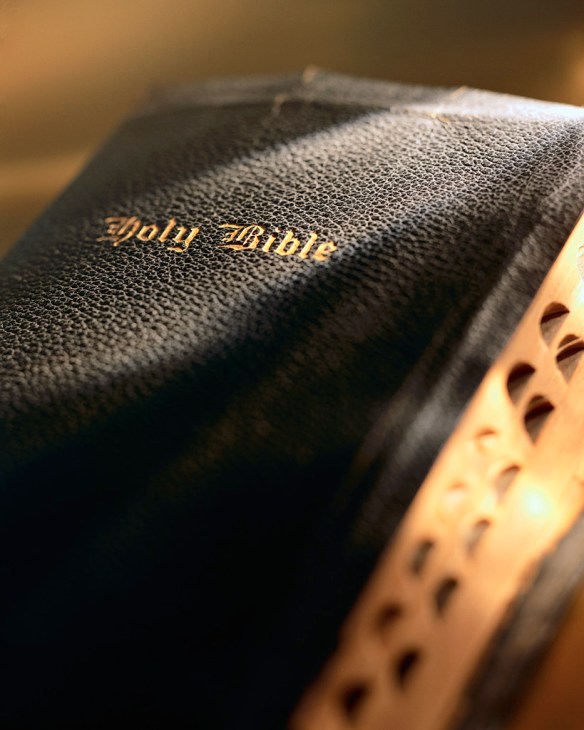
Which kind of brings us back to the issue of how we might read, understand and apply the words of the Bible- particularly those troubling aforementioned passages in the Old Testament.

It is probably worth remembering that what we know as ‘The Bible’ is a relatively modern creation- in terms at least of the canon of scripture that is gathered together in the way we understand it now. There is more about this here if you are interested, or check out this summary of the Biblical Canon from Wikipedia. In the pre modern area, Scriptural truth emerged from debates between learned monks, or was ruled upon by the hierarchy of the Church.

Interestingly enough, I was reading something about the early Ionan writings- from the time of St Columba. One of the books that has survived is the Collectio Canonum Hibernensisa collection of biblical Christian teaching and law making, written on Iona some time in the late 7th Century. What is striking about this book is that it often quotes contradictory sources- the was no concern to decide what should be the absolute final truth- rather the writer appears to expect people to look at the evidence, and work it out for themselves.

Does that mean that there is no truth, just debate leading to a thousand personal opinions that shift according to influence and fashion?

Well- some might suggest that this is the logical outcome of post-modernity as applied to religion. The pendulum swing may yet need to correct itself lest we deconstruct everything to it’s eventual destruction (if you will forgive the mixed metaphor!)

Interestingly enough- what I believe is happening in the emerging church conversation at the moment is that the deconstruction phase is over- we are starting to build again. People are starting to be more comfortable in stating what they have come to believe (rather than just questioning what they had once believed.) We see this creating some conflict- as in Rob Bell’s new book. Of course, such concrete statements (even id tentatively phrased) become targets for the  truth mongers. ‘Oh’ they say ‘I knew all along this man was a heretic/a universalist/un biblical.

I think that is why I started to write this series of blog pieces. I feel it is time to take my own stand on some of these issues- you could say, to find my own bit of truth.

But it needs to be the sort of truth that sets me free.

And if it is to be this, then it needs to be a Jesus kind of truth-

Humble

Biased towards the poor and weak

Driven by love and grace, not existing independently of these

Destablising and challenging- not always obvious

Encountered in stories, relationships and mistake making- not just(or even) in written lists of laws

Applied deeply, not just on the surface

Applied first to oneself, but softly to others- apart from those who wield power

Hmmmm….

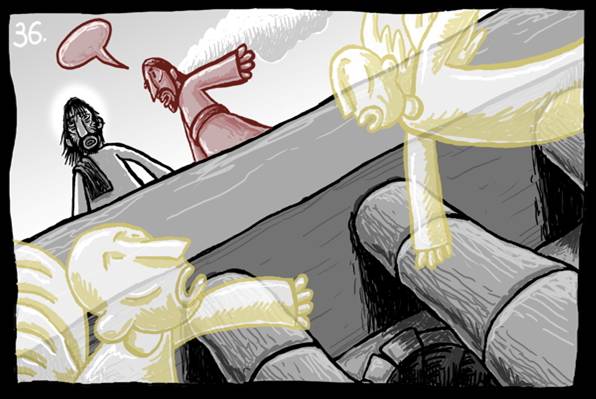
Lent 36…

With flashing eyes the stranger turned away and in a blink of an eye the two men stood high on the temple roof looking down into the courtyard. And then, the second attack…

I don’t think you are Him at all! Look at you- standing there all weak at the knees!

If you are precious to your father, you could throw yourself from this place and the angels would catch you and float you down to the stone floor below.

GO on- DO it!

SHOW ME!

I must… not….test my father….

Now is your time, and mine.

Bible nasties 2- the excuses…

Following on from my previous post, I have been thinking about what more recent theologians have made of these darker passages in the Bible- how have they been explained or discounted?

(N.B. Some of the themes echo previous discussions on this blog about suffering- see here for example.)

As far as I can see it, the apologetics have gone along these lines;

Firstly, there are those folk who seem to see God as red in tooth and claw-

God is a wrathful God, whose justice is sometimes swift and unpredictable.

His purposes and his focus are on eternal matters, not temporal ones- therefore any God-action (no matter how brutal) has to be understood in this context. Suffering is temporary- this life, for all of us, is all to short- but eternity is for ever. Therefore, some shock tactics in the cause of higher spiritual causes are a price worth paying.

Some people, regimes and religions are evil, and deserving of wrath. We only escape by the skin of our teeth- because of Jesus.

After all- he made us all. He designed the Universe about us- we belong to him, and he can do whatever he likes with us.

It is easy to dismiss these kind of theological statements out of hand. It is this sort of mindset that allows people to justify all sorts of activities in the name of God- wars, pogroms, ethnic cleansing. Then there are those who suggest that tsunami’s are Gods way of sorting out Islamic nations, or that AIDS is a God-plague on homosexuality.

All of this was smashed forever (or should have been) by the words of Jesus recorded in Matthew chapter 5.

But then perhaps it is still for those of us that pendulum swing too far towards the ‘gentle Jesus meek and mild’ to remember that the Lion of Judah is not a tame lion…

The next set of explanations people reach for are the spiritual/mystical ones-

There can be no good without the presence of evil- in the same way that there can be no light without darkness. How else can we make choices for good?

‘My ways are not your ways’ declares the Lord- how can we ever understand the mind of God?

We must focus on the big picture- the great cosmic clash of Angels and Demons that are at war in these, the last days.

The light and darkness bit makes sense I think- the choices we make are sometimes murky and ambiguous in their morality- but many others are much clearer in terms of what is right, and what is wrong. But many of the passages referred to in my earlier post appear to suggest that God himself is commanding, or assisting, acts that to our modern eyes appear evil. Almost as if God is himself capable of both good and evil?

I have little patience with the end times theorising of the ‘Left Behind‘ sort. But that is a whole different issue…

Next we have the structural/dispensational arguments-

Most of the passages described in in the first ‘Bible nasties’ post are from the Old Testament- at which point God was dealing with his people according to the old covenant– when God worked with and through his Chosen People, the Israelites.  This covenant was swept aside by the coming of a new one- brought by Jesus not just for the people of Israel, but for everyone.

Others, following on from John Nelson Darby have gone further, and argued that God has dealt with humanity in different ways over the years, which they divide into dispensations.

What this argument seems to suggest is that God used to be angry, vengeful and violent, but then he cleaned up his act. He used to act out of anger, but now he favours mercy. He used to be jealous, but now he relaxes into love.

Is this the same God? This argument does not hang together for me.

Then there is the liberal/ intellectualist excuse-

God is simply not an interventionist God at all. Sure, he started it all off in Creation, but then pretty much he stepped back and let the whole thing unfold, with a few nudges here and there from the prophets, and finally by sending Jesus as a last gasp hope to sort out his errant creation. The Bible itself is mostly myth and manipulation by previous religious leaders- and it’s application now has to be understood through our own intellect and understanding.

But what sort of faithless faith is this? And what of our experience of a God who is present, and incarnated in us, almost despite what we often are?

Here was see for the first time an attack on our primary theological source material- the Bible itself. Is it ‘true’? What does truth mean when applied to such ancient scriptures? More on this later…

Ponder onwards friends.

Lent 35…

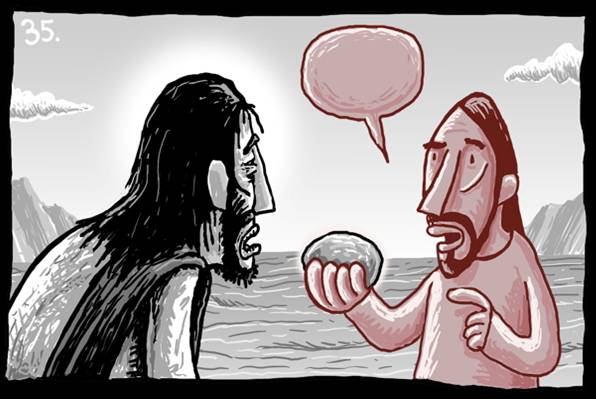
The two men walk into the sun. So begins the first attack

Son of God- what a fool you are to suffer such hunger! You have the power to snuff out the sun, yet you go hungry? Perhaps you are not so strong after all?

If you were, you could turn this stone into bread, and we could sit down to sandwiches for lunch…

We need so much more than bread.

I am the bread of life, and I come to feed souls…

Bible nasties…

The Christian tradition that I grew up into stood firmly in the way of the Book.

Our understanding of faith was often reduced to an understanding of the Bible. We prided ourselves on taking it in whole- unaltered, un doubted, seamless, without contraction or error.

Except of course, the longer I have walked this path, the more I have struggled with this blinkered and partisan view of the Bible. It has been a regular theme on thisfragiletent– as I have returned again and again to chew on the words and the Word.

The position I start from these days is one of wonder and respect for the ancient writings, shadowed with other things- I do not doubt the inspiration or the revelation they contain, but what I thought I knew about the Book, I often find myself now not knowing. I find myself full of questions, to which there are often only more questions, rather than answers. For a while this seemed like a crisis of my very faith, but then became the very life of my faith- the adventure with God could begin anew.

One of the things I had to confront was the realisation that all those lovely life affirming and loving passages of the Bible that I know and love are not all that the Book contains. Rather there is much that greatly troubles me. To ignore (or at best to minimise) these passages is simply not honest. To claim that they are part of God’s plan- that all this death and suffering fits together in an organised whole- it lacks integrity with the way of Jesus- or so it seems to me.

To illustrate, here are twenty examples-

  1. God drowns the whole earth.
    In Genesis 7:21–23, God drowns the entire population of the earth: men, women, children,. Only a single family survives. In Matthew 24:37–42, Jesus appears to approve of this genocide and even to say it will be repeated when he returns.
  2. God kills half a million people.
    In 2 Chronicles 13:15–18, God helps the men of Judah kill 500,000 of their fellow Israelites.
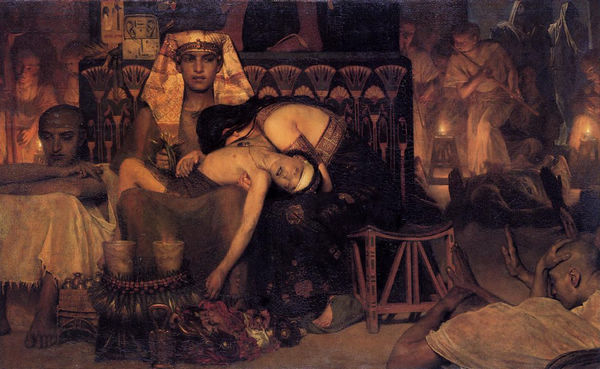
  3. God slaughters all Egyptian firstborn.
    In Exodus 12:29, God kills all Egyptian firstborn children and cattle because their king was stubborn.
  4. God kills 14,000 people for complaining that God keeps killing them.
    In Numbers 16:41–49, the Israelites complain that God is killing too many of them. So, God sends a plague that kills 14,000 more of them.
  5. Genocide after genocide after genocide.
    In Joshua 6:20–21, God helps the Israelites destroy Jericho, killing “men and women, young and old, cattle, sheep and donkeys.” In Deuteronomy 2:32–35, God has the Israelites kill everyone in Heshbon, including children, and plunder the country. In Deuteronomy 3:3–7, God has the Israelites do the same to the people of Bashan. In Numbers 31:7–18, the Israelites kill all the Midianites except for the virgins, whom they take as spoils of war. In 1 Samuel 15:1–9, God tells the Israelites to kill all the Amalekites—men, women, children, infants, and their cattle—for something the Amalekites’ ancestors had done 400 years ago.
  6. God kills 50,000 people for curiosity.
    In 1 Samuel 6:19, God kills 50,000 men for peeking into the ark of the covenant.
  7. 3,000 Israelites killed for inventing a god.
    In Exodus 32, Moses has climbed Mount Sinai to get the Ten Commandments. The Israelites are left with too much time to wonder, so they invent a golden calf god. Moses comes back and God commands him: “Each man strap a sword to his side. Go back and forth through the camp from one end to the other, each killing his brother and friend and neighbor.” About 3,000 people died.
  8. Amorites destroyed by sword and God’s rocks.
    In Joshua 10:10–11, God helps the Israelites slaughter the Amorites by sword, then finishes them off with rocks from the sky.
  9. God burns two cities to death.
    In Genesis 19:24, God kills everyone in Sodom and Gomorrah with fire from the sky. Then God kills Lot’s wife for looking back at her burning home.
  10. God has 42 children mauled by bears.
    In 2 Kings 2:23–24, some kids tease the prophet Elisha, and God sends bears to maul them.
  11. A tribe slaughtered and their virgins raped for not showing up at roll call.
    In Judges 21:1–23, a tribe of Israelites misses roll call, so the other Israelites kill them all except for the virgins, which they take for themselves. Still not happy, they hide in vineyards and pounce on dancing women from Shiloh to take them for themselves.
  12. 3,000 crushed to death.
    In Judges 16:27–30, God gives Samson strength to bring down a building to crush 3,000 members of a rival tribe.
  13. A concubine raped and dismembered.
    In Judges 19:22–29, a mob demands to rape a godly master’s guest. The master offers his daughter and a concubine to them instead. They take the concubine and gang-rape her all night. The master finds her on his doorstep in the morning, cuts her into 12 pieces, and send the pieces around the country.
  14. Child sacrifice.
    In Judges 11:30–39, Jephthah burns his daughter alive as a sacrificial offering for God’s favor in killing the Ammonites. We remember the mercy God showed to Abraham and Isaac, but forget this one.
  15. God helps Samson kill 30 men because he lost a bet.
    In Judges 14:11–19, Samson loses a bet for 30 sets of clothes. The spirit of God comes upon him and he kills 30 men to steal their clothes and pay off the debt.
  16. God demands you kill your wife and children for worshipping other gods.
    In Deuteronomy 13:6–10, God commands that you must kill your wife, children, brother, and friend if they worship other gods.
  17. God incinerates 51 men to make a point.
    In 2 Kings 1:9–10, Elijah gets God to burn 51 men with fire from heaven to prove he is God.
  18. God kills a man for not impregnating his brother’s wife.
    In Genesis 38:9–10, God kills a man for refusing to impregnate his brother’s wife.
  19. God threatens forced cannibalism.
    In Leviticus 26:27–29 and Jeremiah 19:9, God threatens to punish the Israelites by making them eat their own children.
  20. The coming slaughter.
    According to Revelation 9:7–19, God’s got more evil coming. God will make horse-like locusts with human heads and scorpion tails, who torture people for 5 months. Then some angels will kill a third of the earth’s population. If he came today, that would be 2billion people.
Over the next few weeks, I will spend some time thinking about this a little more- considering again what we might make of these passages.
.
Reclaiming the Bible for what it is, not for what it never was.
.
Or at least trying to- I stand in a long tradition of others who have done the same.

Lent 34…

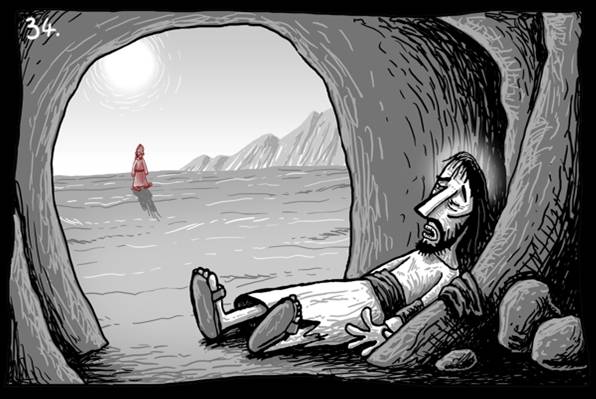
Suddenly he was not alone. Striding across the desert comes a stranger

There is something friendly and familiar about this man- he is cool and clean, and his voice is like butter

But beneath this fine exterior there lurks something else.

.

It is old- older than mankind

.

Look in his eyes and you can see the very depths of darkness and destruction-

Epidemics rage there

In the corner of his gaze, savage animals rip and claw at one another

And with a glance, arrows fly, and cannons spew fire and flame

And in the pool of his vision, men and women objectify one another

And lust for power and wealth and sex

Forests burn and rivers flow toxic from his tears.

.

Now he has a new mission…

Blogging and spirituality…

I enjoyed an old piece of writing by TSK here recently- concerning how he felt that blogging worked as a spiritual discipline.

TSK felt that it worked something like this-

1. Praise (public acknowledgement) – “publish glad tidings daily”
2. Accountability. (Eph. 5: 21 “Submit yourselves to one another”, quote fromAthanasias)
3. Vulnerability (Daniel’s window)
4, Given-ness (Freely you have received, gift economyProv 11:24)
5. Creative Naming (Adam, Neighbors in Ruth)
6. Repentance (editing/deleting/changing our mind in new media)
7. Fellowship (hypertext linking, Koinonia)
8. Evangelism (storytelling, blogging from our lives)
9. Integrity (writing matches our speaking, design reflects reality)
10. Posterity. (store/guard what has been entrusted, writing history)
There was also another one: Watchfulness (“watch and pray”).

I think I would add a couple more-

11. Creativity- most writers would say that words shape us as we shape them.

12. Discipline and long term commitment- blogging output varies, but it demands mostly daily commitment over a long time to develop a voice.

But I think blogging should come with a little warning to introspective folk like me- it can be addictive, and it is not the only spiritual discipline- and should never become so in our lives.

There is also physical community…