Yesterday we had a party in the garden. The weather was kinder than it might have been, but we were still grateful for the loan of a marquee from some friends. We planted 50 trees and spent the whole day outside, playing music and eating good food (mostly thanks to friends too!)
It was a lovely, lovely day, full of most of the best things my life contains, with Michaela at the centre.
Thanks so much to those of you who came. Those that could not, there will be other times for us to meet soon hopefully…
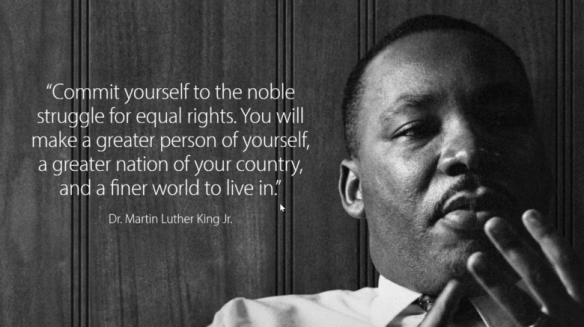
I can’t listen to this man without weeping; the way his voice is drenched in the power of emotion; the poetry and music in his cadences; the old-time-revival preacher style that then hits you with a sucker punch – this man lived and they killed him for it.
I watched Selma last night with my 17 year old son. He knew little of the story or the historical context that King lived through. Afterwards I found myself talking to him about what I knew of it all and to my shame, I felt a certain nostalgia. How could this be? I am not black and have no rights whatsoever to claim any connection to the struggles for freedom that black people have endured in the USA for generation after generation. What I was doing was making a pet of my own personal MLK – a bit like my own personal Jesus. MLK exists in that place of modern sainthood, from a simpler time when good stood up to evil and triumphed.
Or did it? What was King actually fighting for? What was that ‘promised land’ that he so powerfully evoked in all those speeches? What was he dreaming about?
More pertinently, what would he make of the rampant inequality that still exists between black and white people across the planet, but in his own country too? What would he make of how those who he described as ‘poor whites’ are still sold a lie that at least they are better than… in the USA perhaps it is still black people, but we could substitute refugees, Moslems, benefit scroungers, etc etc. King saw this kind of invective as the way that rich people stopped us all lifting our heads and believing in something better, something that God was calling us towards.
This week, the US will indulge in an orgy of self-congratulation, selectively misrepresenting King’s life and work, as if rebelling against the American establishment was, in fact, what the establishment has always encouraged. They will cite the “dream” speech as if it were his only one – and the line about wanting his children to be “judged not by the colour of their skin but the content of their character” as if it were the only line in it.
In so doing they will wilfully and brazenly omit the fact that before his death in 1968, King was well on the way to becoming a pariah. In 1966, twice as many Americans had an unfavourable opinion of him as a favourable one. Life magazine branded his anti-Vietnam war speech at the Riverside church, delivered exactly a year before his assassination, as “demagogic slander”, and “a script for Radio Hanoi”. Just a week before he was killed, he attended a demonstration in Memphis in support of striking garbage workers. The protest turned violent and police responded with batons and teargas, shooting a 16-year-old boy dead. The press and the political class rounded on King. The New York Times said the events were “a powerful embarrassment” to him. A column in the Dallas Morning News called King “the headline-hunting high priest of nonviolent violence” whose “road show” in Memphis was “like a torchbearer sprinting into a powder-house”. The Providence Sunday Journal called him “reckless and irresponsible”. He was back in Memphis supporting the strike when he was killed.
MLK was hated not just because he was black, but also because of his political stance on things like the Vietnam war and poverty. These led him to the same inevitable conclusion that many activists have come to; in order to improve the lot of individual groups, you have to look in detail that economic power structures that are keeping the status quo. You have to look at the nature of Capitalism itself. This from the same article;
“We must honestly face the fact that the movement must address itself to the question of restructuring the whole of American society,” he said in August 1967. “There are 40 million poor people here, and one day we must ask the question, ‘Why are there 40 million poor people in America?’ And when you begin to ask that question, you are raising a question about the economic system, about a broader distribution of wealth. When you ask that question, you begin to question the capitalistic economy … when you deal with this, you begin to ask the question: ‘Who owns the oil?’ You begin to ask the question: ‘Who owns the iron ore?’ You begin to ask the question: ‘Why is it that people have to pay water bills in a world that’s two-thirds water?’”
It is an interesting question; what would MLK’s legacy have been, had he lived? Would he have a achieved greater things, or would his star have inevitably fallen? There is after all some indication that it was already falling even before the fateful bullet. The point is however, that he died. Ever since then, people have used him to illustrate a version of history that made sense to them.
Like Jesus, MLK sought to be God’s revolutionary. Like Jesus, perhaps he knew that this was not going to end well. Like Jesus, the power of his ‘rightness’ ultimately (if grudgingly) was accepted by the culture that he came to, but with conditions. Only some of what he said was accepted. His words were applied to illustrate a version of America that could make people believe that it was indeed the promised land, despite all the evidence to the contrary. The article again;
So in life, King’s one-time contemporaries struggle, as he did, with a white America that is dismissive and a black America that demands more than their movements can deliver. In death, the struggle is to ensure that King’s legacy isn’t eviscerated of all militancy so that it can be repurposed as one more illustration of the American establishment’s God-given ability to produce the antidote to it’s own poison.
MLK was a remarkable man, born into remarkable times. He achieved much, but also far less than he hoped and longed for. There is no promised land, just people who still have a dream that it might yet be brought a little closer.
50 years after his death, I am going to remember him as a revolutionary peace maker, which is a title redolent with irony because it is a contradiction in terms. Jesus turned over tables remember?
I wanted to give a plug to this event which is part of our exhibition at the lovely TIG gallery, tucked away in the village of Tighnabruaich, overlooking the Kyles of Bute on the Cowal peninsula. (If you have not been to this part of the world, you really don’t know what you are missing!)
Poetry & Clay Workshop for Adults
Saturday 14 April, 10.30am–3.30pm
Cost £50
Phone 01700 811681 to book
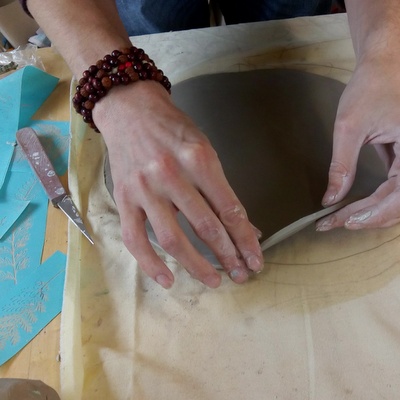
A day out to think and create. The session will start with a trip to the beach to reflect, relax and gather some inspiration. Participants will then be guided as to how to turn thoughts, images and beach finds into poetry and words, before pulling all this together and creating a ceramic poetry piece with images and words.
All tuition and materials are included along with tea and cake. Please bring a packed lunch.
This will be the second time we have run this workshop, which combines two simple ideas- the forming of words which are then fixed into clay. The last time we were blown away by how lovely and profound the process was…
We will bring your creations back to the pottery, where we will dry them, fire them, glaze them, then finish them and get them back to you as a memory of a day that will last forever.
Here, the day is appropriately beautiful. Everything is growing new shoots. Dear friends, this may not be true where you are, but Easter is not a matter of changing weather, it is a statement of hope. May your Easter be another new start where hope rises…
This cross was scratched in a hermit’s cave on Eilean Mor, the McCormaig islands, some time around one-and-a-half thousand years ago. The monk who scratched it lived in a different world and used different languages and concepts to understand the God who died and rose again. The differences do not matter to God, so why should they matter to us?
The death of God
It is said that on the cross, the Wrath of God was
Satisfied; as if the stretched-out slaughter of his
son was the only thing that could turn his mind
to mercy; as if it could not be remade without
blood being spilled; as if the only way to satiate the
violence of God was through the torture of his own son.
Or perhaps that only ever made any sense in the mind
of religious men; perhaps it was never about the deployment
of heavenly legalistic strategy after all; perhaps it was a last
desperate act, when all else had failed, by a God whose
only surrender was to the way of love.
This is the God I reach for; the God I would live for is
indeed the one who died for me – not to ensure my escape
from the fires of hell, for why should I escape (through a
technicality) that which I deserve as much as the next man?
Rather this is the God who stretched his arms so wide that they
reach around everything that ever was and ever will be. He stretched them














 this fragile tent