Advent conspiracy 9: the invention of Christmas…

Today, Bob Fraser takes us on a bit of journey about the origin of our seasonal festivities.

Photo by Samuel Becerra on Pexels.com

In this reflective season of Advent, I’ve been thinking about traditions and religious festivals, and last week I re-watched the seasonal film ‘The Man Who Invented Christmas’.

At this time of year the amount of daylight is getting less and my brief and rather unscientific research suggests that the Norse tradition of Yule marked the winter solstice – the day with least sunshine, which occurs around 21st or 22nd December in the Northern Hemisphere. Dec 25th was also when the Romans celebrated with a festival for one of their Gods, Saturn, (Saturnalia).

In our western culture, an eclectic mix of secular and sacred have, over the years, been fused together to form something else altogether – a bit like copper and tin making bronze.  Somehow The Roman good luck practice of using Holly and the Celtic Druids use of Mistletoe have found their way into the mix. The Druids seemed to be reflecting the ancient Greek practice of people kissing underneath mistletoe during weddings to symbolise peace and people coming together. Even the German tradition of candlelit Christmas trees, has its origin in symbolic use of evergreens in ancient Egypt and Rome. The giving of presents was part of Roman tradition too, as gifts were offered in worship of the God Saturn. It seems then that many of the traditions we associate with Christmas have their origin around two thousand years ago.

So here we are in the Christian season of Advent with Christmas on the horizon, and, as a believer, I am about to embark on a journey of stories and traditions, many of which have their origins in pagan celebrations.

Perhaps the Romans would have been aggrieved at their traditions being hijacked and trampled on, in just the same way that I felt a tad upset some years ago when the Post Office had a spell of not producing stamps with a religious image on them, and some local authorities banned the word Christmas, in an attempt to reflect a more inclusive and multi-cultural approach.

To be honest, I’m way more accepting now of differing traditions than I used to be when I was younger. Issues are no longer as black and white. Yes, I’m uncomfortable with some of the excesses of this season, but it’s good to mark these celebrations in some way. Cultural traditions, beliefs and expressions change over time. Each generation may adapt things from earlier practices. So I don’t expect everyone to align with all the things that I might believe in, just as I might not align with theirs. Surely, a measure of mutual acceptance of the differing stories is more likely to bring peace on Earth than haggling about whether celebrations should be secular or sacred.

So despite it being an enjoyable film, it wasn’t Charles Dickens or the Victorians who invented all of our western Christmas traditions after all. Perhaps they just pinched ideas from the Romans and the Druids and forged them into a new narrative for Christmas. 
Advent conspiracy 8: treacle tins and transcendance…

Another post from artist Steve, whose eye for beauty in the ordinary is remarkable.

Christmas is that magical time of mystery, wonder, miracles and angels.


But lots of us have become ‘selective’ as to what spiritual significance it may all have.


For many, Christmas has become a focus for family gatherings, food+drink, giving+receiving presents, trees+decorations, music playlists, opening doors on Advent calendars, Christmas cards, yearning for snow (but only the kind that makes everything white for just two days and disappears by Boxing Day), family walks, bubble+squeak on Boxing Day, party games and fun+laughter. It might even include midnight mass – but perhaps only as part of a family tradition.


Does God feature at all?
The Office for National Statistics (ONS) recently published figures for 2021 indicating that, for the first time, less than 50% of people in England+Wales identify themselves as Christians (46.2%, compared with 59.3% in 2011… with 37.2% as of ‘no religion’, compared with 25.2% ten years ago).


What do I believe anymore?
Next year, I will have been a Christian for fifty years. At times, it’s been a bumpy journey but, despite my doubts, there remains something that continues to hold me.


Confused+stumbling, stubborn+steadfast… waiting+wondering.

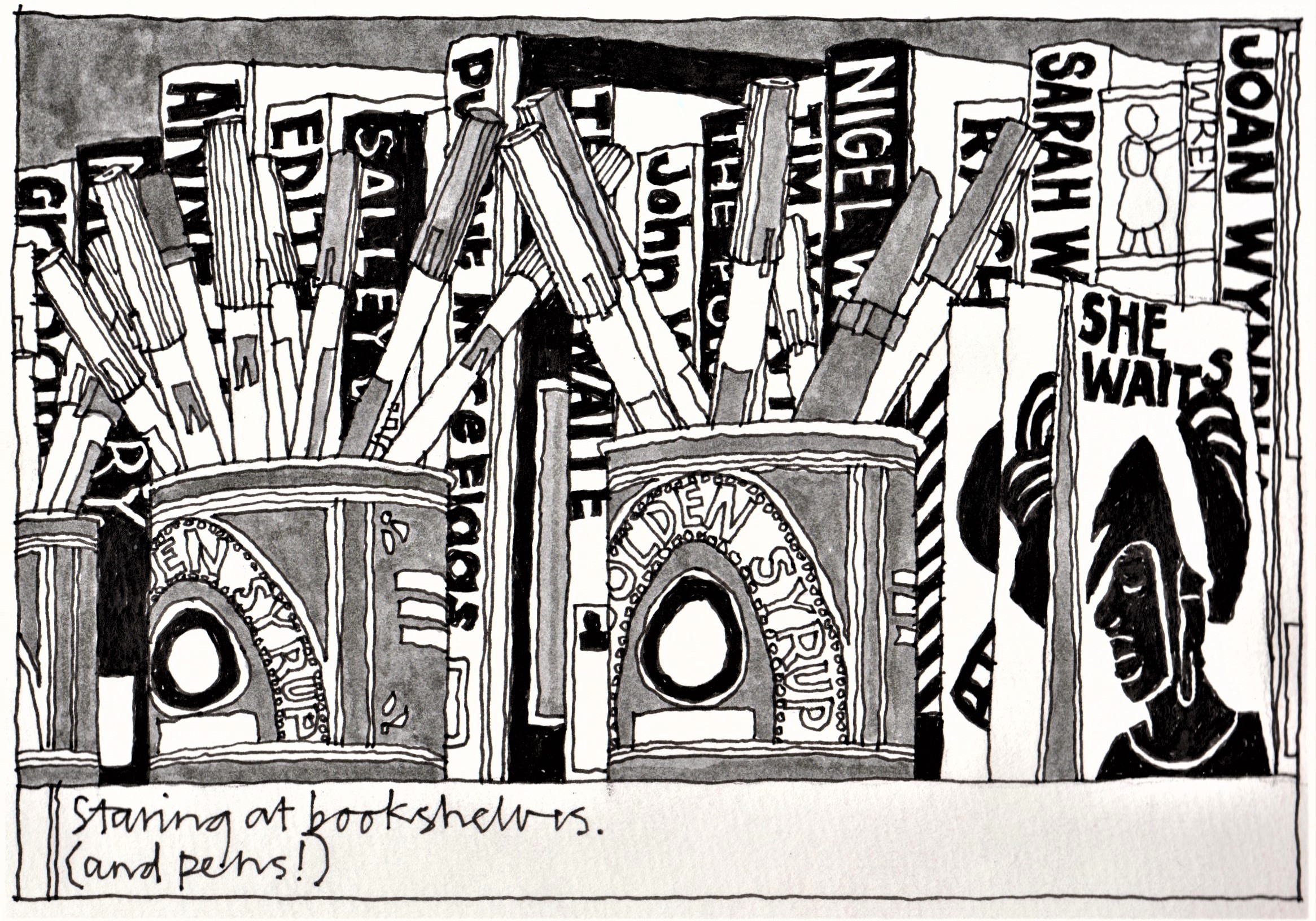
This sketch is of one of our bookshelves at home. As you can see, the image includes three ‘Golden Syrup’ tins. In fact, there are a total of TEN of them on this shelf(!) – including one with holly leaves and the phrase ‘Bake, Eat and Be Merry’ and another which contains fourteen palm crosses. As you can imagine, both the tins and the palm crosses have been accrued over several years.


They’re a reminder of the passing of time.


And for those of us in our dotage perhaps (as Bob Mortimer frequently asked Paul Whitehouse in their ‘Gone Christmas Fishing’ television programmes): “So, how many Christmases have we got left then Paul?”


The continuity and the appreciation of experiences gathered over the years (not just consuming golden syrup!).


The highs and lows of our spiritual journeys and the sense of God somehow always being there along the way.


And, of course, the journey continues…


All those possibilities (and uncertainties)… the extraordinary within the ordinary.

Advent conspiracy 7: Pax Romana…

Lord of Lords.

Saviour.

Prince of Peace.

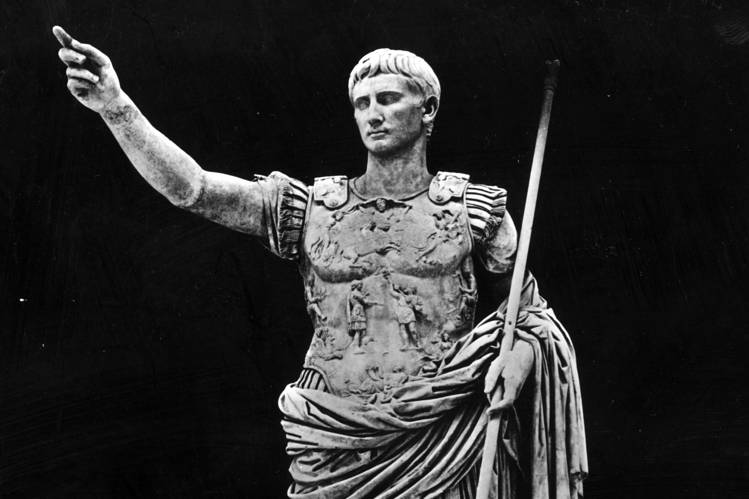
It may be a suprise to some that these titles – which we know so well as religious descriptors of Jesus Christ that have been sung through generations – were borrowed from an earlier historical figure, known first as the Emperor Augustus.

In the year 34 BCE, Augustus defeated Mark Anthony and Cleopatra in the Battle of Actium, and this Victory ushered in a period know as the Pax Romana, defined this way;

The Pax Romana (Latin for ‘Roman peace’) is a roughly 200-year-long timespan of Roman history which is identified as a period and as a golden age of increased as well as sustained Roman imperialism, relative peace and order, prosperous stability, hegemonial power, and regional expansion, despite several revolts and wars, and continuing competition with Parthia. It is traditionally dated as commencing from the accession of Augustus, founder of the Roman principate, in 27 BC and concluding in 180 AD with the death of Marcus Aurelius, the last of the “Five Good Emperors“.[1]

Wikipedia

In other words, the first advent of Jesus happened right in the middle of the Roman peace, wihch was really no peace at all. Not for those oppressed by an expansionist unequal empire.

It was in to this world that the Prince of Peace arrived as total contrast to the Prince of Peace.

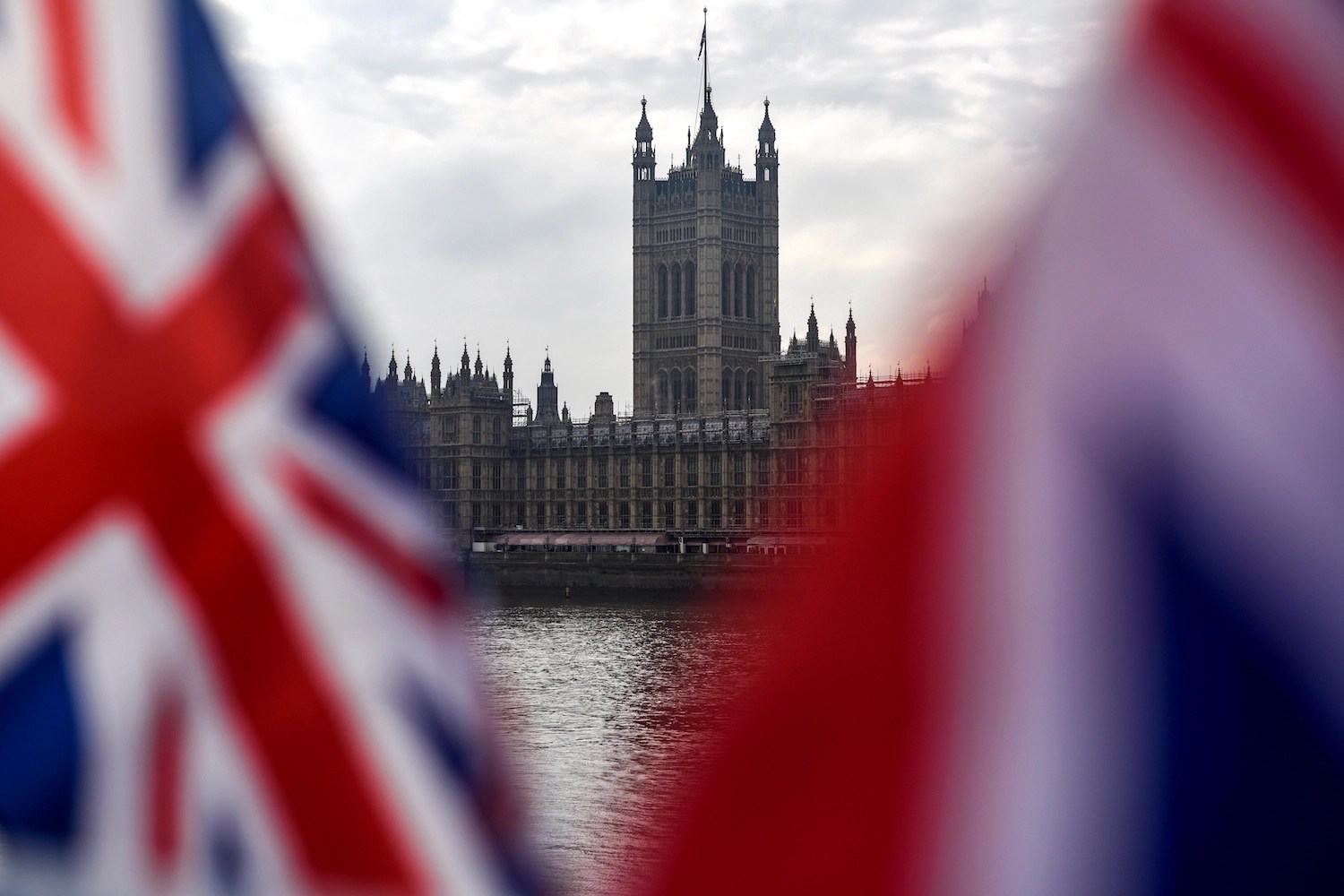
I have been thinking about how my lifetime has been lived in peace. Sure, just as during Pax Romana, there have been wars and skirmishes happened all the time away somewhere else, but these cost me almost nothing. However, just as during the Pax Romana, a different kind of peacelessness has been gathering. It might be understood as the end of the Pax Britanica and the beginning of the Pax Americana.

In total conttast to the Pax Christi.

This Advent, we need the upside-down principles of the empire of the Prince of Peace to disturb us still.

Peace to the world

.

After war came peace

But after peace came profit

And after profit came wealth

And after wealth came inequality

And after inequality came accumulation

And after accumulation many were left with nothing

.

And with nothing there is no peace at all

After the war came peace

But after peace came empire

And after empire came corporation

And after corporation came globalisation

And after globalisation came exploitation

And after exploitation came exhaustion

And those who are exhausted feel no peace

.

After the war came peace

But after the peace came aspiration

And after aspiration came property

And after property came debt

And after debt came foreclosure

And after foreclosure came homelessness

And without a home, there is no peace

.

After the war came peace

But after the peace came consumption

And after consumption came more consumption

And consumption became the only thing that counted

And after consumption came obsolescence

And after obsolescence came more consumption

For without consumption, there is no peace.

.

After the war came peace

But after peace we lost our unity

And for unity we need an enemy

And because of the enemy we need a leader

And great leaders need a great army

And a great army needs a war

And with war there is no peace

Advent conspiracy 6: stories we find ourselves in…

Today’s advent conspiracy comes from Bob who takes inspiration from The Detectorists to imagine something just below the surface that we half percieve…

If you haven’t watched any of the excellent TV series ‘Detectorists’ then I can heartily recommend it. You can find it on BBC iPlayer here: BBC iPlayer – Detectorists

The series first aired on BBC Four in October 2014, and it’s written and directed by Mackenzie Crook, who stars alongside Toby Jones. The two key players are Andy (Mackenzie Crook – The Office, Pirates of the Caribbean) who wrote and directed the series, and Lance (Toby Jones – character actor in many films like Tinker, Tailor, Soldier, Spy, The Hunger Games, Captain America, Jurrassic World and numerous TV series).

The series is set in the fictional small town of Danebury in northern Essex, and the plot revolves around the lives and metal detecting ambitions of Andy and Lance. They both have an obsession to find buried treasure, but, more often than not, all that the metal detectors pick up is a ring pull off an aluminium can, a metal button or a few nails.

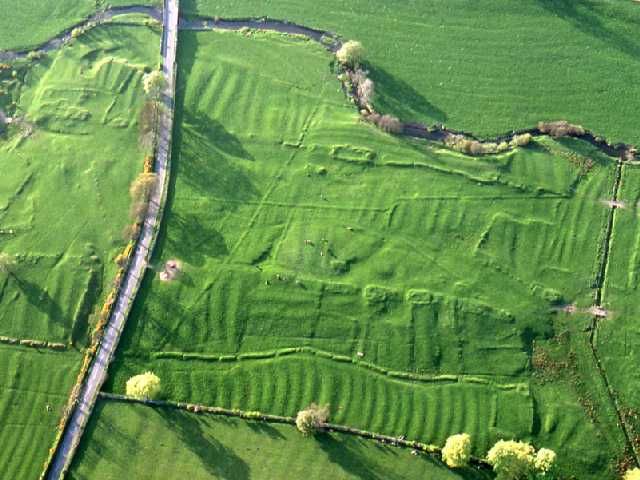
They are convinced that there is something to find and, despite the set-backs, they keep searching. There’s a wonderful drone shot of the field at the end of the first series when they head off to the pub after another fruitless day’s searching and the shot reveals the outline of a large structure below the surface. It reminded me of times when there has been a long spell with no rain and the outline of buried building remains are revealed as a different shade of colour to the surrounding ground. There’s something there, but they can’t yet see it from where they are looking.

I wonder then what grand obsessions existed in the story from two thousand years ago when humble shepherds left their sheep to follow a bright light in the sky, and richer noblemen made a long journey from their homeland far away. What drew them to a small village in the Middle East? How often on their respective journeys would they have doubted what they were doing? How often would they have considered turning back? Was it something they had long anticipated? Was it a story of a hope to come which had been passed down and re-told through many generations? Something must have drawn them onwards.

In the initial post of this Advent Conspiracy by Chris here:  he says,  ‘in moments and in places like this, I find myself sensing something beyond myself that draws me’.

For me too there is something about Advent which draws me and provokes reflection about a journey bigger than our journey; about a story bigger than the story we find ourselves in.

Advent conspiracy 5:

The further adventures of our joint Advent blog, this one coming from Steve Broadway. I love his counterpoint between struggle and persistence. The work of the spirit has both, but it also has moments of transcendent joy. It seems to me that transcendence always has to have the absence of transcendence, in the same way that light can only be seen through darkness…

We also get to see some of Steve’s incredible drawing skills more of this to come!

Reflecting on life’s uncertainties…
Depressing stuff affecting so many lives
Like wars, sanctuary-seekers and homelessness
Abuse, poverty and fear
Hopelessness and despair
The cost of living and heating homes
Some having to decide whether to eat or heat
The haves and the have nots
Caught up in a spiral of hardship.

Reflecting on my spiritual path…
Typically struggling through the wilderness
Often intolerant of biblical interpretations
Annoyed by what I think are lop-sided homilies
And put off by the exuberant faith of some
My own blinkered attitudes don’t help
But still I’m happy to keep searching for meaning
Still seeing goodness in the world
And heaven on earth right now.