(Part of an on-going series of discussions about how we engage with restoration of the land we live on. Scroll down for the earlier discussions.)
Firstly, a warning. This is going to seem like a strange direction to take in this discussion, but I hope you will stick with me…
Let me start with this;
We have lived our lives by the assumption that what was good for us would be good for the world. We have been wrong. We must change our lives so that it will be possible to live by the contrary assumption, that what is good for the world will be good for us. And that requires that we make the effort to know the world and learn what is good for it.
Wendell Berry, from ‘The long-legged house’.
It must now be obvious to us all that western lifestyles, despite the rich rewards they offer to us all, are not good for the world. Our economic models, our underpinning hermaneutics and our assumptions about how things work are all not good for the world.
This is a bold statement, but before we start attacking and defending sacred cows, consider this report to the UK parliament from the Environmental Audit Committee last year.
Piecemeal conservation efforts, and increases in the efficiency of production, cannot tackle the wholesale deterioration of the natural environment the world is now experiencing. Fundamental changes in the production and consumption of natural resources must be made. Without urgent, substantial action, ecosystem tipping points will be exceeded and the global biosphere will be left beyond repair….
….when compared to other G7 countries, the UK is at the very bottom in terms of how much biodiversity survives.
I will leave aside (for now) how our parliament and our government has failed to respond meaningfully to the warnings of this (its own) committee and return instead to Wendell Berry’s contrast between good for us/good for the world.

This piece of ironmongery is something known as a Gunter’s Chain, a distance measuring device used for surveying. It was designed and introduced in 1620 by English clergyman and mathematician Edmund Gunter (1581–1626). It enabled plots of land to be accurately surveyed and plotted, for legal and commercial purposes.
When using this device, surveyors were described as ‘Chaining the land’.
The history of how land went from being open, held as being the common places of the common people who lived there, to being ‘owned’ by individuals is not for this piece, but suffice it to say that before Scotland, England had their own ‘clearances’, known as the enclosures, when the ‘waste’ land (or common land) was made productive. All land was then expected to enrich individuals. What happened later here in Scotland was different, yet the same.
The poet John Clare spent half his life in a lunatic asylum, said to have been driven mad by the chaining of the land he loved so much. His poems now read like prophecies. Here is the beginning of one of them;
John Clare
Far spread the moorey ground a level scene
Bespread with rush and one eternal green
That never felt the rage of blundering plough
Though centurys wreathed spring’s blossoms on its brow
Still meeting plains that stretched them far away
In uncheckt shadows of green brown, and grey
Unbounded freedom ruled the wandering scene
Nor fence of ownership crept in between
To hide the prospect of the following eye
Its only bondage was the circling sky
One mighty flat undwarfed by bush and tree
Spread its faint shadow of immensity
And lost itself, which seemed to eke its bounds
In the blue mist the horizon’s edge surrounds
Now this sweet vision of my boyish hours
Free as spring clouds and wild as summer flowers
Is faded all – a hope that blossomed free,
And hath been once, no more shall ever be
Inclosure came and trampled on the grave
Of labour’s rights and left the poor a slave
And memory’s pride ere want to wealth did bow
Is both the shadow and the substance now
(1793-1864)
The Mores
Our collective memories are short. Here in Scotland, we remember our version of the enclosures, but we tend to see it through the lens of victimhood in which the story we tell is one of oppression of the rights of the Scottish people. This is very much part of the story (in the same way that Clare’s poem above hints at how the enclosures ‘left the poor slaves’) but it also has contributed to a kind of ecological illiteracy.
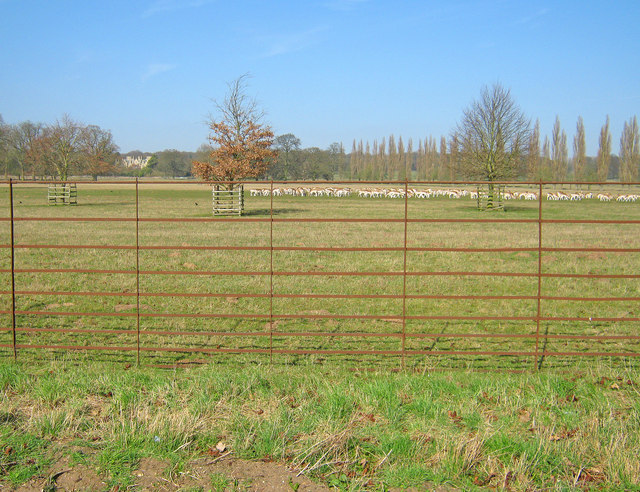
We look at photos like this one and see ‘nature’. Perhaps we should see chains.

Perhaps you are wondering what all this has to do with forests? Everything, I would argue. If the value of land is always it’s ability to produce profit for individuals, then what has since happened to our ecology is entirely predictable – justifiable even.
If land is chained to profitability, it it logical to replace forests with sheep then when sheep are no longer profitable, replace sheep with plantations. The only measure that matters is money.
Worse than this to suggest that this is not working, and that we have to find a different way to relate to our places of living will soon provoke outrage.
One of the first point that will be raised will be about local jobs, the local economy. Communities like ours are already struggling. Our young people leave because of lack of opportunities. Our clubs and institutions – the glue that holds communities together – are often in terminal decline. And now I am suggesting that we have to destroy our forestry enterprises too?
Well, not really. What I am suggesting is that we have to unchain them.
We have to stop doing forestry (or at least a very signficant part of our foresty) for our own sakes and start doing it for the sake of the world.
But people are still important. Community is still important. A vital component of any unchaining has to be for local people to live and prosper in their own place.
Arguably, despite the chains on our land, most local people in my town feel only tenuous connection to the land. We suffer from the same ecological illiteracy I alluded to earlier. We have forgotten what this place once was.
A small example of this illiteracy can be seen by examining the maps of the native woodland survey of Scotland. If you zoom in to the map of the Clyde basin, you might expect to see far more ancient woodland over on the Cowal side- after all, we are in wild Argyll, place of eagles, red squirrels and pine martens. We are the gateway to the great Argyll forest park. The map tells a rather different story though, in that there is as much ‘native woodland’ in unfashionable Inverclyde over the other side of the Clyde. The point is that what we have overhere is mostly vast tracts of plantations of mostly Sitka.
Land restoration CAN live alongside community restoration. In fact, there are many projects both here in Scotland and elsewhere that demonstrate clearly how one can lead to the other. If a community can restore its connection to place then this is a huge part of the unchaining. (Dunoon project, take note!) In the meantime, Community Land Scotland can tell us some stories. This from their website;
The way that Scotland’s land is owned and managed has a huge impact on the country’s ability to tackle twin crises of the climate emergency and biodiversity. With the amount of land in community ownership now larger than the size of the Loch Lomond and Trossachs National Park, community landowners have a vital role to play in the just transition to net zero. No one has more of a connection with their land than the local community and, in this Meet the Pioneers, we heard from three Members about what community-led ecological restoration looks like for them.
- Michael Hunter of the North Harris Trust shared learning from their habitat restoration project that aims to plant 200,000 native trees. The Trust will work with crofting townships on this project.
- Angela Williams and Jenny Barlow of the Langholm Initiative told us how upland moor, ancient woodland, meadows, peatlands and river valley on the edge of the town are being developed into the Tarras Valley Nature Reserve.
- Ben Inglis Grant, a Peatland ACTION Project Officer based with Urras Oighreachd Chàrlabhaigh / the Carloway Estate Trust talked about the work he is doing to support peatland restoration in the Outer Hebrides.
I want to make one final point about this unchaining business. One idea that soon triggers that same outrage is that of a Universal Basic Income. This is certainly not a new idea, but is so counter cultural that despite a growing body of positive research, it seems crazy. Give people an amount of money – everyone, not just those who already have it – and allow them to make unchained decisions about their lives.
What would living here be like for those of us so unchained?
I very much recommend this discussion as a means to imagine this unchaining.

 this fragile tent