Trigger warning- this is a small diversion into Bible history. For some this might be a turn-off right there, whereas others may find it goes to places that they are simply uncomfortable with. There will also be bible scholars who will take issue with some – or all – of the things I am saying, because we are dipping into a vault of murky ancient history filtered through a religion which claims the authority of God on whatever it has sanctified.
But sometimes, in order to make things new, we need to look backwards too – in this case, to the very beginning – so that we can see where we came from, and perhaps where we turned left when we could have turned right.
So, feel free to disagree. Go and do your own research and I hope that this brings to you your own meaning. Find your own story, just as I look for mine.
I was at an Iona community family group meeting last weekend, in which we were discussing Christian humanism. I confess to approaching the discussion warily, as it seemed likely to be rather esoteric, but what actually happened was that it opened a window into something that I found interesting intellectually and more importantly, to offer ideas that might be very useful as we seek to rediscover our story. Or perhaps it would be better to say ‘as we seek to rediscover purpose, mission, our concepts of goodness and our prophetic voices’.
Just little things like that.
For those who have read this far who have no allegiance to Christianity, past or present, perhaps I should say a little bit more about this ‘story’ thing. Western culture was founded – or perhaps it would be better to say shaped then continuously disrupted – by the Christian story. I would argue that what we made of this story was always full of obvious tortuous distortions of the words of Jesus, such as we know them. After all, how can we reconcille conquest, empire, the accumulation of wealth, slavery, poverty, capitalism, etc etc with the words of Jesus? Christianity became a religion that had little to do with the core elements of the story Jesus told.
This is a bold statement, I know, but one that I believe I could ‘prove’ in a court of law.
Arguably, the tensions created by this disconnect have always been there throughout Christian history, characterised by purges against heretics, or successive Protestant reformations. Always, people talked about going back to true religion and recreating the purity of the early church. The source material for this protesting and reforming was always the Bible- viewed through the context and passions of the people reading it.
Part of the problem – the nature of the torturous distortions perhaps – comes about when we ask what the Christian story that we built western culture on actually is/was. There is the story of love, compassion, caring for the weak and poor, looking after widows and orphans. The inverted power structures, the value given to each person. The living lives colectively and fairly. But this never fitted easily with the cultures we created. What did fit was a different gospel, which might be understood as how personal sin results in eternal damnation, but for the sacrificial death of jesus.
Despite the sometimes cataclysmic changes that these religious arguments brought about, we have a different problem now. Churches are empty. Sure, I know there are exceptions, but here in the UK, the number of people who attend church is still declining, still aging, still arguing and as such the Church is less and less relevant as a moral or political force. It still has an important ceremonial function, but it has no prophetic voice. It has no story that anyone is listening to. Perhaps, given the tortuous distortions I refered to above, this might not be a bad thing.
But the end of one story (if indeed that is what we are seeing) leaves an empty space. People have always looked for meaning and purpose and without a story, what do we have? In a post-covid world, overshadowed by global warming and mass extinctions, how do we conceive of a better story? In a political system dominated by inequality and the failure of our institutions and political/economic systems to bring hope, how do we shape our story towards better things?
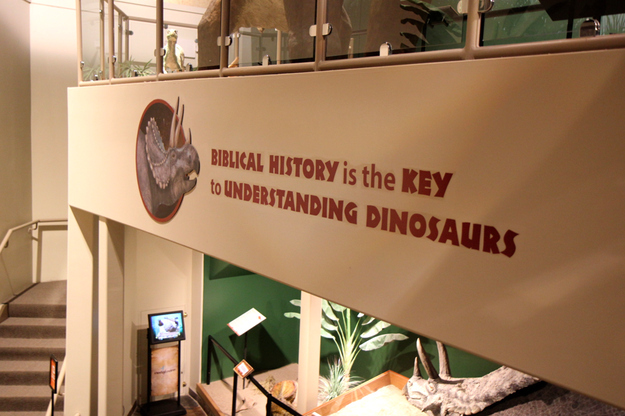
Can’t remember where I got this from. The Creation museum perhaps?
Given what I have said above, the Bible would seem to be a strange place to start, right? After all, even now there are plenty of people in the world who seek to use it as blunt weapon to bludgeon us towards their story – often a very narrow story that seems very much to be part of the problem; a story that is anchored to textual determinism, at least in relation to some of the words of the Bible, which is seen as a unified, divinely inspired and heavenly-delivered holy text.
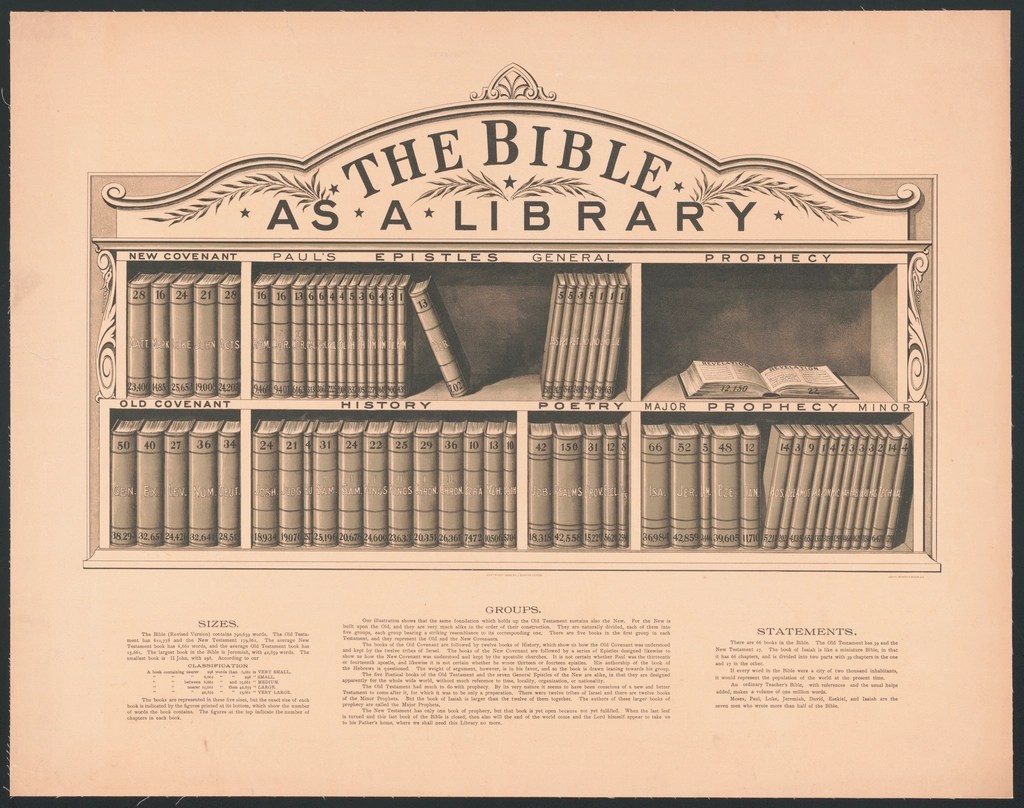
But what if the Bible is much less than that, but at the same time, much more? What if it is a library of miss-steps, half truths, mythological history and open-hearted laments? What if it is one third poetry? What if there are no other books in human history that are like it?
More pertinently, what if the Bible – or at least the books of the new testament – contains great big clues as to how the words of a man called Jesus became repackaged into a religion called Christianity by a Jewish religious genius (who never actually met Jesus) called Paul?
This was what we ended up talking about at our meeting.
Remember those clues I mentioned above? Here is what we think we know – with the usual warning that some (many!) will take different views.
The oldest of the four gospels is Mark’s gospel. It is very different from the others, so much so that later scribes have tried to give it a different ending. He does not include the resurection.
The other gospels seem to quote freely from Mark, but spin off into other directions. They add many of the ideas that MAY have been influenced by Paul.
Paul never met Jesus, and we can infer tensions between him and the other apostles who actually did – many of whom get a very bad press in the gospels! Paul’s encounter with Jesus was mystical, and he seemed to trust this more than he did the words or experience of those who had been his disciples.
Paul was a sophisticated, educated man. The other apostles were not. (But Jesus picked them!) Without his innovation and leadership, it seems unlikely that the early Christian church would have survived – many other Jewish movements did not after all. The difference was… Paul.
The oldest actual book to be included is thought to be St Paul’s first letter to the Thessalonians, in which some believe he was correcting or addressing issues that had been created by an earlier letter around the second coming of Jesus.
This letter may well have been the Didache (pronounced did-a-kay), which was a letter from the apostles in Jerusalem giving instructions as to how to run a church. As such this letter certainly predates most of the NT books, but may well be earlier than them all. More on this later.
The canon of scripture that evolved over the next many centuries involved many good people struggling to make sense of a complexity of writings that most of us have no idea ever existed. The struggle to do this well, according to a set of principles that made sense, is to be honoured. But we have to remember that the library of diverse books that entered the canon was a human construct, that was shaped by context, best understandings and compromise.
All of which should leave us room to treat these incredible documents with respectful skepticism. After all, they are strong enough to allow our questions, our doubts, our various entanglements. The ‘truth’ they contain is no less real if we question its historicity for example (there are plenty of problems reconciling the Bible with the archeological/historical record.) We might learn as much from apparent contradictions as from attempts to ‘make it all fit’.
The bottom line here is that our interpretations and understandings of the Bible- what it is, what it has to say, what it means for our lives, our politics, our priorities – what STORY it leads us towards depend a lot on what we think the Bible is. If we are to allow it to shape us, I would argue that we must first loosen up a little. It is OK to take the book/s out of their leather case. Doubt them and see where the doubts lead. Believe them and see where the beliefs lead.
If you want to know more about the complex and fascinating (to me anyway!) bible history, then it can be difficult to know where to start. There is so much out there and unless you are an academic (and I am certainly not) then it is difficult to know who is dealing with these issues honestly and who is coming at them with a perspective pre-formed by their own tribe.
The Bible Project has tried hard to bring some of the acedemic perspective to a wider audience, with video’s like this one;
More controversially perhaps, and thanks to my fellow (and inspirational) Iona community family group member, I would point you towards some of the writing and speaking of a man called James Tabor, who communicates well around many of these issues, including via his excellent you tube channel. Videos like this one;
So where does all of this take me to? Can it really be a way towards a new and better story?
I think so, firstly because it allows us to break with the old one – not to dismiss it, but to include and transcend it. After all, arguably this is exactly what Paul did to the teachings of Jesus – brilliantly, and perhaps problematically. Secondly because It might encourage us to project new – yet faithful – understandings onto our context in a way that is free from some of the distortions. Of course, we will no doubt make new distortions, and for this we need those who will doubt and test them too.
Finally, I want to return to the Didache. I had never heard of this document, and this was interesting to me too. How is this not better known? (Perhaps you are far ahead of me however and the problem was just my ignorance.)
James Tabor has a blog piece that talks in more detail about this document. You should read it, but I will quote from it here;
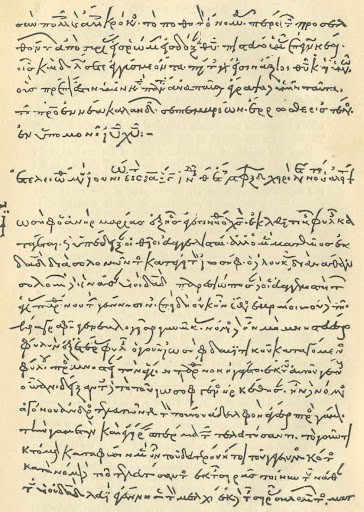
The Didache was discovered in 1873 in a library at Constantinople by a Greek, Priest Father Philoteus Bryennios. This precious text, dating to the late 1st or early 2nd century CE, is mentioned by early Christian writers but had disappeared. Father Bryennios discovered it in an archive of old manuscripts quite by accident.
TheDidache is divided into sixteen chapters and was intended to be a “handbook” for Christian converts. The first six chapters give a summary of Christian ethics based on the teachings of Jesus, divided into two parts: the way of life and the way of death. Much of the content is similar to what we have in the Sermon on the Mount and the Sermon on the Plain, that is, the basic ethical teachings of Jesus drawn from the Q source now found in Matthew and Luke. It begins with the two “great commandments,” to love God and love one’s neighbor as oneself, as well as a version of the Golden Rule: “And whatever you do not want to happen to you, do not do to another.” It contains many familiar injunctions and exhortations, but often with additions not found in our Gospels:
Bless those who curse you, pray for your enemies, and fast for those who persecute you. (1.3)
If anyone slaps your right cheek, turn the other to him as well and you will be perfect. (1.4)
Give to everyone who asks, and do not ask for anything back, for the Father wants everyone to be given something from the gracious gifts he himself provides. (1.5)
Many of the sayings and teachings are not found in our New Testament gospels but are nonetheless consistent with the tradition we know from Jesus and from his brother James:
Let your gift to charity sweat in your hands until you know to whom to give it. (1.6)
Do not be of two minds or speak from both sides of your mouth, for speaking from both sides of your mouth is a deadly trap. (2.4)
Do not be one who reaches out your hands to receive but draws them back from giving. (4.5)
Do not shun a person in need, but share all things with your brother and do not say that anything is your own. (4.8)
As well as the similarities, there are real differences from the Christianity of Paul however. Communion for example is to be a simple thanksgiving meal of wine and bread with references to Jesus as the holy “vine of David.” It ends with a prayer: “Hosanna to the God of David,” emphasizing the Davidic lineage of Jesus. The bigger issues raised by the Didache are these (again via James Tabor);
The entire content and tone of the Didache reminds one strongly of the faith and piety we find in the letter of James, and teachings of Jesus in the Q source. The most remarkable thing about the Didache is that there is nothing in this document that corresponds to Paul’s “gospel”―no divinity of Jesus, no atoning through his body and blood, and no mention of Jesus’ resurrection from the dead. In the Didache Jesus is the one who has brought the knowledge of life and faith, but there is no emphasis whatsoever upon the figure of Jesus apart from his message. Sacrifice and forgiveness of sins in the Didache come through good deeds and a consecrated life (4.6).
The Didache is an precious witness to a form of the Christian faith more directly tied to the Jewish orientation of Jesus’ original followers. I encourage my readers to take a look for themselves. There are many versions both on-line and in print. You can begin here: Early Christian Writings: The Didache.
I wonder how this makes you feel?
Perhaps you are weary from all this deconstrction – I certainly am. The idea of being confronted with documents that start to undermine the very nature of the divinity of Christ might be the last thing we need. Anyway, this is not defnitive. The Didache is just an ancient document that never made it into the canon of scripture that became the Bible. It contains other problems too- not least the apocalyptic vision that Paul may have been clarifying and correcting in his letter to the Thessalonian church. Perhaps this document describes an evolutionary early set of followers trying to establish some kind of common practice. Perhaps we needed a theologian such as Paul to bring the whole story together.
But then again…
As with all theology, my last question is always , So what? How might these ideas lead to liberation, to renewal, to a new story?
What is most important, the details of doctrinal correctness, or the heart and spirit of the matter? It is the latter that gives us our story is it not, and to me at least, this rings all the more true when set free.




 this fragile tent