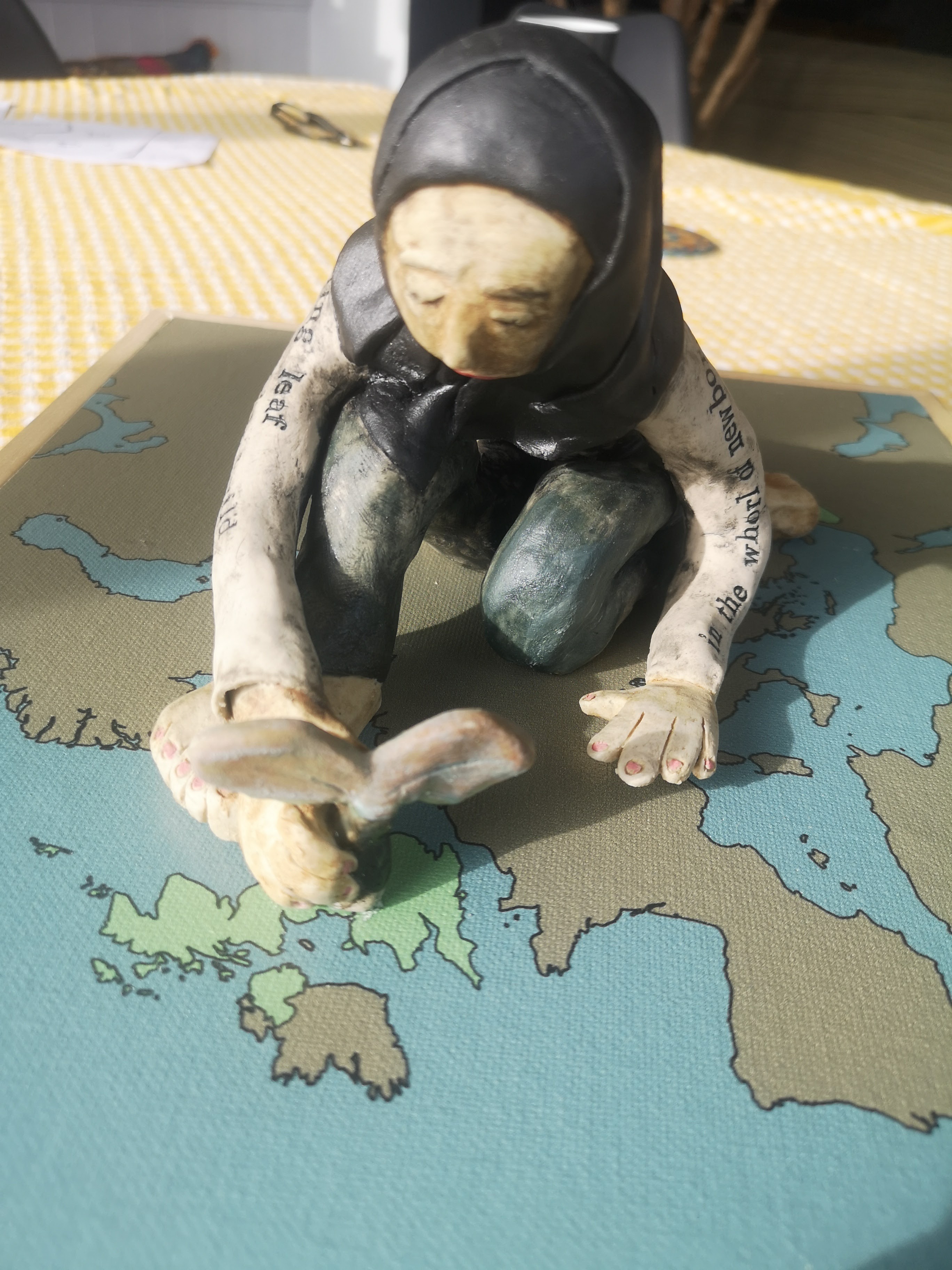
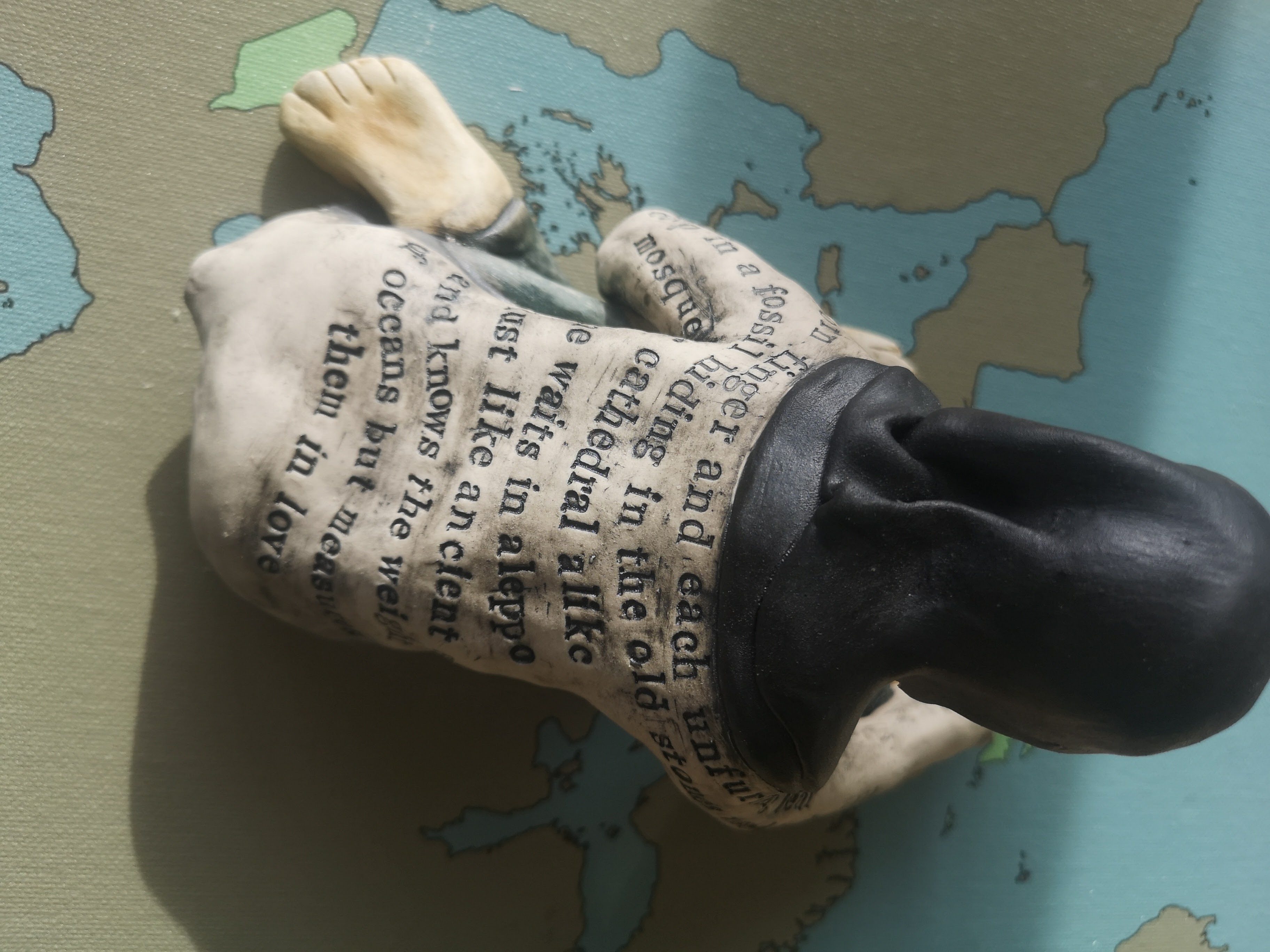
Theopoetics 2: defining a butterfly..

Yamabe no Akahito (active 724u2013736), One of the Three Gods of Poetry From the Spring Rain Collection (Harusame shu016b), vol. 1 by Yashima Gakutei is licensed under CC-CC0 1.0

One of the problems we have in trying to grapple with theopoetics is that it is almost impossible to define. Certainly there does not seem to be one single definition. You might argue that this kind of amorphous, pliable, porous approach is typical of many other post-modern ideas, typified by the retreat from hard-edged scientific truth, which is often understood as an instrument of power and control. You might be right.

But why do I gasp when I see a flight of swans or geese heading south as the winter approaches?

I return to the idea of ‘the poem’. I know there is a danger here as theopoetics is NOT about poetry – or not only about poetry – but hear me out. Remember that one third of the Hebrew bible was written as poetry, and that poetry has formed the bedrock of other religious movements, most notably the great Sufi writers of the middle east.

Here is the question though; what is a poem and where is its power? Or to put it another way, where is the truth of a poem and what use is it? You could also ask, who decides WHICH poems are important?

I would argue that there are many ways to answer these questions.

  1. Form, meter, rythm, technical matters. (In other words, all the things I hate to think about when I write poetry!) You can decontruct a poem down to individual parts and miss the point entirely
  2. The experience of WRITING the poem. For me this often a visceral experience. If I shake with anger, or weep real tears then I know I am writing something that matters. This does not make it a ‘good’ poem – or does it?
  3. The subject matter of a poem is important … or is it? I love poetry that is prophetic and speaks truth to power, but a poem can be about anything and still relate to the greatest human issues.
  4. Then there is the READING of a poem. They are often like swans in flight in their ability to make me gasp. Many do not, so I skip past them. There are technical and content reasons why some grab me more than others, but I feel this first in my body, as a physical reaction. It is like a spiritual narcotic.
  5. The truth of poetry is almost always ambigious to some extent. This is the nature of language – it often contains layers of meaning, and poetry mostly makes this less clear, as a deliberate practice, employing similie and metaphor not to explain as much as to open up spaces. We project truth on to poetry as much as we extract it.
  6. Some poems have been ‘adopted’, almost like official anthems. The meaning of these poems has almost always been obscured or distorted. Consider Blake’s ‘…and did those feet in ancient times walk upon England’s…”
  7. There is an open question for me about how we read scripture-poetry. The apocalypse of John? The beatitudes? The majestic poetry of Isaiah? Should we be allowed to read these differently or should we treat it ALL as poetry even? If so, how does this change the way we approach the text? Do we diminish it, or do we make it more true?
  8. Finally consider how poetry at school tends to be suffocated by the educational imperative.
Poetry in Motion by Ian Paterson is licensed under CC-BY-SA 2.0

All of which is another way of saying that creative spiritual experiences of the kind we might describe as theopoetical will ALWAYS be difficult to define. Perhaps this is the very heart of their usefulness. In an age of sectarian cerainties we need ways to once more be confronted with mystery and unknowing, which is the very heart of mysicism. But this is certainly not about the absence of meaning. It is about the pregnancy of the moment when we sense a connection being made to what some (but not all) call god.

Theopoetics invites us to focus on the how. The doing. The shaping of the thing. The heartbeat. The physical reaction. The beauty of it. The love that inspires towards action.

What this looks like in practice is as varied as… poetry.

Theopoetics: exploring new theology (part 1)…

My contention is that ideas matter. Consider how our current UK government has taken inspiration from certain ‘think tanks’ to apply a philosphy of extreme liberal economics. Ideas, when operationalised, can change the world.

Theological ideas have a particular kind of power as they have god (or gods) on their side. Even whilst we are witnessing the decline of religious participation in the western world, theology remains a powerful force for good or ill, dominating the discourse at the heart of the politics of the most powerful nation on earth and forming the fracture lines of many a hostile border.

On an individual level, many of my friends have been going through a period of deconstruction, when they have questioned much of the theological underpinnings of the faith they inherited. My own deconstruction journey into this territory is writ large across the whole timeline of this blog. But deconstruction is only ever part of the process. A friend said it like this recently in an e-mail;

I am certainly in the time of that journey where I am looking for those trustworthy guides … I know that deconstruction does not fill me up with anything, it only warns me against what I know I do not want to become. So, finding meaning is what I hope for.

Trevor Williams

Where do we start then? Whom do we trust to lead us? Where are the apostles, the prophets, the authors we need to read, the preachers that we need to listen to?

Perhaps more importantly though, can we trust our own hearts to lead us? This takes courage, but it also takes a certain kind of self-compassion, accepting that we do not have to be perfect. We do not have to get it all ‘right’. The measure here (as in the beginning of it all in Genesis chapter 1) is not purity, but goodness; goodness that embraces the inevitability of failure as well as the hope that we can do better.

In previous post (which I cannot find, but I’m sure I talked about it somewhere before) I confessed to applying these three things to my own search for meaning.

  1. I acknowledge those whose teaching/writing/leadership has inspired me, consciously holding on to those things I inherited that is ‘good’. These act like signposts or filters or channels through which I measure and encounter the new
  2. What sings in my soul? I have decided to trust my own embodied reaction as a guide for accepting and adventuring. If I read something or encounter something and it lights me up emotionally/physically/spirituality (even intelluctually) then I will pay attention.
  3. What is useful? By which I mean the degree to which ideas contribute towards my understanding of peace love and justice. If they do not seem immediately useful in this regard, I am not necessarily rejecting them as ‘wrong’, rather I am far less interested.

I am quite aware that this list is contentious. I have spoken about it to a number of friends, and some of them have been troubled by it. It may also be incomplete – for example, Trevor, in the e-mail I quoted from earlier, suggested adding ‘beauty’ to the list, something which was interesting because it resonated with a new (to me) idea I have been adventuring with called theopoetics (more on this later.)

After all, a quote from Jean Vanier has stayed with me for years about how we encounter god in all that is beautiful and all that is broken so I have no doubt that a certain kind of beauty opens me up inside… perhaps this is indeed a reliable way to encounter the divine.However, this seems more than contained within my number 2 because beauty often sings in my soul. It might be a different song to yours, but it sings loudest for me when mixed with brokenness, because there I think we find god. This is why encountering Steve Broadway’s portraits of steet sleepers was so powerful at this event;

I mentioned this word theopoetics. I confess, my initial interest was because I assumed this to be describing some kind of mash-up between spirituaity and poetry, something which sounded right down my street – after all, this has been a well trodden path for centuries so such a word seemed potentially useful. However, it turns out this was wide of the mark. I needed to think bigger, much bigger.

Lets start with the etymology of the word;

Theo; meaning ‘of god or deities’.

Poetics from poiesis, meaning ‘the activity in which a person brings something into being that did not exist before’ or more simply, ‘to make’.

So what we seem to be describing here is the process of making god.

To many of you this might sound like heresy. After all, this might mean that we are describing ‘making up’ god. Dreaming him/her in to being. Creating our own creator. Well, perhaps this is exactly what we are indeed describing.

Before you become too outraged, consider this; all our concepts of god have come from somewhere. Within the Christian tradition I come from, we base (almost) all of these on propositional truths extracted selectively from the bible. The way we read this bible becomes the primary, and some would say only, way to understand who god is, what he wants us to do and what the future holds for all of us.

But we only do this because people have previously decided that this was the best way to do things. This was the god they made for us, in the form of his written words. I don’t say this to dismiss the god we have inherited, just to point out that everything we think we know about him or her has been imagined by someone, sometime.

Kind of reminds me of Pete Rollins’ work, which I talk about here.

Photo by Monstera on Pexels.com

But back to this word, theopoetics. As far as I am able to understand, those who have been exploring this as a concept are comfortable with the idea of making god, but more than this, they are less concerned with the ‘what’ questions of faith (i.e., all those propositional truths wrapped up into doctrine) and more concened with the ‘how’, by which I think they mean the process by which we encounter god in the midst of our lived experience, in the mess of what we are becoming. The idea is to focus on the aesthetics of this experience, and allow this to shape us.

In other words, rather than getting too worked up about defining what is ‘right’ perhaps we should just explore it together using whatever activities and tools that will be most helpful to bring us closer to the divine and hopefully to turn us towards acts of love and compassion.

Particularly, art and creativity, because these seem the most helpful of all, as they allow us to be fully embodied and present in the moment of encounter. Of course, there are other ways (including the study of the bible for example!) but theopoetics encourages us towards full body encounters with creative, immersive artistic expression.

As a poet, this sings in my soul and opened a window for me, which I intend to explore further on this blog. It also resonates with the three ‘tests’ I applied above;

  1. It has grown from a tradition I recognise, and is anchored to principles I find compelling, not least a concern for social justice and a concern to give a place for mystical experience through art and creative engagement
  2. It excites me, by opening up some new posibilities inside. Something is singing in my soul
  3. It might yet prove to be a useful way to think about how spirituality might shape the world towards good.

More to come…

Disruptor…

disruptor noun

a person or thing that interrupts an event, activity, or process by causing a disturbance or problem.”the film follows his evolution from Hollywood star to political disruptor”

a company or form of technology that causes radical change in an existing industry or market by means of innovation.”the company is becoming a major disruptor in the healthcare industry”

BIOLOGY a thing that interferes with or significantly alters the structure or function of a biological molecule such as a gene or hormone.”several drugs show promise as DNA disruptors in cancer cells”

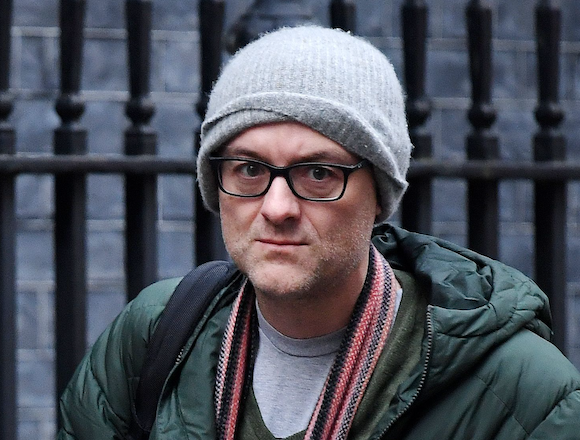
The pandemic was itself a disruptor, but it has perhaps also made us more likely to promote disruptors to positions of power. People like Cummings (above) and the boss who dissapointed him, Johnson.

Truss and Kwarteng are a purer form of the same thing, at least in terms of their belief in an ideological solution to our complex problems.

All have since crashed an burned. I supect none of them are in the slightest bit repentant because most disruptors carry the whiff of the fanatic.

I confess that I too have been a disruptor. In a former life, I was tasked with the reorganisation of a mental health system. Finally, my long developed convictions (and perhaps prejudices) about what a mental health system needed to look like could be actioned. I had all the research, and I was doing things that were above all, right. The fact that many of these changes required massive disruptions to the way that the service had traditoinally done things – more than this, in the way they understood things – was a shame, but that was not going to stop me from trying.

There is a long story here which I will not engage with just now, but I too crashed an burned, but I do not regret trying. I just wish I could have been better at making things happen. I wish that those who resisted and complained had instead joined my wholeheartedly in doing things that I still think needed to be done and indeed will be done elsewhere.

But then, I am a disruptor. I would say that, right?

Changing institutions is notoriously difficult. Often they need to fall in to ruins before those inside will accept the need to rebuild them. I was trying to fast-track this process but lacked certain crucial skills because disruption alone is rarely enough, even if (as I like to think was the case with what I was attempting) you are on the side of the angels.

Consider the role of the old testament prophets, most of whom also crashed and burned. Their role is often misunderstood as being predictors-of-the-future, some kind of state soothsayers/fortune-tellers. It is better to understand them as holy disruptors, whose role was to speak truth to power; to call the kings and priests back to the calling that they had forgotten.

The role of the truth-teller in the Old Testament (or in the New Testament, in the example of Jesus) seems an important one in any change process. We need people to look at what is and shout loudly that ‘we can do better’. However Cummings and Kwarteng and me are not Elijah, Jacob or Isaiah. Not even close. What hope was there ever that we could bring about change that mattered? It is easy to throw stones, but you need someone to make new windows. It is even easy to preach compassion, but someone still has to get their hands dirty in the mess of other peoples suffering.

Photo by Tim Gouw on Pexels.com

We all have our favourite disruptor though. They tend to be the prophets from our tribe, who preach words that make us feel that we are right and that others are clearly wrong. In promoting our personal disrupt-saviours, we preserve the status quo. We allow the same sectarian factions to prosper. We fail to form any momentum towards change.

I think this was one of my (many) problems in trying to lead change in mental health services. I needed a skill-set that I lacked, around engaging, compromising, building relationships with others who were different from me and focussing on the hard work of fine detail plans. In other words, change, even if inspired by disruptors, then needs politicians, planners and completers. I was none of these things.

Ideology matters too of course, in terms of the values that underpin our disruptive instincts, but success (measured in terms of change) requires…

Starmer?

(Whose party I am a disruptive, disatisfied member of still, by the skin of my clenched teeth!)

More poetry…

I participated in a zoom reading with a couple of friends the other night to mark National Poetry day. It was a lovely evening, full of those tender moments that only poetry can bring. Like being held somehow.

It was recorded, so if you fancy dipping in to some poetry, I’ve posted them below.

I was reading poems (mostly) from my new book, which can now be ordered directly from here (as well as the usual Amazon behemoth and the like). 

Those who kindly pre-ordered their copies will be getting them soon too – we are waiting for a batch to arrive here.

Here are the two recordings.

Poetry reading for national poetry day…

We thought it would be lovely to host a poetry reading to celebrate national poetry day. It will be on Zoom, this thursday evening. It would be fantastic if some of you would join us!

It is really lovely to share this with my friends Chris and Vicky. I met them both through poetry, as we have worked on some other projects together down the years, but I have discovered that poets make very good friends. Their writing is very different, but shares a certain kind of space inside that moves me deeply. I very much look forward to hearing them read from their own work.

Apart from the obvious ego driven reasons for doing things like this, my hope is that together we can get below the skin of things. Poetry can be really helpful in this regard – it facilitates little spiritual journeys. Spiritual that is not in the religious sense, but more about seeking meaning, depth and transcendance.

Having said all that, I promise that there will be lots of laughter… and perhaps a few tears. What else is poetry for?

Grab a glass of wine, settle down and let words connect you. The event is free, all you need is the code for the zoom meeting, which I will ping your way if you express an interest.

There is a facebook event here which has the link too.

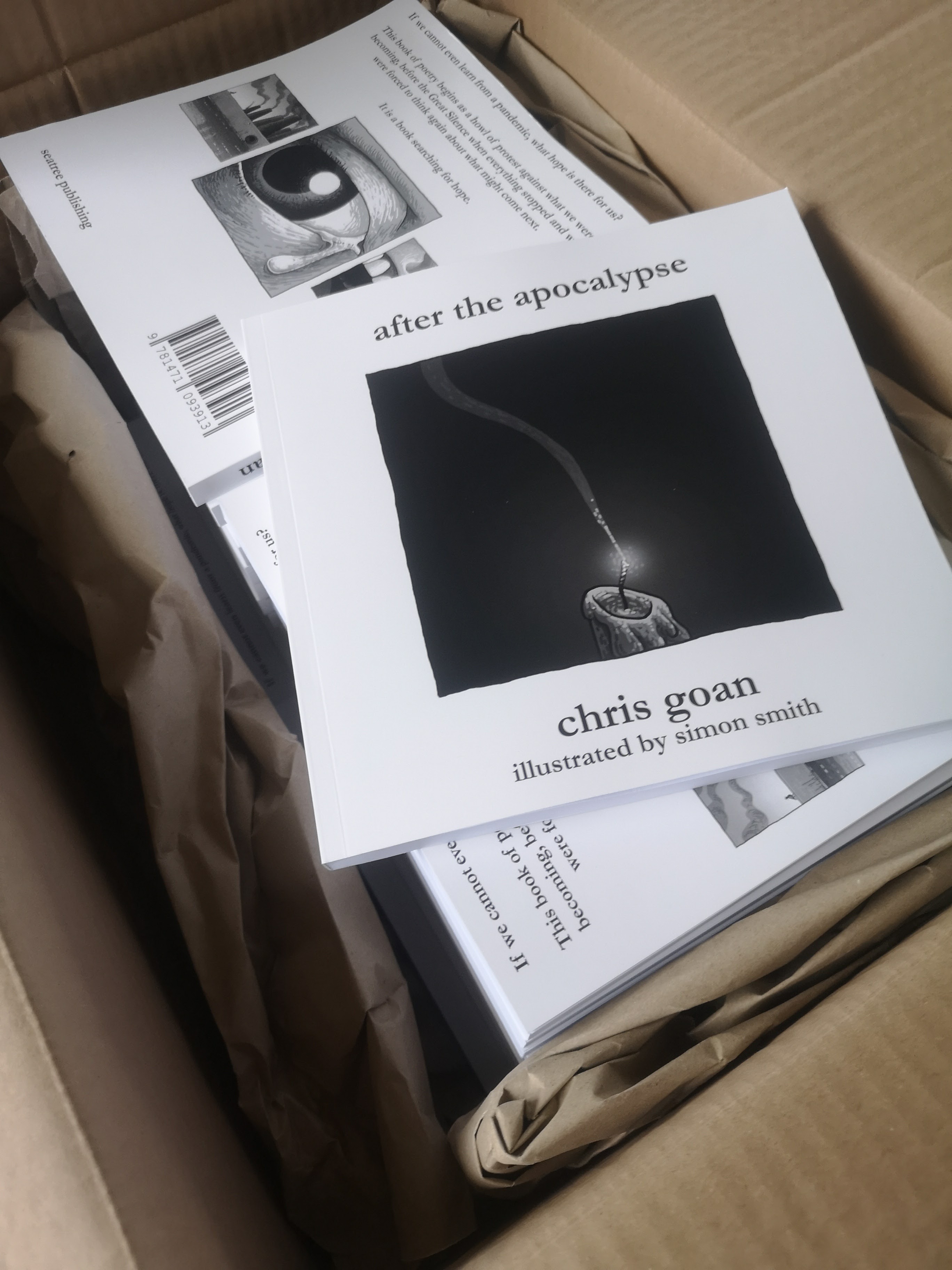
New book ‘after the apocalypse’ – now available to pre-order!

Here it is then friends- the book is available to pre-order. If you do, you will get a few quid off (£17 rather than £20) and free UK postage and packaging. I’ll also sign it for you!

You can order here.

Here is a sample – ths one with a warning, because it contains some profanity. I hope that you will see that this was not because I wanted to be provocative- although perhaps the issue might demand it. Rather I just wanted to be honest.

New book out soon! ‘After the apocalypse’…

I can finally say it. The new book is out soon. Here is the cover;

It has been a long time coming. Five years in fact. It started out when Si Smith (more of him later) asked me to do a kind of poet-in-residence thing at an art exhibition he was curating entitled ‘World upside down’ back in 2017 (there are digital traces of the wonders it offered here.)

This exhibition was inspired (if that is the right word) by Donald Trump’s use of the Beatitudes in his inauguration speech. For me, this began a long period of writing words of resistance against an increasingly right wing world ignoring the crises of climate change and widening inequality.

A lot has happened over the last five years. Trump came and almost went. His trusty side-kick Boris Johnson the same. Oh, and we had this thing called a pandemic.

Writing protest poems is a kind of sickness – I found myself being sucked inside a vortex of negativity. I could still see compassion and goodness but it seemed stilted, fleeting and fragile. Then the Great Silence caused us all to STOP.

What next? Where do we see hope? What have we learned and where do we find inspiration for the journey to come?

These three periods- before, during and after the apocalypse give shape to this book which will be out very soon!

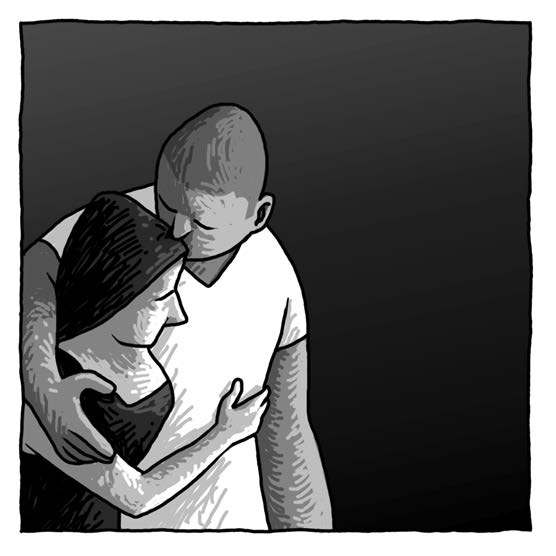
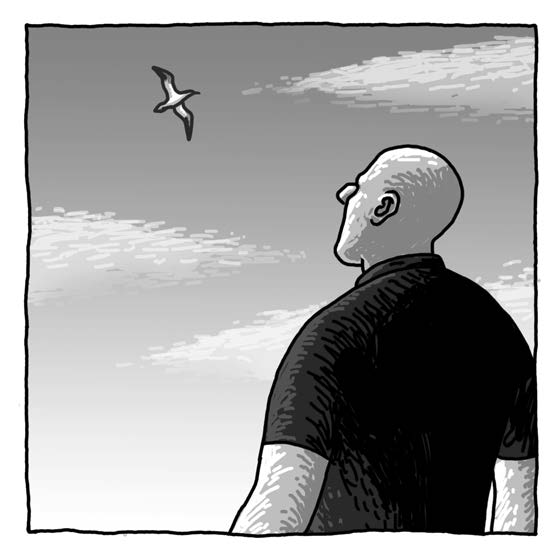
I am so grateful to Si for his incredible images. He did them at a time when he was desperately trying to work on another big project (which I hope to be able to shout about in the future.)

If you have never seen his work before, he is an artist, illustrator, print maker and graphic novellist based in Leeds. You can check out his other work (including the seminal ’40’ images and ‘how to disappear completely’.)

My plan is to release some of Si’s work alongside selected poetry from the book over on instagram, but here is a taster;

I want to live

I want to live in a world in which refugees are welcomed

As if coming home. As if the food they are given

Was cooked by their own mothers.

I want to live in a world in which people share what they have

With those who have nothing. Where fear of scarcity is foolish

Because we finally recognised abundance

I want to live in a world in which love for neighbours

Made hedges and fences inconvenient. As if real estate

Is not real after all

I want to live in a world in which guns are things for museums

Behind glass with suits of armour. Where tanks are

Used only to store liquid

I want to live in a world in which nothing is expendable, as if landfills

were already full. As if bags of bolts and empty cans

Can be used again tomorrow

I want to live in a world in which children are thrilled by birdsong

and gloriously appalled by black beetles. Where great adventure is made

Out of mountain and forest

I want to live

Letting go…

We are just back from a trip down to Windsor, where we were exhibiting at Art in Clay. It was a trip down to another country, both figuratively and literally. The grass was bleach blond from heat and the cars were massive. We walked along a street of tiny old cottages and idly checked the price of one that was for sale. We were shocked.

At events like this one, you get a lot of time to people-watch. Two immaculately dressed women, for example, accompanied by a girl of about eleven or twelve, all three of them in summer dresses, hats and high heels. The girl modelling her movements on her older role models as if carefully choreographed as they turned on slender necks and ran long finger nails over items that seemed worthy of attention. It seemed to me that the girle was in training; learning the rules of recreational shopping.

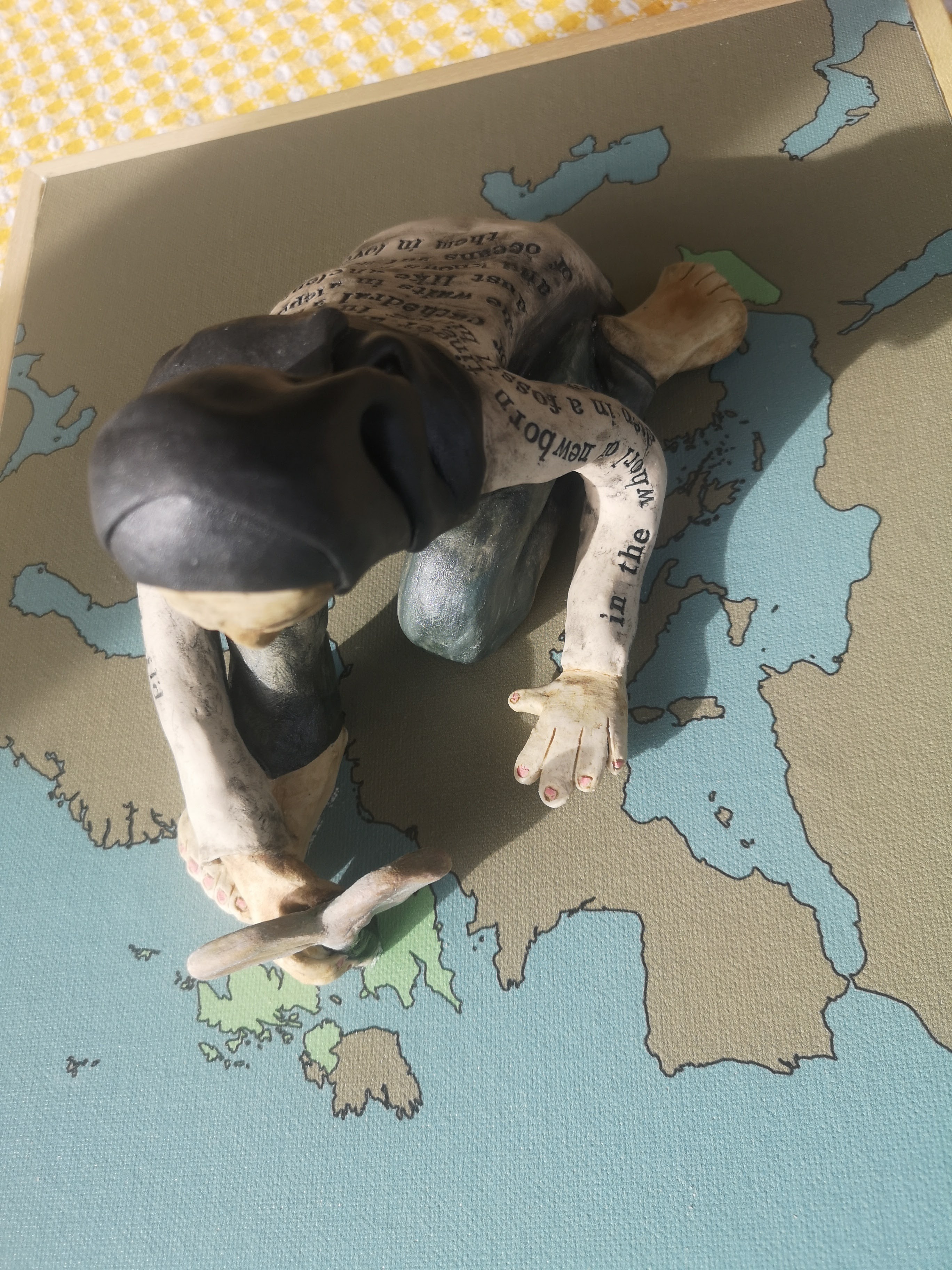
Because our stall is laden with words (poetry) people tend to stand for a long time and read. There are often tears. Sometimes there are long conversations in which we feel like priests must do when holding the humanity of others in confession or at moments of community crisis. It is a deep privilege.

Between these two extremes, we try to sell things and make a living. Sometimes to people who want to add decoration to already decorous lives, but often to those who are searching for meaning, or who somehow find the words/images/objects that we make allow them to reflect, to remember a loved one, or to set themselves once again towards something that matters.

I am sure you feel the contradictions here as we do. As we seek a simpler, more sustainable life, not driven by accumulation, we are dependent on those who would add to their storehouses from our manufacture.

There is another reason for my current introspection. This photo is of the house I was born in. On the way up from Windsor, we visited perhaps for the last time, to clear out the last few items from the vast accumulation that my late mother had ammassed from her almost sixty year residence therein.

I sat in a chair in an empty room and tried to collect in my mind things that mattered. Of course, these were not objects- we have to let them go, sooner or later. I tried to see through the mess of memories, both good and bad, and hold on to the truth of who I am and where I came from. This was not easy- after all, both of those I grew up with in this house are now dead. Also, I have spent a lifetime trying to leave this place behind – to make the power of it diminish. I wanted to be a person who did not come from here at all.

I remembered how shame characterised my formative years. How I lied to cover up that shame at times. How I never felt like other people, never quite belonged. How bizarre and odd our lives were at times because of mental illness and mad religion…

…and despite the front door respectability, I remembered the poverty. Each penny had to be pinched till finger-tips went white. We had everything we needed, but it never felt enough because we could never have things that those around us took for granted.

There it is again. The power of objects. They give identity, self worth, confidence even. They allow us (whilst accumulating the same things as those around us) to express our individuality. Or at least it seems that way for a while.

Later on, those object no longer express status, rather they become memories. My mothers house was stacked full of them. Pictures from my sister’s childhood. Pens, books we read together. Toys. Clothes still shaped to bodies now long gone.

All of which, whilst we might treasure for a while, we must eventually let go.

Pre-political spaces where hope has yet to be crafted…

Photo by Ocko Geserick on Pexels.com

I have been dipping in to twitter a little of late – I was challenged to try to do a bit of twitter poetry, and so have been dropping in a few lines each day. It is perhaps a futile pursuit, which I may not do for long, but for the first time in my life it has put me in regular contact with the vast seething mess of the twittersphere.

And what a place it is. So much anger. So much righteous indignation. The delight taken in the shaming of other people. But you know all this. You probably stay away for all of these reasons, and I salute you for it.

Of course, even if the platform has an unfortunate way of highlighting the worst of us, it is not all hate and vitriol. Yesterday I read a tweet from author and activist Alistair McIntosh. Here it is;

This, on #TheoryOfChange. Vaclav Havel describes “the pre-political” zone, the work of artists, musicians “or simply ordinary citizens” who refuse to live in the lie and insist on living “within the truth”; the “theatre of the spirit” that transfigures social consciousness.

McIntosh was quoting from a 1978 Havel essay, entitled ‘The power of powerlessness‘, which you can read in full here.

It his me like an arrow, because I needed it to. I have been feeling very low recently – as I examine myself to try to understand why, I think it comes down to a feeling of pointlessness. I started a spiral which began with seeing myself as over, failed, unsuccessful. This felt true both in a personal sense and more generally, as if the ideals and passions I have lived my life towards are over, done.

At the same time as feeling like this, I was trying hard to look for hope. Perhaps the hold of right wing ideology was starting to crumble? Perhaps we were finally starting to turn towards climate justice and economic justice?

The problem is that for every tiny ray of hope there is so much looming darkness. It can be almost impossible at times like this to dream of things getting better; a lonely and broken place to be; a dark well with few hand or foot holds.

I do not share this account in order to wallow, or to seek sympathy. Many of us go through these times, particularly creative people because the sensitivities we bear are often related to woundedness and this makes us vulnerable. Add to this the overarching historical and cultural context and it can be very hard to keep going, to keep creating, to keep hoping.

Perhaps these things are cyclical.

Every year I plant seeds early in spring, riding the crest of spring optimism. I till the ground, mulch it and trust in future fertility. I thrill to the emergence of green shoots, then carefully and tenderly transplant them to beds inside and outside the polytunnels. I water them and wait in hope and expectation.

Then there are the crops that fail, through slugs or birds or some other mystery. The rain never falls just when we need it, the sun scorches. The cold nights nip and curl the leaves. Weeds start to choke out new growth at just the time when I am busy with something else, so that when I come to pull them out, damage has been done. This year, bumble bees have nested in the best patch of spuds so that I do not harvest them. The big squashes seem slow and the second planting of carrots have not germinated. It all seems hard work and I wonder if it is worth it. The supermarket is not far away, after all.

Then I start to question why I am doing this. I accuse myself of pursuing some kind of middle-class fantasy, preening myself with a coat of green virtue whilst in reality living fully within the norms of an overconsuming and unsustainable society. In the words of Ecclesiastes (ch 1);

Meaningless! Meaningless!”
    says the Teacher.
“Utterly meaningless!
    Everything is meaningless.”

What do people gain from all their labors
    at which they toil under the sun?
Generations come and generations go,
    but the earth remains forever.
The sun rises and the sun sets,
    and hurries back to where it rises.
The wind blows to the south
    and turns to the north;
round and round it goes,
    ever returning on its course.
All streams flow into the sea,
    yet the sea is never full.
To the place the streams come from,
    there they return again.
All things are wearisome,
    more than one can say.
The eye never has enough of seeing,
    nor the ear its fill of hearing.
What has been will be again,
    what has been done will be done again;
    there is nothing new under the sun.
10 Is there anything of which one can say,
    “Look! This is something new”?
It was here already, long ago;
    it was here before our time.
11 No one remembers the former generations,
    and even those yet to come
will not be remembered
    by those who follow them.

My recovery from this kind of cynicism is never complete, but I was also greatly helped by listening to this man again. Brian McLaren was talking about his new book Do I Stay Christian? over on the Nomad podcast. You can listen here. McLaren has been one of the most important thinkers/writers in my life, so it was lovely to hear him speak again, in that way he has, skewed towards kindness. The book deals head on with the problem that many of us have with Christianity- an inability to see ourselves part of what the whole thing has become, alongside a deep yearning for what it might be. McLaren actually says that some people, for all sorts of reasons, need to leave, but he also hopes that those that can will stay and try to be part of the change.

(As an aside, I’m not sure where I fit in to this. Did I leave or did I stay?)

In the middle of this conversation, McLaren made some comments about change, which reminded me of Havel’s comments above. McLaren said sometihng like this; most of the work for change happens before hope has arrived.

In other words, those who work for change do so in spite of hopelessness, and in the very presence of suffocating futility.

It happens in what Havel calls th ‘pre-political zone’, before ideas have become solidified. Before disatisfaction has colectivised into protest. Before fringe activism has beome a movement.

Long before ideals have been made into policy. Long before any solution can be visulised, let along laid down in law.

Photo by lilartsy on Pexels.com

I have been thinking about this idea of artists, poets and musicians who play within the ‘theatre of the spirit’, and how these murmurings might become the seeds of change.

It sounds fanciful, in the absence of hope.

But that is the point.

The narrative power of old stories…

Fire stoking as at intermission of story telling, ATC Cranborne by Simon Barnes is licensed under CC-BY-SA 2.0

If this (17 year old!) blog is about anything, it is about a search for meaning. I seldom have any desire to look back at early entries but this seems consistent throughout. Often I have found myself concerned with religion – as a source of inspiration and frustration in equal measure – because surely religion is also primarily concerned with meaning?

But the religion I knew most intimately was not really about meaning – not directly anyway. It was mainly about providing ‘answers’, albeit to questions framed only in a way that we wanted them to be considered. The rest was more about belonging- using the right words and singing the right songs. We were not encouraged to search too far from the fixed tramlines that we were given or to do too much questioning of the certainties that our tradition provided.

Aside from the frustrations that many of us feel about such religious restrictions, there are many problems with this kind of closed-circuit religious thinking, particularly in a changing world dominated by problems that our old doctrines either provide no answers to (such as climate change, or economic injustice) or actually seem to make worse (such as polarised attitudes towards gay people or other conflict with other religions.)

If we are to be seekers of truth (which is just another way of saying seekers of meaning) then integrity must draw us to adventure further. I do not necessary mean a rejection of our tradition (although many of us have found this to be a necessary step) rather that we remain open to renewal and re-reformation.

I need to say a little more about this word ‘truth’.

Truth, according to Jesus, will set us free. What he might have meant by that has been debated down the generations, but any religious types think that truth is found in the literal sense from the words of scripture. It will be of no surprise to you to hear that I do not believe this reading is correct. If it were, I find it odd that Jesus used his words in the context of challenging religious bigotry (check out John chapter 8) not underlining it.

And here is the rub. If we use scripture like a definiative rule book/text book/blueprint that has been locked and closed, all we have open to us is to learn what has already been decreed and declared to be ‘correct’. There may still be many subtleties and depths that we can dive in to, but fundementally the only way we can read these old stories is the way that our religion has mapped out for us. To put it another way, we are presented with stories that have already been shaped to tell the over-arching story that has been provided by our tradition. It has all been made to ‘fit’ this narrative, a feat that has always required considerable contortions and calisthenics.

Typically we miss the many blind spots and assumptions behind these readings, because our first concern will be ‘correctness’; a feeling rendered all the more urgent by the fact that getting it wrong might result in eternal damnation.

I am speaking here with intimate knowledge only of my own religious beginnings but I think there is good evidence to suggest that we can generalise this to other forms of religion – both Christian and other faiths – particularly those who rely on scripture as their primary (and sometimes only) reference point. I think this is a terrible shame, for a number of reasons, which I will try to tease out below.

Photo by Luca Nardone on Pexels.com

The first thing that I would say is that closed system readings of scripture are not honest. They are only made possible by imposing restrictions on the minds of the reader, who is expected to read them only in the way that is authorised. For example, readers are expected to accept the ‘inerrancy’ of the bible, no matter how hard it is to make it all fit together as a coherant whole.

It is also often intellectually blind, in that it ignores or rejects any knowledge that might be seen to challenge the closed reading of those stories. For example, most of the people in the tradition I grew up in have no idea about how the canon of the bible came to be compiled. Asking questions about how the events told in these ancient stories mapped on to archeological discoveries or alternative histories would be seen as dangerous and subversive to correct belief. For the same reason, our knowlege of other streams of Christian theological thinking was limited indeed- mostly to just knowing that ‘they’ were all wrong.

The reader is also asked not to question certain underlying assumptions, without which the whole closed system would collapse. For example, we might be encouraged to read backwards from understandings gained from narrow readings of one part of scripture, interpreting complete other sections of the canon in the light of those understandings. The key assumption here is that the bible must not be seen as a library-like collection of ancient scriptures written by ancient people over a considerable length of time, but rather as a complete and whole manuscript that was always intended to be provided in its current form from the beginning of time. Perhaps you might protest that it can be both, but it does not change the fact that the assumptions we make changes the readings immeasurably.

The effect of these assumptions means that we have to ignore contradictions. If the reformation taught us to value scripture, it also soon taught us to value our own understandings of this scripture more. Truth wars became the way we did religion for hundreds of years and we in the West live at the end of all this; arguably an increasingly irrelevant remnant, defined more by our narrow religious views than our capacity to live for grace and goodness.

Perhaps the most problematic result of these closed system readings is that they lock us in to black-and-white thinking. Any command-words from anywhere in the canon of scripture have to be taken as fixed instructions handed down directly from God. It is true that we did not do this completely (ignoring purity codes from Leviticus about mensturation cycles for example) but this was a bit of a guilty secret, with no easy explanation when confronted.

Another aspect of this is how our approach to religion becomes highy legalistic, as if the scriptures themselves exist as a code of instruction that is applied and interpreted by our priest/judges, or our bishops/supreme court. Legal correctness takes precedent over anything else, even if the outcome is undesired, as in the rejection of homosexuality alongside the desire to remain loving and accepting of outsiders, and the church has to endure more of this sort of thing.

Finally, if we use only closed reading systems, there is little room for adventure. Institutions will tend towards control, order and a resistance to radical diversity. Arguably, any spiritual journey worth making will be towards personal (and hopefully collective) transformation, NOT towards greater doctrinal convergance. It is not impossible to make these journeys within closed reading systems but I would suggest that this will always be difficult.

Photo by Alex Azabache on Pexels.com

So what value have these old stories? Why not just treat them as quaint old folk tales intended for children? Why continue to expect them to be relevant all these thousands of years after they were written?

Well, in these fast changing times, I think we need these old stories more than ever, and I am not willing to throw any babies out with the bathwater.

It is perhaps worth remembering that there are many other ways that Christians have always read scripture. There is a summary of some of these in this post, in which I listed the following kinds of reading;

  1. Narrative reading- where we get into the story, the context and history from which the words emerge from.
  2. Conversational reading- where we engage with the different conversations across the generations embraced in the Bible- for example Jesus with the religious powers of his day, the Priests and the Prophets, the Jews and the Gentiles.
  3. Missional reading- in which we ask we ask, in each passage of Scripture, how is God extending his overarching mission of blessing all nations through a community of people.
  4. Political/Economic reading- the skew of God’s attention towards those who suffer injustice at the hands of earthly empire involving money, sexuality, power, violence, and law.
  5. Rhetorical reading– in which we look for what the text it trying to do, rather than just what it is saying.
  6. Contextual reading – in which we try to understand how the specific context might have influenced the writing of the text
  7. Literary reading– “…when readers of the Bible develop sensitivity to the ways poets, protesters, storytellers, activists, priests and mystics use language, the Bible is liberated from its constitutional captivity to be the wild, inspired, and impassioned collection of literary artifacts that it is.” (Brian McLaren)
  8. Close reading– better readings of scripture will examine the small details of the narrative- the bits that we easily miss that the writer chose to include in the text, which is rich in culture and traditions that we easily miss.
  9. Communal reading– the Bible is complex and hard, and the only way we can really engage with it is through the broader community- firstly in terms of “the community of the dead” where we listen respectfully to how previous generations have understood scripture, whilst understanding their skew towards a western, wealthy, white, male perspective. Secondly we look for the voices of minorities- those who have been forced to the margins. It is not ONE perspective, but rather both/and.
  10. Recursive reading– understanding of the Bible, and emphases within it change, ebb and flow across generations, and within lifetimes. This might be one of the ways that the Holy Spirit brings renewal.
  11. Ethical reading– text applied without ethics have allowed our faith to justify slavery, genocide, anti-Semitism, oppression of women and gay people- therefore we have to accept that interpretation is a MORAL ACT, so we should test an interpretation by reason and scholarship,using our rational intelligence, and a sense of justice and ethics. How might I treat people if I follow this interpretation? Whom might I harm? What unintended social consequences can we predict if this interpretation is widely embraced? Could people be vilified, harmed, or even killed because of this interpretation? McLaren points to those in Scripture who have wrestled with God in the face of his seeming injustice… Job, Moses, Abraham.
  12. Personal reading– “the reader is himself or herself in the predicament the text addresses. So faithful readings are habitually humble, expectant, open, and hungry and thirsty to encounter the Living God. Even the “professional” reader and teacher of the Bible must remain forever an “amateur” too …”
  13. Mystical reading– we must “…develop the habit of mystical openness, receptivity not only to understanding from the text but to enlightenment from the Holy Spirit, not only to interpretation but to revelation, not only to intelligent engagement with the text but also to personal abduction by its message.”
  14. Christo-focussed reading – where we no longer approach the Bible as a collection of words of equal weight- but rather that we approach all other words through those of Jesus.

This is far from an exhaustive list and whilst some of these might be seen to be more practiced by theologians, the point here is that scripture has ALWAYS been used in a much wider way than the narrow closed readings that we have locked them it within.

Photo by Lukas on Pexels.com

My argument here is not against scripture, but for it. It is not a tirade against the value of these old stories, but a desire to rediscover them, to reframe them for our new context, to set the power they contain free again to do new things.

I am comfortable with seeing the Christian scriptures as a library of generations of people trying to make both personal and collective meaning out of chaos- much as we are trying to do now. Much of these stories also seemed to have been written down in the context of abject failure (slavery in the OT, occupation in the NT) – again, much like the feeling that some of us feel now. Nevertheless, throughout the whole mess of this scripture, themes emerge of a longing for justice, restoration and wholeness. Above all, these themes come together in the stories told about a man called Jesus.

The relevance of these stories, when encountered outside the closed readings that we have been used to, is startling. Consider, for example, the stories from the very beginning of the Book of Genesis, that go something like this;

Simple people, living in harmony with nature, rise and seperate themselves through the accumulation of knowledge. Soon there is conflict between the hunter-gatherers and those who fence the land and accumulate belongings, leading to the murder of one brother by another. The accumulation gets more extreme, leading first to cities, then to empires, followed by more empires. God is so angry that he wants to wipe the world clean in a flood and start again.

You can read these stories in all of the ways discussed above, but I want to propose one last reading, one that I will call a ‘radical reading‘. Radical, that is, in the sense of looking for prophetic inspiration towards change. Looking for ways towards justice that might be relevant to our situation.

Against such there is no law.