Another brilliant vid/poem from Tim Watson…
Proost advent 12…
Reply

Another brilliant vid/poem from Tim Watson…
Time for some pottery… This is a short video around the creation of a large pot in Seatree Pottery up in Argyll. It is one of a series of pots in a grouping called ‘Hebridean devolution’ which use the same form- layers of altered clay built up to form a large urn, but each piece will be in different states of completion. The landscape up here is old, long eroded. It cradles so many stories, not least the Celtic traditions which have merged with and been altered by an encounter with the teachings of Jesus. In the midst of all this change, all this history, we are being made. We are being made new.
This morning we hear from Hannah Caroe again, with a lovely story poem…
Today’s post comes via Rob, my partner in Proostyness. This is what he has to say;
This reading from Ian Adams’ ‘Some Small Heaven‘ seems as appropriate and meaningful to me as it did the first time I read it.

The Hope of the Few
When the powerful manipulate the truth,
when the powerless are exploited,
and we who seek good seem incapable of bringing change,
where is hope?
Advent is the celebration of the few.
Of the small.
Of the unknown and the unnoticed.
Never forget the potential
of a prayer made in seclusion,
of one generous action,
of some small gesture of faith,
or of a simple blessing
– to scatter the proud
and to shatter their illusion that theirs is the last word.
As alone as you may feel.
As small, as unknown or as unnoticed.
Your prayers, your generosity, your gestures, and your blessings
will heal the world.
Image, by Si Smith.

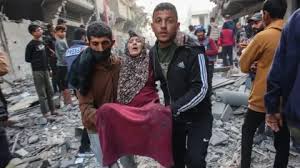
The background to this advent is horror in the holy land. We all know this, but it has become almost impossible to talk about freely. Even the words we use to describe what is happening in Gaza (not to mention the West Bank and Lebanon) are contested.
Genocide.
Aparthheid.
Terrorism.
Antisemitism.
In part this appears a deliberate consequence of the propoganda war, but it leaves many of us exposed, angry and fearful. The internet algorythm then plays the polarisation game and we find ourselves divided against each other, each with a different version of the ‘truth’.
There are sensitivities here that we have to acknowledge – the terrible history of the Jewish people and the horrific attack that was the catalyst to this event, but we now must call the Israeli military response what it is – the most brutal attack on an urban population in modern history, desctived as genocidal by the International Criminal Court.
There is no equivalence here, no proportionate response. It is violence unleashed, and almost 70% of those killed have been women and children. There is no justification for this kind of slaughter.
Amnesty International agrees. The 297 page report makes for harrowing reading.
“Our damning findings must serve as a wake-up call to the international community: this is genocide. It must stop now.”
– Agnès Callamard, Amnesty International
They are in no doubt what needs to happen.
Meanwhile the rest of us feel powerless, or complicit even. After all, our government continues to offer broad and unflinching support to a regime that is infliciting unimaginable suffering on a whole people. Hundreds of companies in the UK make items used by the Israeli war machines. Our media is oddly compliant, despite the exclusion of journalists from the war zone and the 146 journalists and media workers killed by Israeli bombs.
This powerlessness impacts us like a moral injury – it becomes an unresolvable cognitive dissonance which means that most of us have to just switch off to it all, because what else can we do?
Many, including many of our friends, caution us against outright opposition to Israel’s genocide. After all, do they not have a right to defend themselves? It all seems so complicated, so let us just offer up prayers for peace and leave it to higher powers to sort out. But there is no peace in light of such on-going brutality, and there can be no peace without justice, without restoration and a rolling back of the violent jugernaut that has been cruhing the Palestinian people for so long.
Thoughts and prayers are not enough.
A few weeks ago, Michaela and I joined an Iona Community zoom call to hear from a man who had lost 19 members of his family to a bomb strike in Gaza. He has know idea why they were targeted, but it may be because he is a journalist. One of the participants in the call started to offer words of compassion, but he stopped them.
I don’t want your sympathy, he said. It means nothing to me. I don’t know you and you don’t know me. I just need you to do something.
This stayed with us for weeks. But what could we do? How can any of us respond to what is going on?
We tried informing ourselves- finding out as much as we could about the history, from the mess the British left after they left and the massacres of 1948 right through to all those himan rights violations followed by the ebb and flow of violence and counter-violence.
We noted in particular the role played by Christians in this mess – how Christian Zionists seem to outnumber Jewish ones for instance, and the hold that a certain myth of Israeli ‘specialness’ has even within mainstream churches, which blinds us to so much brutality. If you want to know what this looks like in the West Bank for example, listen to this…
We looked to see if we could support organisions working for peace like the Amos trust because perhaps getting money into the right hands is the answer… how much it is needed after all!
Then Michaela woke up with an idea in her head.
What if we could put something in the hands of the CEOs and politicians that have power and influence. Something simple but beautiful.
An object of meaning that they had to choose to either keep or throw away.
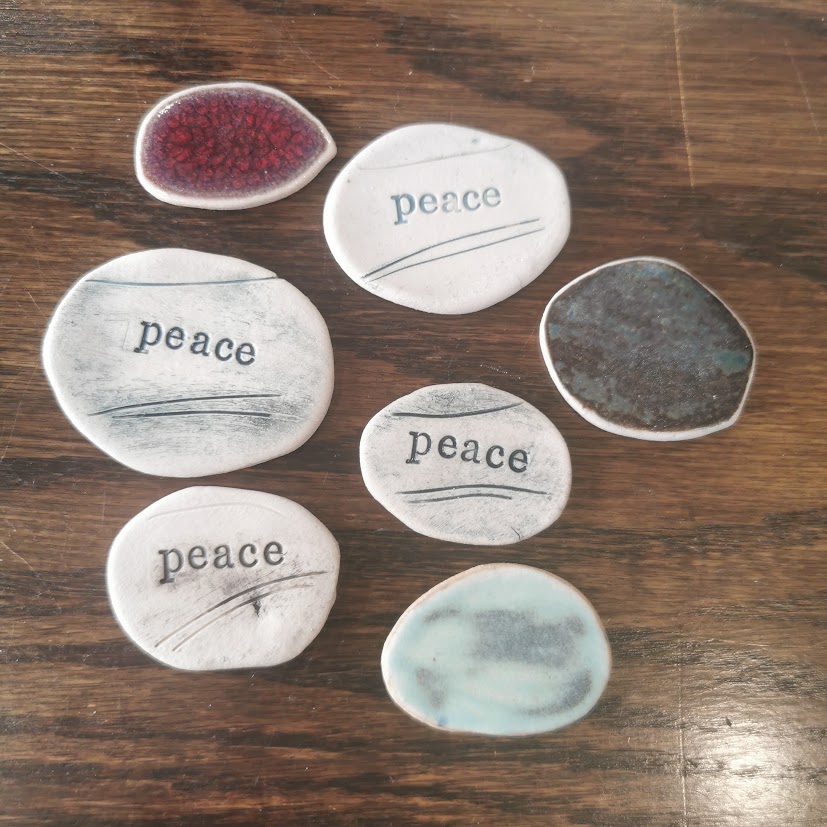
So far she has made 413 of these ceramic stoneware pebbles, with a glaze on one side and the word peace on the other.
Friends have helped with the making and glazing, and we intend to post them out to CEOs of UK companies who make items used in the Israeli war machine, and to our politicians and to those conpanies on the boycott list who support the Israeli government or military financially.
We are calling them pebbles of peace.
Want to get involved?
Each envelope will cost around £1.50 to post. Already we have posted out about 300, and these costs have been covered by a community of people who have chipped in to add their voice to the outrage. There are still a couple of hundred to go (we will fire another batch in the kiln in a week or so) so it you want to help out, either by supporting some postage, or even by taking a batch and posting them yourselves, then let me know.
We wrote this to go along with the pebbles.
Pebbles of peace
We are a group of friends longing for peace in the middle east. We represent no big organisation or interest other than that of our own.
We feel overwhelmed by the scale of the hurt and pain being caused by the war – on all sides. The thousands of dead children and the hundreds of thousands whose bodies will carry wounds in body and soul for generations to come.
When will it stop? Who will be the peace makers?
We think that change happens through brave people like you making hard decisions towards peace, even at personal and collective cost.
We send you this little token of peace and invite you to pick it up.
What you do with it is up to you.
You can keep it…. or throw it away.
If you keep it, our hope is that you will be doing so as a commitment towards using whatever power or influence you have – big or small – to make peace.
We know these things are complicated, so we make no other request.
Today I offer this video again.
It captures so much about how I am trying to engage with the context we find ourselves in. In a world of widening inequality, climate breakdown, genocide and popularist politicians, what do we live towards? What part of the advent story might be drawing us?
All I have is this.
This poem stopped me in my tracks…
One of the lovely things about Proost has been the way it has allowed the connection of creative people over a wide distance. Poetry in particular has allowed people to connect into what has often felt like a ‘tribe’ or community. Talitha, who was a core part of previous Proost poetry collections, is down in Australia for example, and it is through her that Stevie sent in this poem.
Take a moment and listen to this. You will not regret it.
Today we get to hear the brilliant musicianship and creativity of Lofter.
I ‘met’ Ant, Lofter’s lead singer through reaching out around Proost things as he had been a previous contributor of music to the old publishing platform. We interviewed him on our podcast, in which he tells his musical/spiritual story. What a talent!
Proost advent 5 brings us two lovely poems by Hannah Caroe, both inspired by the annunciation.
Today’s beautiful and moving video comes from Australia. which Talitha describes like this;
This moment of Advent quiet pause is an invocation, and a cry of protest, and incorporates a blessing from Garry Worete Deverell, a Trawloolway man from northern Tasmania. Images and video curated by Talitha Fraser, a Ngai Tahu/Pakeha settler living on the lands of the peoples of the Kulin Nations with respect and gratitude for mana wahine in her life.
 this fragile tent