Scottish emerging church 2010- a view from the west…

Here it is again- the old EC term. Given one more airing…

I was a little sad about the demise of Stewart’s ‘Emerging Scotland’ Ning site-

And so I thought that it might be time to consider again where we are up to North of the border, and throw out a bit of a challenge to others in Scotland who have used the term to do the same…

In many ways this is a continuation of thoughts begun here.

I think we up here were a bit slower to use the term than elsewhere, but there is no doubt that the ‘conversation’ has been transformative in many ways. The questions however remains as to how this might have played out in the specific Scottish context- as opposed to down south.

I will divide my response into two different parts- firstly my personal experience, and then my imperfect impressions of the wider context.

The latter comes with a warning- I am not a professional minister, nor at the centre of faith based organisations in Scotland. I do feel slightly qualified to express an opinion however as I have been thinking, talking, reading and seeking connections on these issues for several years now. I have met a lot of wonderful people, and felt an equal measure of hope and pessimism for the future of our churches. What I offer then, is the view of a knowledgeable and sympathetic outsider.

Firstly then, my own experience.

I arrived in Scotland in 2002, eager and enthusiastic to belong to a church up here, and to continue to find worshipful expression through music and community. My background previously was Evangelical/charismatic left-of-centre traditional church. I joined a local church, but increasingly found it difficult to stay in that context. I will not tell that story here, but it will be a familiar experience to many of you.

In an attempt to break out of the narrow spaces I found myself in and to seek a way of living out my faith that offered a real connection to my context and an honest engagement with my faith, I left formal church in 2006. This was not an easy decision- rather it was taken over a long period, with much pain and many sleepless nights.

So, with some friends, Michaela and I set out on something new. We started a housegroup, and Aoradh grew and changed- initially it was a group of people who wanted to do evangelism through art, but increasingly became less driven by grand plans to win converts, instead seeking partnerships and creating spaces to contain our own worship, and to host others.

In all this, I had discovered the ’emerging church conversation’. My theology was first destroyed, then renewed and lit up by new questions and new/old perspectives of God. I felt again a thrill about the life that Jesus calls us to for the first time in years.

But our little group was isolated and desperate for connection, mentoring and encouragement, so I spent some time looking around for similar things in Scotland- things we could learn from and lend support to. And I found very little. Sure the language of emergence was being used by some of the institutions- the Church of Scotland, and the International Christian College for example, but this did not seem to be converting to any kind of grass roots activism, or mutual support that we could plug into.

Neither did the established churches seem to have resources or energy that they could apply to supporting the embryonic groups that may have been emerging. They were caught up in a survival battle of their own.

In the absence of other networks sympathetic to the new ground we now found ourselves treading, I started a Facebook group, which very quickly picked up around 100 members. I also set up a couple of meets in Glasgow, and was keen to ask questions about whether people wanted more and closer contacts. Stewart then started the Ning site, and some meets took place in other places too.

The on line stuff flared up then died down like most on line networking. It has a short shelf life, easily becomes contentious and repetitive and the theological arguments become wearing very quickly.

I was still hungry for more- a network of people who were prepared to stand with one another- share resources and ideas, encourage fragile new developments and be committed to the kind of openness and generosity that is supposed to be the watchword of church.

I have made some good contacts, and still hope that out of these, more of the above may yet flow, but there is still no formal, or even less formal network in Scotland through which new groups can find encouragement and support. Our group has less need of this perhaps now- partly because we are further down the road, and have made a lot of our mistakes already, but also because we have made more connections with English based organisations.

What is left to me, is a desire to live an authentic, open, generous Christian life- looking outwards, not inwards, and seeking relationship and partnership with other individuals and groups wherever possible. Sometimes I think I am walking this path. Other times I feel lost in a tartan wilderness.

I have stumbled into conflict along the way too. I do not like conflict, and do not always handle it well. It tends to make me retreat and localise- which becomes then an obstacle for the very networking I believe is called for…

Along the way it has been difficult not to constantly make evaluations and judgements about the wider Scottish context. This is not easy, as we first need to ask whether there is ONE context. Our West of Scotland semi rural small town Highland context is very different to Glasgow, which is different from Edinburgh or Inverness.

However, I am committed to using a broad brush with careless abandon, so at risk of causing offence, here are my impressions-

  • ‘Emerging Church’ are words used in Scotland in the academy and the conference/general assembly. They have less relevance at the grass roots here than they do elsewhere.
  • Churches who use the language of emergence are driven most by desperation. They are looking for a new way to evangelise- to fill the pews and mend the leaking roofs.
  • The sectarian nature of religious development in Scotland still imposes rigid walls of suspicion between different faith groupings- not just the Catholic/Protestant divide, but between Protestant groupings too. This means that finding commonality through which ideas and support can be channelled is that bit more difficult up here.
  • No denomination has stepped forward to deliberately offer support emerging fledgling para church groups, as the C of E (and others) have done in England.
  • And the English stuff stops short of the border, as there is still this weary anti English stuff even in the church where we really should know better.
  • The dominant activism in Scottish church looks towards American models of Evangelism and as such is still fighting the old truth wars. This is a regressive force in our faith- the pressure this thinking brings to our ways of doing church is to call our dwindling population to greater fervour, purer understanding of the Bible and to pray for Revival in order to shake the population from their wicked ways, and some how take us back to the 1950’s.
  • Distances are greater, and population numbers and low density tends to make finding peers and like minds more difficult.
  • There are some new developments- Solas festival for example. But these do not yet seem to me to be associated with the fostering and development of new forms of church. Rather they are a new things done by people who are part of existing institutions. They are none the worst for that of course and it is early days for Solas (the first festival was this year) but perhaps this could be described as new wine skins for old wine. We need the fine old wine, but we also need sparkling new stuff, and new wine skins.
  • Then there is the class issue. Working class, underclass, middle class. Inner cities with huge problems with worklessness and addiction. Places where theological debate has no relevance, unless it stimulates action. Action not from the outside- parachuted missionaries- but more from the faith that finds new relevance in the broken places. Emerging church conversations have not shown themselves to be well equipped for this in Scotland.

Finally then- the challenge.

I have been quite negative above. And this is not fair, because I do not feel negative about the future of the people of faith in Scotland.

But I do feel that we have an opportunity that might just slip away.

An opportunity to forge an underground railway, along which we pass down the agents of the New Kingdom.

The challenge is to ask those of you who have a more complete view than me where my blind spots are. What am I not seeing? Where do my generalisations miss things that are happening? Where are the networks of support that transcend the old boundaries and carry genuine new hope?

And if I am more or less right, what should we do about this?

Richard Rohr on Dualism…

My friend Maggie sent me a link to a quote from Richard Rohr the other day. We are both looking forward to hearing him speak at Greenbelt Festival in a couple of weeks.

(Yikes- a couple of weeks! Aoradh are doing various things at GB, and we have a lot of work to do before we will be ready!)

Anyway, the quote tapped into the theme of dualism- which I mentioned before- here, and has also been a central idea in McLaren’s recent book

Dualism.

As applied to theological understanding, this debate goes something like this-

Western civilisation has been hugely influenced by Greek philosophy, and in particular the work of Plato.

This is not a new idea- I have been in a number of emerging church discussions that have highlighted the contrast between the philosophy of the ancient Hebrews with the potential skew in perspective that comes from wearing our Western Platonic goggles. But it is an idea that appears to have become increasingly important as we seek to re-engage with the ancient scriptures, and as some of the core tenets of our faith are being reshaped.

Plato (in contrast to the polar opposite- you could say ‘dual-‘ position of Aristotle) regarded all that was of the earth as temporary, worthless- a mere shadow of the ultimate reality. Ultimate reality is not material- it is the essence behind the fumbling form and shape we humans give to things.

The end result was a culture skewed towards division. Enlightened thinkers tended to view the world as made up of the profane, and the sacred. The sacred was unchanging ultimate reality, whilst the profane was changing, shifting, worthless.

The tendency to divide every subject into two seems to have been pervasive- left/right, good/bad. evangelical/liberal etc- the dualities multiply and abound.

As these ideas mingled with the founders of the early church- who after all were at the centre of the Greek/Roman world that embodied this dualism in terms of their philosophy and origins- then it potentially had some powerful effects on religious thinking-

  • The sense of the material world being of lesser importance than the ultimate reality of an orderly, dispassionate unchanging God.
  • The resultant need to focus on winning souls, as a priority over any other religious activity.
  • The in-out stuff- the us and them stuff. We are enlightened and saved- you are not.
  • Enlightenment means becoming aware of our imperfection, set alongside the perfectness of God.
  • In the creation of this ‘ideal state’- a Christian version of Pax Romana– it is only citizens who count- only people who have converted.
  • And in return, Christians can confidently expect prosperity and blessing commensurate with being a citizen of this ideal kingdom.

The interesting and difficult question that McLaren is suggesting that we need to ask in ‘A new kind of Christianity’ is about considering the faith of the Ancient Hebrews- their understanding of God. He (and others) propose that this Ancient Hebrew God was very different from ours.

For a start, many of the simple dualities that we take for granted are challenged by the stories of the Old Testament.

  • This God is not unchanging- but appears to be persuaded, and is willing to engage with the most gritty earth bound issues in way that can only suggest wild and uncontained passion.
  • Winning souls or converts is simply not an issue. The Jewish people appeared to have no idea of heaven or hell- but rather were to be a source of blessing to others in the here and now.
  • They were a people set apart- but not in the idealised sense. Rather they had a difficult and tortuous relationship with their identity and calling- constantly getting caught up in becoming too superior, too big for their boots, too independent and self sufficient.
  • There does not seem to have been the same ideal of ‘perfection’ either. God was unknowable, unfathomable, mysterious. His ways were not orderly and predictable- and so engagement with him was dangerous. Purity was about keeping laws, about living a communal routine governed by festivals and ritualised repentance/sacrifice. In this context, there was not a simple dual version of saved/unsaved- rather a process of engagement and belonging to community.
  • The Hebrews saw themselves as the ‘Children of God’, and as such were a Holy Nation, belonging to God. But they constantly incurred the wrath of God through their lack of respect of the ‘other’, the aliens in their midst. There was also a lot of war making and slaughter apparently commanded by God, which is frankly confusing and difficult to understand, and fit poorly with the words of Jesus.
  • Finally the Hebrews clearly looked to God to be the source of their prosperity and nationhood. But it did not end well did it? The succession of advancements and cataclysmic downturns that categorise the history of the nation of Israel might suggest that God is not interested solely in national or even local prosperity- that this can never be commanded, or guaranteed through orthopraxy.

Back to the Rohr Quote-

Jesus’ teaching on moral equivalency between himself and God and everybody else includes the neighbour, the outsider, the foreigner, the Gentile, the sinner, and finally, the enemy.  This is total non-dualistic thinking.  It was from this level of non-dual thinking that we find Jesus finally saying in John 17:21- 22:  “Father, may they be one.  May they be one in us as you are in me and I am in you.”Jesus lived his human life inside of a unitive consciousness, and yet he could make use of the dualistic mind to make clear distinctions, as well. (“You cannot serve both God and Mammon” [Matthew 6:24].)  And this, too, is the goal for all of us: unitive (non-dual) consciousness is the only way to deal with the big issues like God, love, suffering, death, and infinity.  But then we can revert to dualistic consciousness to make practical decisions about turning left or right, or whether to buy apples or oranges.

Adapted from Experiencing the Naked Now (webcast)

Another one of those discussions about church…

I shared lunch with some friends today- I meet with three other blokes to pray every couple of weeks. It is a really good mix of folks as each of us are very different, but share a desire for honesty, friendship and to create a safe space to share faith and life.

Today we spoke about church.

It is a familiar theme. I am the only one of the group who is no longer attending a regular Sunday morning service in a church building. All of my friends are still hanging on in there- just.

It is not that any of us do not appreciate the value of meeting and worshipping communally- it is just that the baggage that comes with this seems to have a high price- and also that the activities through which communal worship is celebrated can just be so suffocatingly irrelevant- for us, let alone for our kids or our friends and neighbours.

The question of what might be possible as an alternative has exercised much discussion, including on this blog.

In particular, today we asked a local version of this question…

A couple of days ago, in response to a comment on this piece by Aileen, I wrote this-

I wonder  if  we were ‘over sold’ some of the ideas about what it means to be a Christian. We have been told repeatedly that people are of two sorts-
Saved and unsaved
Good and ‘of the world’(or even ‘evil)
Transformed and untransformed
Enlightened and deceived by the devil
We have the Holy Spirit who will sort us out- they don’t.

This dualism allows us to then suggest that Christians are elevated above all other people- more holy, more loving, living better lives. And then when we discover (as we inevitably do) that Christians are often just as screwed up and damaged /damaging as the next person, we are exposed to a great disappointment- and what the Americans would call a ‘disconnect’ between our rhetoric and reality.

I have come to believe that the Kingdom of God at loose on the earth is NOT the same thing as ‘the church’. Rather “God plays in ten thousand places, from the father to the features of mens faces, lovely in limbs and hands not his”

The question is, if this is true, what the POINT of the church is? If Christians are untransformed by encountering Jesus- what is the point?

I think I would reply that we are not untransformed- the very fact that you and I are asking these questions is proof of that. Rather what we come to is an awareness that we can reach higher, and deeper- and expect an encounter with the divine as we do this that is so much more than a one directional intellectual exchange of religious ideas/doctrine. But also that we are called to walk humbly- and to hold ourselves in awareness of our sinful state- not other peoples sinful state, but our own.

Perhaps then the purpose of the church is to be a sprinkling of salt, bringing out flavours of the world, and a source of light that illuminates good and beautiful things. This kind of church I can belong to!

I have no desire to start a new church though- in the sense of a new institution, or a new exclusive gathering of people who try to sell their ‘product’ and their version of truth to everyone on the outside.

But what began to emerge today in our discussion was the possibility of a more regular celebration event, in partnership with others where possible.

In many ways this might compliment some of the more intimate small group church things that I love.

Who knows what might emerge, but I have a feeling that it might be time to make some noise again…

The reformulation of ’emerging’ Church?

I have been watching another little internet spat rumbling on over the past few weeks about this thing called ’emerging church.’ I resisted posting anything myself because I was not entirely sure what my own thoughts were- and to be honest the arguments about EC are wearing very thin.

Not that I do not still think the term is useful- for me it is still something that has meaning. But more as a description of process, not of destination.

It was always inevitable that this rather formless, leaderless movement, gathered together through blogs and podcasts more than in books and buildings, would ebb and flow, splinter and reform. This is what seems to be happening. The early adopters of the label have mostly moved on- radicals tend to have short attention spans, and perhaps to0 easily offend or take offence.

The latest discussion/disruption began with this post by Kester Brewin– who was reflecting on his impression of the return of a lot of early pioneer leaders seemed to be returning to the institutions that they left.

TSK kind of agreed.

‘Romantic tosh’ said Jonny Baker. He pointed out that it had never been an either-or situation, but a both-and. A lot of the new forms of Church had been actively fostered and supported by traditional church forms- particularly by the C of E in England. Here is Jonny talking about this very thing back in 2008 (perhaps it is a sign of how much things have changed recently that this seems a long time ago?)-

So- for my two penny worth, here is the view from up north.

U here the influence of the ’emerging conversation’ has been strong, if a few years behind the English experience. However despite the use of the term within some of our big religious institutions (the Church of Scotland here for example) there has been little physical development, or signs of significant innovation around new forms of Church- unless I am missing something.

Perhaps this is in part because the sectarian entrenchment, both between Catholic and Protestant, and between embattled protestant groups (who still tend to be more interested in fighting dogmatic truth wars) has been so pervasive up here. The influence of American style fundamentalism via satellite TV  is also a constant irritation to me.

My small group often feels isolated. We have sought to make friendships and partnerships wherever we can, and to network ourselves to others with whom we can share activities and stories. Up here, the issue is not whether emerging church is retreating back to institutions, but rather a question of where those of us who are seeking to find new ways of doing church will find any kind of mutual support and mentoring.

All movements need leadership. Those of us that have been inoculated against ‘modern’ leadership (by our experience of Church) tend to eschew the forms of church that are led like large industrial-military organisations.  For this reason, the leadership required by us is of a very particular kind- I have written about this before- here.

But I simply do not care whether these leaders are part of a large institution or not.

Although my impression is that the generosity and tolerance seen in the old C of E perhaps makes it well suited to the task…

I wonder where we will be in 5 years? We live in interesting times.

Emerging church and the new Charismatic-Mystics…

I came across a post on on the Emergent Village blog that really resonated with me. This was a piece by Dave Brown, who speaks really well about his background in the Charismatic movement. His ambivalence towards this background is very familiar- a combination of cringe and affection that I have spoken about before- here for example.

He talks about a new emergent kind of Charismatic movement, typified by the tripped out whacky stuff that surrounds John Crowder- Check this out!

Scary?

Hilarious?

Or just totally baffling?

My reaction is no surprise to me. Mostly I just recoil. But I have been in environments like this- usually hiding behind a guitar, but enough to feel a slight yearning for the uninhibited emotional and spiritual outpouring that such encounters provide- even the slightly more buttoned-down British version of them.

And talking of the British version, Dave makes mention in his article of Sloshfest- and other festivals in Wales, associated with familiar names (to us here in Aoradh anyway) like Godfrey Birtill. (We invited him to Dunoon once, and it was a bit of a road accident- but that is another story!)

Check out this site too- by the ‘Drunk Monk’.

What of all this then? Those of us who have escaped environments like these have common stories- of the oppression and madness that comes when you overheat and over sell ecstatic experience, leading to all sorts of leadership excesses and psychological damage. But we will also remember the freedom, then joy, the sense of release and belonging. Lots of good, mixed in with some really bad. I am happy to leave most of it behind…

But fringe movements like this are emerging at the same time as our own. People are forging a new frontier of faith, because the old one is whithering- and as Dave points out in his article our direction has been too often into the intellect- we have congratulated and celebrated deconstruction and theological debate. And we have eschewed emotion, and joy, and outward celebration.

And to be honest, I have simply never liked ambient chilled out music. I like music that engages, rather than simply providing a blank wallpaper.

I liked what Dave had to say here-

None of us on the fringes want to be held down by spiritual tyranny. That’s why we’ve voluntarily exiled ourselves to the desert of edge-pushing spirituality. And that was one of the things that attracted people like my parents to the Charismatic movement. They wanted more than establishment-friendly religion. And while Charismania has frequently (and often rightly) been criticized as all emotion and no substance, I think it’s unwise to adhere to the opposite extreme of all head and no heart. More specifically, I think we all could handle a little more emotion in our spiritual regimen. It’s okay to cry or laugh in church. It’s okay to express our passion with boisterous antics…or weepy, knees-on-floor reverence.

It’s okay to come out from behind the mask of objective distance. Because sometimes life sucks and we need to share the burden with somebody. And sometimes God has worked a miracle and we need to shout it from the rooftops. Sometimes we’re pissed off and it does more harm to hold it in. And sometimes we’ve experienced a hit of holy joy and freedom that we can’t explain, and we should share these things because that’s what community is for.

I don’t want this precious movement of the emerging church to end up as just another dry, debate-filled clique that gradually becomes the empire it set out to avoid. But I have enormous hope that that will never be the case. Because we are all part of a bigger story that will continue to evolve. Even as we sometimes try to distance ourselves from the label, we on the fringes are still an integral part of the larger Christian movement that’s been rolling on for millennia, and it always will be bigger than any one empire that tries to lay claim to it.

Amen brother (as I used to say)

Amen.

Emerging children…

Michaela told this story the other day-

Once there was a large cruise liner voyaging across a wide ocean. It was full of people of all ages, who appreciated the safety and security offered by the experienced crew. Landfall was predictable and always on time, and although there were many storms, most of these could be by-passed or ridden out thanks to the ships stabilisers.

The crew of the liner were skilled at the production of all sorts of entertainment- balls, grand dinners, deck sports and above all- childrens activities. The kids were able to have fun, and this gave the parents to opportunity to do thier own thing, without any anxiety about what the kids would be up to.

But some of the passengers became restless. The life on board was just a little too predictable, and the ports of call organised and booked long in advance. For some, what was needed was a new adventure- the call of the high seas, and the beckon of the distant unexplored shore.

So they packed their belongings into small boats, said their goodbyes, and set out with their families on the blue sea.

And as they left the liner, someone shouted-

“But what will you do with the kids?”

We had a discussion at the Tautoko weekend about kids in these new forms of emerging church/small missional community/fresh expression (or what ever the current term that we are trying out is.)

Of course, the kind of church or community who might use one of these labels are varied. Some are embedded within more traditional church structures- complete with Sunday schools, youth groups and dedicated support structures for the development of young Christians.

Other communities are like mine. Groups of families and individuals who find themselves doing church in a more isolated situation, and kind of making it up as we go along. And those of us who are parents often worry. Because this experimental freedom is great for us- it was our decision (or perhaps our calling) but what about the kids?

How will they learn the stories of faith if not through Sunday school?

How will they absorb the Christian tradition unless through participation in a Church? (Note the capital C.)

How can we take a risk with their souls- the risk that we might be reducing the influence of Jesus on their formation, and so on their future and even eternal lives?

These are questions that Michaela and I have worried about. We no longer attend formal church, but live out faith in small group meetings, housegroups and in planning worship events in public spaces. It is exciting for us, but just ‘normal’ to our kids Emily and William. What legacy are we leaving in their lives?

Back to the discussion. The room contained parents of kids from about-to-be-born right up to 18. We talked about our experiments with family worship and Jonny described how their kids had grown up in as part of the Grace community. Others talked about the value they still found in their kids attending Sunday schools.

Despite the variety of opinion- some strands emerged that were meaningful to us-

  • Guilt and anxiety comes all too readily to parents. Particularly around the bringing up of our children towards and understanding of faith.
  • Perhaps we entrust this responsibility to others too readily. And this trust has a mixed reward- in our own memories, and in terms of those who survived Sunday School into adulthood with a live faith.
  • Involving our kids in something that contains all our passions and hopes rather than just reluctant duty must be a good thing! In this way perhaps we can impart something deep and real…
  • But HOW we involve the kids is important. Naz described housegroups where adults met to do their thing- to meet their own spiritual needs- and the kids had a great time running riot in the house or garden!
  • We decided that sharing FOOD was important.
  • And that taking kids seriously- and trusting them to contribute- was vital.
  • We also noted the importance of mentoring and deliberate inclusion from OUTSIDE our kids immediate family. So perhaps this might be another member of the community recognising a skill or passion and inviting our young people to use it.
  • Finally we noted the fact that kids seem to be able to deal with modular and perhaps even contradictory experiences of faith. Our kids typically combine small group meetings, youth groups weekends, major events like Greenbelt Festival, along with forms of church that we might find rather difficult.

I am glad that we left the big ship and set sail in our small one. I only hope that the journey is full of blessings for kids.

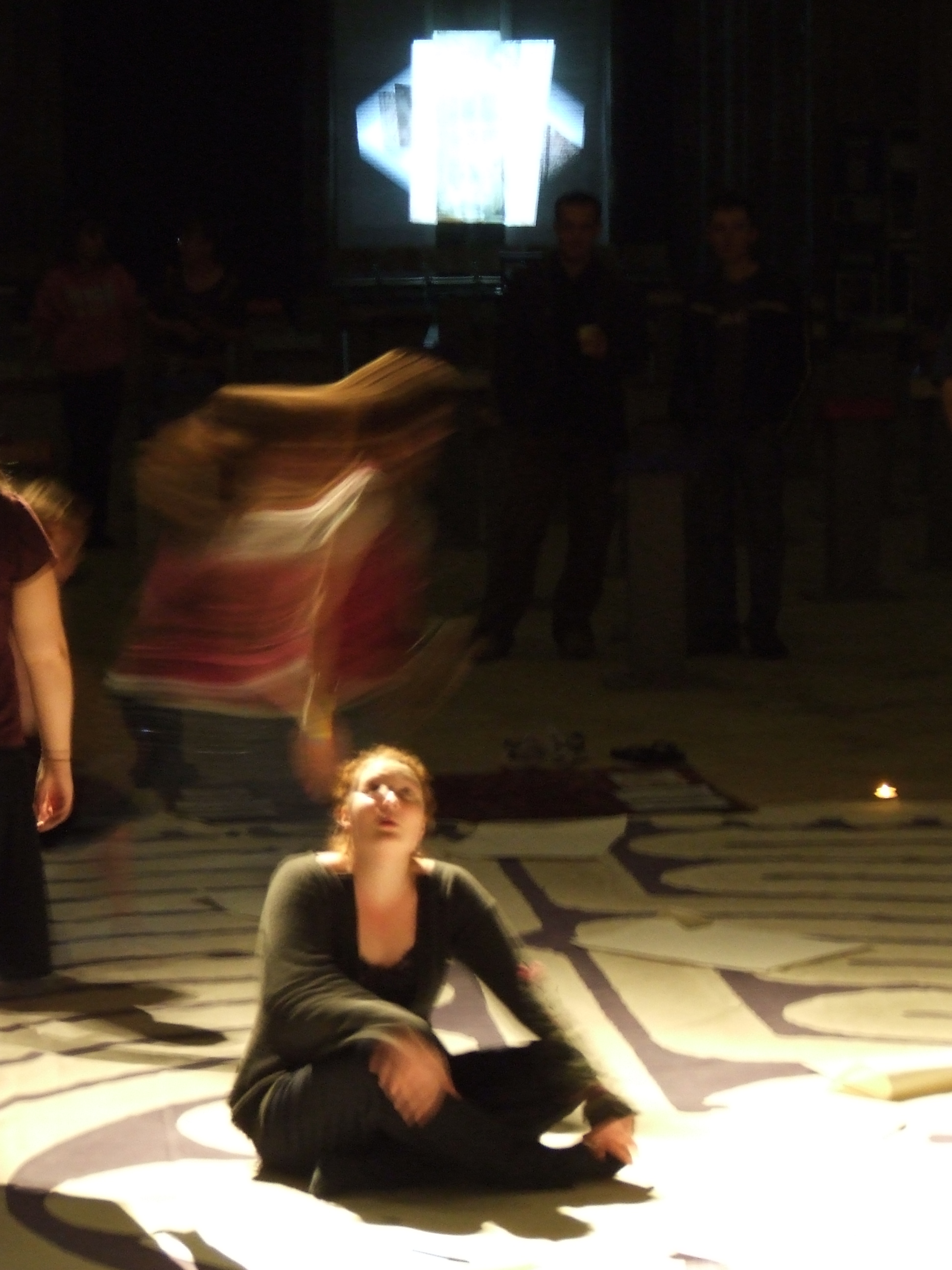
I love this picture, taken of a little girl dancing in Gloucester Cathedral during the Tautoko gathering last year. It represents the freedom that I hope for for my own kids-

Tautoko network…

Michaela and I are just back from a lovely weekend down south- attending the Tautoko network gathering in Ironbridge, Telford. Our friends and fellow Aoradh members Simon and Helen went down this year which made it all the more special.

Tautoko (apparently a Maori word meaning a group that seeks to support/uplift others) is a network of people who are involved in emerging church/small missional communities/new monastic communities/alternative worship. This is how the network defines itself-

A network of uk based mission practitioners and communities who are restlessly trying to follow Jesus in the midst of a changing contemporary culture.

To share the journey with others who face similar mission challenges.
For mutual friendship, encouragement, solidarity, support, gift giving, discernment, resource sharing, ideas and learning.
To see what emerges as creative people connect.

Ethos:
Open set
Spin free
Generous
Vulnerable
Questioning

What I like about the network, is that it does not make unreasonable demands on already busy people, or take itself too seriously. It is rather disorganised (although there are moves afoot to bring a little more organisation) and characterised by friendship.

Because of our rather isolated location, the chance to meet up with others and share ideas, hopes and stories is always a real delight. It was great to see some familiar faces, and some meet others for the first time.

I will post a few thoughts relating to conversations later.

Thanks to Jonny, Naz, Gareth and Mark who put effort into the planning and leadership this year!

Some photies-

‘Emerging Scotland’- what next?

A year or so ago, I put quite a lot of energy into trying to find connections with other individuals and groups that were involved in similar para church activities as we were- other people who might use words like emerging/missional/alternative worship.

To this end, I started a Facebook group, set up a few meetings, and began to make contact with some lovely folk.

Stewart then started a Ning site, which has seen some activity, and has over 100 members. There have been further meetings, and on line discussions. However, Ning are changing the way that they operate, and will be charging people to use their sites soon.

The question then arises- what next?

I thought I would reproduce my recent comment on the Emerging Scotland Ning site here. Any comments/ideas/thoughts welcome…

Hi folks
I have been thinking a bit about the site, and what we might be its future…
I started the facebook site a – which is here.
.
Activity on the FB site has kind of dried up- perhaps because we replaced it with the ning site, but also perhaps this is a natural progression of all on-line networking. We tend to start well, and make some connections, but then move on to other stuff. The net tends to pull us constantly towards the next ‘new thing.’
.
There is a danger that the site becomes just a place to argue about theology- which quickly becomes boring and pointless for most of us, even if important to others.
.
There is also the real question as to whether the ’emerging’ word still has any currency. It still might be something that enables people to gather around a vague set of questions- but increasingly, it is not a term that people are using. I am not sure what might replace it though- Missional? This word always seemed a little contrived to me.
.
When I started the ES FB site, my hope was that we might see the development of a supportive ’emerging’ network in Scotland- facilitated by on line stuff, but not exclusively on line. This was partly about our own needs here to find partnerships, mentoring, encouragement, and cross-fertilisation of ideas, but also an idea that developed out of a number of conversations with others. People described isolation, and a lack of freedom and permission to do things differently.
.
I hope and believe that this has been happening through some of the connections made through Emerging Scotland, but to be honest, I still wonder whether we could or should do this better.
This rather depends on whether there are enough of us that want to do this- I know that many are busy with churches and organisations, and feel that they have more than enough networking, and perhaps no time/energy for more.
.
However, if people are still interested in developing physical connections, then I would propose that we put a little more energy in developing some local meetings- as already began to develop for a while. A few ideas that occur to me ‘off the cuff’-
.
1. a meet up at SOLAS for those going there in a couple of weeks (some of us will be there on the Saturday?)
2. specific interest meetings- worship, youth work, community building
3. Developing partnerships around activities- sharing skills and resources
4. Joining other networks- such a Emergent, or CMS.
5. Setting up some kind of loose administration/facilitation process-or asking an established organisation to host this for us
.
I think the bottom line for me is that if we move to facebook, and the current low level of activity continues, then it would be no bad thing. I will probably call in from time to time (although I rarely use FB these days.) However it will be a missed opportunity- and I suspect that Emerging Scotland will kind of atrophy.
.
Those of you who blog or have access to other information portals, perhaps it is worth broadening the discussion and asking people to consider what they need?
.
Cheers
Chris

Alternative worship, retrospective…

(I love the photo above by the way- it was one of those accidental images, taken in the half light of Gloucester cathedral last year.)

I have been thinking a lot more recently about ‘alternative worship’.

I think for many of us, the precursor to these new form of worship and spirituality was charismatic soft rock worship. In the past our spirituality was expressed almost exclusively through weekly climactic events- ecstatic music and inspirational preaching. This form of worship tailed into boredom and irrelevance for many- at the same time as people began to realise that it was possible to rediscover and re-invent many older spiritual practices- and to encounter these in smaller and less hierarchical communities.

Others found their way into alt worship through a dance/club sub culture- which was extremely influential in the early days. Still others were seeking to discover authenticity in more traditional liturgical environments.

Can I point you towards this podcast which digs into the background and history of the movement.

It features an interview with Jonny Baker– who, for those who might not know of him, is one of the movers and entrepreneurs of all sorts of interesting church and community projects, including the worship community Grace, a co-founder of the outlet for lots of resources that is Proost and part of the CMS team who are encouraging so many good things, particularly in the C of E, but also around the world. Jonny has been very encouraging to me personally- around the writing I have done, but also as part of the wider network of small groups doing different mission/community/worship things. A good bloke- with the experience and intelligence to say things that are worth listening to.

This podcast digs into the where alternative worship came from, in all its messy creativity, but also asks where we are now.

I think we are at  a point where we need to re examine what alternative worship means- this for both personal local reasons, and for wider ones. In terms of the wider issues first-

The clue is in the title- ‘alternative’. What are we an alternative to? And at what point does someone need to find an alternative to the alternative? it is a term that was formed in change- but of course change soon become establishment, and needs further change.

There appear to me to be different strands already developing. There are some small but high profile urban groups, whose efforts are focused on creating high concept art. These groups are great as exemplars and as inspiration, but most of what they do- in terms of resources, skills and the sub cultures they grow out of- are beyond the rest of us. Perhaps for some they are even alienating and confusing.

Other alternative worship forms appear to be being incorporated and embraced by traditional church- as a way of bringing life and renewal to old structures. Of course there is always the danger that this becomes window dressing for the same old same old.

Then there are groups like mine. Fragile collections of disparate people who are perhaps not trendy or well resourced, but are trying to use skills that we have forgotten that we possessed and (far more importantly) trying to learn how to love each other, despite all the usual obstacles. Here the focus rapidly shifts from doing exciting stuff and being involved in a ‘new thing’, to how we can live with each other in the presence of our hurt and brokenness, and how we can lay ourselves down to worship in a way that is authentic and true despite all this baggage. I suppose this is not alternative worship- it is just worship– perhaps using a wider tool bag to assist us along the way.

For me, this is partly about laying down our ‘art’ and embracing community. Not a thing that I find easy at all. It is also about radical involvement and inclusion- and allowing worship to arise from your context. Our group has many people who are talented ‘craft’ people for example, and a few poets. So we tend to have lots of cutting and sticking and some lovely poems. We are less driven by technology. But should others come who have these skills, the trick will be to involve and encourage…

Holy space

Some of these issues feel very real and pressing to me at the moment. This for two reasons.

Firstly, Aoradh is still in the middle of a rather developmental transition at the moment. I think we will survive, but at times I have wondered. It is nothing even faintly surprising to anyone who has ever been part of small pioneer groups- all the familiar issues of ethos, focus, the need for honest open relationships and to challenge certain behaviours in a loving and caring way. Oh, and that old issue that we have avoided- LEADERSHIP.

We have been meeting to talk about these things, but this has taken so much energy that we have had little left to be creative and passionate about worship- which kind of defeats the purpose! However, we now have a few things on the horizon, which brings me to the second point.

We are keen to keep our focus LOCAL- finding spaces and partnerships in our own local community. But along side this, we have been invited to participate in some larger national events- like Greenbelt and the new Solas festival. It is an honour to be invited, and also potentially great as a boost for what we are about, and a chance to discover new ideas and friendships. But it also brings into focus some of the issue above.

For instance Greenbelt alt worship has changed. We are being asked to throw ourselves into a creative soup with some other groups to create a day long session. This involves a whole lot of negotiation and on-line collaboration with groups whose ethos and philosophy may well be very different from ours- whose context and constituent parts demand a very different style and approach. Mark Berry has stepped forward to curate and co-ordinate the day we are involved in, and it is going to be fascinating to see how these things come together.

The early discussions have had an interesting effect on my group. We all have different levels of comfort with uncertainty, and some of the e-mails flying round have led to a kind of general retreat, as they have dealt with concepts and ideas that seem beyond us. We are in a developmental phase, but some of my friends are just stepping backwards.

I found myself wondering whether alternative worship is  in danger of becoming a showcase for the kind of experiential celebrity driven ‘performance’ that I was glad to leave behind when I stopped leading large scale soft rock worship services.

The heart of this thing (I think) is how we encourage one another as we stumble towards Jesus, and of creating deliberate communal spaces to share this journey.

I have found so much life and encouragement around alternative/emerging/missional practices. But they are just words after all…

    New monasticism comes of age…

    The concept of a new kind of monastic community has fascinated me.

    Perhaps because I lack discipline in life, and so practising a deliberate spiritual rhythm has seemed both extremely attractive but rather out of reach.

    New monasticism has gathered interest as a rather trendy form of church community- growing on the edge of ’emerging’ stuff. It has links with the 24-7 prayer movement, as well (of course) as much older traditions. It has a radical edge that is also attractive to me.

    Today- driving back from Lochgilphead in the darkness after a long meeting- I tuned to radio 4, and caught the end of ‘beyond belief’, which included interviews with a member of Moot, and a general discussion about- new monastic communities. It was a searching discussion, which asked some important questions about the nature of monastic life, and whether this new monastic stuff really involved the same amount of ‘giving up’ and setting out on a real path of self sacrifice. Commitment is not for life- but for a season. Perhaps until the inevitable small group conflict begin! You can listen again on the i player- here.

    It is also clear that some of the new communities do not seem to regard themselves as standing in the same tradition as the old monastic way of being- but rather seeking a deeper life (not necessarily overtly Christian.)

    It is worth checking out the interview on the Moot site with Shane Claiborne.

    I see there is a new Ning site- New Monasticism Network.

    My own small community is in the process of chewing over what we mean by ‘community’.  We are going through what I can only describe as a 4 year barrier- when we are having to look to re-examine ourselves. It has been painful and challenging, if necessary. New labels and concepts are not for us at the moment- rather we just need to remember to practice the disciplines of friendship and love.

    Because the formation of any small community, as previously discussed, can be a process of such incredible highs, and such terrible lows. Jonny Baker pointed out these posts by Ian Adams. I really liked what he had to say, which seemed loaded with wisdom- and I suspect, hard experience!

    In any community there will be always be a lot of focus on what we do. That’s fine – the actions of the community, its surface life – are important. But behind the activity is something less obvious, more subtle, and perhaps even more important. This is what I think of as the spirit of the community.

    Almost every family, project, team, society or business has a spirit or value system, often unrecognised, and sometimes less than positive. Gracious or greedy, caring or care-less, transparent or manipulative [or a mix of those] – the spirit of a community is how it feels to encounter it – and the spirit of thing has the power to create something beautiful – or to trash it.

    Because these small groups of ours- they are very fragile. They need loving and nurturing. Sometimes we just want to walk away- and perhaps there is a time to do just that. But they also offer such hope and life.

    So, whatever your label, may you find friends and fellow pilgrims to travel with. It is the Jesus way…