Vocation…

Yesterday I received my redundancy letter. It was not a surprise- it has been two years plus in the writing. Neither was it entirely without choice, I have decided not to accept offers of alternative employment within the social work department.

Which brings me to this word-vocation, defined in the dictionary as

vo·ca·tion

[voh-key-shuhn]  Show IPA

noun

1.

a particular occupation, business, or profession; calling.
2.

a strong impulse or inclination to follow a particular activityor career.
3.

a divine call to God’s service or to the Christian life.
4.

a function or station in life to which one is called by God: thereligious vocation; the vocation of marriage.

But also defined here like this;

The idea of vocation is central to the Christian belief that God has created each person with gifts and talents oriented toward specific purposes and a way of life. In the broadest sense, as stated in the Catechism of the Catholic Church, “Love is the fundamental and innate vocation of every human being” (CCC 2392). More specifically, in the Orthodox and Catholic Churches, this idea of vocation is especially associated with a divine call to service to the Church and humanity through particular vocational life commitments such as marriage to a particular person, consecration as a religious, ordination to priestly ministry in the Church and even a holy life as a single person. In the broader sense, Christian vocation includes the use of one’s gifts in their profession, family life, church and civic commitments for the sake of the greater common good.

I entered social work as a vocation. It was almost a priestly thing for me. This might be difficult for others to understand-it is not as though social work has a status that might be seen to deserve respect. But there are lots of parallels- both are concerned with pastoral care, both are (or were) driven by higher ideas and ideology, both are embedded in institutions in the main.

To leave a vocation is no easy matter.

Reading through the second definition of the word (above) I wonder about this suggestion that God has created each person with gifts and talents oriented toward specific purposes and a way of life. This reminds me too much of old conversations about some kind of plan that God has written for each of us in some kind of massive ledger, and woe betide us if, like Christian in Pilgrims progress, we step off the golden path into some kind of career apostasy.

Such determinism has little place in my understanding of our pilgrim journeys, but we all make choices, even if the choice is to not change a thing. I do not know clearly what my vocation is at the moment. I have some clues of course- if I was to get to the very heart of things, it would be to create– to write words that inspire and shape the thinking of others. Whether this is a realistic vocation now has to be tested!

But this bit of the definition above I can stand on firmly;

Love is the fundamental and innate vocation of every human being”

And the application of this in the ways that we come to live, this is the long road that we Christian pilgrims have to travel.

Travel well…

Conversations on being a heretic…

There is a great video of a discussion between Brian McLaren and Scot McKnight here;

Conversations of being a heretic

McLaren is always worth listening to even if (like McKnight) you find him to have gone too far down the path of heresy. His intelligence and humanity mingled with a deep faith have been for many of us the means by which faith might live on beyond the religious straight jackets that we have gratefully shed. He has been a pioneer into new and deeper understandings, and these people are always seen by the establishment as heretics. Just read the comments under the video clip.

The Edge of the World…

I have been really busy this week making a bedroom for William out of one of our scruffy box rooms. This always involves far more work than you think- particularly when you want to make the most out of a small space. He is delighted with his new room, and this means that his old room, with amazing views out over the Clyde, can start it’s transformation into a B and B room.

In the middle of all the chaos I sat down with a cup of tea and flicked on the TV, and a film was showing that I had heard about, but never seen- an old Michael Powell  film, made in 1937 called ‘The Edge of the World‘.

The film was Powell’s first feature film and grew out of his fascination with the changes happening out on the edge of the British Isles- the depopulation of St Kilda in 1930 in particular. He wanted to film there but it just was not practical, so he made his film on another wild wonderful island- Foula, 20 miles West of the Shetland Islands. The cast and crew lived there for several months, even having to build their own dwellings.

I think this film, dated as it is, contains fascinating glimpses of a life now gone in our far flung islands. A time before air travel or fast ferries and mobile telephones. A time of the corncrake at the edge of hand harvested fields and hands twisted from hard work.

Anyone who has spent time in any of these isolated wild places will know that they can have the capacity to change you inside. Powell went back to Foula in 1978, thankfully still with a thriving community, and made another film for the BBC. He too had been shaped and changed by the islands.

This is one of the reasons why I take my own pilgrimages out into the Hebrides whenever I can. We will be heading out again in a couple of weeks.

Hmmm- I feel another plug coming on; if anyone wants to join one of our wilderness pilgrimages you may like to check out some of the photo’s and info on our Facebook page.

‘Making missional communities’ podcasts…

Graham sent us a copy of the recording of our talk about making small missional communities at Calvary Christian Fellowship near Preston.

We were invited to take a road trip to describe something of our experiences with Aoradh, and we structured the discussion into three main sections ‘in’, ‘out’, ‘up’ with me talking about some of the background and theory (such as it is!) behind what we do, and Michaela describing our activities in a bit more detail. We tried to be really honest about the difficult bits as well as all the great stuff.

I have uploaded it as a series of podcasts, partly because other folk in Aoradh might be interested to know what we said about them, and also because the issue of how we make and sustain community in these fluid postmodern times seems to be pretty important, so others might like to hear something of our story.

You should be able to download the different sections on these links, but I am told that ‘ourmedia’ sometimes takes a little while to make uploads ‘live’, so you may need to come back a little later…

Making missional communities 1

Making missional communities 2

Making missional communities 3

Making missional communities 4

Making missional communities 5

Making missional communities 6

Making missional communities 7

Making missional communities 8

Aoradh Easter service…

We are just back from a lovely Easter service.

Thanks to the kindness of Aileen, one of our local ministers, we were given permission to use the beautiful Inverchaolain Chapel– out along Loch Striven. It is a small simple stone building, cupped in the bowl of the hills next to the Loch.

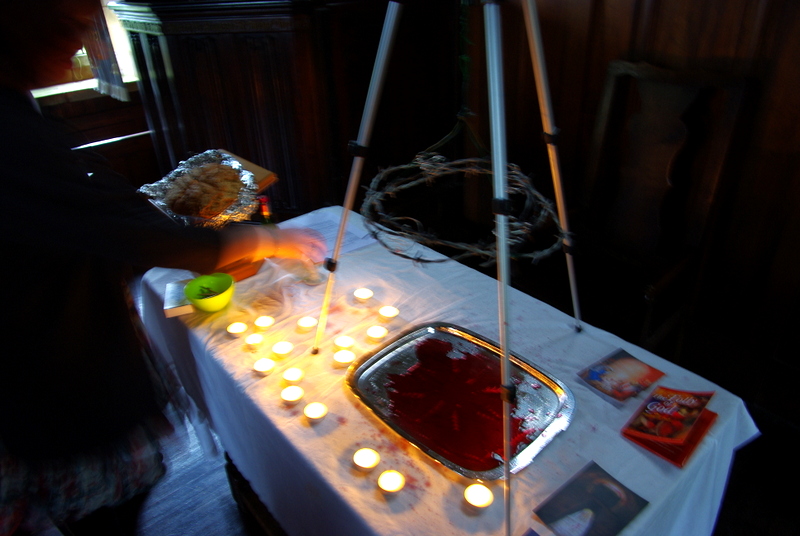
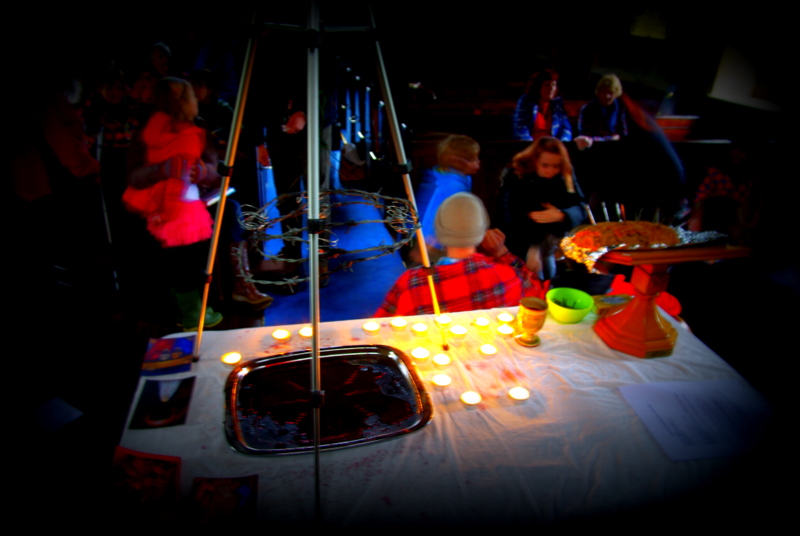
Audrey led us through a liturgy, using some ideas borrowed from Tabled– which is a fantastic collection of creative ideas for communion. We used two objects- one was a crown of thorns suspended with little baskets containing frozen cubes of wine, which dripped down onto a silver tray and a white cloth. The other was a loaf of bread into which we asked people to push nails. The images were powerful and Audrey’s words complimented them wonderfully.

(By the way- if you try the frozen wine thing, bear in mind that wine does not freeze very well- better to use water with some food colouring.)

Afterwards we went back to Andy and Angela’s as the planned picnic was rather rained off. No matter though, we took with us something precious that brought a deeper sense of the death of Jesus, and his resurrection then, and through us, now.

‘The wrath of God was satisfied’

Within churches across the western world, many of us will be singing this line today- from the modern hymn by Stuart Townend, ‘In Christ alone’. The whole verse goes something like this;

In Christ alone! who took on flesh
Fulness of God in helpless babe!
This gift of love and righteousness
Scorned by the ones he came to save:
Till on that cross as Jesus died,
The wrath of God was satisfied –
For every sin on Him was laid;
Here in the death of Christ I live.

It is a great hymn, deeply emotional and soaring in its melody. However I increasingly find the one dimensional nature of it’s theology really difficult. It is this one line about the wrath of God. It conjures up the idea of some kind of unstoppable force of holy hate and destruction in the universe that was narrowly averted only by the torture and death of Jesus.

This is another one of those underpinning assumptions of Evangelicalism that most of us accepted as unassailable truth- Jesus died the horrible death on the cross that was rightfully ours and because of this, God was able to undertake some kind of divine conjuring trick for some of us. This was the only way to overcome the natural forces of justice in the universe. It was the only way to deal with the wrath of God.

For non theologians like me, the fact that this kind of understanding of the atonement of the cross is not the ONLY way of understanding the central drama of the Christian faith might come as a surprise. Recently of course, a number of hugely controversial books have emerged taking a new look at the issue. The authors of these books (Rob Bell, Steve Chalke, Brian McLaren) have often been subjected to the outrage of the faithful.

So, on this Good Friday, I thought that it might be worth examining some of the other understandings of atonement- the other ways that followers of Jesus have attempted to come to terms with the enormity of a God who would come to earth to die such a death.

The name given to the theory of atonement outlined above is ‘Substitutionary atonement’ or sometimes ‘Penal Substitution’. However rather than talk more about I think it would be useful to take a journey through atonement in church history.

Firstly, there is a summary of some of the ideas in this clip by Tony Jones, along with some of his own hard hitting alternatives;

There are other theories of atonement, but here is a quick summary of the dominant ones again;

Moral influence

In this view the core of Christianity is positive moral change, and the purpose of everything Jesus did was to lead humans toward that moral change. He is understood to have accomplished this variously through his teachings, example, founding of the Church, and the inspiring power of his death and resurrection.

This was the atonement theory dominant in the early church in the second and third centuries and was taught by the Church Fathers. It was also popular into the middle ages and beyond.

Ransom theory

Jesus liberates mankind from slavery to Satan and thus death by giving his own life as a ransom. Victory over Satan consists of swapping the life of the perfect (Jesus), for the lives of the imperfect (mankind).

Christus victor

Here Jesus is not used as a ransom but rather defeated Satan in a spiritual battle and thus frees enslaved mankind by defeating the captor. This theory continued to influence Christian theology for a thousand years.

Satisfaction

This theory grew from the work of the 11th century theologian Anselm.  Mankind owes a debt not to Satan, but to sovereign God himself. A sovereign may well be able to forgive an insult or an injury in his private capacity, but because he is a sovereign he cannot if the state has been dishonoured. Anselm argued that the insult given to God is so great that only a perfect sacrifice could satisfy and Jesus, being both God and man, was this perfect sacrifice. Here we see the influence of earthly politics projected onto the heavens.

Penal substitution

The Protestant reformers developed Anselm’s theory.  Instead of considering sin as an affront to God’s honour,  rather sin is regarded as the breaking of God’s moral law. Placing a particular emphasis on Romans 6:23 (the wages of sin is death), penal substitution sees sinful man as being rightfully deserving God’s wrath with the essence of Jesus’ saving work being his substitution in the sinner’s place, bearing the curse in the place of man (Galatians 3:13).

A variation that also falls within this metaphor is Hugo Grotius’ “governmental theory“, which sees Jesus receiving a punishment as a public example of the lengths to which God will go to uphold the moral order.

Some would argue that all these theories contain part of the truth, and (in the absence of certainty) I think I would agree with this.

Apart from this thing that we call ‘the wrath of God’.

I would contend that our theological projections of God are always partial, always incomplete and always emerging from our cultural perspective. So it was natural for the children of the modern enlightenment to see God as embodying a force of logical, highly technical justice. It seemed like the elevation of mankind towards democratic freedom mediated by the purity of the law was a process ordained by God, and so this must also be the character of God himself.

God the judge- stern, inflexible, bound by the fine detail of the law, but able to save a narrow few through a technicality.

But today we remember the death of a man Jesus.

The scandal of the cross.

The unreasonableness of the cross.

The injustice of the the cross.

The laying down of all power and majesty, the ultimate vulnerability of the cross.

The end of all our hopes on the cross.

The defeat of the cross.

The humanity of the cross.

And the mystery unfolds within us.

Rowan Williams resigns…

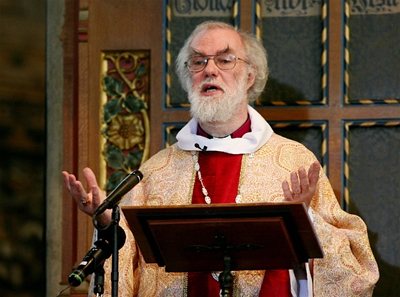
Today it was announced that Archbishop Rowan Williams is to resign as Archbishop of Canterbury and return to academia as master of Magdalene college, Cambridge from December of this year. I am not a member of the Anglican Communion, but my roots still reach back in this direction, and I feel a real sadness at the departure of this gentle, thoughtful and gracious man from his key leadership role.

His time as leader was marked by division- over women in ministry and homosexuality in particular. Time and again he has sought to be a bridge for debate and understanding, but the chasms remain between the liberal reformers and the Evangelical wing of the church.

Rowan Williams seems to have been criticised from both the liberal side (because of his reluctance to take on the theological conservatives in open warfare) and from the Evangelical side (because of his refusal to stand on a narrow interpretation of scripture on key issues.) But to me, there was always the feeling of deep integrity in all that he did. He has been a leader to be proud of. The Church in it’s widest sense will miss him greatly as it seeks to move into our new context.

As for the CofE- what next for the old girl? Who will be the next Archbishop? And what direction will he seek to steer? Can the Anglican Church survive in it’s current form?

The Guardian mentioned Archbishop Sentanu– who might yet be the first African born Black Archbishop. Another mentioned is Bishop Chartres, who has been opposed to the ordination of women, and was at the centre of the controversy over the way the church handled to recent protests outside St Paul’s Cathedral.

Whoever takes over, they will need our prayers, and could learn a lot from Rowan Williams.

Williams was never a popularist- there was little about what he said that could ever be reduced to a sound bite. It was always too thoughtful, too considered, to cerebral perhaps, or too poetic. So by way of grateful celebration for this man who truly has been an apostle in the fullest sense of the word, I will quote one of his poems.

It is slightly unseasonal, but nevertheless seems apposite for a man who seeks the depth of what it means to serve Jesus;

Advent Calendar

He will come like last fall’s leaf fall.
One night when the November wind
has flayed the trees to the bone, and earth
wakes choking on the mould,
the soft shroud’s folding.
He will come like frost.
One morning when the shrinking earth
opens on mist, to find itself
arrested in the net
of alien, sword-set beauty.
He will come like dark.
One evening when the bursting red
December sun draws up the sheet
and penny-masks its eye to yield
the star-snowed fields of sky.
He will come, will come,
will come like crying in the night,
like blood, like breaking,
as the earth writhes to toss him free.
He will come like child.

Rowan Williams

By the way- Greenbelt festival have just made all of their rich and varied back catalogue of downloadable talks free, including a couple by Rowan Williams here– well worth a listen.

Terrorism, religion and the group dynamic…

I spent much of today talking about terrorism. This is not usually part of what I do, but I was asked to attend a local awareness session. In the end it was rather fascinating.

What we tried to think about was the sorts of processes and relationships in our communities that might draw people into extremism, and right away, we people of faith have to concede that one of the most common drivers for this in the world at present is religion.

Many people would have in their mind a stereotypical terrorist, and they well be Muslim, male and aged around 25. There are real problems with these kinds of stereotypes of course, as I have spoken about previously here. There is also a real possibility that we exaggerate the potential threat, and this plays into all sorts of paranoid murky politics.

However, we now know that even our sleepy rural county of Argyll has been touched by terrorism. Several extremist groups have used outdoor centres/outward bound courses up here to breed team spirit, and the bombers who attacked Glasgow Airport a few years ago did so from a holiday home base in our area.

What brings people to the point of being able to justify the use of extreme violence? Of course this is not a new thing, and many would regard the drivers of inequality, imperialism and oppression as fertile breeding grounds. However, today we talked about some of the societal/group pressures that might draw people in;

Belonging

The need to be ‘saved’ from an old life, and released into a special calling, as part of an enlightened elite. So we see some people drawn into extremist groups out of situations of isolation, confused identity, drug addiction and poverty.

Crusade

People often see themselves as on a special mission, to right injustice and to live to a higher calling. There is an exclusiveness to this, and a tendency to see others as weaker, more contaminated, sinful, outsiders to the truth.

Narrowed world view

Extremists are united by a compelling narrative, often focussed on a single issue and simplified to black and white kind of thinking. In this narrative, there will be good guys and bad guys, those on the inside, those on the outside, and a call to fight back.

The drive to proselytise

The need to be bigger, more powerful, to convince others of the rightness of your cause, and to win converts. All other things are secondary and this end justifies all means.

Powerful, manipulative leadership

Leaders who convince, who have elevation over others and able to use hyper emotionality and  charismatic manipulation to bring cohesiveness and common purpose.

Distortions presented as fact

Leaders like this often present historical and theological perspectives, or downright distortions as fact. They emphasis certain aspects (for example eschatology, judgement, Jihad) over others (for example, forgiveness, grace, peace.) People are not encouraged to think for themselves, to test and debate issues, rather they are expected to achieve correct belief.

Removal and isolation

Before every act of violence, there seems to be something in common- a time of removal, sequestration. People are removed, or remove themselves from wider society, and focus on the purity and certainty of their cause, and the need for their final act.

Here is the challenge then- I invite those of you who have been involved in Christian churches to consider this list from that perspective. Those of you familiar with charismatic or fundamentalist denominations may find this list rather familiar. The point is, the group dynamics of religion that distort faith and breed a kind of hatred and destruction do not just belong to the other, they arise from who we are as humans.

Jesus seemed to understand this very clearly, and anyone who knows his teaching would see it as the antidote to all of the above. He seemed to reserve his anger almost exclusively for the kind of religion that valued the law (or religious understandings of the law) over people.

And yet we stand in the shadow of two thousand years of repeated examples of where the group dynamic within our churches has become toxic and released all sorts of hatred, judgementalism and even death as a result.


Opening worship…

We had an Aoradh meeting tonight to plan some activities. We talked about a ‘benches’ event (using benches as meditations stations, possibly in conjunction with Cowalfest,) a Labyrinth, and we also had a long conversation about plans to collaborate with some friends in a local church in the creation of a new regular worship service.

This is a new departure for us for several reasons- firstly it would amount to a regular ‘service’ (however loosely we understand what this might mean.)

However, it also opened up a lot of discussion about what is meaningful to us in worship. Some of us still just love to sing. Others lived in the shadow of long experiences of overly manipulative music dominated worship services, in which we felt like we were being told what to do, what to experience, what to feel.

So, the journey continues; to find ways towards authentic, open hearted, hopeful, respectful and creative worship.

For me too there is still the challenge of finding how to use authentic, open hearted, respectful and creative worship music. For some time I have laid music aside. I still feel that I need to encounter wider ways to worship.

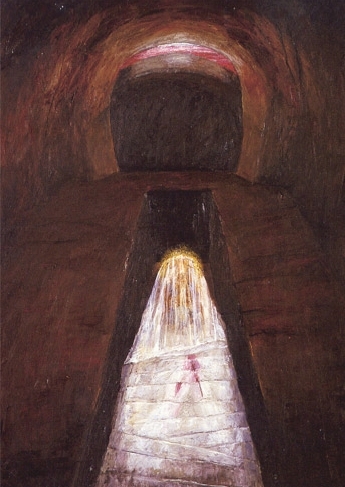
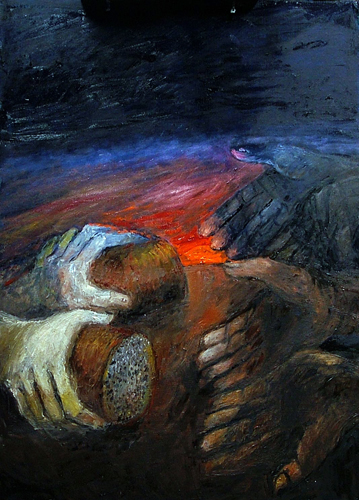
Tonight Michaela handed around some cards with images on made my Sieger Koder– they were a present from our friend Maggy, and part of a collection called ‘The Folly of God‘. They are intended as aides to contemplation and worship- in a purely visual sense. This is all a little alien to me really. I am much more driven by words.

But this is the point- to be open to the new. To be ready to be challenged, shaped changed by things that we encounter, take into ourselves, then give back.

Michaela has asked us to live with the image we picked and we will meet on Easter Sunday to speak about our experience.

Here are a couple of Koder’s paintings;