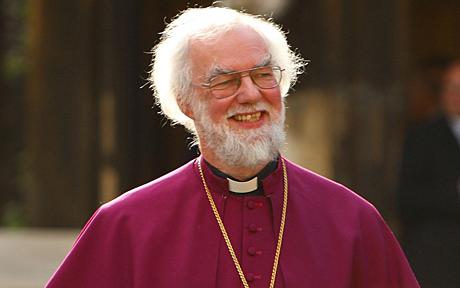
The Archbishop and the little girl…

Did anyone see this story over the weekend?

It seems that the father of a little girl called Lulu took objection to the teachers at her Scottish Church primary school ‘doing God’. Curiously Lulu was asked to write a letter to God, entitled “To God; how did you get invented?”

Lulu’s Dad, who is not a believer, cheekily forwarded the letter to the Scottish Episcopal church (no reply- sorry Andrew!) the Church of Scotland (no reply) the Catholic church of Scotland (a nice but complex answer) and finally to Lambeth Palace- and received this reply;

Dear Lulu,

Your dad has sent on your letter and asked if I have any answers. It’s a difficult one! But I think God might reply a bit like this –

‘Dear Lulu – Nobody invented me – but lots of people discovered me and were quite surprised. They discovered me when they looked round at the world and thought it was really beautiful or really mysterious and wondered where it came from. They discovered me when they were very very quiet on their own and felt a sort of peace and love they hadn’t expected.

Then they invented ideas about me – some of them sensible and some of them not very sensible. From time to time I sent them some hints – specially in the life of Jesus – to help them get closer to what I’m really like.

But there was nothing and nobody around before me to invent me. Rather like somebody who writes a story in a book, I started making up the story of the world and eventually invented human beings like you who could ask me awkward questions!’

And then he’d send you lots of love and sign off.

I know he doesn’t usually write letters, so I have to do the best I can on his behalf. Lors of love from me too.

+Archbishop Rowan

Lovely.

Garden resurrection…

We had a lovely day yesterday.

As a celebration of Easter, some of the Aoradh crowd gathered at our house. We ate a meal together, sang some songs, then did some activities with the kids- including the ubiquitous easter egg hunt.

Then we sat round a fire, next to a little stone ‘tomb’ and told the story of the Mary, and the garden.

Then we lingered. And spoke of life, and faith.

It felt very special- in the way that deep time with friends can be… a lovely way to celebrate Easter.

Lent, 40…

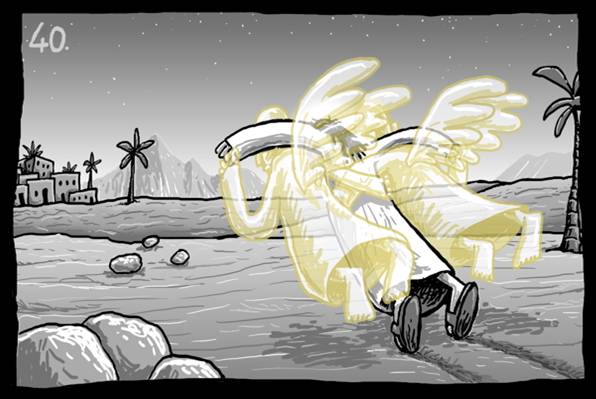
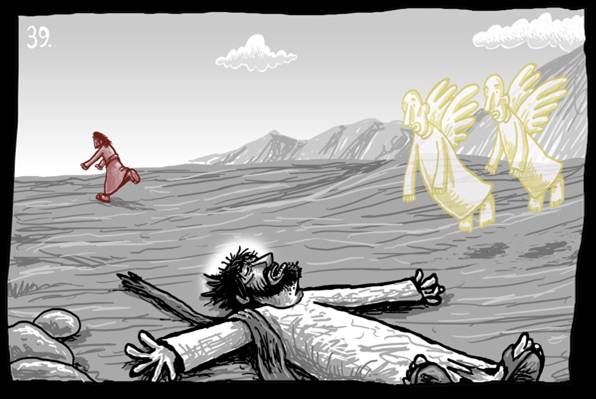
I know that strictly speaking lent ended yesterday- but here is the final piece from ’40’- Si Smith’s lovely images of Jesus in the wilderness, along with my words. It has been quite a journey. If you enjoyed it, then you can download or order a physical copy of it from Proost.

So, the journey continued- back into a world of men-

.

To all the homes and houses

And the broken down old shacks

To the Priests and the soldiers

To the slaves and the fat cats

.

To the athlete and the cripple

To the beggar and the king

To the broken and the dying

And those who have no song to sing

.

To the place where children squabble

And the old folk gossip in the square

And the singing from the synagogue

Calls the town for prayer

.

To all this living and this loving

This fecundity of life…

.

Now is your time my friends

And mine

Easter- the story in the garden…

I wrote this piece for our Aoradh Easter gathering… He is alive!
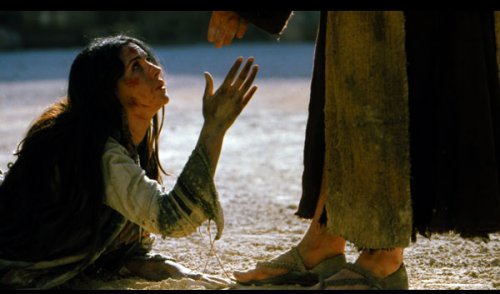
It was still dark when Mary left the house.

Not that she had been sleeping. The house was full of fear since Jesus had been taken. Fear of the soldiers coming by torchlight and beating on their doors. Fear that they too would face a long lingering death on a cross.

But there was something worse than fear- worse even than death. When they killed Jesus, everything that Mary had hoped for- everything she had believed in- had fallen apart.

All she had left was a dead body.

To prepare for the grave.

She would have gone sooner- but yesterday had been a religious festival, and the pew police would have been out in force to prevent anything that looked like work. Particularly this kind of work, for this kind of man.

So she carefully closed the door behind her, and gathered her cloak against the morning chill and walked softly through the empty streets towards the edge of town.

As the sky lightened to the east, she came to a small hilly area, full of cool early morning shadows, and grand old trees. It was the garden of a rich man- where he had prepared a tomb for his family.

He had been one of those ‘secret’ supporters of Jesus- Mary felt anger burn in her- another powerful religious type who had a reputation to maintain. Where was he during the terrible mock trial…and the beating…and the humiliation….and the long walk toGolgotha? Still- he had supplied the tomb which was not without risk, and had also paid for some expensive perfume and spices with which to prepare the body. Guilt money she thought, bitterly.

It was already getting lighter as she walked under the trees, the dew on the grass soaking the hem of her skirt. It suddenly occurred to her that the tomb would be closed. The stone would have been rolled across the entrance and her journey would have been in vain. A sudden anxiety quickened her steps.

A rocky outcrop lay ahead, still laced with morning mist. She was almost there.

As she reached the tomb, shafts of low sunlight were beginning to filter through the trees, making it hard to see clearly.

The tomb was open.

Someone had moved the stone.

Mary’s pace slowed almost to a stop. She walked as if through water. And she had forgotten to breathe.

Standing in the entrance to the tomb, her eyes had to adjust to the darkness. She finally took a shaky gasp of air, and steeled herself for the task ahead.
Steeled herself for another glimpse of that broken body.

But the stone cut slab lay empty.

Empty apart from the winding sheets.

At first, she could not take it in. What was this? What did it mean?

Then it hit her like a new bereavement. It was not enough that they should just kill him, they also needed to erase his memory from the people. The last thing they needed was a shrine to give a focal point for more of his kind of revolutionary activity.

They had taken the body.

They had taken her Lord.

……………………………………………………………..

Later, when she told the story (and there were always people who wanted to hear it) she would always struggle to remember what happened next.

She knew that she had started running- retracing her steps through the garden, and back into the town. The streets were coming alive, and she must have looked like a mad woman, running crying over the cobbles and hammering on the door.

She knew too that Simon and John set off to the tomb to see for themselves, because she followed behind.

She remembered walking the garden, hardly able to see the ground in front of her because of her tears.

In the middle of it all, she found herself back at the tomb- but she was no longer alone. Two men, dressed in white stood with her. She was past caring who they were, or where they had come from but remembered the surprise in their voices when they asked her “Woman, why are you crying?”

A strange question to ask anyone in a tomb.

Then she stood in the morning light again, not knowing what to do, where to go, who to speak to. Feeling desperate, alone and hopeless.

Suddenly, came another voice- “Who is it you are looking for?”

She mumbled something about the taking of a body, and taking him for a gardener, began to ask if he knew anything about what had happened, when another word stopped her in mid sentence.

“Mary” he said.

Spoken softly and gently- with a tinge of humour, and a dripping with of love.

It was a word on which her whole life pivoted.

He was alive.

And now, so was she.


Bible nasties 4- that word ‘context’…

I was reading about a recent archaeological discovery at Fin Cop iron age hill fort, in the English Peak District, near where I grew up.

A mass grave has been discovered- full of the bones of women and children. The bodies appear to have been thrown into the surrounding ditch and the smashed remains of the fort thrown down on top of them.

To make sense of this story, we have to understand something of the context in which the events happened- the culture, the dynastic background, the history.

I read about the Fin Cop massacre at the same time as I was thinking about all that Old Testament bloodshed. The parallels are rather obvious.

In 500BC, most of the killing that the ancient Israelites indulged in with such apparent approval from God was over. They were then a defeated people, living under Babylonian rule. But what hit me again is the approach that many Christians make to the Bible, and the stories that it contains.

The stories tend to be imported into our context with a lot of fixed assumptions.

Firstly the assumption that they are ‘true’- in the sense of being 100% accurate factual historical records of real events.

Secondly, the assumption that God is speaking to us directly through these words, which then require no testing, no wrestling- rather our role is to be passive acceptors of heavenly revelation.

Thirdly the assumption that God himself wrote the words- each individual one, and therefore any challenge to either of the two assumptions above is a direct challenge of God himself, and is therefore heresy.

Perhaps you might think that these assumptions are just fine. I have struggled with them over the years- and coped by not allowing myself to ask questions.

Because once you start, it is impossible to stop.

One of the first questions that start to challenge the above assumptions is this one- context. The writings in the Old Testament concern events that happened around 2000 years before the birth of Jesus. The oldest evidence for Hebrew writing is around the 10th C BC, but most scholars believe that the books of the OT were first written down around the 6th C BC. What this means is that the stories were passed down by oral tradition for countless generations.

Many of these generations, like the people who lived at Fin Cop, were short and bloody.

So stories were told of Abraham, who started it all, and of Jacob who sustained the wandering tribe during slavery. Then there were the stories of the birth of a nation out of the years in the desert, and the rise of great kings and great kingdoms. Stories justified, sustained and unified- particularly during the hard times of exile and captivity.

And in the middle of it all- woven through the whole- is God. Hopes for God, encounters with God, fears cast on to God, prayers to God. A people whose stories are covered by the fingerprints of God.

What might we expect then of these stories, when we allow ourselves to consider something of the context?

Might we expect them to be historically 100% accurate- and ‘true’? Well, frankly no. That is not their point. They were living stories to bring breath to an exiled proud people- they were not eyewitness accounts of a traffic accident (which, come to think of it, are not necessarily ‘true’ either.)

Might we believe that God is speaking to us through the words, and that our role is just to accept them with no challenge, no test, no questioning?  To which I reply Yes, and no. Wrestling and questioning with textual meaning are spiritual practices, when done with honesty and integrity- and the certainty that whatever meaning we find will be partial, and certainly not the final version of truth that will emerge from the text.

Do we need to believe that God wrote/inspired every word, completed and whole, and that to question this is heresy? My answer to this is- no, we do not. But then perhaps I am a heretic. Because I have come to believe that this view of the text has more to do with the need that a modern context had for quantifiable, objective, rationalised evidence for God.

Context is important. As are at least 11 other ways of reading these ancient writings.

But there are many ways to approach this wonderful collection of writing- all of them flawed. Because the words are always filtered through the reader.

Lent 38…

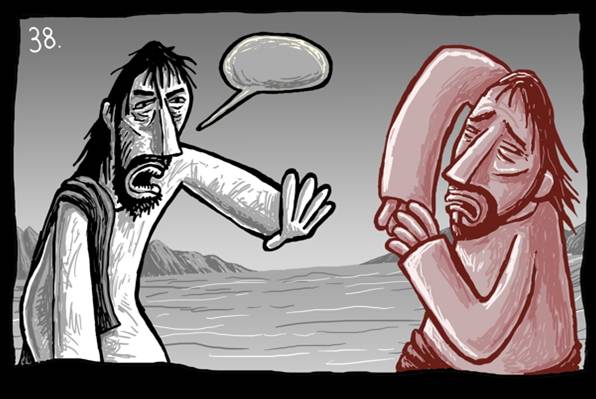
ENOUGH!

I serve only one master-

The Spirit of the Sovereign Lord is on me

He has sent me to the poor and the weak to tell them the good news

He has told me that it’s time to heal the broken hearted-

Shout freedom to all captives, and to break the chains of those you have bound

Now is the time of my fathers grace

And the destruction of your plans

And the stranger

Was gone

Lent 37…

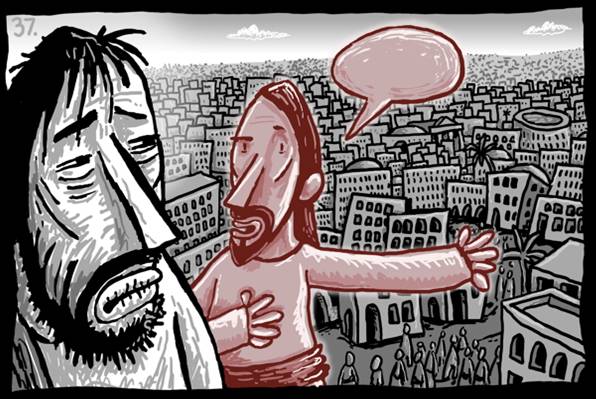
With a howl of disgust the stranger turned again and took the man to a high place overlooking a huge city. So began the third attack

Look you fool- all this could be yours! You cower in the desert and but look- the whole world is at my feet!

I can give you anything you could ever want; Money, power, servants, fame, influence- are these things not necessary to complete this mission of yours?

Why not do things in style?

Why grovel in the dust when you can live like a King?

All I ask is this- do it MY way. Listen to me….

Bible nasties 3- truth and scripture…

(This is a continuation of a series of posts (here and here) asking questions about the dark passages of the Bible. Forgive me if this is all old news to you theological types- I began writing this as a review of where my own thinking is up to….)

So, we come to that truth word. I am tempted to try to deal with this as a philosophical concept- but for now, lets stick to Jesus-

 Then you will know the truth, and the truth will set you free.

John 8:32

What did Jesus mean?

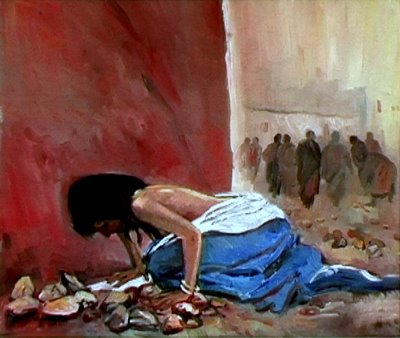
When you read the full passage, the whole thing gets even more complicated- Jesus is in the middle of one of his regular arguments with the religious hard liners- the Pharisees. Firstly they try to catch him out by bringing him a woman caught in adultery- who by law (Biblical, scriptural law that is) should be stoned to death. (Check out Deuteronomy 22:22 for example.)

Leaving aside the fact that only the woman was brought to be stoned, not the man who was the other half of the coupling, what Jesus did here was to take an absolute unequivocal law- an absolute scriptural truth- and turn it upside down and inside out. The way he did this infuriated the religious folk, and thrills us as we read the story.

Next, Jesus claims to be the Light of the World, and the Pharisees try to challenge him using logic and truth- asking him to bring forth witnesses. Then there is a lot of isicussion about the nature of sin- all of it aimed at the very people who seemed to have got it all together in terms of scripture.

So- what sort of truth is it that will set us free when we get to know it?

The church tradition (Protestant Evangelical, slightly Charismatic, left leaning) that I grew up in would have suggested that the issue was that the Pharisees did not get the real truth- they were caught up in surface deep ‘goodness’- all of which may be the case. But this tradition has made a sport of ‘truth wars’ for generations- ever since the reformation there has been a constant schism followed by splinter followed by subdivision- each grouping claiming that their truth was truer than the last one.

And each one of these schisms has used the Bible (or rather their enlightened interpretation of the Bible) as evidence for their claims to truth. Which is just what the Pharisees did. Is this really the kind of freedom that Jesus had in mind?

Is this the kind of truth that he had in mind?

Because in this passage, and in all others, Jesus seemed to apply the truth with a distinct bias towards the poor and weak. It is one of the reasons that I am still captivated by him. The freedom he seemed to promise was from the tyranny of the law- the application of hard, rigid, unyielding truth- particularly when wielded by the powerful. This kind of truth he always (and I mean ALWAYS) seems to have turned upside down and inside out.

Which kind of brings us back to the issue of how we might read, understand and apply the words of the Bible- particularly those troubling aforementioned passages in the Old Testament.

It is probably worth remembering that what we know as ‘The Bible’ is a relatively modern creation- in terms at least of the canon of scripture that is gathered together in the way we understand it now. There is more about this here if you are interested, or check out this summary of the Biblical Canon from Wikipedia. In the pre modern area, Scriptural truth emerged from debates between learned monks, or was ruled upon by the hierarchy of the Church.

Interestingly enough, I was reading something about the early Ionan writings- from the time of St Columba. One of the books that has survived is the Collectio Canonum Hibernensisa collection of biblical Christian teaching and law making, written on Iona some time in the late 7th Century. What is striking about this book is that it often quotes contradictory sources- the was no concern to decide what should be the absolute final truth- rather the writer appears to expect people to look at the evidence, and work it out for themselves.

Does that mean that there is no truth, just debate leading to a thousand personal opinions that shift according to influence and fashion?

Well- some might suggest that this is the logical outcome of post-modernity as applied to religion. The pendulum swing may yet need to correct itself lest we deconstruct everything to it’s eventual destruction (if you will forgive the mixed metaphor!)

Interestingly enough- what I believe is happening in the emerging church conversation at the moment is that the deconstruction phase is over- we are starting to build again. People are starting to be more comfortable in stating what they have come to believe (rather than just questioning what they had once believed.) We see this creating some conflict- as in Rob Bell’s new book. Of course, such concrete statements (even id tentatively phrased) become targets for the  truth mongers. ‘Oh’ they say ‘I knew all along this man was a heretic/a universalist/un biblical.

I think that is why I started to write this series of blog pieces. I feel it is time to take my own stand on some of these issues- you could say, to find my own bit of truth.

But it needs to be the sort of truth that sets me free.

And if it is to be this, then it needs to be a Jesus kind of truth-

Humble

Biased towards the poor and weak

Driven by love and grace, not existing independently of these

Destablising and challenging- not always obvious

Encountered in stories, relationships and mistake making- not just(or even) in written lists of laws

Applied deeply, not just on the surface

Applied first to oneself, but softly to others- apart from those who wield power

Hmmmm….