
You serve me the finest food
Right before my enemy
You lift my broken head
And pour on me your blessing
And your shepherds crook makes me feel safe
Your beauty and love chase after me as long as I live
And I will be back home with you for ever

You serve me the finest food
Right before my enemy
You lift my broken head
And pour on me your blessing
And your shepherds crook makes me feel safe
Your beauty and love chase after me as long as I live
And I will be back home with you for ever
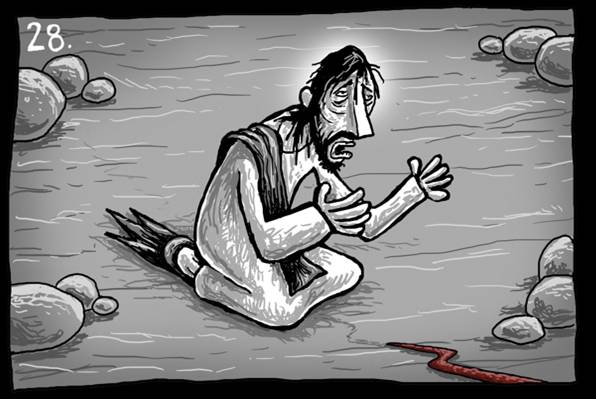
But from the man came this prayer;
.
You are my shepherd
You bring me to lie in dark green pastures
And find me the coolest pools to drink from
You guide me along the paths of your righteousness
And restore my troubled soul
Even though my way goes through the valley of the dead
I fear no evil
For you walk with me

He was a man, and men need food and rest.
So evil saw its chance.
It stalked him- ready to strike.

A C Grayling, secular humanist/atheist has taken it upon himself to re-write the Bible- as a secular, moral document. It seems his motivation was to make available the ‘good’ stuff whilst editing out the ‘God’ stuff.
Fair play to the bloke, people have accused me of the same. The whole emerging church conversation has often been accused of sanitising the unpleasant judgmental side of the Bible in favour of a more accessible and cuddly message.
I do not agree with either Grayling, or the assessment of EC critics of course…
Because the God we encounter in the stories of the Bible is capricious, glorious, confusing, challenging, forgiving, condemning, war making, peace bringing. Because of this, no matter how hard we try, systematising and defusing our ideas of God always fail.
It might be possible to read the Bible as a book of moral fables, of quaint historical interest, but also vaguely character building in indefinable ways. You will have to ignore whole bits of the Bible to do this of course, and along the way may come to wonder whether the Bible can be regarded as ‘moral’ at all.
What makes the Bible vital, engaging and alive is the spine tingling possibility of- God. What transforms the reading of the Bible is the fact that we use it to approach- God.
Without God- there would seem very little point in reading this miscellany of stories of ancient people.
So sorry AC- I will not be reading your ‘Good book’, I will stick to my not so good one, in all its messy challenge.
But then you did not expect me to do anything else did you?
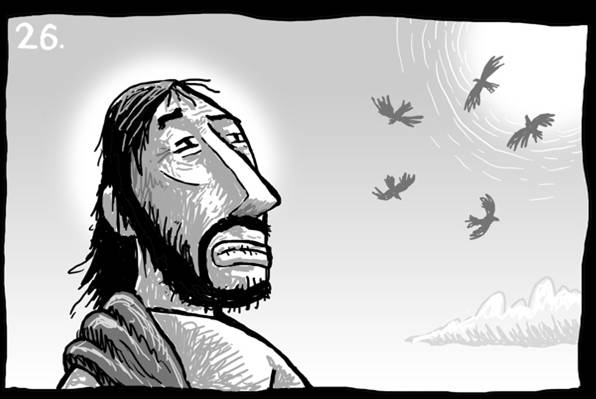
Each day bore down on him.
The horizons swim, liquid in the heat
But he does not stop…
Walking, walking.
Listening.

Here too was cruelty
The desert reached out and tore at him
Thorns scarring his body- ripping into his flesh…
Soon to become
His crown
Even here there were temptations- distractions.
Fruit that promised relief from the cravings he felt
But instead brought sickness, and death.

Time seemed to have no meaning. Hours passed and faded into days.
He walked half in this world, half in another.
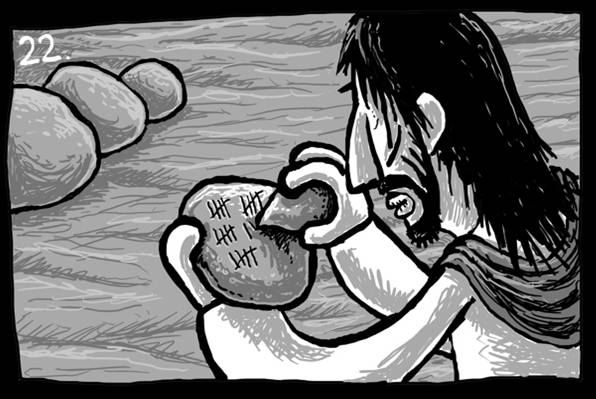
A sharp stone poked him back into full reality, and he picked it up.
A stone to make men stumble and a rock to make then fall.
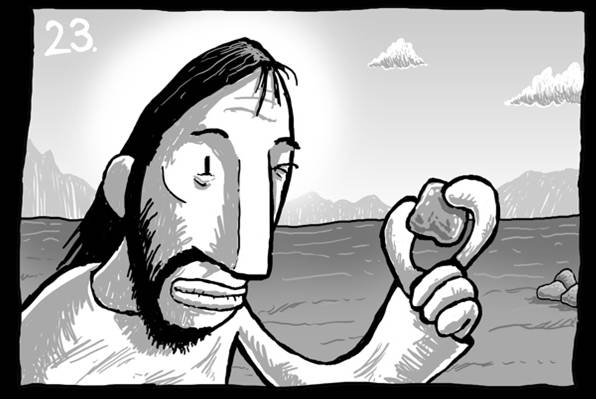
He walked on into days. Still drawn by a voice- now right here, then distant.
One moment closer than his own heartbeat, then just a distant whisper in the desert wind.
Now is your time, my son… and through you all things will be made new.
Did anyone see this on the news yesterday?

(There are more pictures here.)
They could be the earliest Christian writing in existence, surviving almost 2,000 years in a Jordanian cave. They could, just possibly, change our understanding of how Jesus was crucified and resurrected, and how Christianity was born.
A group of 70 or so “books”, each with between five and 15 lead leaves bound by lead rings, was apparently discovered in a remote arid valley in northern Jordan somewhere between 2005 and 2007.
A flash flood had exposed two niches inside the cave, one of them marked with a menorah or candlestick, the ancient Jewish religious symbol.
A Jordanian Bedouin opened these plugs, and what he found inside might constitute extremely rare relics of early Christianity.
The director of the Jordan’s Department of Antiquities, Ziad al-Saad, says the books might have been made by followers of Jesus in the few decades immediately following his crucifixion.
“They will really match, and perhaps be more significant than, the Dead Sea Scrolls,” says Mr Saad.
“Maybe it will lead to further interpretation and authenticity checks of the material, but the initial information is very encouraging, and it seems that we are looking at a very important and significant discovery, maybe the most important discovery in the history of archaeology.”
One of the few people to see the collection is David Elkington, a student of ancient religious archaeology who is heading a British team trying to get the lead books safely into a Jordanian museum.
He says they could be “the major discovery of Christian history”, adding: “It’s a breathtaking thought that we have held these objects that might have been held by the early saints of the Church.”
It remains to be seen whether these books are indeed what they appear to be, and what their pages might reveal. But as Elkington said above, the thought of these books being handled, passed around and treasured by people who had known Jesus- perhaps even his disciples- this brings a tingle to the spine.
Will there be material here that will challenge, and puzzle? I suspect so.
There will almost certainly be a scramble to ‘make it all fit together’. To preserve the illusion (or delusion) of those of us whose faith rests on a particular view of the Bible- as an organic, seamless whole ‘without error or contradiction’.
I do not mean to be critical- but it is just that the more I look, the more I see questions, uncertainties, paradox, cultural and contextual bias. And to deny these is for me deny faith, and replace it with religion.
Faith remains- and the journey of engagement- with the Spirit of God encountered in all sorts of ancient text, but also in the sunrise, and the shared cup of tea.
 this fragile tent