Talking of David- this made me smile-
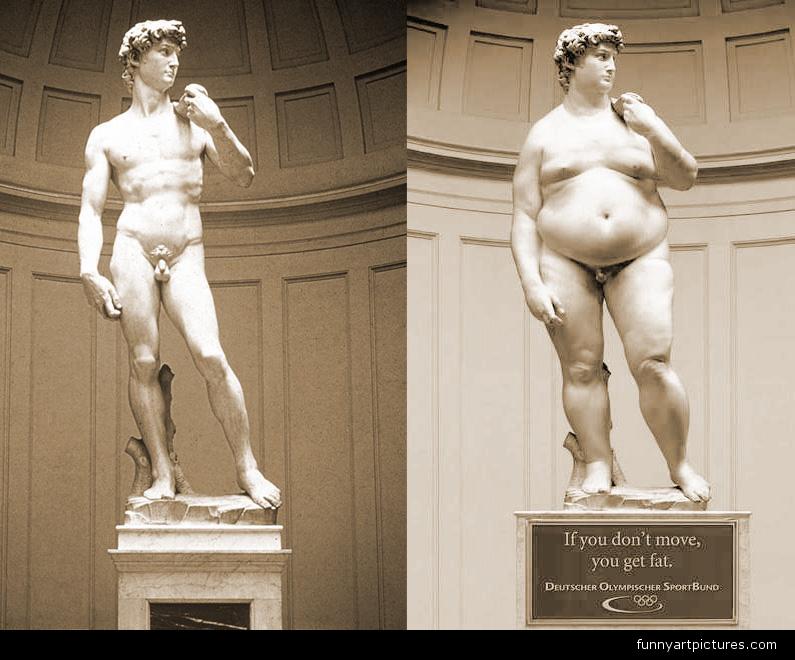
Talking of David- this made me smile-

I have spent some time preparing some meditations on Psalm 131 as part of our continuing Aoradh project to prepare some common meditations, which we then e-mail around our small community (along with others who have asked to be included in the circulation list- let me know if you would like to be included too.)
This next week I have been rediscovering my way into a favourite Psalm of David-
Psalm 131
A song of ascents.
Of David.
1 My heart is not proud, LORD,
my eyes are not haughty;
I do not concern myself with great matters
or things too wonderful for me.
2 But I have calmed and quieted myself,
I am like a weaned child with its mother;
like a weaned child I am content.3 Israel, put your hope in the LORD
both now and forevermore.(NIV)
I thought it might be good to post my contributions on this blog too, so here is the meditation for Monday-
This week we will use the words of one of the shortest and most tender Psalms of David.
David- the all conquering King of an ascendant Holy Nation, whose deeds in battle will be sung for a thousand years.
Whose beauty, talents and wild edge of passion make him the admiration of every man, every woman.
Standing before JHWH.
Consumed by his frail humanity.
Creaking on his feet of clay.
I caught the end of a lovely programme this afternoon on Radio 4 all about ‘pop up cinema’- an idea we in Aoradh have been playing with- where you set up your own cinematic happening.
Simon has had this dream of using the old buildings on Dunoon pier as a temporary cinema/discussion space. Others, it seems are doing similar things…
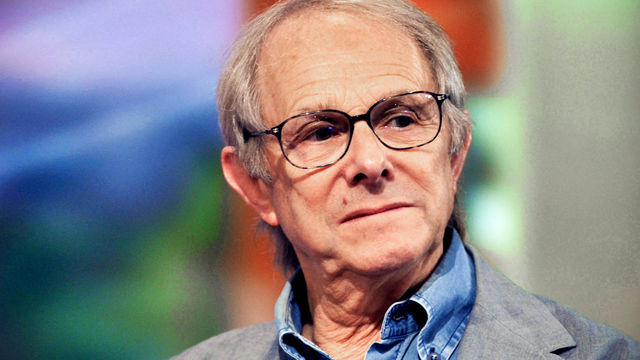
The programme was all the more interesting, as it contained a live (Scottish) audience discussion with one of my favourite directors- Ken Loach. He works in a rather unique way, with actors improvising rather than using a script. His subject material is often working class Britain, and people marginalised and brutalised by poverty.
His films are always challenging, poignant and saturated with humanity. And some have made me laugh out loud. One of the things he said on this programme really made me smile- he said that he could only make films about people that he liked.
This is film making that is motivated by a set of principles a million miles from those that predominate in Hollywood, and we British people should be proud of what Ken Loach has achieved.
The film being discussed on the programme is the challenging Sweet Sixteen– filmed within sight of my house over the other side of the Clyde in Greenock.
A powerful film, that I have not been able to watch twice- but some of the images still linger with me.
Here is a clip- with French subtitles for all you posh people who can’t understand the accent.
A couple of news stories this week brought this issue out into the open again-
Firstly, there was the story about the gay couple who won a court case against a Christian hotel for discriminating against them by refusing to offer them a bed.
Then in another story reported on the news today Lesley Pilkington, a psychotherapist for 20 years, faces being stripped of her accreditation to the British Association for Counselling and Psychotherapy (BACP) after treating a patient who had told her he wanted to be “cured” of his homosexuality.
You can listen to the short news item with associated interviews here-
\’Gay cure\’ row- from \’Today\’, radio 4
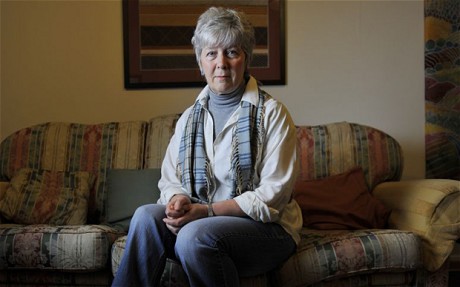
Full story in the telegraph, here. It describes how a gay journalist struck up a conversation with her at a conference run by the US organisation called the ‘National Association for Research and Therapy of Homosexuality’ or NARTH (see here for an earlier discussion about NARTH on this blog.) She then offered the man therepeutic help for his homosexuality.
She is quoted (here) as saying this- “When a therapist believes in good faith that a person can change his or her lifestyle she should be free to offer her expertise without the fear of the loss of her job or professional credentials. The equalities and anti-discrimination agendas are undermining the freedom of individuals to choose to change their lifestyles. These laws are leading to the elimination of a fundamental human right.”
I found myself feeling very sorry for this woman- she is facing a media witch hunt, as well as a threat to her livelihood. But I also find myself wondering at her naivety, and also worrying about her approach to therapy.
She is not without her supporters- see here and here. Some would see this as another attack on Christian values, undermining the Biblical basis for our society. I am afraid I do not concur.
Most therapeutic approaches (eg Cognitive Behavioural Therapy, psychodynamic psychotherapy, Person Centred Counselling, Rational Emotive Therapy etc) start from a set of core beliefs about the nature of our psyche, and offer more or less evidence based therapeutic tools to provide opportunities for meaningful change.
But the kind of help being offered by some Christian Counsellors, such as Mrs Pilkington, starts often with a different kind of fixed position- one based on a view of sin, and in particular, the nature of sexuality-
“We don’t use the word ‘cure’ because it makes it [homosexuality] sound like a disease. We are helping people move out of that lifestyle because they are depressed and unhappy.
“We say everybody is heterosexual but some people have a homosexual problem. Nobody is born gay. It is environmental; it is in the upbringing.”
It seems (rather startlingly) that Mrs Pilkington has a son who is gay-
“He [my son] is heterosexual. He just has a homosexual problem,”
“[My son] is still gay … we are developing a relationship that was quite difficult for many years but is now coming back in a very nice way. I am confident he will come through this and he will resolve his issues and that he will change.”
I am a Christian, who has worked as a mental health specialist for 20 years, including a number of years as a therapist/counsellor, using CBT and Person Centred therapies. But I beleive that when ‘therapy’ is allied to narrow views, even narrow Christian views, it becomes very dangerous. It becomes very easy to lose sight of the individual, and focus instead on ideology.
You could argue that Mrs Pilkington gave fair warning to the journalist, and he carefully manipulated her and set her up. It is also quite possible that the full story has not come out in all the news articles that are out there.
But this kind of intervention has no place when practiced by someone working in a position of trust accredited by the BACP.
Christians are still getting into such strange waters over the issue of homosexuality. I find it so frustrating. Even if you accept the reading of the three Bible references that are unequivocally condemnatory of homosexuality as being directly translatable into our context- and there is a real theological debate about this- then you are forced to acknowledge that there are far more references in the Bible (and particularly the words of Jesus) against other things- Greed, avarice, jealousy, misuse of power over the weak and poor, religious bigotry etc etc.
Some of you may think that this is just because I have been sliding like a liberal for too long and if the Bible says it, then it is true. And you are entitled to your opinion. And to my continued friendship.
But please- do not take up therapy.


Now faith is confidence in what we hope for and assurance about what we do not see.
Hebrews 11:1-3
I think the word ‘faith’ is one that I overuse.
This is possibly because it can be a rather generous, non-specific word with which to describe personal, private belief. I use it in this way more as a badge of introspective spirituality rather than a declaration of religious conviction.
Because conviction, certainty and clarity of belief have simply never come easy to me. The words of Hebrews above easily rang out as evidence of my failure- my lack of faith. Others seem to have no such spiritual weakness. They are like St Paul. I am like St Thomas.
Today however, an analogy came to me.
I was thinking about another noble human characteristic- courage. Most of my generation have never had their measure of courage tested by war or extreme adversity- but we are all stirred by stories of those who have.
The spitfire pilots of the Battle of Britain who took to the skies against overwhelming odds. The men steeling themselves to climb a wooden ladder to almost certain death as the whistle blew to start an attack in the Somme.
And if these images are a little too martial for your tastes, then we might also mention the man who stood before a line of tanks in Tiananmen Square armed with nothing more than a flower, or those who push themselves beyond the outer limits of human endurance in the high Himalayas, or the polar icecaps.

Some of these people seem to be over blessed with courage. Or perhaps under concerned with fear.
And this courage can be like a force of nature- it can be transformative, inspirational and raise for us an ideal that we can all aspire to. Or at least admire from afar.
At the same time though, this kind of courage can be blind, foolish and self seeking. It can be abused by others (and ourselves) and is easily allied to causes far less noble. In this way, perhaps courage can be dangerous.
And it can also be deceptive- because courage is an entirely subjective experience. Who knows what measure of fear was overcome by the people who achieved such admirable feats in the face of adversity? Were they naive and uninformed? Dulled by some kind of narcotic? Driven by deeper demons?
Or was their courage merely a front- a means to force down the fear, and despite all their lack of confidence and self belief- to press ahead anyhow?
Does this work for you as an analogy of how faith might also be an active force in our lives?
In his book ‘How (not) to speak of God’ (which I loved) Pete Rollins talks about (a)theism. Contained in all our ideas about God is also the fact that what we know is incomplete, imperfect and error strewn. He would contend that the only honest way to approach God is to start from the point of (a)theism- where our theories about God are confronted with our unknowing.
I too have come to believe that belief in God is an amalgam of all these things-
Our faith and our doubt
Our knowledge and our uncertainties
Our crowning confidence and crippling fears about the future
Our theology and the place where theories fail
Our transcendent experiences of the divine and our plunges into Godless darkness
Times of declarative joyful certainty, and nights of lonely doubt
Times when the fragrance of the presence of God hangs in the air, and times when all is meaningless and barren
Times just to hold on to the hem of hope
And after it all, there is still
God.
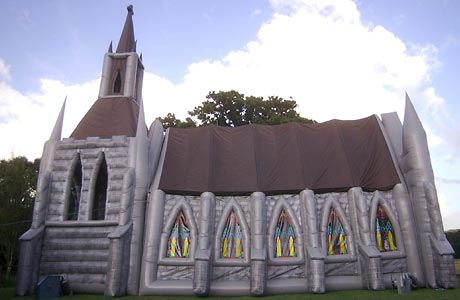
This afternoon some of the Aoradh crowd met up with Peter and Dorothy Neilson for a chat.
Peter and Dorothy are the parents of one of the Aoradh crew- Pauline B, and apart from just the pleasure of sharing a long cup of tea, it was great to talk of church- what is, what has been and what might be to come.
Peter is particularly well qualified to talk of these things as he was the convener of the Church of Scotland’s ‘Church without walls’ report. At present, he divides his time between Church consultancy work, running retreats with Dorothy, and no doubt a hundred other things.
Today we discussed the story of Aoradh and Peter was able to talk of how our development fits into a wider experience of faith inside/outside church in Scotland. Some of this we knew about, but a lot we did not. Scotland is a small place (in terms of numbers of people,) but as we have discussed before, we are not well networked.
For instance, he talked about his involvement with Coracle in Edinburgh, who are doing some interesting things.
Peter also used a phrase that made me smile- suggesting that Church in the past had tended to be Pneumatic- it sucked you in, then sucked you dry.
He was of the opinion that the development of small communities who live out faith through small ritual and celebration may well be part of the future of church.
And in so doing, we might let go some of the need to suck- and remember also to breathe out…
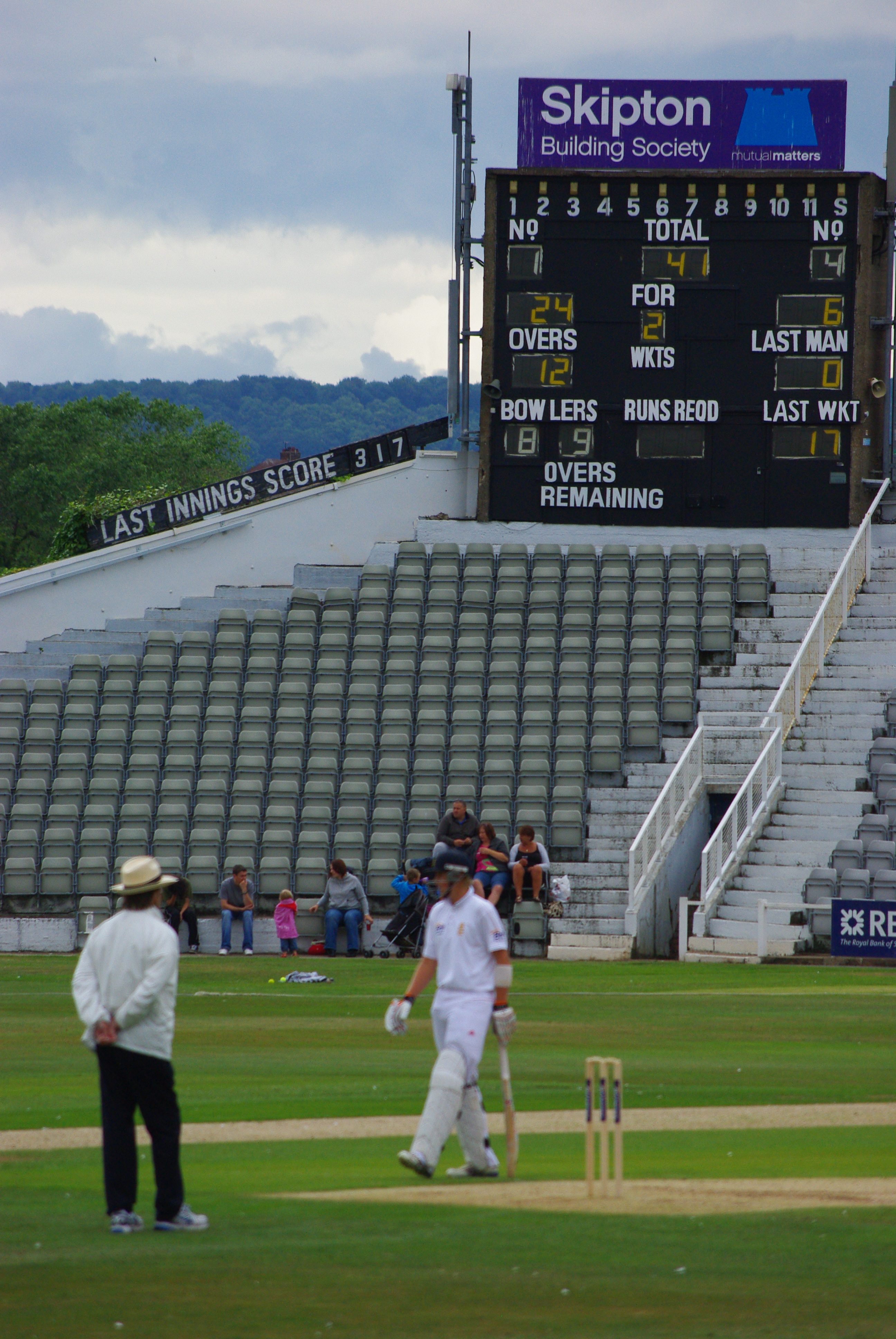
I have avoided any mention of cricket during England’s recent triumph over Australia in the Ashes, but today Will and I sort of joined the local cricket team…
We went to a coaching session advertised in the paper, and had a great time, although I am aching in familiar cricket muscles that have been dormant since my last serious playing days.
Which were 20 years ago!
William is obsessed with cricket- which to this particular father is a great thing- and in this case, gave me an excuse to join in. I particularly enjoyed a serious batting session, smashing the ball all over the sports hall.
While we are talking about the Ashes, I came accross England Spinner Graeme Swann’s you tube diary the other day, and it made me laugh- the man seems to have some genuine comic timing. Here is a sample-
A couple of years ago I blogged about the then up and coming film ‘Test of Faith‘. Here is the trailer-
I had forgotten about the film until reminded recently by Pauline A, and have still not watched the whole thing- although there are lots of clips now on you tube as well as the link above.
The science/religion debate is an old itch that I keep having to scratch. I am not entirely sure why… this was the subject of long discussions with an old friend, no longer with us, and his voice still forms part of the debates in my head.
But I have no interest in ‘proving’ or ‘disproving’ anything- and most of the technical debate just passes me by. However, I am driven to grapple with what it all means– how it relates to the bigger picture.
And also- how we people of faith can remain open and honest when faced with apparently challenging and oppositional science. This has been a subject of some recent conversations, so I thought that a fresh post on this issue might help me (and hopefully you) to have a chew on this issue again…
In another previous post I said this-
I believe that the poem of life that has been given to us in Genesis is true. I am not a scientist, or a theologian – I am a poet. For poets, truth is given not as a blue print, or a mathematical equation, although these things are wonderful and creative in their own right. Poems bring meaning and beauty in the abstract, in order to make clear the obvious. They are often far more concerned with the ‘why’ questions than the ‘what’ or the ‘how’. Poets should have no fear of scientists, who speak a different language.
As for those of us who have faith in the Creator God, I think we should also have no fear as we read the poem of life from the beginning of Genesis. We do not need to defend, or to stand against the scientific community. It makes us look stupid. Think of those folk in an earlier age who found their world view challenged by those who said that the world was not flat, and that rather than the sun turning around the earth, in fact we seemed to orbit the sun. This was the theological dynamite of the medieval age, and as such, was an idea suppressed by the religious powers of the day.
But God is not defined or limited by science – his was the art that birthed the science in the first place.
There remains however, the issue of evolution- a grand theory that has been used and misused for 150 years to try to make sense of the science. (There is a list of broad positions that Christians appear to have taken up in relation to this issue here.)
A theory that has almost total support in the scientific world in it’s broadest sense. How then do Christian scientists make sense of faith in the face of such a dominant hegemony? The film seems to deal with this really well- here are a few clips that are well worth watching-
Finally- after all the debates- lets return to the book of the Bible that perhaps above all contains the human search for the meaning behind life- the book of Job-
I am longing for spring.
It always happens to me around this time of the year. Not because winter isn’t beautiful, but rather because spring releases something in me. It is a physical thing, as well as a psychological/spiritual thing.
The days open up and lengthen with a soft green light.
New life is everywhere- every leaf, every lamb, every bracken shoot is a bursting with hope and potential.
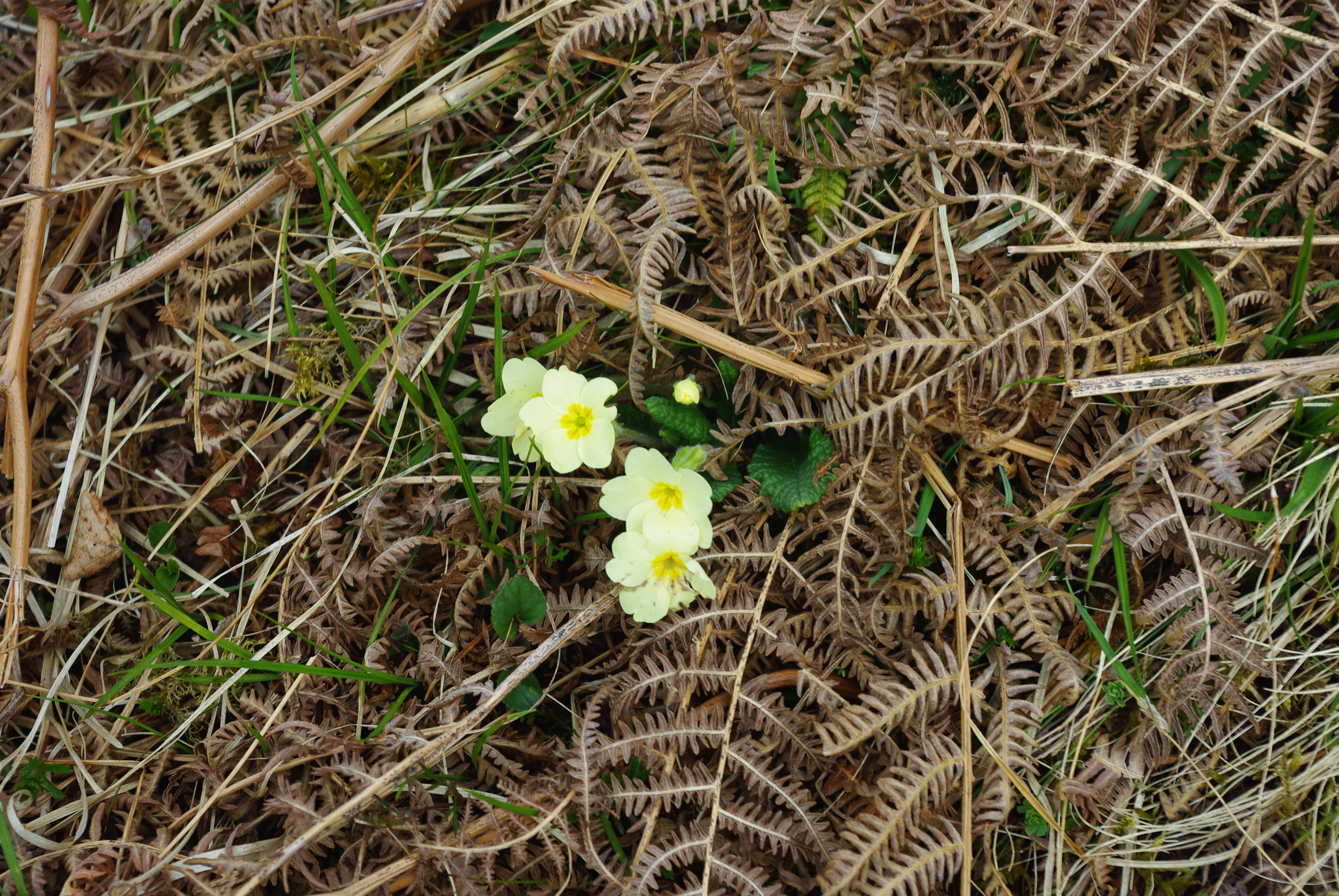
And I can start to linger again in wild places- perhaps in my new camping hammock! A present from Michaela for Christmas. I am still not sure exactly how sleeping in a hammock under a tarpaulin will compare to a tent, but I am looking forward to finding out.
The other essential ingredient to such a trip is this one-

Here in Scotland, as opposed to England, sensible and sensitive use of small campfires is permissable- check out the Scottish Outdoor Access Code. This is a controversial issue- as in high pressure beauty spots such as Loch Lomond, the mess made by weekend revellers is everywhere.
Trees ripped and damaged, charred paper and disposable barbecues strewn around- and always some idiots who think it is possible to burn bottles and cans in wood fire and as a result leave a welded mess on the otherwise pristine shore line.
It has long been a point of argument between my friends and I as to which one of us lights the best fire. I maintain that my ‘chimney’ technique, where combustible material is stacked above the source of heat in a collapsible, self feeding tower is the best way. But the reality is that none of us are really good at it.
I have never successfully used one of those spark making fire steels, let alone rubbed sticks together to make flame.
So to help us dream of long evenings under the spring stars- here is a bloke who knows what he is doing-
 this fragile tent