Another post from artist Steve, whose eye for beauty in the ordinary is remarkable.
Christmas is that magical time of mystery, wonder, miracles and angels.
But lots of us have become ‘selective’ as to what spiritual significance it may all have.
For many, Christmas has become a focus for family gatherings, food+drink, giving+receiving presents, trees+decorations, music playlists, opening doors on Advent calendars, Christmas cards, yearning for snow (but only the kind that makes everything white for just two days and disappears by Boxing Day), family walks, bubble+squeak on Boxing Day, party games and fun+laughter. It might even include midnight mass – but perhaps only as part of a family tradition.
Does God feature at all? The Office for National Statistics (ONS) recently published figures for 2021 indicating that, for the first time, less than 50% of people in England+Wales identify themselves as Christians (46.2%, compared with 59.3% in 2011… with 37.2% as of ‘no religion’, compared with 25.2% ten years ago).
What do I believe anymore? Next year, I will have been a Christian for fifty years. At times, it’s been a bumpy journey but, despite my doubts, there remains something that continues to hold me.
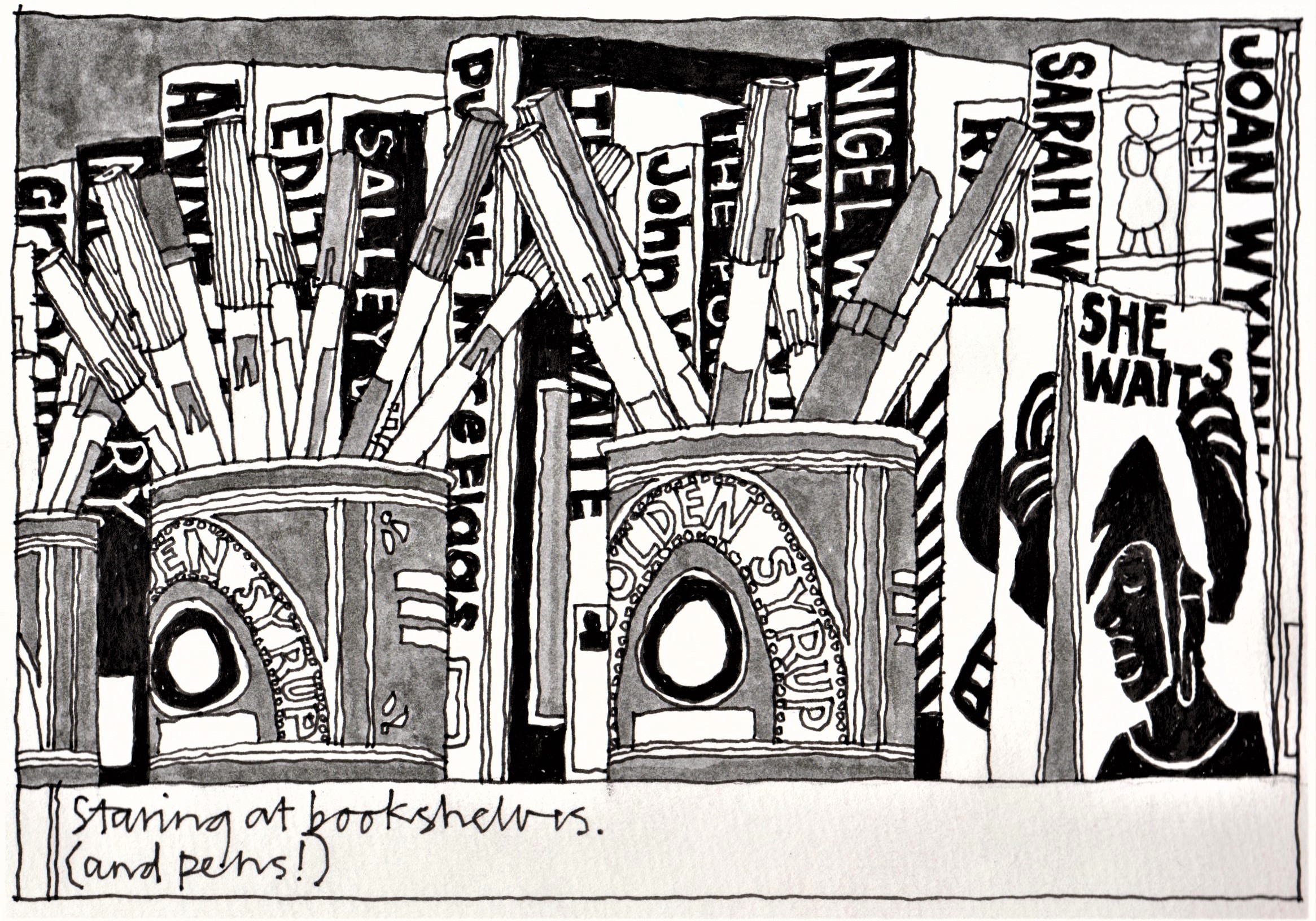
This sketch is of one of our bookshelves at home. As you can see, the image includes three ‘Golden Syrup’ tins. In fact, there are a total of TEN of them on this shelf(!) – including one with holly leaves and the phrase ‘Bake, Eat and Be Merry’ and another which contains fourteen palm crosses. As you can imagine, both the tins and the palm crosses have been accrued over several years.
They’re a reminder of the passing of time.
And for those of us in our dotage perhaps (as Bob Mortimer frequently asked Paul Whitehouse in their ‘Gone Christmas Fishing’ television programmes): “So, how many Christmases have we got left then Paul?”
The continuity and the appreciation of experiences gathered over the years (not just consuming golden syrup!).
The highs and lows of our spiritual journeys and the sense of God somehow always being there along the way.
And, of course, the journey continues…
All those possibilities (and uncertainties)… the extraordinary within the ordinary.
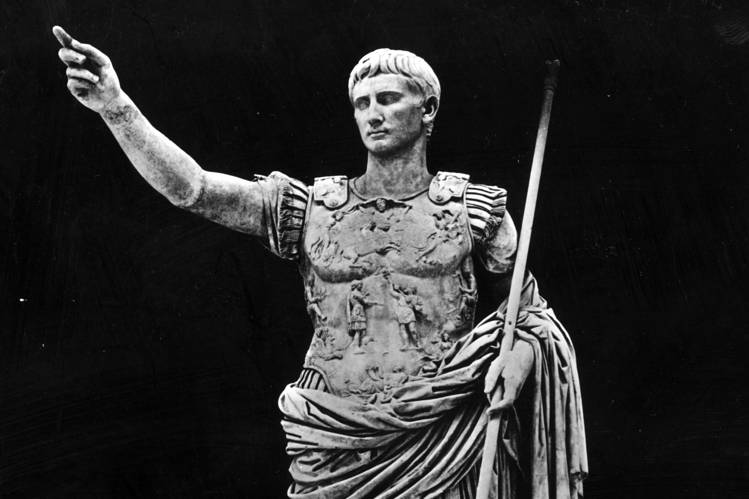
It may be a suprise to some that these titles – which we know so well as religious descriptors of Jesus Christ that have been sung through generations – were borrowed from an earlier historical figure, known first as the Emperor Augustus.
In the year 34 BCE, Augustus defeated Mark Anthony and Cleopatra in the Battle of Actium, and this Victory ushered in a period know as the Pax Romana, defined this way;
In other words, the first advent of Jesus happened right in the middle of the Roman peace, wihch was really no peace at all. Not for those oppressed by an expansionist unequal empire.
It was in to this world that the Prince of Peace arrived as total contrast to the Prince of Peace.
I have been thinking about how my lifetime has been lived in peace. Sure, just as during Pax Romana, there have been wars and skirmishes happened all the time away somewhere else, but these cost me almost nothing. However, just as during the Pax Romana, a different kind of peacelessness has been gathering. It might be understood as the end of the Pax Britanica and the beginning of the Pax Americana.
In total conttast to the Pax Christi.
This Advent, we need the upside-down principles of the empire of the Prince of Peace to disturb us still.
Peace to the world
.
After war came peace
But after peace came profit
And after profit came wealth
And after wealth came inequality
And after inequality came accumulation
And after accumulation many were left with nothing
.
And with nothing there is no peace at all
After the war came peace
But after peace came empire
And after empire came corporation
And after corporation came globalisation
And after globalisation came exploitation
And after exploitation came exhaustion
And those who are exhausted feel no peace
.
After the war came peace
But after the peace came aspiration
And after aspiration came property
And after property came debt
And after debt came foreclosure
And after foreclosure came homelessness
And without a home, there is no peace
.
After the war came peace
But after the peace came consumption
And after consumption came more consumption
And consumption became the only thing that counted
Today’s advent conspiracy comes from Bob who takes inspiration from The Detectorists to imagine something just below the surface that we half percieve…
If you haven’t watched any of the excellent TV series ‘Detectorists’ then I can heartily recommend it. You can find it on BBC iPlayer here: BBC iPlayer – Detectorists
The series first aired on BBC Four in October 2014, and it’s written and directed by Mackenzie Crook, who stars alongside Toby Jones. The two key players are Andy (Mackenzie Crook – The Office, Pirates of the Caribbean) who wrote and directed the series, and Lance (Toby Jones – character actor in many films like Tinker, Tailor, Soldier, Spy, The Hunger Games, Captain America, Jurrassic World and numerous TV series).
The series is set in the fictional small town of Danebury in northern Essex, and the plot revolves around the lives and metal detecting ambitions of Andy and Lance. They both have an obsession to find buried treasure, but, more often than not, all that the metal detectors pick up is a ring pull off an aluminium can, a metal button or a few nails.
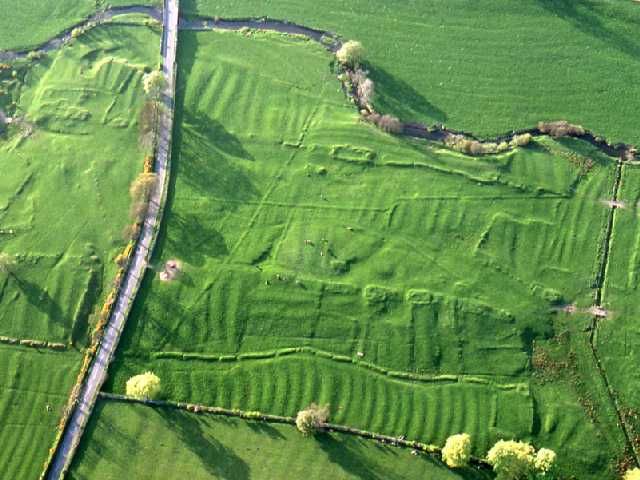
They are convinced that there is something to find and, despite the set-backs, they keep searching. There’s a wonderful drone shot of the field at the end of the first series when they head off to the pub after another fruitless day’s searching and the shot reveals the outline of a large structure below the surface. It reminded me of times when there has been a long spell with no rain and the outline of buried building remains are revealed as a different shade of colour to the surrounding ground. There’s something there, but they can’t yet see it from where they are looking.
I wonder then what grand obsessions existed in the story from two thousand years ago when humble shepherds left their sheep to follow a bright light in the sky, and richer noblemen made a long journey from their homeland far away. What drew them to a small village in the Middle East? How often on their respective journeys would they have doubted what they were doing? How often would they have considered turning back? Was it something they had long anticipated? Was it a story of a hope to come which had been passed down and re-told through many generations? Something must have drawn them onwards.
In the initial post of this Advent Conspiracy by Chris here: he says, ‘in moments and in places like this, I find myself sensing something beyond myself that draws me’.
For me too there is something about Advent which draws me and provokes reflection about a journey bigger than our journey; about a story bigger than the story we find ourselves in.
The further adventures of our joint Advent blog, this one coming from Steve Broadway. I love his counterpoint between struggle and persistence. The work of the spirit has both, but it also has moments of transcendent joy. It seems to me that transcendence always has to have the absence of transcendence, in the same way that light can only be seen through darkness…
We also get to see some of Steve’s incredible drawing skills– more of this to come!
Reflecting on life’s uncertainties… Depressing stuff affecting so many lives Like wars, sanctuary-seekers and homelessness Abuse, poverty and fear Hopelessness and despair The cost of living and heating homes Some having to decide whether to eat or heat The haves and the have nots Caught up in a spiral of hardship.
Reflecting on my spiritual path… Typically struggling through the wilderness Often intolerant of biblical interpretations Annoyed by what I think are lop-sided homilies And put off by the exuberant faith of some My own blinkered attitudes don’t help But still I’m happy to keep searching for meaning Still seeing goodness in the world And heaven on earth right now.
Following on from Steve’s honest description of travelling through unbelief, and Bob’s description of rumbles of war just over the horizon I find myself once again wondering about the enforced jollility some of us often feel as disturbing dissonance as this season unfolds. It has always seemed to me that if there is joy at all, it is as likely to be encountered accompanied by tears as much as laughter. Sometimes both come together. I have tried to write about this apparent contradiction many times in my poetry. Advent, it seems, is a paradox.
Perhaps you will call me miserable (or use the slightly kinder word ‘melancholic’) but this would miss something important. Advent is always hard for many and this one is harder than most. Yesterdays post from Bob about Ukraine offers a very present example, but there are many closer to home who are also struggling.
The individualisation which has defined our age has also condemned many in western societies to solitary confinement just when we needed each other the most.
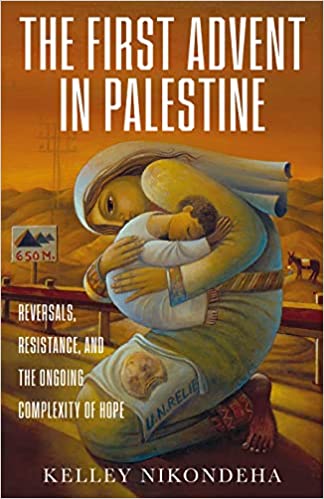
In the midst of my own Advent ponderings I am reading this book, which Michaela bought for me as present. She knows me well. The author places her Advent in the context of the ongoing suffering of the Palestinian people, but also in the context of the first Advent, which describes the arrival of Jesus into chaos… into an Israel overcome and broken by a succession of occupations, only the latest one being the Romans. The book starts like this;
What does joy look like from the perspective of broken troubled times? What is the peace that we hope for? What justice? These are never just individual questions, rather they move us away from self-religon back towards the collective, shared consciousness that rediscovers our connectedness to both each other and to the created world. To the ‘Christ who loved things by becoming them’.
As I read Steve’s words two days ago describing his thinking seat in the face of an ebb of faith, a poem was nagging at me. I offer it here in the hope that it wall say more with fewer words.
This is part of our daily collaborative advent project, which will be spread accross a few locations/blogs.
Today’s piece comes from singer/songwriter Bob Fraser, who has written some of the soundtrack to my (and perhaps your) earlier life.
We would love you to come with us on the journey. The simplest way to do this is to subscribe to one of the blogs, and then you should get a daily notification (you can always unsubscribe later!) Otherwise, you can interact with the posts via the usual social media platforms (although I am no longer doing twitter.) A few shares and likes will help us make connections too…
Our intention is to move forward with hope, savouring questions and having no fear of doubt. We live in darkness but look towards light.
How must it feel to have your homeland occupied by the enemy, to be dispossessed of your land, to have your home bombarded and devastated, and reduced to a pile of rubble? How must it feel to lose relatives and friends, lose possessions, lose dignity, and be surrounded by devastation, chaos and uncertainty, knowing no security, and not knowing where the next meal may come from, or whether you even have a table to sit at? How would we cope with no electricity, no running water, living the life of a refugee in a climate of fear? What must it be like to be frightened by the callous actions of extremists, and equally fearful of your own emotions which may boil over in desperation demanding justice and revenge?
For an ordinary bloke wanting to live a peaceful, meaningful life, earn a living, care for a family, bring security and protection to those you love, and maintain a grip on beliefs and values, a life in that kind of environment would be severely restricted.
Even when a cease fire is declared, providing desperate civilians a much needed opportunity to assess the damage, look after the wounded and somehow go on with their lives, it’s a fragile peace and experience suggests it will not last, that conflict will resume, and there will be yet more suffering.
Sometimes, our hearts can feel like that enemy occupied land – battle weary, battered and bruised after yet another enemy onslaught. Every now and then there is a temporary cease-fire, giving chance to re-group, offering new hope and encouragement to keep going. Yet, after only a brief respite, another bombardment comes, threatening to destroy much of what we had salvaged from previous wreckage. Enemies know how to target with precision any weakness in defences. Their aim is to steal, kill, destroy, immobilise, silence, and distract. They know how to create dis-unity, spread lies and confusion, cut off supplies, extinguish hope, break the battle line, prey on the vulnerable, sever communication, dampen spirits and create exhaustion.
Options are limited in a situation where most of what is happening is outside our control. The only choices available are probably equally daunting. Neither choice comes without risk. Neither is right nor wrong. We can remain victims, hunkering down until the next cease-fire, longing for peace, yet existing and surviving rather than really living, but at least being close to roots and family and all that is familiar.
Or, we can gather all those we love and anything we can salvage, and start out on a path that is unfamiliar, heading for a destination which is unknown, taking on a new adventure with hope of a better life.
Whichever option is chosen, we’ll need to cling to the hope that even though life at the moment is not how we imagined it would be, the best is yet to come.
We will also be having some contibutions by the fantastic singer/songwriter Bob Fraser, who has written some of the soundtrack to my (and perhaps your) earlier life.
We would love you to come with us on the journey. The simplest way to do this is to subscribe to one of the blogs, and then you should get a daily notification (you can always unsubscribe later!) Otherwise, you can interact with the posts via the usual social media platforms (although I am no longer doing twitter.) A few shares and likes will help us make connections too…
Our intention is to move forward with hope, savouring questions and having no fear of doubt. We live in darkness but look towards light.
Today’s reflection comes from a typically honest Steve Broadway, pondering matters of faith…
Advent is particularly associated with waiting… but for me, this year, Advent will be a little different from the Advents of the past. My own ‘faith journey’ has stalled – so much so that I’ve decided to take an indefinite sabbatical from attending church services while I endeavour to wait for this period to pass.
In some ways, agreeing to be a part of a ‘multi-blog collaboration’ seems both inappropriate a little scary.
I am an early riser. I’m usually up by 5am.
At various times in my life, I might have used this time for prayer and/or reading daily reflections/Bible passages.
I no longer do such things.
I can no longer be bothered.
And yet, since moving house, I now frequently find myself in my ‘Thinking Seat’ staring out of the window at the dawn of a new day.
It’s something of a magical time.
Could it be the start of my journey to rediscover my faith?
“Caught by the light of some small heaven” (as my good friend Ian has described it) perhaps?
Today marks the first day of another season of Advent. It also marks the beginning of a daily collaboration with some blogging friends, in which we will be sharing a post each day over our different platforms.
We would love you to come with us on the journey. The simplest way to do this is to subscribe to one of the blogs, and then you should get a daily notification (you can always unsubscribe later!) Otherwise, you can interact with the posts via the usual social media platforms (although I am no longer doing twitter.) A few shares and likes will help us make connections too…
Our intention is to move forward with hope, savouring questions and having no fear of doubt. We live in darkness but look towards light.
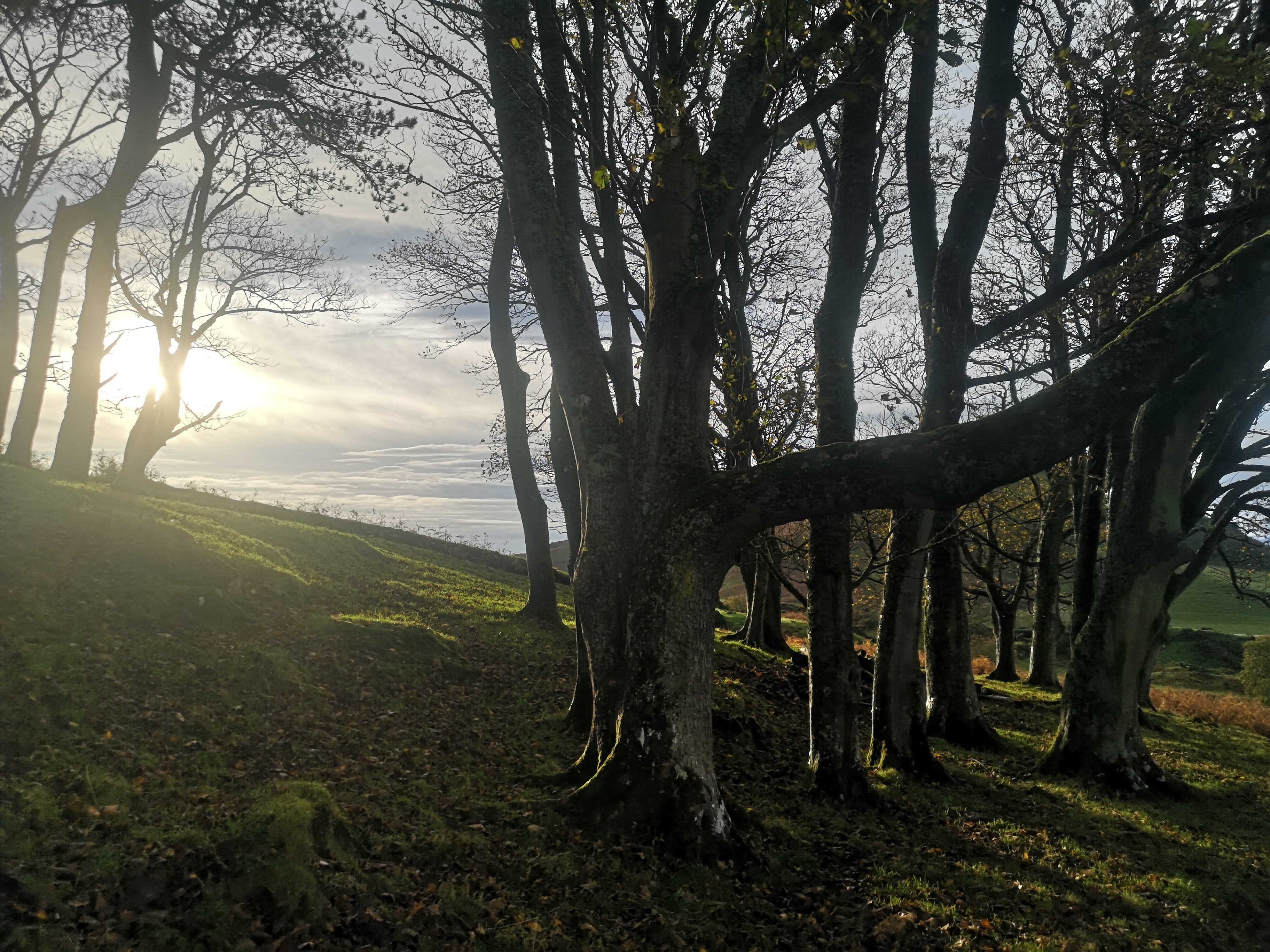
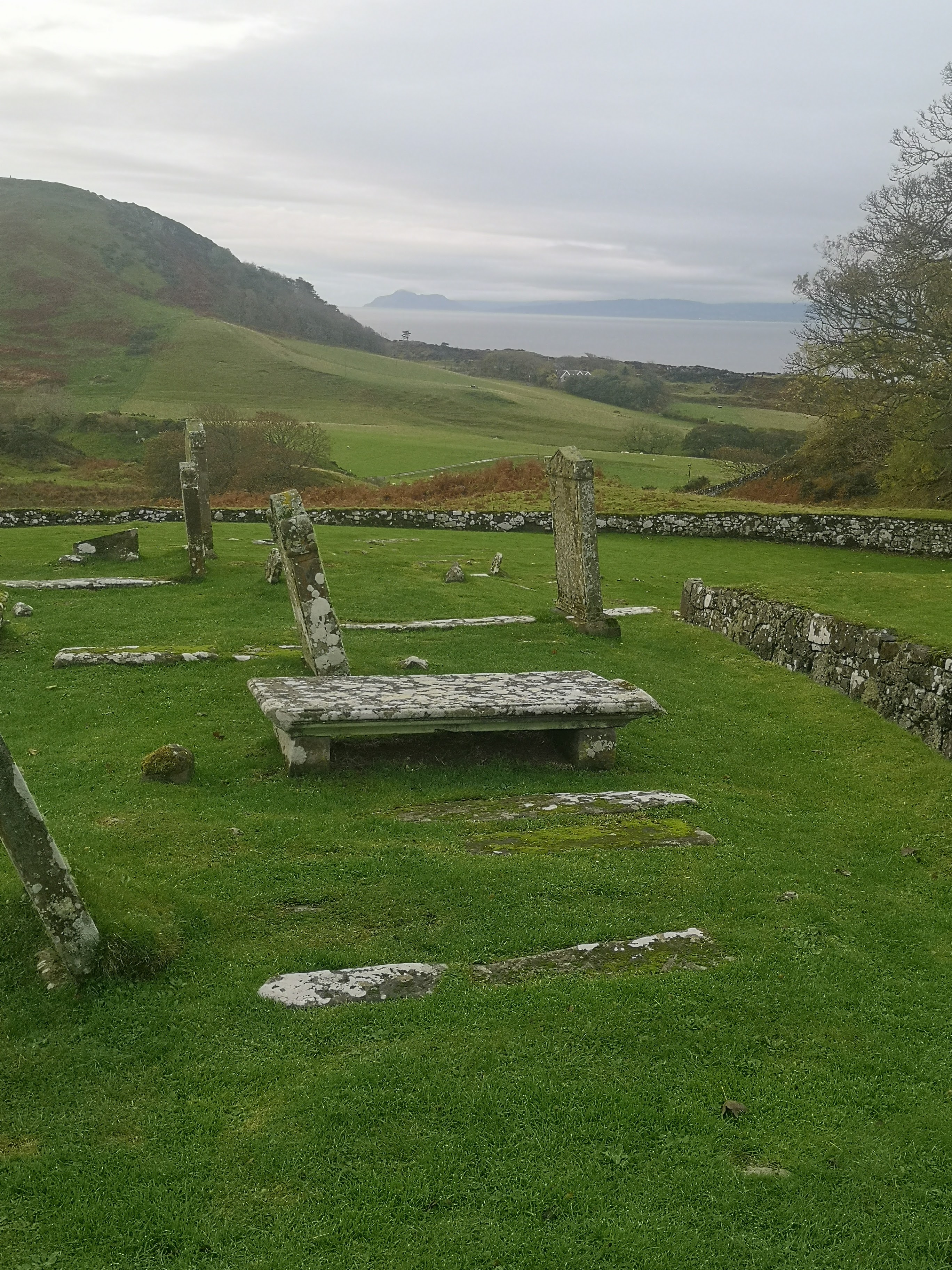
To get us started, this is a view from one of my favourite places, the site of St Blanes chapel, built in a bowl of Isle of Bute hills on the site of a monastery established by or after Catan, an Irish missionary saint, some time in the 500s.
Amongst and around the viking graves and medieval church walls, you can see marks and mounds in the earth from the earlier religious settlement. A boundary wall marking the division between ‘secular’ and ‘sacred ‘space, simple beehive cells made from piles of stones in which monks lived. A well still full of fresh sparkling water. Wild plants whose ancestors may have been planted as part of a monastic garden.
Leaning in are huge trees; oaks and sycamores – ancient, but more recent than the placing of the stones.
But the stones themselves – they are old on a different scale. Shaped by the igneous intrusion that formed much of these parts.
It is a place of reflection. A place when our hubris is measured against almost-infinity. Our place in things becomes so tiny so ephemeral.
Wierdly however, this place never erases my individuality, rather it contains it. Rather than reducing me to so much blown chaff, as relevant (and as irrelevant) as a fallen leaf, it connects me.
But what is this thing that I feel connected to?
The old answers never felt authentic, even when I pretended greater confidence. They used language and ideas given to me that were at best merely a mode of travel, they were never a destination. Perhaps there is no destination. But still, in moments and in places like this, I find myself sensing something beyond myself that draws me. I have no pressing need to define it, to categorise, but I feel hints of sometihng vitalising and alive beyond almost anything else in my experience.
Are these just the fanciful meanderings of a middle aged man? Perhaps, but if so, I am in good company at St Blanes chapel. People have been seeking the same answers there for one and a half thousand years, despite the intervention of Vikings and the Reformation (incidentally, apparently the minister there refused to play ball with the reformists, and he was so loved that they let him be.)
Advent is not about certainty, it is about a sense of something more ‘felt’ than known. In my experience it contains a longing that can not be easily described. It is perhaps best understood as a fleeting transcendent connection to something beyond
The most tantalising thing of all is that what I think I sense most strongly in these moments is goodness.
Advent begins on Sunday. I love to allow seasons like this to shape some contemplation, and so intend to put together a daily reflection thing via my blog. Does anyone want to contibute?
Advent is about anticipating something better. Hoping for light that is still to come, even in present darkness. Do whatever you like with this this. Could be a poem, an image, a video clip, a song, or a painting, or anything else that provides a space for others to be still for a moment and reflect.
How is it that still, you love things by becoming them?
How was it that this brown-skinned man with the heart of a woman
Took upon herself another name for everything, so we could
Encounter her in all these beautiful things and bleed with her when she
Lies broken? And just when all seems lost, she whispers still –
See, I am making all things new.
Even you.
It can be hard at first to step aside from both secular and religious cliches about the approach of Christmas, at least until you allow yourself a bit of space to think again about the nature of this season.
the time when winter is still deepening, the coldness increasing, the days shortening
the creak of increasing Christmas pressure coming at us from our screens
fears of scarcity despite our abundance
the end of last year and the approach of the next
the certain knowledge that there will be a new spring
the simple, all surpassing idea of immanuel, the god who loves things by becoming them
If you would like to join us for the journey, reply here or drop me a message. You need espouse no particular position of faith. Just help our hearts open a little when we need it most.
Following on from the last post, in which I attempted to describe my feelings around a new attempt to form a climate action group for my local area, I have been continuing to consider the problem of how to respond creatively and with integrity to crisis of our time.
There is a need for all of us from time to time to take an inventory not just of our own personal place in the world, but how this relates to the great goodness the world contains. If we are to treasure the gace hidden in all things then we must also seek to be part of it and not just consume it, or be an unwitting part of its destruction. The great disatisfaction this sets up in many of us at present is the feeling that we are powerless to change the very destruction we are seeking to avoid. This itself is a place of personal and collective sickness of spirit.
As for myself, I have tried to make as many changes that I could towards sustainability – the growing of food, the recycling, the fixing and reusing, the buying second hand. However, I also feel guilty because of the destructive things that I do – the vehicles I drive, the leaky home heated with fossil fuel, the over consuming western culture within which I still participate. Like many of us, this sets up chains of cognitive dissonance that twist me up in ways that are profoundly self defeating.
I am privileged to live a comfortable life in a beautiful place between mountains and sea. This privilege places me on the outside, removed from cutting edge consequences more visible around greater concentrations of humanity, particularly in the poorer southern parts of the world. Discussions about climate change here are made from a position of climate privilege and collective blindness about the mess we have made (and continue to make) of our ecosystems. We look at mountains covered in spruce plantations and think they always looked like that. We dodge deer on the roads forgetting entirely that they are there because of a lack of natural predators. We celebrate iconic single species such as otters and sea eagles with no clear idea of their loneliness and the total unbalanced ecosystem that our patterns of farming and resource extraction have created.
My attempt to respond to these issues has already proved problematic, for these sorts of reasons;
There are some vested interests that might well get in the way- for example, how can a council funded organisation protest against the council and hold it to account?
It seems that death by detail is likely. There are so many strands of potential action (allotments, recycling, plastics, beach cleaning, forestry, diversity, single species protection, ocean protection zones, conservation farming, rewilding, etc.) How do we prioritise?
The detail is often reflected in individuals with passions and hobby horses. These are not necessarily ‘local’ or directly relevant to OUR location here and now. Again, how do collectivise around one particular issue or small set of issues?
We all have egos in the game- we like to think that our passion projects are the most important. We can then be dismissive of others and fail to add collective value.
What is the appropriate response to a climate emergency HERE in Argyll? My feeling is that small scale consumer/citizen focussed activities of the kind that are being promoted through the Dunoon Area Alliance (a funded community support organisation) (for example green mapping, recycling, plastics campaigns etc) are important in that they give people a feeling of getting involved, but they are not proportionate to the scale of the emergency. None of these actions are transformative or would make significant impact, apart from perhaps at the informational level.
There seems to me to be a difference between an activist group and small-scale community activities. Both have important roles to play but require different approaches/structures/memberships.
Activism most likely involves a degree of confrontation, which is not for everyone.
There is a lot of complacency about climate change and loss of habitat diversity here in Argyll. We consider the landscape to be ‘wild’ and ‘natural’, because it is largely open country. It is in fact neither of these things.
What then might local climate activism look like in Argyll? What are the major issues impacting on our ways of living here? What industrial processes that have shaped our interactions with the natural world, for good or ill? Which problems should be our priority and where do we put our energy? In a previous post I asked these questions;
What are the industrial processes that are destroying the Cowal environment? This takes us straight towards the three F’s- Farming, Forestry and Fishing. They are all sacred cows with huge local power and social capital. Challenging established practices will upset people we know and love.
Where can we see examples of local counter-cultural political/social/economic alternatives that we can learn from? We have to think both big and small, in that we need to hold an idea of transformation that is also LOCAL.
For example, S mentioned a small Irish town that has become fully ‘sustainable’. Coll has its own independent power grid. Other towns have gone fully plastic free. Some places have used local politics to revive collective action. Other places have converted almost all shared spaces into collective food growing areas.
What can we learn from these examples and how can we hold our own political systems to account for their lack of ambition?
I think these are important questions here, and in my mind at least, they already start to suggest areas of engagement. I have been inspired in part by this;
The thing about this piece is that despite its visual and political impact, it has created significant reaction. It was also largely the work (I think) of one or two people, who did not ask for permission, beyond talking to the owner of the land on which the structure was built.
It is also proportionate to the landscape and location. It is made of local timber and can be seen from distance, whilst doing no damage. Some people objected, but it has largely recieved local acceptance, even to the point or retrospective planning permission.
More than this, the power of the object comes from artistic, creative playful question making. It might be regarded as theopoetic. The shape and idea is deceptively simple, but the more you think about it, the more it starts to shift the way that people see things.
This structure offers a meeting point, a space to share ideas and make small revolutions. Power to those who made it, I say.
We can’t all build an ark – although then again perhaps we need one in every area – but we can learn a lot from this approach. Local, thinking big and small. Proportionate to the scale of lanscape. Using local skills. Slightly subversive, making a statement for others to respond to without preaching. Using art rather than persuasion.
There are also some clues there about the nature of the group that might support such activity. Clandestine, confronting work of this kind probably needs a supportive, safe community behind it, who are prepared to share the work and the potential adverse reactions.
I have some ideas already, but obviously can’t talk about them here yet… However, if you are local and interested to know more, get in in touch.