A quote from some bloke interviewed on radio 4 in relation to the latest terror attacks in India…
Inevitably, the media have been calling this awful event ‘India’s 911’.
The awful thing is that India is not unused to terror attacks- they seem to have been a constant throughout the post-Raj history. Most of these terrible things pass almost unnoticed in the west. Who remembers this from 2006 for example-
A series of seven explosions killed at least 174 people on crowded commuter trains and stations Tuesday evening in the Indian financial capital of Mumbai, police said.
Officials said at least 464 people were injured in the blasts in the city’s western suburbs as commuters made their way home. All seven blasts came within an 11-minute span, between 6:24 and 6:35 p.m. (12:54 and 1:05 p.m. GMT).
Analysts are comparing the attack with the mass transit bombings in Madrid in 2004 and London last year, saying they all involved a series of mutiple blasts and were well-coordinated.
These attacks are a little different, as they strike at the heart of India’s elite- the seat of financial power in Mumbai.
Who was responsible? No-one is sure. Al Qaeda has been suggested, although they always are. Religion and it’s power to convince people that the ends are justified by the terrible means always seems to have a part to play (check out earlier post about religious fundamentalism.)
India will blame Pakistan. They always do. And the whole world watches them looking at each other down a nuclear barrel…
Which brings me to my point. What should our response be to such dreadful violence- our personal response, and our collective response?
Britain too has had it’s share of terrorism. For the past 40 years or so, it was related to Ireland. Now we seem to be a breeding ground for a new generation of terrorists who grow up as part of a disaffected ethnic underclass.
When terrible things happen, there seems that governments have to be seen to ACT. This is one of the ways that democracy works. We want our governments to be active and decisive in the protection of our way of life- or at least governments think we want them to do this.
The debate becomes simple. We are under attack, we must fight back. We must not let them get away with this.
The outcome of this seems to be that Governments in turn are able to justify terrible acts in REACTION.
Almost like revenge. Payback.
A whole language set evolves- that ludicrous term ‘the war on terror’ is but part of this.
America had it’s own dreadful day of terror-
It was a day when the whole world held its breath, and in that instant, history found a fulcrum.
What happened next? Wars in Afghanistan, which once started will now go on, and on.
A war in Iraq, which was sold to members of the public on a set of fears that have now been found to have no basis in truth.
And a suspension of human rights, in the name of international security. State sponsored torture and detention without trial.
Shortly after 911, Brian McLaren wrote an open letter to President Bush. I remember reading it, and feeling proud that Christians-followers in the way of the King of peace- could raise their voices for justice and love and understanding, even in such a time as this. I think that this is our calling.
Never to condone, but always seek to understand. Never to accept that violence is the answer to violence. And that healing is possible, even for the most broken.
I have searched for a copy of Brian McLaren’s letter, to see how what is to be made of it with hindsight, but can’t find it (anyone out there know where I can find it?)
I think that we can already guess what history will remember most about Bush and Blair, and the stain of Guantanamo in a time when imperialism was resurgent.
I just found myself caught up again in an advert for the Salvation Army Christmas appeal.
I have worked with Salvation Army projects in England. They have to survive in a harsh social care environment. The advert describes the familiar cutting edge of the work they do with street sleepers.
I know all the arguments- people end up on the streets for all sorts of reasons, and need to be facilitated to help themselves- out of the destructive cycles that brought them there. Well meaning sticking plasters don’t work in complex social crises.
But if I was down to the bottom of me, and found myself on the street, a hot drink and a hand on my shoulder would be no token. It might get me up the next day.
A cup of sweet tea on a cold night might not change the world, but the hand that served it might be the start of something called hope.
And a thick blanket will never wrap the worries of a generation, but a young girl whose bright lights have gone dark might instead find grace.
And if some stinking socks are removed and twisted toes are unbound in a warm soapy bowl, there will be no world peace. But it might being peace to one persons world, for a while…
Today I was up very early as I had to be in Oban sheriff’s court for 10.00am.
As I left the house (7.30) the temperature gauge on my car read -3. As I drove away from the Clyde, it dropped to -6. At those temperatures, all the moisture in the air is sculpted onto the tree branches and blades of grass as white ice crystals. It was stunning.
Around the head of Loch Fyne, the water’s edge had frozen solid. In fact, the whole shore line was covered in a blue coat of blue-white ice, all several inches thick. Loch Fyne is a sea loch, so I can only assume that at certain states of tide, the slack conditions mean that the fresh water dominates, raising the freezing temperature.
I drove on past Inveraray, and up into the hills, over towards Loch Awe. And never was a name so apt- with the backdrop of stunning now covered mountains, and the deep blue sky for contrast.
I had a discussion with my friend Nick the other day about the nature of wilderness. We are still trying to finalise a book of meditations for use in the wild places. He had written something based around the Biblical idea of wilderness as desolation- of removal and isolation from God. However, for me, and perhaps for many people who are over used to a domesticated or urban landscape, wilderness is perhaps a wonderful idea- rich with the possibility of a Created place, unsullied and unpolluted- wild and untamed.
This idea became all the more real to me today, as I heard a story.
Standing in Oban court house with some of the other witnesses, I was discussing the journey, and the state of the roads, and the stags I had seen in the white field next to the Loch. A nice woman, who is a ward sister at Oban Lorn and the Isles General Hospital was part of the conversation.
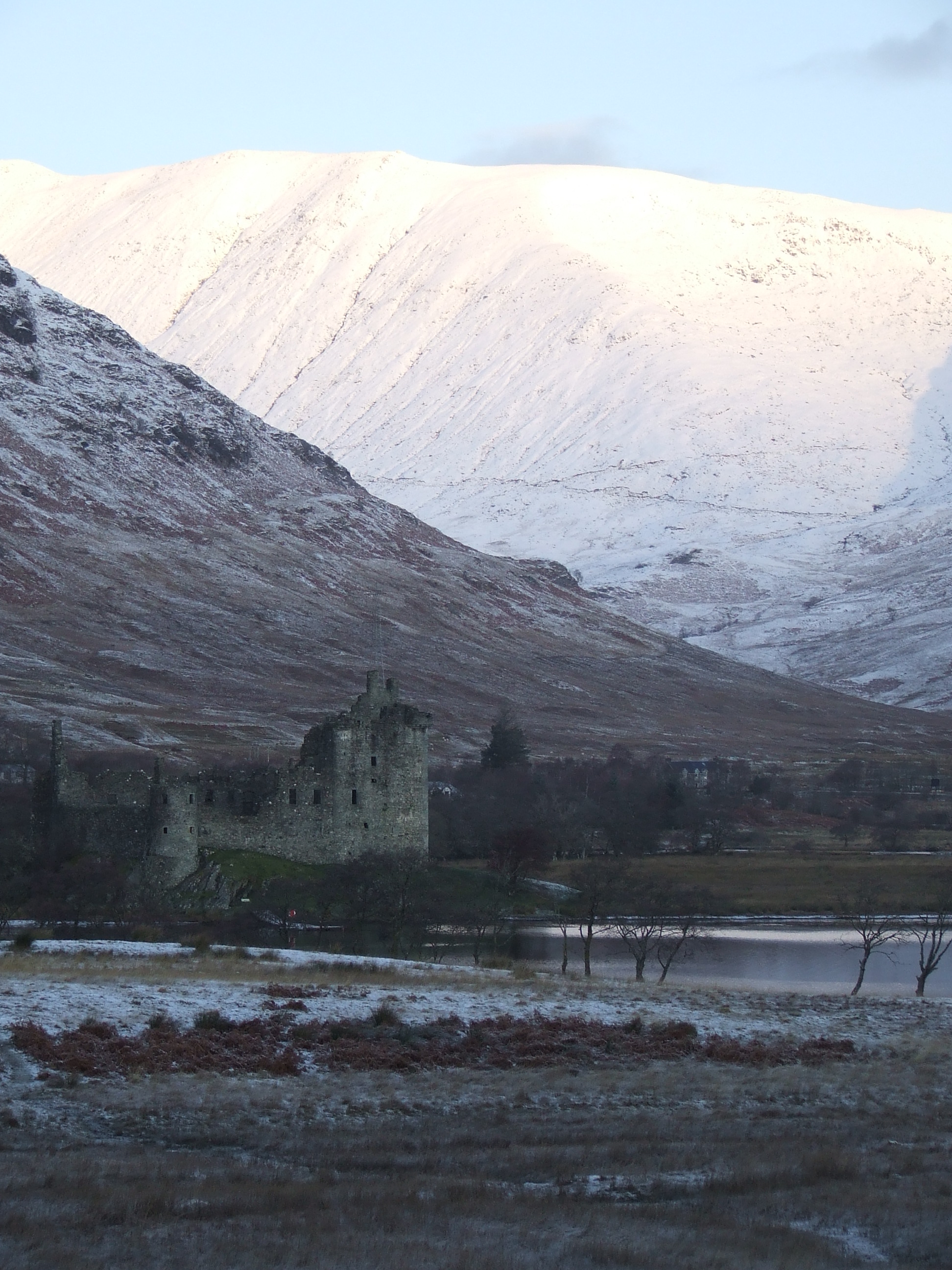
And she told me that a few months previously, she had been heading to a training course in Dunoon, also early in the morning, and had been forced to swerve on the road past Kilchurn Castle as there was a dead deer in the road that had obviously been killed by a car fairly recently. Then she saw a large black shape near the wall.
Stopping the car, she watched in amazement as a large black cat, about the size of a leopard jumped the stone wall, and padded over the fields into the forest. It had been feeding on the dead deer.
There have been stories (Check out this article here.) Half glimpsed shapes at the forest edge. Big heavy deer dragged into the undergrowth by a powerful animal that simply should not be here… There have been sightings in Aberdeen, and many in Argyll. I always doubted them- there was no solid evidence, and after all, there is the bloomin’ Loch Ness monster!
But this lady- she was a nice, sensible person, who was not playing the story for shock value. She was in no doubt as to what she had seen.
As I drove the road on the way home, my eyes kept flicking accross to the forest edge. The possibility of yellow eyes watching me past was always there.
Confidence. Self worth. Strength of purpose. Motivation and manliness.
I wear all of these like a latex mask…
Sometimes.
But then a sense of my own inadequacies crowd in, the mask melts, and I am left feeling stripped and exposed.
My wife calls it my ‘artistic temperament’- and indeed, such sensitivity can be creative. But she is just being kind- she loves me after all.
I thought as a kid that I would outgrow these fragilities if I could only… educate myself, get a good job, be thin, sing and play the guitar, find the love a beautiful girl, become successful, and popular and renowned for my artistry, creativity and wisdom.
But unfortunately, I found that I never quite outran these shadows- despite all the wonderful things life brought to me.
Some days I am a contributor, a celebrator, a lover of life and all things, an enthusiast for truth and beauty, a weeper at sunsets, and the proudest, tenderest husband and father.
On other days- hopefully fewer now- I am a withdrawer, a wound licker, a failure, a buffoon, a man so drab as to become invisible.
So here are two poems, written in very different moods. Both of them are true…
I want to change the world
I want to change the world
Piece by piece
To the broken and the hurting
I would bring release
To give voice to pure and noble thoughts
In poetry and prose
I’ll draw men from their watering holes
Into Waterstones
Make the County Council Library
A place of pilgrimage
And me the new Chestertonian
Thomas Coleridge
(Minus the opium)
I want to make a difference
To the cupboards of the soul
If not to bring down evil empires
At least to blow big holes
To the tatters of a ragged heart
In evident disgrace
I would sing redemption songs
And whisper words of grace
Let me show Gods store house
Bursting full of goods
Let me plough this furrow deep
And plant my golden spuds.
For I was made to weave some words
Into this tapestry
And though the tongue pokes out my cheek
Still this picture is of me
And if I gild the lily
As I overuse my pen
Still I love to show the
Slender turning of its stem
And the misting of the moist warm air
On icy blue white flower
For I am His creation
And His creative power.
Significance
Sometimes it seems the world has had enough of me
It has missed my fool’s wisdom
And never noticed
The stab at significance I made
In the weary light of this
Steely day
There was a moment or two
When the gap between
Hope and possibility narrowed
Like arctic floes
In a cold sea
Before the mists closed their muzzle
On the nape of my neck
And the black water yawned
And beckoned me in
I reached till the small of my back
Near broke from the cantilever
But these splayed-out fingers
Found only an empty grasp
And skinned knuckles
But hey
After all this time
You’d think I would remember
I am small
And flawed
And often ungrateful
So, three senior managers find themselves out of work. Two resign and one is suspended pending investigation (Head of Children’s services, Sharon Shoesmith- she will not be back.) Full story here.
I had posted earlier about my own reaction to the tragic news of Baby P’s death and the resignation I felt at the inevitable witch hunt that would surely follow.
Now the Social Work inspection agency (the same one that recently awarded the Haringay children’s services 3 stars for their excellent work) has now found serious failings in leadership, supervision of staff, the sharing of information and, perhaps most worryingly, evidence that kids who are suspected of being abused are not routinely interviewed alone (that is, away from parents.)
So, do I DEFEND these, my colleagues, and their obvious failings?
And should there be a disaster in Argyll involving perhaps, a mother who is mentally ill, and a drug using father, who physically abuse a child in this horrendous way, I hope that by a combination of our closer communities, our good working relationships with colleagues in health and the police, and good practice, that we will be able to intervene and save that child.
The truth is, of course, is that even with our imperfect systems- this happens all the time. We intervene and try to make things better. Sometime we succeed. But never without a cost, that is paid out in the lives of young people as they move on into adulthood.
Argyll and Bute Council had a recent inspection from the Social Work Inspection Agency- it is there for all to read on the SWIA website (here.) It was far from positive. However, after hard work, the replacement of just about a whole management system (somehow, I survived!) and by learning the rules by which we were being measured, the follow up report was much more positive- here.
Children are incredibly fragile. And also incredibly adaptive and resilient. They survive, somehow in appalling circumstances. They even survive the states interventions to protect them.
If they are lucky.
For much of my career I have worked with adults in crisis. Many of them have been the survivors of childhood trauma- sexual abuse, beatings, broken homes and all sorts of other dreadful things. I am always amazed at how people survive…
But the dreadful truth is that dreadful things have happened before, and will happen again. And when they do- those whose task is to try to prevent these things happening will be found wanting.
That is not to say that things could not- SHOULD not- be better. But shock-reaction rarely achieves anything other than shock-defensiveness.
Meanwhile there are some very real issues facing us as we look at our attempts to protect children in our society.
There are the financial ones, mentioned before.
The community ones, in a society where people increasingly lack connection and commonality.
The regulatory ones- the constant drive to eliminate risk and bad practice leads to huge complexity, and individual responsibility for social workers- who in turn, take fewer risks.
And once we remove kids- where do we put them? Foster care placements can be impossible to find, and the homes that have not already been closed are full, and often highly problematic for the kids there.
I hope that the baby P issue will open up this debate, rather than focus on the ritual execution of yet more social work staff.
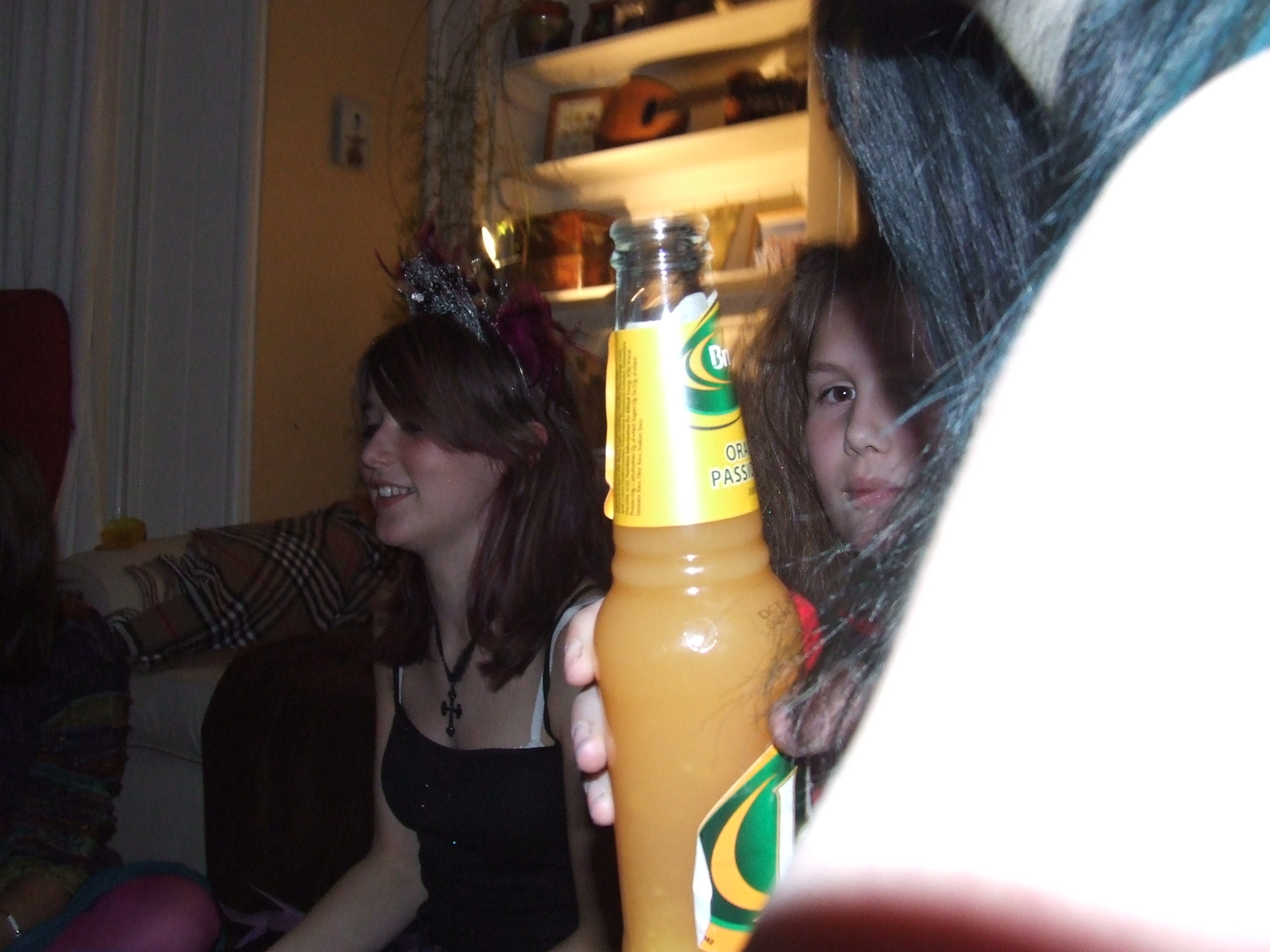
We had a lovely day- a lazy morning of presents and coffee then a trip to a cafe, and finally she had a house full of friends for a party- a kind of Goth fairy party as far as I could see.
For the first time ever, her parents were not required to actually run the party- she did it all herself- meeting, greeting, party gaming and all.
I am very proud of her.
If a little redundant.
Our role in the affair was to clean up afterwards.
I met up with a friend this evening who I had not seen for a couple of years. We met at a conference in Holland at which I was leading worship a few years ago. He is a lovely guy with a deep and passionate faith and a restless, driven energy.
It was great to see him again- to hear of his news from Ireland and work in Finland. And so sit in front of a fire with a glass or two of Whisky.
It came to me again how much or paths have taken different directions.
When I met him he was a Charismatic Catholic and I was attending a Baptist Church. He left Catholicism and moved into a Charismatic Evangelical church, and now is in a small house church. His theology is firmly towards Spirit inspiration of the Holy Word of God.
As for me, well I meet with friends in a house, get involved with other things via an arts group and seek wider fellowship with people who have found a place within the ’emerging church’ discussion.
My friend and I, as we have done previously, soon got into deep discussion. Sometimes this conversation verged on argument, but not really- although it was passionate and heart felt. Another friend bowed out early and went home, and Michaela kept out of our way too…
The point of conflict was about the usual things around emerging church- the totemic issue of homosexuality, the way we understand and read the Bible and the issue of ‘Demonic deception’ that began in the roots of the emerging church movement. He had read a book that spelled out the dangerous errors present within and underneath the EC. We could not go into detail, as Michaela was giving him a lift home, and called time at 1 AM.
Is there any point in these conversations? Neither of us was likely to make any major shifts in thinking.
I suppose you could say that they have the effect of rehearsing the arguments, testing the core assumptions and developing a deeper understanding.
But I think they may be also energy sapping and distracting. The EC has not got it all sorted- but then, who has?
Meanwhile, there is the real stuff to get on with- the living and loving and the serving and greeting of old friends.
Speak tenderly my loved one
My heart is laid wide open
Ventricle and clavicle
Could easily be broken
Vulnerable and winnable
Hungry for your mercy
Like a wanderer returning home
Weary thin and thirsty
I hear your distant voice
Dancing in these mountains
Your music in the flowers-
And flowing in the fountains
Come away with me my love
In this hillside let us dally
Apple of my shining eye
Lily of my valley
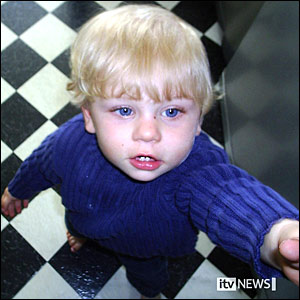
One of the heatbreaking picture of baby P shortly before he died.
I am off work today- a return of an old problem with cluster headaches. Dreadful things- a conveyor belt of Migraines. I think I am over it, and then the vision goes, the sickness and nausea kick in, and the head starts to split…
In between, I am functioning, but not very well.
Almost by way of penance, I have been catching up with some information about the dreadful story of baby P, whose tragic death at the hands of his mother and mother’ boyfriend has been all over the news these past couple of weeks.
I am a social worker, and once again I find that my whole profession appears to be on trial by media and politicians.
There seems no doubt that something went badly wrong with the plan to support and protect this little boy. His body bore the marks and scars of a dreadful litany of injuries. Faced with this information, it seems so simple- he should have been rescued much earlier- at one of the many point of contact. Here is a list of contacts with services;
78 contacts with health workers, doctors, social workers and police
2 health visitors
3 doctors
1 mental health worker
1 policewoman
4 social workers
1 family friend;
1 childminder
10 hospital visits (to at least 3 hospitals)
4 visits to clinic
5 parenting classes (the last two weeks before his death)
Seen by GP 14 times
Seen by health visitor 7 times
Mother seen by mental health worker 4 times
The fact is, society needs someone to blame. Despite all the different agencies involved- and despite the fact that all child protection decisions in England are taken by multi-disciplinary conferences, the finger of blame has fallen on social workers. All the other contacts listed above count for little…
Large numbers of us, in the face of this shock, have mutated into mere gobs on legs, iterating and reiterating the last plausible prejudice that sat on us. A terrible thing has happened, it’s all down to X (fill in the prejudice) and someone’s head should bump bloodily down the steps of the Temple of the Sun, to save us from the wrath of the gods.
This is the second tragic death in the Haringey area of London to make news. The last one sparked a public inquiry (Victoria Climbie- details here.) The shocking failings of services in that case reverberated around the social care world. An inexperienced social worker who appeared to be totally out of her depth was hounded by the press in this case.
I have been a social worker since 1990. Like many of my colleagues, I chose social work as a career because I wanted to make a difference. I wanted to work for something that mattered- and as far as I understood what my faith called me to, what mattered most were those at the broken edges of society- those who are in the most need.
For most of my career I have worked with adults who have mental health problems, but in this capacity have worked with many many family situations where kids were at risk. The simple truth is that outcomes (measured in terms of self esteem, education and vocational acheivement, and later experience of life problems/mental illness) for kids who grow up in troubled situations is not good. Add mental illness, and parental addiction to substances into this mix, and damage is likely to be more severe.
However, if you REMOVE kids from home in the UK and place them in foster care or in group living environments, then outcomes are even worse.
I worked in a childrens home for a while back in 1989, and it nearly broke me. It was a violent, oppressive place, with a high octane mixture of very damaged kids ranging from 7 years old to 17. All of these kids were there because foster placements were either impossible to find, or had broken down because of the extremes of behaviour exhibited by the kids. Thankfully this place has now closed, but the issue of how best to support the most vulnerable kids within our society remains the same.
Most social work departments use a sliding scale of interventions, based on a multidisciplinary assessment. So typically, things will start with a discussion between health, education and social workers, and a plan might involve extra childcare, or home support for parents. Child psychology or family therapy is extremely difficult to access, and often the system is forced to focus on kids in the most need, and to offer supervision, but few solutions. The removal of children from home is always seen as a very last resort.
These are complex issues, that depend on highly complex systems, riddled with bureaucracy and regulation. After each scandal, we kid ourselves that there is a regulatory solution- a way of organising the risk of a further failure away. Whatever the failings in this current case, the simple truth is that kids will continue to be born to dysfunctional and damaged parents, and attempts to protect and support these kids will sometimes succeed, and sometimes fail.
Sometimes they will fail badly, and the results will be tragic.
There are so many variables- team dynamics (within departments and across disciplines), available resources, work loads, culture of the organisations, etc.
Our process presumes that it is normally better for a child to stay with the family, even in a household which falls far below the ideal, and social workers who go to their managers with a recommendation to commence care proceedings know that they will have to put up a very strong case.
When you consider the outcomes of the 60,000 looked-after children in our care, this is hardly surprising. Almost threequarters of them will leave care with no formal qualifications. Only one per cent will go on to enter any kind of university education. One fifth of looked-after children are homeless two years after leaving care; 25 per cent of our prison population has been through the care system. Things have to be really bad at home before care looks like a better option.
Yet in other countries the picture is very different. In Germany looked-after children do extremely well, with 95 per cent of children in the German care system going on to vocational education. Crime committed by looked-after children in Germany runs at 5 per cent of the rate of crime committed by those in our care.
Money is important. In Germany most looked-after children live in small community homes, with fewer than 16 residents. By contrast, more than two-thirds of our looked-after children are placed in foster families which cost less than a quarter of a residential placement in Germany.
Money also hangs in the air at case management meetings, and sets up serious conflicts of interest. It is the local authority managers who decide whether to go for care proceedings. They are also the people who will have to find the money to pay for care.
When budgets are tight, the best interests of the child are not always aligned with the best interests of the local authority. In fact the two can often be contradictory. And in those crucial meetings the social worker, the main advocate for the child’s welfare, is often the most junior person in the room.
As a society we need to look again at our priorities. Unsurprisingly, the current social work witch hunt following baby P’s death has already seen a rise in the numbers of kids being removed form parents. Practitioners will almost certainly take less collective risks. Given the pressures on the systems looking after kids in care, this may well be unsustainable.
Is this what we want?
I think the focus on BLAME masks a societal failure to put the needs of kids first. But given the current financial crisis, I fear that finding a scapegoat or two will be the preferred option…
As for me, I will say a prayer for this baby, and his parents. And for the imperfect workers (like me) who work in an imperfect system, and hope that we can make things better.
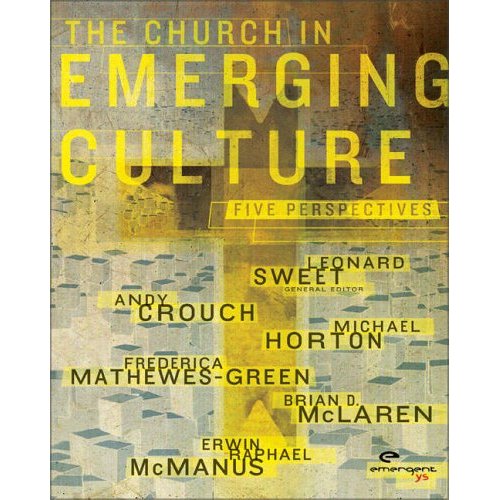
I have been reading this book- ‘The church in emerging culture’, ed Leonard Sweet. It takes a look at where church is up to from 5 perspectives- Andy Crouch, Michael Horton, Fredrica Mathewes-Green, Brian McLaren and Erwin McManus.
I have lost my way with it a little- more because of the format I think. Each person writes a chapter, then the other authors get a chance to put in footnotes and comments. I like the idea, but in practice, it makes for a strange book- lots of the comments are congratulatory, or disagreeing whilst being terribly nice.
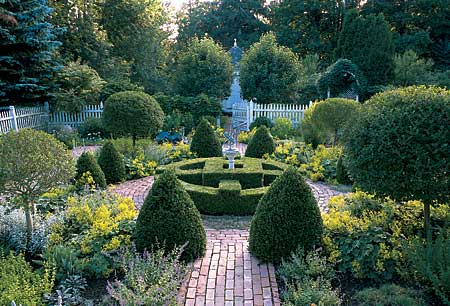
However, there is an introduction by Leonard Sweet in which he uses this image to make us think about the different ways of being church. I have simplified (because I had to- the bloke it too clever for me!) the discussion, and reproduce it here.
What do you think? Is this a good analogy?
I suppose the interesting thing is that flowers and fruit grow in all of these places- and they can all be very beautiful…
Garden- traditional church?
An ‘enclosure’- fenced off enclave of righteousness. Rooted in traditions. Collaboration between divine gardener (God), master gardeners (ministers) and horticulturalists (theologians), along with the canonical seasons.
Fruit and flowers grow and are appreciated.
The outside of the garden is of little concern. The garden is shaped and hallowed.
The garden demands that we walk slowly, prune quickly, earn the flowers by hard work- composting them well with the goodness distilled from previous generations.
Alien seeds are not tolerated. Constant struggle to win back the garden from the encroachment of time and surrounding wilderness.
Park- evangelical church?
Made for walking. Tied together by paths and vistas. Taking the old story of nature, and reforming it in new ways.
Rather than setting up high barriers, the park regulates the space by RULES. It is open to visitors at appointed times and under the supervision of park-keepers.
Technology and innovation are employed in parks- fountains, play areas- things that attract visitors.
The park manager decides which features to include in the park, borrowing from a wide variety of flora and fauna- but does not do so uncritically- always striving to work within the opportunities given by landscape and tradition.
Glen- progressive church?
The glen is an open and unprotected, surrounded by encroaching vegetation and forest.
It is defined by the relationship between landscape and soil fertility that allows settlement. The edges of the glen- its crags and steep slopes, require hard work to navigate. People avoid these places because of the fear of falling.
Glen dwellers revel in the mystery of the seed and season. They travel in packs of people of group consciousness. They are concerned with the cultivation of food from the land to feed the hungry, not about the beauty of gardens and parklands.
In the garden, you are what your parents planted- here, you are what your seeds become…
The people of the glen have to be highly adaptable and innovative to survive. The thin soil easily washes away, and new production methods have to be embraced.
However, in the Glen, tradition is powerful. People are more likely to look backwards than forwards. The reformers often seek to purify what already exists…
The meadow- emerging church?
A tract of moist grassland where flowers and grasses grow in profusion- all muddled together. There are also boggy places with fragile mosses and lichens. Willows and shrubs also grow there. They just happen. They are not managed by humans. The are rich in botanical (theological) diversity.
They are what first grows after devastation- for example, a forest fire.
Meadows are then inventive, creative and developmental.
The plants that grow in the meadow are intermingled and to some extent dependent. A Flax will never become a meadowsweet, but they will grow side by side. Beauty is evident in each. Fruit grows amid flowers and weeds.
Dwellers in the meadow are not interested in rules or doctrines- but rather in images and relationships and stories that bring people together.
There may be no easy, well trodden paths, but the meadow invites you to run through it bare foot. In this way, every generation can cut its own path. Every generation can turn from a world in which we have tried to garden everything and walk free.
In the meadow, all parties are active, none are passive.
In the meadow, there is a high rate of invention, but a high rate of failure. Plants come for a while, but die away to be replaced by other plants, as the soil conditions and moisture levels change.











 this fragile tent