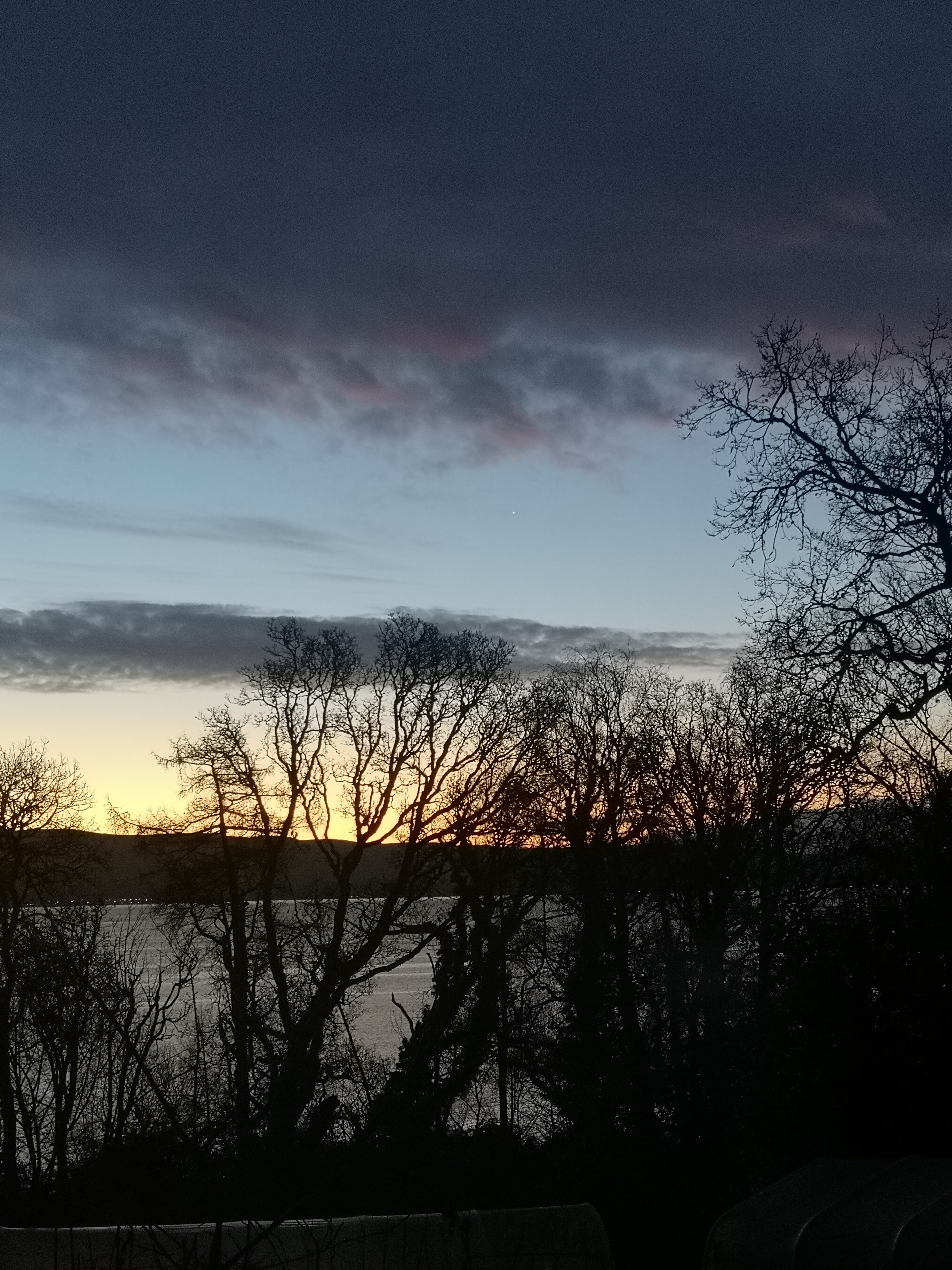
Today is the shortest day of the year, at least for those of us in the northern part of our beautiful planet.
Light has pulled back, retreated defensively, waiting for a chance to tentatively return and from hereon forward, each evening will gift us with approximately 2 minutes 8 seconds extra daylight.
There will be cold to come; icy days when it is easy to slide and fall.
There will be storms to face; days when panes of glass between us and the wild winds seem hopelessly insufficient.
There will be bone soaking dampness; the sort that makes it impossible to imagine that mud might become soil again.
There will be false starts: days when it seems as if spring has finally come, only to be snatched away again.
Despite all of this, each and every day, we are gifted 2 minutes and 8 seconds of light.
This post is from my friend Chris Fosten. I met him through poetry. Sometimes when you read a poem, you ‘meet’ somone and know instantly that you will like them and so it was with Chris. Here here talks about those Christmas days that are both normal and extraordinary at the same time. May we all make our own memories like these.
By the way, Chris has been a long time blogger, podcaster and has pubished a book of his poems here.
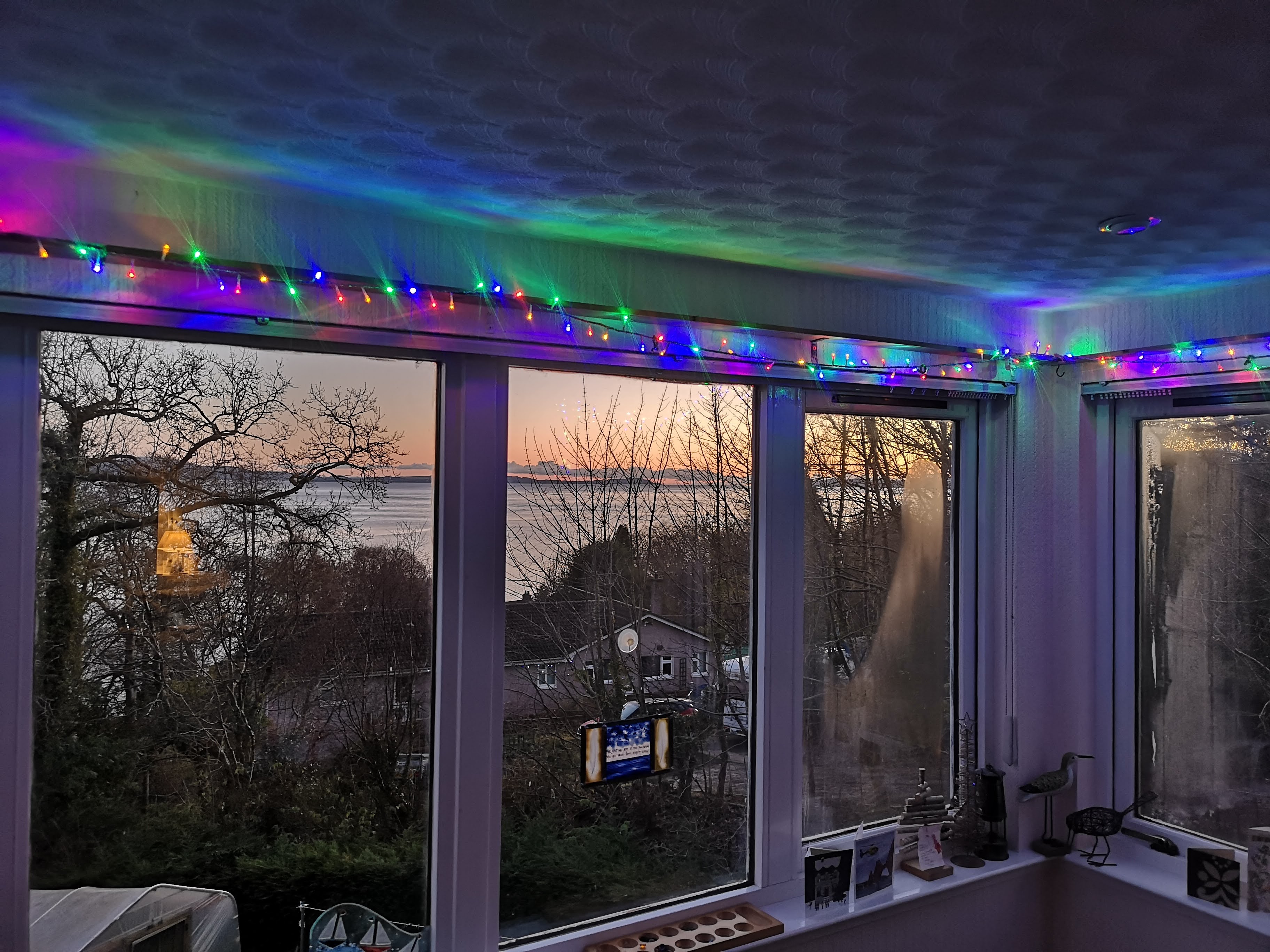
I love Christmas, and I view anyone with any sort of visible Christmas lights as an ally. I’m sure that seems crazy to some, but it’s true: in the darkness, they are optimistically, and sometimes over-enthusiastically, bringing joy. It’s been true since I was a child. I used to love sitting in the room with the Christmas tree, all lights off except those on the tree itself. I was entranced. Every evening, they are still the last things to switched off, and occasionally I still sit and marvel before flicking the switch. There’s a sort of happy abandon in coloured Christmas lights – a wilful joy breaching the darkness. I love them – a visible, brazen, symbol of hope.
I think my memories of Christmases have quietly taught me that, while things are very much different now, what has always made Christmas is the people I am with. The people who, in quiet ways, have brought that joyful splash of colour into my life. The people who, to quote John, are “the light that shines in the darkness, and the darkness has never put it out.”
For me, the small, ordinary, things; the times of love and laughter, the shared significant moments, can be the fairy lights.
Christmas can be hard. I have friends who are clinging on by their fingernails, watching the approach of fake festivity with dread.
It is no surprise that cultural assumptions around Christmas impose a kind of torture on those who feel out of sorts with them.
Perhaps this is you. In part, it will be me, not only because of recent losses, but also because I tend towards the meloncholy, particularly at this time of year. However, In my case at least, this is not the whole story. I am blessed not to be alone for a start, and my table will not be empty. Still, I will struggle and sowill look for small moments beyond the inevitable excesses when things are deeper and these will be my Christmas.
To those of you who struggle, often in secret, to ‘get through’ Christmas, I want to say this; it is no shame to opt out of what you need to opt out of. There is nothing wrong with doing what you must to get by. If you need to grit your teeth and watch back-to-back episodes of old TV programmes, do it. If you need to stay in bed with a good book and try to forget the whole thing, this is fine too. There are days when these things are necessary.
There might be moments though. Small things known only to you. Tiny exchanges between you and the mercy that holds you. They will be easily missed and soon forgotten, unless you reach out and take them in your hands.
Remember that Jesus bloke- the one who is actually the true meaning of Christmas? What was all that about then? What was he for?
It is a genuine question, for at least two reasons- the first one is obvious, in that Jesus plays almost no part in our celebrations within the culture of this country at least, beyond the odd school nativity play, in which Jesus is at best the eternal baby. We can (and I have) easily rail against what it has become. In the face of this however, I force myself to step back and remember that feasting has its place after a long journey, and to bring our communities together around a common table. We need this more than ever, right? The looming pandemic might well rob us again…
(As an aside, it seems that in the first one and a half thousand years following on from the life of Jesus, his followers feasted at easter, not christmas. Make of that what you will, but things seemed to start to change at least in part because St Francis proposed the idea that we did not need to wait until the cross for God to love us, rather that the whole thing was about incarnate love.)
The other reason is more esoteric however, because it is a theological one. Those of us from a religious background have often been given a template that, once imposed across all scripture, means that the whole thing is about trying to solve the problem of human sin. The gift that Jesus gives us in this template is as a holy sinless sacrifice to allow the rule of cosmic punishment to be set aside, for some at least. There are many problems with this template of course, which I will not go in to here, but it has dominated until recent times, when many thinkers in and around the church have begun to question it as a flawed or at least partial insight into the gift of Christmas.
The question then, takes us backwards and forwards. Backwards towards the ancient Hebrew idea of ‘Messiah’, and forwards towards what Richard Rohr calls ‘The cosmic Christ’.
The Messiah of old is about justice for the oppressed. His gift is jubilee for the weak and poor, when the crooked roads are made straight and the widow and orphan are embraced. This Messiah will bring about a new kingdom in which people remember that way of love.
The Cosmic Christ on the ther hand, is not just a man, but he is the very substance behind the whole material universe. The point here then is not (only) about solving the problem of sin, but rather a visible revealing of the incarnation of love inside all created things.
Rather than saving a fallen world, this Christ shows how love is constantly coming to us and being revealed to us by the world around us. It is buried within everything because without love, nothing would exist.
Remember, when we speak of Advent or preparing for Christmas, we’re not just talking about waiting for the little baby Jesus to be born. That already happened 2,000 years ago. In fact, we’re welcoming the Universal Christ, the Cosmic Christ, the Christ that is forever being born in the human soul and into history.
And believe me, we do have to make room, because right now there is no room in the inn forsuch a mystery. We see things pretty much in their materiality, but we don’t see the light shining through. We don’t see the incarnate spirit that is hidden inside of everything material.
The early Eastern Church, which too few people in the United States and Western Europe are familiar with, made it very clear that the incarnation was a universal principle. Incarnation meant not just that God became Jesus; God said yes to the material universe. God said yes to physicality. Eastern Christianity understands the mystery of incarnation in the universal sense. So it is always Advent. God is forever coming into the world (see John 1:9).
We’re always waiting to see spirit revealing itself through matter. We’re always waiting for matter to become a new form in which spirit is revealed. Whenever that happens, we’re celebrating Christmas. The gifts of incarnation just keep coming. Perhaps this is enlightenment.
This is the gift we recieve as advent moves towards Christmas. The incarnation of…
Thanks so much to all of you who sent messages over the past few days. It really does make a difference.
It feels important to carry on with these advent posts, so here is another old poem that has taken on a different significance from when I wrote it.
Perhaps the advent message here is less clear to you, but let me reframe it this way; previously I have used the term ‘the mercy’ to describe the great one-ness and am-ness of all things.
Richar Rohr describes this as ‘The Christ’ or the God who loves things by becoming them. The Christ refered here is both the same as and different from the physical person of Jesus. The Christ, through whom all things were made and have their being, comes to us as a child called Jesus, to live in the midst of our brokenness and vulnerability, to reveal to us the ways of mercy.
You may ‘get’ this, or it might seem strange and misguided. However, I feel it stronger than ever. We are have our being within this mercy, which both forms us and holds us. Our division from it and our individualism within it are tautological mysteries from which much of the pain of the human condition emerges, but this division is only temporary.
We tend to see our lives as linear events, as if our advent journey is always towards a distant vanishing point. As we look at the world around us though, the reality that we see is almost entirely cyclical. Seasons ebb and flow, the planets arch and turn about their heavenly stars, even the universe may well be looping back on itself as it expands.
Another way that I have tried to conceptionalise this is as a great water table, in which the essense, or the spirit, forms a great journey through different states, from sky to rain to river to sea and back again.
Advent, might form another cycle.
We rise then we return, held by the mercy.
Will the river run forever?
.
Will the river run forever?
Will it keep on tumbling down this cliff?
Will it keep on sparkling with the splash of light and life?
Will it dance to the scale of fin and fish,
Or will the music it makes
Fall silent?
.
Will the river run forever?
Will it carry the boat that carries me?
Will the flow go past these fields I know
And twist and turn to new places?
Or am I just a fool, floundering
In a stagnant pool?
.
Will the river run forever?
Will it keep carving these old rocks?
Will it keep on carrying them as suspended sediment,
Spew them through the open-mouth of an estuary
Fan them across the ocean floor,
Or will it fail?
.
Will the river run forever?
Will it irrigate? Will it recreate the flow
Of life in me? Will it roll through this world like laughter?
The first one might take you down, but can I suggest you stay with it for a while. Let it rest before you move on to the second.
Most of us are not used to reading poetry, but for most of the history of written language, it has been used as an aid to meditation and mysticism. The Hebrew Bible is at least one third poetry, for instance, more than likely copying the practices of the Babylonian culture that dominated them, from which fragments have survived too, most notably the Epic of Gilgamesh.
Other traditions are more familiar with this practice, particularly the Sufis within Islam, who have inherited the most astonishing work of poets such as Attar, Rumi and Sanai.
If you are approaching poems as a spiritual practice, it might be worth remembering the tradition of lecto divina, or holy reading, in which we read a passage 3 times, attending to our bodies and looking for words that resonate. The simplest easy to do this is to read a poem, and allow one sentence to speak to you. Wait for a moment, then read again.
There is a discussion to be had here about what is ‘scripture’ and whether it is appropriate to use poetry written by someone like me in this mystical way. That is a discussion for another time.
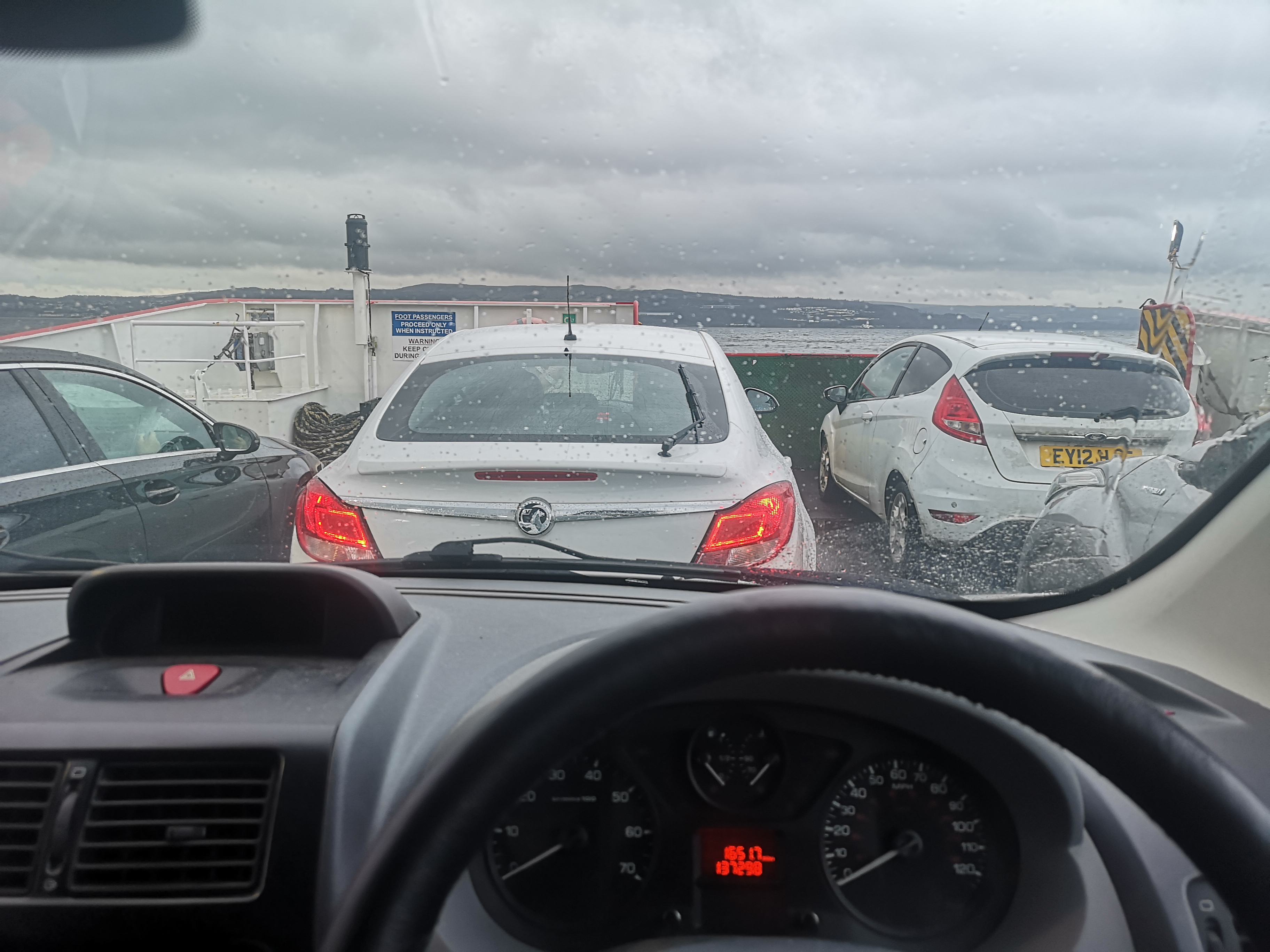
Today, I am driving 7 hours down to England, having been called to my mother’s bedside. We have been here before and may well be many times yet, but it feels hard. A long journey towards the unknown.
I did not need to make this journey alone, but persuaded Michaela that I needed to. I will probably regret that a few times. But there were once three of us; my mum, my sister and me. We lived in our ordinary dysfunctional bubble, the inside of which will soon only belong to me.
But how blessed are we who journey together? In my loneliness, I am rarely alone. I am surrounded by people I love. I am held even when I do not feel the holding arms.
Those of you who make your own journeys, alone or in company, I pray for you this kind of companionship. I pray it to for my old mum.
It is Immanuel.
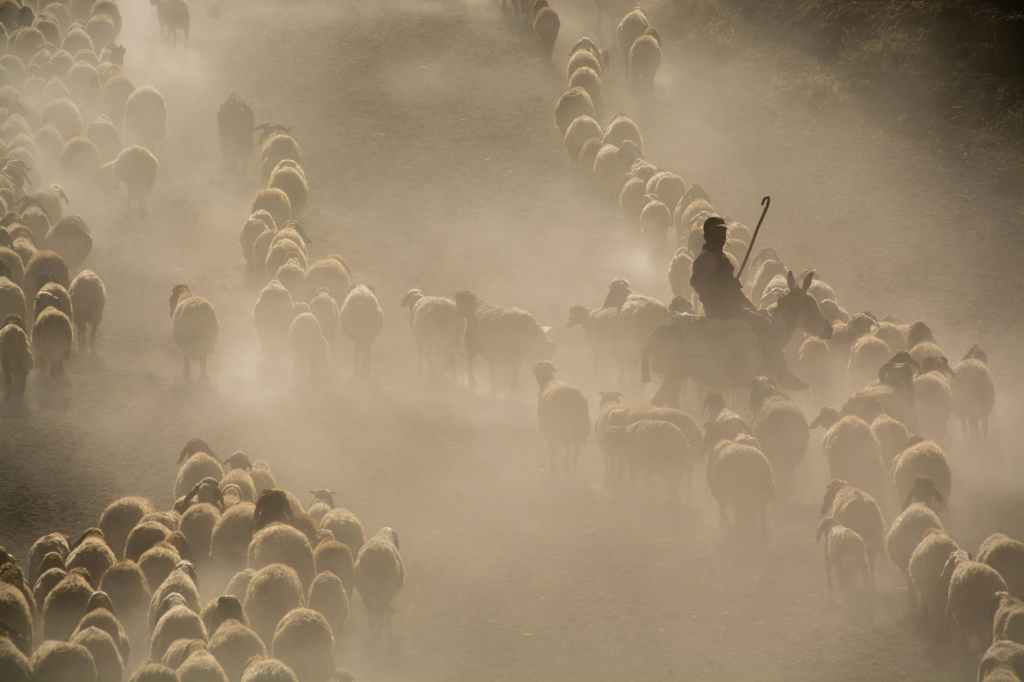
Shepherd
. Gathered Like the late autumn crop Like loose threads in a sock Like a post box gets mail Like the children of Israel Like birds overheard Folk at a deathbed Chicks under a wing A choir come to sing Like stories not told Like the sheep in this fold
. Gathered Like wet fallen leaves Like fields full of sheaves In the arms of a mother In the life of my lover Crowd to upcoming band Like a beach full of sand Like hook and like eye Like clouds in clear sky Like boats back from sea Like you gather me
. Gathered Like slow recollection Like mutual affection Like pond-bottom slime Around the scene of a crime Bright hearths in December Like football club members Like the hungry to feast Around the holy high priest Honey bees to a hive Refugees who survived
. Gathered Like dry clothes from a line Like grapes to make wine Like fish in a net Like old age regret Like friends in a pub Like the weft of a rug Like cards from the table Like a fibre-optic cable Like hairs in a comb Prodigal now back home
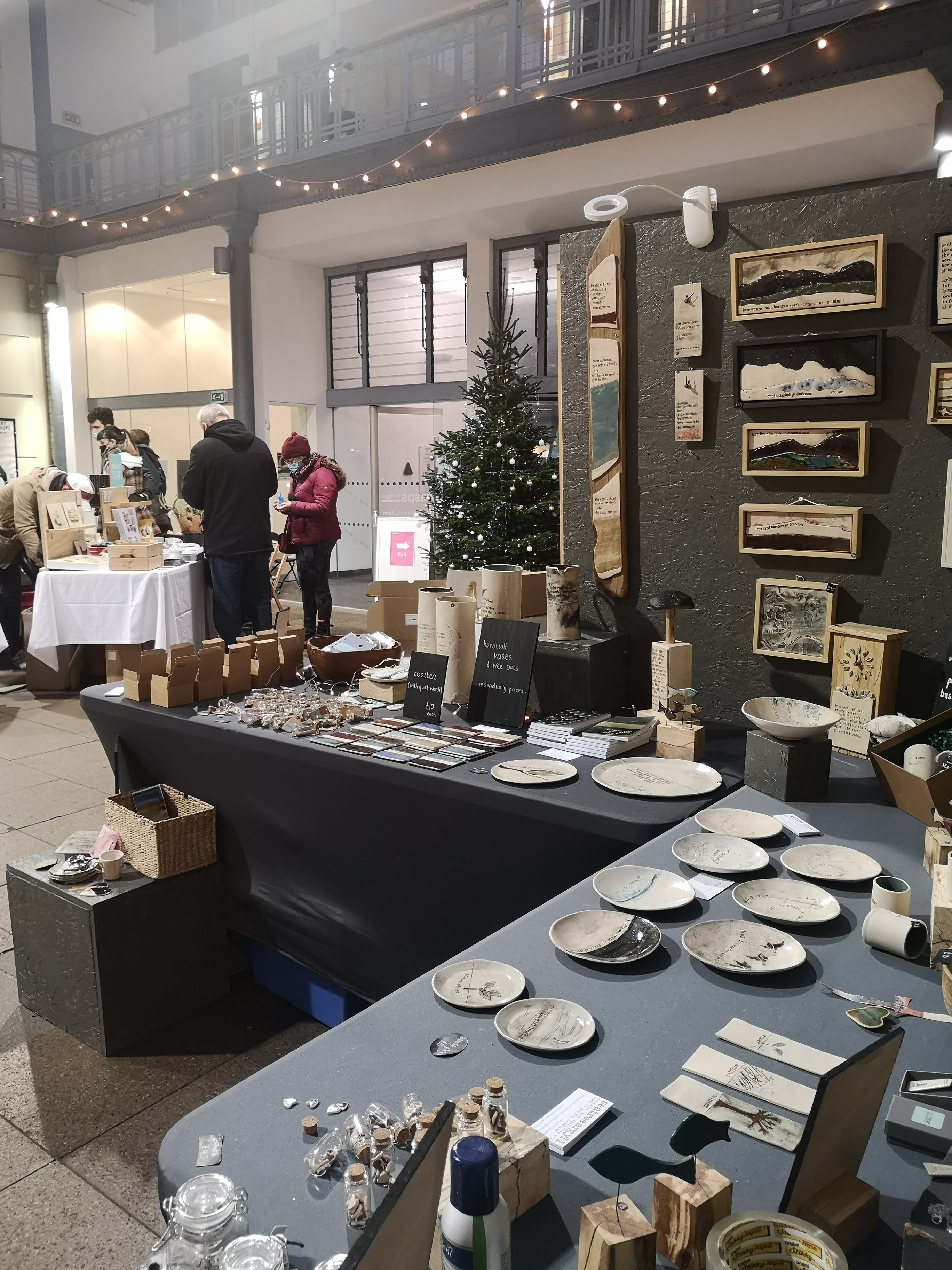
Over the weekend, Michaela and I did a version of our dayjobs. These days we make most of our living selling ceramics. We do this through galleries and shops but we also attend a few ceramics fairs and craft events ,so on Saturday and Sunday we were in the Briggait, an old drafty drippy fish market in Glasgow.
Selling stuff.
It is Christmas, after all.
We had a lovely weekend. We sold a lot of ceramics, had lots of great conversations and won a a free place at the next WASPS artists fair because ours was judged the best looking stall. In the evening, we ate out at a lovely vegan eatery and went to see James Bond strut his stuff before retiring to our Budget Ibis hotel.
It felt like we had stepped out of our rural backwater in to the mainstream.
There is the rub.
We are amongst that wide slice of the UK whose income is reliant on commerce, and in particular, that kind of commerce that might be given a boost around Christmas time, when people splash the cash on friends and family.
Frankly, we have struggled a bit with this. How can it be right that we, who seek a simpler more sustainable life, unplugged as much as possible from mainstream consumerism, need others to buy OUR stuff so this life is possible?
Is all shopping part of the problem?
Well, no. Of course not.
Trade – as in the fair exchange of goods and services – is a human good. It is how we are able to mange our varied skills in community to benefit from the fact that not everyone is the same, and some can do things that others cannot.
At best these exchanges are face-to-face, and based around a local economy.
If you are interested in the difference between this kind of trading and the more globalised, multi-national, corporation owned, kind, you might be interested in what has become known as the Preston Model- the town where I used to live;
But leaving all that aside, back to our little stall in Glasgow. Thankyou to all of those who came and bought things; bowls, plates, vases, poetry books, pictures etc.. (And while I am at it- thanks to those who have bought things from our webstore or from galleries!)
We hope that we are able to provide a service, in terms of an object that carries meaning, that is a fair exchange (in terms of the work we do to make this object) for the money we ask in exchange.
In return, we try to use this money well, to buy services and goods from other people. Our income is small, and deliberately so, but what we have, we try to buy from local suppliers, or from free trade, sustainable sources. This is simply not always possible but we think it is important to do this not as a charitable excercise, but as a social good, and for the sake of our planet.
You may see this as tokenism. I do not agree though, for two reasons;
Firstly, if we try to follow a life of the spirt, we know already that we seek to find the meaning below the surface. The way we trade is a fundamental part of our lives, so how can we not see this as part of our spiritual journey? As we seek to change the way we trade towards greater justice and social/economic/environmental responsibility we are do this as a spiritual discipline as well as a financial one.
Also, one person doing this is a drop in the ocean, but that is not a reason not to do it. Rather, we seek to create chains of influence, which is actually the very thing that trade IS – a chain of influence that is lubricated and liquified by money. What we are seeking is to turn our small actions in to a mass movement and these always start small.
Let me make this clear. This is NOT an advertisement for our business- you will see I have not included any links in this piece. You can find many other small, local people who are just like us.
A couple more stories from our weekend.
Because we make things that deliberately carry meaning – or become a vehicle for the meaning that others ascribe to them – our stall is often a place where emotions run high. It is a regular thing to see tears or to suddenly find ourselves in deep conversation with strangers. It is a very deep honour to be trusted like this.
Over the course of the weekend, I spoke to people who were retiring and looking for something that marked the change, a woman whose mother had just died, someone who was seeking to find ways to make work oportunities for their learning disabled son and his friends. These were not small conversations.
Then there was this conversation;
We sold a small clock like this one, but with words on which read ‘Let’s whisper dreams of things to come’;
It was bought by someone whose best friend’s husband died two weeks ago of cancer, as a gift for her in her pain and loss. The more I think about it, the more lovely this seems.
I used to rail against consumerism each year as Christmas approached. I made all sorts of token efforts to make personal changes- some years we only shopped in charity shops, or only from locally made produce, or with a limited budget. Always there was the obvious back story of ‘the true meaning of Christmas’, whatever that might be.
There is a version of this (which we consume through a thousand screens) that seems to be about being nice, being generous, and enjoying friendship and family. These are good things. Presents are good things I- I like getting presents and I like giving them too.
But this story of Christmas is not going to save the planet. It seems to be a story that has failed us, like an old scientific theory, superceded by experience and hard won knowledge.
Neither am I sure that this is in fact the ‘true meaning of Christmas’, even in our commercially oriented times. But what is then?
I suppose first and foremost, the true meaning of Christmas is that it was the start of a new story…
…a story about an ancient prophet who claimed to be God, which upset people so much that they killed him…
…or a story about the start of a new kingdom and a new way of living that was simpler, more connected and subjugated to something called love…
…or a story of how people took the example of the life and death of a man and formed it in to a religion, albeit one that often seemed to miss the point entirely…
…or a story in which we find ourselves. A story that challenges us and draws us towards an active hope that things could and should be better…
But there are many many other versions of this story. It became maleable and has been adapted and adopted by all sorts of divergent causes. It was worn by those in power like a badge to justify their power and has been employed by slaves to remind them that they were more than just slaves. So the story might become diluted and distorted from over use and under examination. It is a story that might then lose its power entirely because there is nothing more disposable than a meaningless story.
But how we need a new story at the moment; a better story than the one we have been living with. Here is Monbiot on politics for example;
The interesting question though is whether this story will be a new one after all, or rather a rediscovery/re telling of one that we had mostly forgotten.
The story that began at Christmas is celebrated in a burst of consumerism. But what if we remembered that Jesus told his followers that they did not need two shirts on their backs and modelled a way of sharing everything? The same Jesus who told us that the rich would struggle to enter the Kingdom of God that he was proclaiming, which would bring blessing to the weak, the poor and the broken? How might this story affect the way we live? How might it shape our politics, our economics, our theological understandings of the world?