Back to the very beginning…

Trigger warning- this is a small diversion into Bible history. For some this might be a turn-off right there, whereas others may find it goes to places that they are simply uncomfortable with. There will also be bible scholars who will take issue with some – or all – of the things I am saying, because we are dipping into a vault of murky ancient history filtered through a religion which claims the authority of God on whatever it has sanctified.

But sometimes, in order to make things new, we need to look backwards too – in this case, to the very beginning – so that we can see where we came from, and perhaps where we turned left when we could have turned right.

So, feel free to disagree. Go and do your own research and I hope that this brings to you your own meaning. Find your own story, just as I look for mine.

I was at an Iona community family group meeting last weekend, in which we were discussing Christian humanism. I confess to approaching the discussion warily, as it seemed likely to be rather esoteric, but what actually happened was that it opened a window into something that I found interesting intellectually and more importantly, to offer ideas that might be very useful as we seek to rediscover our story. Or perhaps it would be better to say ‘as we seek to rediscover purpose, mission, our concepts of goodness and our prophetic voices’.

Just little things like that.
For those who have read this far who have no allegiance to Christianity, past or present, perhaps I should say a little bit more about this ‘story’ thing. Western culture was founded – or perhaps it would be better to say shaped then continuously disrupted – by the Christian story. I would argue that what we made of this story was always full of obvious tortuous distortions of the words of Jesus, such as we know them. After all, how can we reconcille conquest, empire, the accumulation of wealth, slavery, poverty, capitalism, etc etc with the words of Jesus? Christianity became a religion that had little to do with the core elements of the story Jesus told.

This is a bold statement, I know, but one that I believe I could ‘prove’ in a court of law.

Arguably, the tensions created by this disconnect have always been there throughout Christian history, characterised by purges against heretics, or successive Protestant reformations. Always, people talked about going back to true religion and recreating the purity of the early church. The source material for this protesting and reforming was always the Bible- viewed through the context and passions of the people reading it.

Part of the problem – the nature of the torturous distortions perhaps – comes about when we ask what the Christian story that we built western culture on actually is/was. There is the story of love, compassion, caring for the weak and poor, looking after widows and orphans. The inverted power structures, the value given to each person. The living lives colectively and fairly. But this never fitted easily with the cultures we created. What did fit was a different gospel, which might be understood as how personal sin results in eternal damnation, but for the sacrificial death of jesus.

Despite the sometimes cataclysmic changes that these religious arguments brought about, we have a different problem now. Churches are empty. Sure, I know there are exceptions, but here in the UK, the number of people who attend church is still declining, still aging, still arguing and as such the Church is less and less relevant as a moral or political force. It still has an important ceremonial function, but it has no prophetic voice. It has no story that anyone is listening to. Perhaps, given the tortuous distortions I refered to above, this might not be a bad thing.

But the end of one story (if indeed that is what we are seeing) leaves an empty space. People have always looked for meaning and purpose and without a story, what do we have? In a post-covid world, overshadowed by global warming and mass extinctions, how do we conceive of a better story? In a political system dominated by inequality and the failure of our institutions and political/economic systems to bring hope, how do we shape our story towards better things?
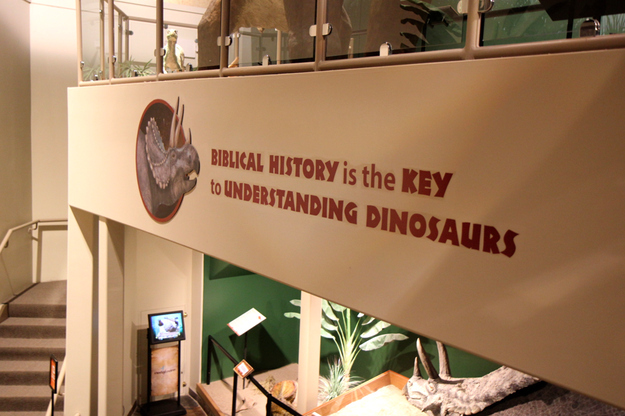
Can’t remember where I got this from. The Creation museum perhaps?

Given what I have said above, the Bible would seem to be a strange place to start, right? After all, even now there are plenty of people in the world who seek to use it as blunt weapon to bludgeon us towards their story – often a very narrow story that seems very much to be part of the problem; a story that is anchored to textual determinism, at least in relation to some of the words of the Bible, which is seen as a unified, divinely inspired and heavenly-delivered holy text.

But what if the Bible is much less than that, but at the same time, much more? What if it is a library of miss-steps, half truths, mythological history and open-hearted laments? What if it is one third poetry? What if there are no other books in human history that are like it?

More pertinently, what if the Bible – or at least the books of the new testament – contains great big clues as to how the words of a man called Jesus became repackaged into a religion called Christianity by a Jewish religious genius (who never actually met Jesus) called Paul?

This was what we ended up talking about at our meeting.

Apostle Paul (1600 – 1699) by Rijksmuseum is licensed under CC-CC0 1.0

Remember those clues I mentioned above? Here is what we think we know – with the usual warning that some (many!) will take different views.

  1. The oldest of the four gospels is Mark’s gospel. It is very different from the others, so much so that later scribes have tried to give it a different ending. He does not include the resurection.
  2. The other gospels seem to quote freely from Mark, but spin off into other directions. They add many of the ideas that MAY have been influenced by Paul.
  3. Paul never met Jesus, and we can infer tensions between him and the other apostles who actually did – many of whom get a very bad press in the gospels! Paul’s encounter with Jesus was mystical, and he seemed to trust this more than he did the words or experience of those who had been his disciples.
  4. Paul was a sophisticated, educated man. The other apostles were not. (But Jesus picked them!) Without his innovation and leadership, it seems unlikely that the early Christian church would have survived – many other Jewish movements did not after all. The difference was… Paul.
  5. The oldest actual book to be included is thought to be St Paul’s first letter to the Thessalonians, in which some believe he was correcting or addressing issues that had been created by an earlier letter around the second coming of Jesus.
  6. This letter may well have been the Didache (pronounced did-a-kay), which was a letter from the apostles in Jerusalem giving instructions as to how to run a church. As such this letter certainly predates most of the NT books, but may well be earlier than them all. More on this later.
  7. The canon of scripture that evolved over the next many centuries involved many good people struggling to make sense of a complexity of writings that most of us have no idea ever existed. The struggle to do this well, according to a set of principles that made sense, is to be honoured. But we have to remember that the library of diverse books that entered the canon was a human construct, that was shaped by context, best understandings and compromise.
  8. All of which should leave us room to treat these incredible documents with respectful skepticism. After all, they are strong enough to allow our questions, our doubts, our various entanglements. The ‘truth’ they contain is no less real if we question its historicity for example (there are plenty of problems reconciling the Bible with the archeological/historical record.) We might learn as much from apparent contradictions as from attempts to ‘make it all fit’.

The bottom line here is that our interpretations and understandings of the Bible- what it is, what it has to say, what it means for our lives, our politics, our priorities – what STORY it leads us towards depend a lot on what we think the Bible is. If we are to allow it to shape us, I would argue that we must first loosen up a little. It is OK to take the book/s out of their leather case. Doubt them and see where the doubts lead. Believe them and see where the beliefs lead.
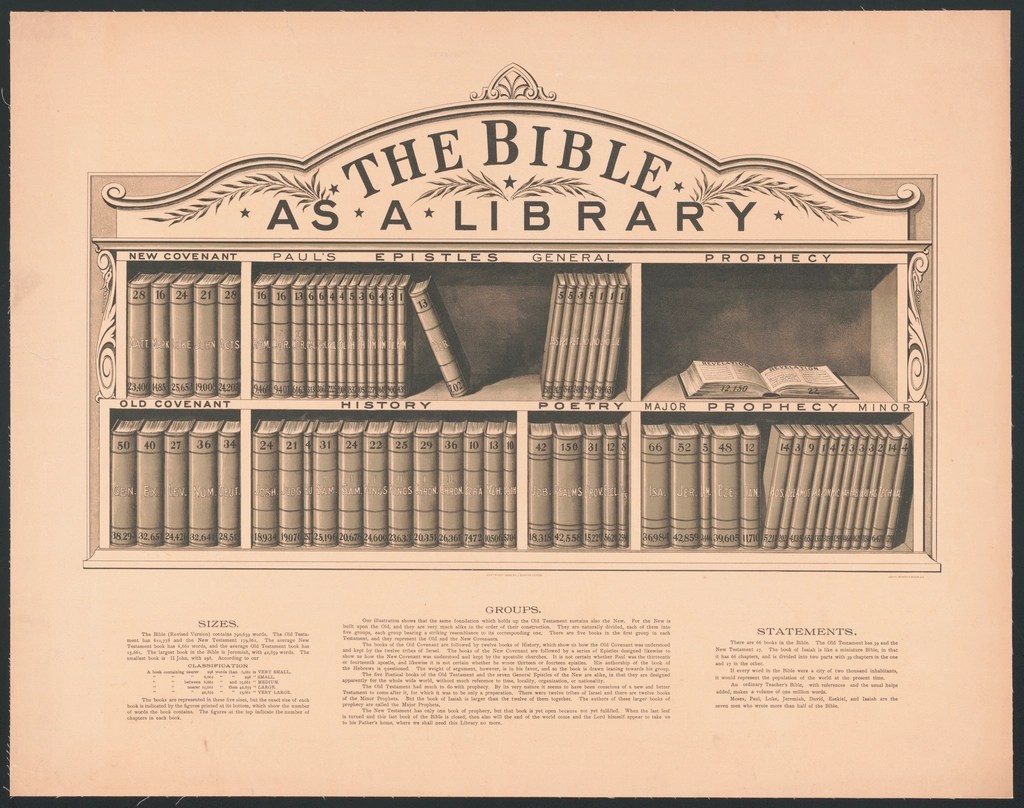
The bible as a library by Library of Congress is licensed under CC-CC0 1.0

If you want to know more about the complex and fascinating (to me anyway!) bible history, then it can be difficult to know where to start. There is so much out there and unless you are an academic (and I am certainly not) then it is difficult to know who is dealing with these issues honestly and who is coming at them with a perspective pre-formed by their own tribe.

The Bible Project has tried hard to bring some of the acedemic perspective to a wider audience, with video’s like this one;

More controversially perhaps, and thanks to my fellow (and inspirational) Iona community family group member, I would point you towards some of the writing and speaking of a man called James Tabor, who communicates well around many of these issues, including via his excellent you tube channel. Videos like this one;

So where does all of this take me to? Can it really be a way towards a new and better story?

I think so, firstly because it allows us to break with the old one – not to dismiss it, but to include and transcend it. After all, arguably this is exactly what Paul did to the teachings of Jesus – brilliantly, and perhaps problematically. Secondly because It might encourage us to project new – yet faithful – understandings onto our context in a way that is free from some of the distortions. Of course, we will no doubt make new distortions, and for this we need those who will doubt and test them too.
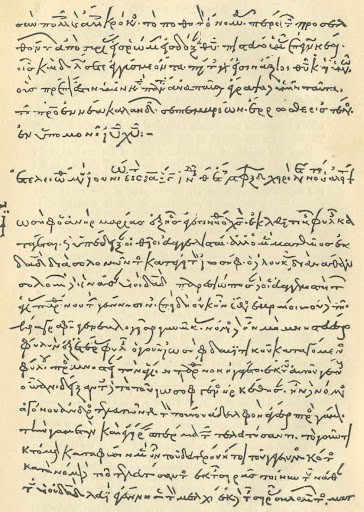
Finally, I want to return to the Didache. I had never heard of this document, and this was interesting to me too. How is this not better known? (Perhaps you are far ahead of me however and the problem was just my ignorance.)

James Tabor has a blog piece that talks in more detail about this document. You should read it, but I will quote from it here;

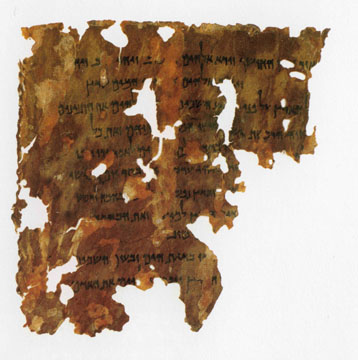
The Didache was discovered in 1873 in a library at Constantinople by a Greek, Priest Father Philoteus Bryennios. This precious text, dating to the late 1st or early 2nd century CE, is mentioned by early Christian writers but had disappeared. Father Bryennios discovered it in an archive of old manuscripts quite by accident. 

TheDidache is divided into sixteen chapters and was intended to be a “handbook” for Christian converts. The first six chapters give a summary of Christian ethics based on the teachings of Jesus, divided into two parts: the way of life and the way of death. Much of the content is similar to what we have in the Sermon on the Mount and the Sermon on the Plain, that is, the basic ethical teachings of Jesus drawn from the Q source now found in Matthew and Luke. It begins with the two “great commandments,” to love God and love ­one’s neighbor as oneself, as well as a version of the Golden Rule: “And whatever you do not want to happen to you, do not do to another.” It contains many familiar injunctions and exhortations, but often with additions not found in our Gospels:

Bless those who curse you, pray for your enemies, and fast for those who persecute you. (1.3)

If anyone slaps your right cheek, turn the other to him as well and you will be perfect. (1.4)

Give to everyone who asks, and do not ask for anything back,
for the Father wants everyone to be given something from the
gracious gifts he himself provides. (1.5)

Many of the sayings and teachings are not found in our New Testament gospels but are nonetheless consistent with the tradition we know from Jesus and from his brother James:

Let your gift to charity sweat in your hands until you know to whom to give it. (1.6)

Do not be of two minds or speak from both sides of your mouth, for speaking from both sides of your mouth is a deadly trap. (2.4)

Do not be one who reaches out your hands to receive but draws them back from giving. (4.5)

Do not shun a person in need, but share all things with your brother and do not say that anything is your own. (4.8)

As well as the similarities, there are real differences from the Christianity of Paul however. Communion for example is to be a simple thanksgiving meal of wine and bread with references to Jesus as the holy “vine of David.” It ends with a prayer: “Hosanna to the God of David,” emphasizing the Davidic lineage of Jesus. The bigger issues raised by the Didache are these (again via James Tabor);

The entire content and tone of the Didache reminds one strongly of the faith and piety we find in the letter of James, and teachings of Jesus in the Q source. The most remarkable thing about the Didache is that there is nothing in this document that corresponds to ­Paul’s “gospel”―no divinity of Jesus, no atoning through his body and blood, and no mention of Jesus’ resurrection from the dead. In the Didache Jesus is the one who has brought the knowledge of life and faith, but there is no emphasis whatsoever upon the figure of Jesus apart from his message. Sacrifice and forgiveness of sins in the Didache come through good deeds and a consecrated life (4.6).

The Didache is an precious witness to a form of the Christian faith more directly tied to the Jewish orientation of Jesus’ original followers. I encourage my readers to take a look for themselves. There are many versions both on-line and in print. You can begin here: Early Christian Writings: The Didache.

I wonder how this makes you feel?

Perhaps you are weary from all this deconstrction – I certainly am. The idea of being confronted with documents that start to undermine the very nature of the divinity of Christ might be the last thing we need. Anyway, this is not defnitive. The Didache is just an ancient document that never made it into the canon of scripture that became the Bible. It contains other problems too- not least the apocalyptic vision that Paul may have been clarifying and correcting in his letter to the Thessalonian church. Perhaps this document describes an evolutionary early set of followers trying to establish some kind of common practice. Perhaps we needed a theologian such as Paul to bring the whole story together.

But then again…

As with all theology, my last question is always , So what? How might these ideas lead to liberation, to renewal, to a new story?

What is most important, the details of doctrinal correctness, or the heart and spirit of the matter? It is the latter that gives us our story is it not, and to me at least, this rings all the more true when set free.

Chautauqua…

pirsig


Currently I am reading Robert Pirsig’s Zen and the Art of Motorcycle Maintenance. Somehow I never got round to it before. I am enjoying it- Prisig has a lovely way with words and a great love of ideas, images, philosophy.

One word he uses a lot is this one- Chautauqua. 

I would like to use the time to talk in some depth about things that seem important. What is in mind is a sort of Chautauqua — that´s the only name that I can think of for it — like the traveling tent-show Chautauquas that used to move across America, […] an old-time series of popular talks intended to edify and entertain, improve the mind and bring culture and enlightenment to the ears and thoughts of the hearer. ( Pirsig, p.17)

The origin of the words seems to be a movement founded in the 19th C that provided education and entertainment to isolated farming communities via a kind of travelling circus- complete with lectures, discussions and workshops. They fed a hunger for knowledge and self improvement.

Pirsig uses the word whenever he introduces as new concept, a new idea.The Chautauqua becomes the vehicle by which the mind can travel. The fact that this story is happening in the context of a motorcycle journey (with his curious son as a pillion passenger) makes the Chautauguas all the more vital.

I mention this as it made me think again about the way we encounter the words of the Bible. Might it be better to see them as a travelling circus tent full of ideas, concepts, poetry, philosophy? A spiritual Chautauqua. Those of us that visit and engage do so as people eager for the fun of the journey, able to debate, question, laugh, cry, heckle or just listen in awe.

So, rather than academic stuffyness, or unassailable unapproachable holiness. Rather than being ‘The Word of God’, might we see the Bible as Chautauqua?

A tent at the side of the road in which to exchange ideas about who God is…


In case you thought I have been harsh on the Bible of late…

There has been an awful lot on this blog recently about the Bible- apologies to those of you who are not interested in such debates. But hey, it is MY blog after all, and I think these things are more important now then ever.

How else do we find a rudder in the mess of what we are becoming, unless we ask these deep searching questions?

This is NOT the same thing as trying to hold back time- trying to return us to some faux Victorian world view. We need to be free to re-encounter the words of the Bible, to debate it, to question it and allow ourselves to be questioned by it. My recent posts have been a bit about trying to make some space for this.

I saw this today- Steve Chalke of Oasis kind of saying the same thing;

<p><a href=”http://vimeo.com/86521708″>Restoring Confidence in the Bible</a> from <a href=”http://vimeo.com/user12741304″>Oasis UK</a> on <a href=”https://vimeo.com”>Vimeo</a&gt;.</p>

Tony Campolo on homosexuality…

Over the last few years, a number of people who would previously have been regarded as Evangelical Christian heavyweights appear to have changed their stance on homosexuality significantly. There seems to be a whole wing of Evangelicalism that is ‘coming out’- or do I generalise from the particular?

Is this accommodation with the changing views of culture- albeit lagging behind because of a dragging-anchor theological hermeneutic?  Or is it the fact that Christians are finally catching the scent of freedom and justice on the breeze? Whatever, I celebrate the change.

I will not list the names I am thinking of, as this plays into the hand of the totemic brigade- you know the way it works, the degree to which a person is ‘OK’, ‘Biblical’, ‘Theologically sound’, depends on whether they agree with us on certain totemic issues. I try, but if I am honest I am guilty of a bit of this too…

I was first inspired by listening to Tony Campolo speak back in the early-mid 1980’s. He upset a lot of people at Spring Harvest festival some time around then (I think I was there, but the story might have become more important than fact on this one!) by telling a story something like this;

You know folks, X (can’t remember the exact figure) number of people have starved to death since I started to speak to you tonight.

And you know what is worse? Most of you people here do not give a shit.

And even worse that that, most of you are far more concerned that I just used the word ‘shit’ than the fact that those people have starved to death.

It is hard to convey how genuinely shocking hearing these words from a preacher at Spring Harvest was back then. Campolo has always been rather left field.

However, his stance on homosexuality in books of his I have read went something like this;

It is not the fault of gay people that they were born different, but the Bible is clear that the homosexual act is sin. It is however NOT a sin to be homosexual, as people have no control over their sexual orientation. Therefore to be gay and Christian is to be celibate.

I think he may even have used the old ‘love the sinner, hate the sin’ argument. If he did not, others certainly did in his wake.

Contrast this with the clip below. He does not need to talk about the theology- rather he tells a story, which is a very Jesus kind of way of doing theology of course.

The emotional musical soundtrack is a bit naff, but Campolo is always (ahem) Campelling.


Reading history through objects…

Last year there was a cracking radio series entitled ‘The history of the world in 100 objects’, which concerned itself with objects chosen from the thousands in the British Museum. It was impossible not to be reminded of this as we walked around the museum last week.

What I loved about the series was the way that the presenter (Neil MacGregor, Director of the British Museum) was able to use each object as a time capsule, or some kind of window into where we came from.

Most people who read the Bible find an extra frisson of fascination around objects that have some connections to Bible history. Two of these objects had me thinking again about the way that we use history not just like a distorted telescope lens, but more like a kaleidoscope. The light we see at such distance is bent by all sorts of assumptions and overlaid constructions- never more so than when the Bible is involved.

The first object (or set of objects to be more accurate) is this one- the Lachish relief.

lachish relief

This relief is from a time of  around 3000 years ago- and this too was a time of war. (It is estimated that there were only around 50 Million people in the world then, but still there was an the urge to fight!) In this instance, the fighting recorded was the great siege of Lachish in Judea, 701 BC by King Senacherib.

Lachish is first mentioned in the Bible as one of the cities taken by force from its existing inhabitants by Joshua. In Joshua 10, it is recorded that the King of Lachish started out as an ally of the Israelites, fighting alongside them, before ‘God gave Lachish to Israel’, who ‘took it in two days and killed everyone’. Despite this, somehow Joshua remains our hero. He was establishing Gods promised holy nation…

Jump forward around 4 centuries or so, to around 1000 BC, the kingdom of Judah had more powerful neighbors in the form of the  Assyrian Empire, stretching Iran to Egypt, and maintained by the all powerful Assyrian war machine.

Good King Hezekiah, who seemed to get all the worship purity stuff right, made some rather bad political decisions and defied the Assyrian King Sennacherib.

In 2 Kings 20 there is a story of one of Sennacheribs men delivering insulting blasphemous words about the lack of power of the Jewish god when faced with the power of the sword. Here Hezekiah cleverly pays off the Assyrians, and eventially God kills first most of their army, then Sennacherib himself gets his comeuppance.

The story from the Assyrian records are rather different;

 “In my third campaign I marched against Hatti. Luli, king of Sidon…fled far overseas and perished…In the continuation of my campaign I besieged Beth-Dagon, Joppa, Banai-Barqa, Azuru, cities belonging to Sidqia who did not bow to my feet quickly (enough); I conquered (them) and carried their spoils away.  The officials, the patricians and the (common) people of Ekron –  who had thrown Padi, their king, into fetters (because he was) loyal to (his) solemn oath (sworn) by the god Ashur, and had handed him over to Hezekiah, the Jew (and ) he (Hezekiah) held him in prison, unlawfully, as if he (Padi) be an enemy-had become agraid and had called (for help) upon the kings of Egypt (and) the bowmen, the chariot(-corps) and the cavalry of the king of Ethiopia, an army beyond counting-and they (actually) had come to their assistance.  In the plain of Eltekeh, their battle lines were drawn up against me and they sharpened their weapons.  Upon a trust (-inspiring) oracle (given) by Ashur, my lord, I fought with them and inflicted a defeat upon them…I assaulted Ekron and killed the officials and patricians who had committed the crime and hung their bodies on poles surrounding the city…I made Padi, their king, come form Jerusalem and set him as their lord on the throne, imposing upon him the tribute (due) to me (as) overlord…As to Hezekiah, the Jew, he did not submit to my yoke, I laid siege to 46 of his strong cities, walled forts and to the countless small villages in their vicinity, and conquered (them) by means of well-stamped (earth-)ramps, and battering-rams brought (thus) near (to the walls) (combined with) the attack by foot soldiers, (using) mines, breeches as well as sapper work.  I drove out (of them) 200,150 people, young and old, male and female, horses, mules, donkeys, camels, big and small cattle beyond counting, and considered (them) booty.  Himself I made a prisoner in Jerusalem, his royal residence, like a bird in a cage.  I surrounded him with earthwork in order to molest those who were leaving his city’s gate.  His towns which I had plundered, I took away from his country and gave them (over) to Mitinti, king of Ashdod, Padi, king of Ekron, and Sillibel, king of Gaza.  Thus I reduced his country, but I still increased the tribute and the Katru-presents (due) to me (as his) overlord which I imposed (later) upon him beyond the former tribute, to be delivered annually.  Hezekiah himself, whom the terror-inspiring splendor of my lordship had overwhelmed  and whose irregular and elite troops which he had brought into Jerusalem, his royal residence, in order to strengthen (it), had deserted him, did send me, later, to Nineveh, my lordly city, together with 30 talents of gold, 800 talents of silver, precious stones, antimony, large cuts of red stone, couches (inlaid) w3ith ivory, nimedu-chairs (inlaid) with ivory, elephant-hides, ebony-wood, box-wood (and) all kinds of valuable treasures, his (own) daughters, concubines, male and female musicians.  In order to deliver the tribute and to do obeisance as a slave he sent his (personal) messenger.”

Ancient Near Eastern Texts – Relating to the Old Testament edited by James B. Pritchard, Princeton University Press, New Jersey 1950, quoted here.

The next scene in the relief is the aftermath of battle- people fleeing burning city. This is seen as the first ever depiction of that all-too-familiar modern phenomenon; mass refugees. Why did the Assyrians want to show this in their propaganda? Was it a warning to all those who would challenge the powers of the great king? Note however that the exiles were not all murdered, they travel with their livestock and belongings. The Assyrians showed a degree of humanity that Joshua seems to have lacked.

The great king Sennacherib was assassinated by one of his sons however as described in the Bible- the cycle of war continued.

Cyrus cylinder

One of the other objects I wound myself staring at was this one- the Cyrus Cylinder.

This is one of several such cylinders that have been found in the walls and buildings of ancient Babylonian cities and palaces- it seems that the builders of these places wanted some kind of record to remain in the foundations of what they made.

The text on the Cylinder praises Cyrus, sets out his genealogy and portrays him as a king from a line of kings. The Babylonian king Nabonidus, who was defeated and deposed by Cyrus, is denounced as an impious oppressor of the people of Babylonia and his low-born origins are implicitly contrasted to Cyrus’s kingly heritage. The victorious Cyrus is portrayed as having been chosen by the chief Babylonian godMarduk to restore peace and order to the Babylonians. The text states that Cyrus was welcomed by the people of Babylon as their new ruler and entered the city in peace. It appeals to Marduk to protect and help Cyrus and his son Cambyses. It extols Cyrus as a benefactor of the citizens of Babylonia who improved their lives, repatriated displaced people and restored temples and cult sanctuaries acrossMesopotamia and elsewhere in the region. It concludes with a description of how Cyrus repaired the city wall of Babylon and found a similar inscription placed there by an earlier king.

Again, readers of the Bible will remember Cyrus-

His treatment of the Jews during their exile in Babylon after Nebuchadnezzar II destroyed Jerusalem is reported in theBible. The Jewish Bible’sKetuvim ends in Second Chronicles with the decree of Cyrus, which returned the exiles to thePromised Land from Babylon along with a commission to rebuild the temple.

‘Thus saith Cyrus, king of Persia: All the kingdoms of the earth hath Yahweh, the God of heaven, given me; and He hath charged me to build Him a house in Jerusalem, which is in Judah. Whosoever there is among you of all His people – may Yahweh, his God, be with him – let him go there.’ (2 Chronicles 36:23)

This edict is also fully reproduced in the Book of Ezra.

In the first year of King Cyrus, Cyrus the king issued a decree: ‘Concerning the house of God at Jerusalem, let the temple, the place where sacrifices are offered, be rebuilt and let its foundations be retained, its height being 60 cubits and its width 60 cubits; with three layers of huge stones and one layer of timbers. And let the cost be paid from the royal treasury. Also let the gold and silver utensils of the house of God, which Nebuchadnezzar took from the temple in Jerusalem and brought to Babylon, be returned and brought to their places in the temple in Jerusalem; and you shall put them in the house of God.’ (Ezra 6:3–5)

As a result of Cyrus’s policies, the Jews honored him as a dignified and righteous king. He is the only Gentile to be designated as Messiah, a divinely appointed leader, in the Tanakh (Isaiah 45:1–6). Isaiah 45:13: “I will raise up Cyrus in my righteousness: I will make all his ways straight. He will rebuild my city and set my exiles free, but not for a price or reward, says Yahweh Almighty.” As the text suggests, Cyrus did ultimately release the nation of Israel from its exile without compensation or tribute. Traditionally, the entire book of Isaiah is believed to pre-date the rule of Cyrus by about 120 years. These particular passages (Isaiah 40–55, often referred to as Deutero-Isaiah) are believed by most modern critical scholars to have been added by another author toward the end of the Babylonian exile (ca. 536 BC).[90] Whereas Isaiah 1–39 (referred to as Proto-Isaiah) saw the destruction of Israel as imminent, and the restoration in the future, Deutero-Isaiah speaks of the destruction in the past (Isa 42:24–25), and the restoration as imminent (Isa 42:1–9). Notice, for example, the change in temporal perspective from (Isa 39:6–7), where the Babylonian Captivity is cast far in the future, to (Isa 43:14), where the Israelites are spoken of as already in Babylon.[91]

Here we have a king from outside the chosen people, appointed by God, showing the kind of tolerance, respect for human rights and concern for peace that had been a scarce commodity.

And this very object remains as a testimony to who he was.

Human history; the rise of power, or the journey towards love?

I am interested in understanding who we are, why we are, what we are becoming- in the light of the fact that we are more than flesh that just becomes dust- we are people who have been travelling for millenia towards a deeper encounter with God, however we understand this.

I look at all this through my own distorted set of lens- but I do so consciously. So rather than co-opting history to glorify our own slice of empire (which was the origin of the British Museum after all) perhaps we can understand history in the light of who Jesus was.

In this way, small thing, small people, voices from the margins- these things become important. Great powers less so- they come and go, empires rising and falling like epidemics.

In-groups are broken- we are set free from narrow religious/geographical/ethnic boundaries. Now we can look for the marks of grace and love wherever we find them.

And we can learn to value above all the fruits of the Spirit- love, joy, peace, patience, justice, compassion.

Even when looking back.

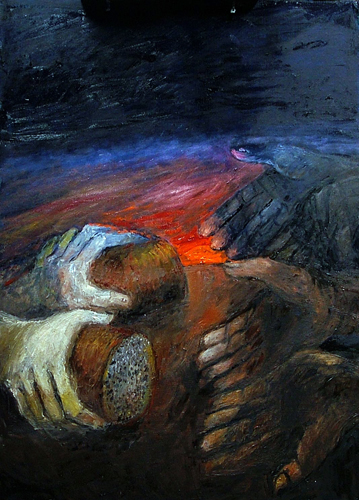
Scooping them up for the Kingdom…

koder-sharing-bread

Lovely chat tonight out at our pub discussion thingy- talking about the Kingdom of God.

It is an old discussion for many of us, but we were chewing again on all those mysterious stories that Jesus told us- those The Kingdom of God is like… stories. Mustard seeds, fields of weedy wheat, women making bread with yeast, corn falling on random ground etc. It is all rather mixed up and mysterious, particularly as the stories from Matthew’s gospel tend to have the odd bit of smiting and burning in torment, all of which does not fit with fluffy-Jesus very well.

We talked too about our understanding of The Gospel- which for most of us used to be the saving sinners from hell when they die thing, and how this version of the Gospel comes mostly from a reading of Paul’s letter to the Romans backwardly applied to the rest of the Bible, when actually the Gospel that Jesus talked about was this one;

Repent, for the Kingdom of God is at hand.

(Or perhaps)

Its time to turn things around, shake things up, take a long hard look at yourself, because there is a deeper, more beautiful way of living that has come to you- the insurgency of God…

Our discussion then turned to what living as an agent/citizen/participant in this Kingdom/Revolutionary movement/Insurgency might mean.

The old understanding of the Gospel made it all simple- saving the lost so that they might go to heaven. Our primary purpose is evangelism. All other tasks are distractions from the Gospel. I find this narrative very difficult on all sorts of levels now, but the mission of the Kingdom is far more challenging, vitalising, engaging- we leave behind the hard in-out legalism and instead have to practice the disciplines of love (Romans 13:10)

This might in the face of it seem rather woolly and directionless, like encouraging one another to go out and be nice. However love is not just a passive thing- it demands action, particularly in the face of desperate need and danger to those who might be regarded as the recipients of our love.

I began to wonder about the old call to ‘save the lost’, usually applied to those who are not like us, so therefore were in danger of roasting in hell.

My friend Pauling put it rather neatly- Love might involve “Scooping a few people up” she said. Some people need scooped. And we might need to do a bit of scoopage.

We laughed- but despite all those old dangers of paternalism/maternalism, sometimes scooping people up- lifting them, holding them, is just what we need to do. The lost and the least, the broken people, the awkward, the lame, the lonely.

We used to call this Salvation, evidenced by conversion. For some this leads to amazing transformation- there is nothing woolly about this kind of love, or this kind of insurgency.

Is it time to reclaim the language of salvation for the Kingdom of God?

We can call it Scoopage if you like.

Imagining a poetry of Christian spirituality…

broken statue

I am still gathering poetry submissions for inclusion in an up and coming poetry collection to be published by Proost– please keep them coming in!

Proost is a company set up by Christians to gather together lots of the creativity coming out of the left field ragged edge of the church here in the UK. In doing this they have been incredibly encouraging to people (like me) whose output is unlikely to find other commercial outlets. The poetry collection was an attempt to broaden out this ethos still further.

In the process of looking at this, I have been forced once again to consider what I might understand as ‘Christian’ poetry, or even ‘spiritual’ poetry.

The tradition of church that I grew up has little time for poetry. The nearest we got to it were the lyrics of songs and hymns- with people like Matt Redman or Graham Kendrick as the most widely known contributors. The subject matter and style chosen for these songs is very limited, and goes something like this;

  • Substitutionary atonement
  • Over use of obvious rhyme structures- face/grace love/above died/justified
  • Over identification with love songs- ‘Jesus is my boyfriend’ kind of stuff
  • Substitutionary atonement
  • Lack of room for questions, for uncertainty, for doubt
  • Lack of room for lament
  • Often driven by commercialism- what sells in the American mid west.
  • Substitutionary atonement

These songs became the cultural carriers of our faith- they gave us a proscribed language to describe our understanding of God but this left us only with a set of rather clichéd phrases that we rehashed over and over again- usually strapped to a good tune to make them more palatable.

Hardly surprisingly, those people that wrote poems at all in the churches I went to tended to write poems along these lines too, although this was a marginal practice, as the feeling was that the main forms of expression of faith were preaching the word, evangelising the lost and worshipping through singing.

There is of course a rich tradition of writing poetry in other Christian traditions- Hildegard of Bingen, Francis of Asisi, Teresa of Avila, John Donne, Christina Rossetti, Gerard Manley Hopkins, R.S. Thomas, Thomas Merton to name but a few. However, most of us do not know the work of these wonderful poets well, if at all. Some of them we know as people of faith, but the relationship that poetry has to the development of their spiritual understanding is far less clear. It is not something that we are schooled to even ask.

Eastern traditions are much clearer about this relationship. The Sufi tradition of poets like Rumi, Sanai and Attar are all famous because they were poets. The words they made arose from their spiritual journey- they were the very process of engagement with the divine, not an accidental by product. Here is a bit of Rumi to make the point, written around 800 years ago;

Say who I am

I am dust particles in sunlight
I am the round sun.

To the bits of dust I say, stay.
To the sun, keep moving.

I am morning mist,
And the breathing of evening.

I amwind in the top of a grove
and surf on the cliff.

Mast, rudder, helmsman and keel.
I am also the coral reef they founder on.

I am a tree with a trained parot in its branches.
Silence, thought and voice.

The musical air coming through a flute
A spark off a stone, a flickering
in metal. Both candle
and the moth crazy around it.

Rose and the nightingale
lost in the fragrance.

I am all orders of being, the circling galaxy,
the evolutionary intelligence, the lift
and the falling away. What is
and what isn’t.

What makes this poetry so wonderful to us is the freedom that exists in the middle of it- the sense of generosity, wonder and beauty. It opens something up- a window into something deeper. It seems to arise as much from personal experience- revelation even- as from a desire to proselytise or sell a particular idea to us. This is not Christian poetry- but then again, perhaps it is the poetry that we Christians need to be reading.

We often forget that the Bible is a product too of middle eastern mystics, prophets and nomads in their search for God. We forget that around a third of the Bible is written as poetry- not just the obvious bits (Psalms) but we also have searing prophetic rants, apocalyptic weirdness  raunchy love poems, even St Paul seemed to be sneaking lyrics from hymns into his letters.

We needed the Bible to be a legal document, a constitional, foundational tool for life that we could mine for concrete instructional truth- what we got was lots of poetry- although we rarely see it as such. It is an interesting question as to whether reading the Bible as poetry changes how we engage with it.

But back to the point of this piece- which is a search for a new kind of Christian poetry- using language set free from the narrow cliches. An honest kind of poetry- that arises from a deep well of the Spirit within us. Poetry that does not shrink from pain, form ugliness, from doubt, from anger at God even. Poetry that asks questions as much as it answers them. Poetry that holds us to account for our actions- particularly those of us in power. Poetry that is skewed towards the weak, the broken, the poor (as these are the last made first.)

Poetry that can become the songs of the Kingdom of God that is woven into the fabric of our world- in each leaf, each ripple, each stratum, each child, each crack addict.

If you should come across poetry like this, you will recognise it for what it is, even if it disturbs you, discomforts you.

And if you do- send it my way!

Biblical marriage- but not as we know it…

In response to my previous post on gay marriage,  Sam Dawlatly (who has a book of poetry out on Proost soon by the way!) had this to say;

So here’s another point of view: the Bible doesn’t advocate monogamy… David had 8 wives and Solomon had more. Then at some point between then and a time perhaps before Jesus it was decided that marriage was between one man and one woman. Now the Law was given to Moses, so as far as I can make out there are no Laws that state explicitly that marriage is for one man and one woman. I am prepared to be corrected, as I am not a theologian. However monogamous marriage seems to be the norm in the New Testament.

What led to this change? It seems to me that “Christian monogamous marriage” as we accept it to be is not, in fact, biblical, but more cultural. I’m not advocating polygamy, but if the basis of marriage is more cultural then perhaps we shouldn’t use the Bible to define it and criticise those who seek to alter the definition according to modern culture?

He has a point you know. Deuteronomy is the scourge of all fundamentalists, who have to resort to immediate dispensationalist contortions every time. Check out chapter 22 for a case in point.

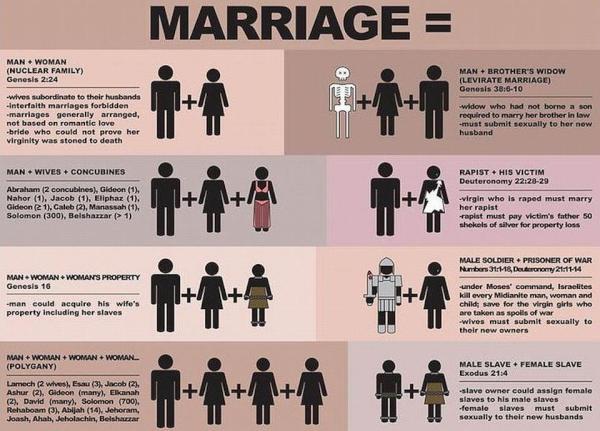
Or (with tongue in cheek) I offer you this;

marriagechallenge

Imaginative encounters with scripture…

israel-125year-old-man-laughing

There are many ways to read scripture passages; some of you may remember a list I once reproduced here of some of them.

There is also this one- an imaginative reading. In this kind of reading, we immerse ourselves in one of the stories of the Bible- placing ourselves as one of the characters, seeing it from a human perspective, being part of the action. This kind of reading is often applied to stories from the gospels.

It is also a kind of interaction with scripture which appeals to people like me who write.

One of the passages I was given to aid reflection in my silence last year was the story of Blind Bartimaeus, in Mark, chapter 10. It is a lovely story, full of Grace, and here is my imaginative response;

Once-blind Bartimaeus

What a day.

There I was, sitting in the town square tying to sell a few pots, when everyone started to run down towards the road. Naomi and old Jebediah almost knocked each other flying in their haste.

“What is going on?” I shouted “What’s all the excitement about?” But no one would stop to tell me- they were all heading down to the road- even blind Bartemaeus picked up his stick and started to rattle his way out of the square, taking his begging bowl with him. Soon there was just me and old Martha who is so old that she has forgotten what day it is.

Despite myself I followed the whole village down the hill. They were all craning their necks to catch sight of something. “What is going on?” I repeated myself. Finally Naomi answered- “It’s that man Jesus- the Rabbi. The one I told you about. He is coming here! James saw him this morning and ran all the way back to tell us!”

Jesus of Nazareth! Of course I knew something of him- who didn’t? The stories were flying back and forward about what he was up to. Some said he was a new Prophet sent to speak to the people of Israel just like the old times. Others said he was a fraud who was just making trouble, and there had been quite enough of his sort in these parts.

There are even those would say that he is The One– the Messiah- come to fulfil all those old scriptures. Come to release captives, to bring sight to the blind, a declare the year of the Lord’s favour (if I remember my school boy Isaiah properly.)

What did I think of all this? A load of crap I said to all who asked- another loud mouth living off the bread of folk who have little to give in the first place. The country was full of ‘messiahs’ after all- every one with their own set of followers. Naomi is a little more gullible than me, shall we say- this was the third teacher this year that she had got all excited about. “This one is different” she would say, “he is not interested in money, or fame, or power- he just seems to talk about love and this thing that he calls the New Kingdom.” She also told me stories of miracles- but we have heard them before as well. A bit of religious trickery always seems to make people more ready to part with their coin. Naomi might live and breathe this sort of thing but I for one give it no attention.

Just then the crowd started to hush “He’s coming!” someone said. I was standing at the back as people lined the road, so I quietly climbed on the branch of a low tree to get a better view.

There were quite a few people on the road- mostly men, but a few women. I had no idea which one was Jesus- they all looked pretty ragged, but at the same time somehow ‘road fit’- these people clearly knew how to put in the miles. They walked in groups, talking animatedly and gesturing at one another- there was a lot of laughter and one man even turned a cartwheel to please the crowd.

Just then, right in front of me, blind Bartimaeus started to shout. He had no idea exactly how close he was to the travellers so he shouted really loudly;

“Jesus, son of David, have mercy on me! Jesus, son of David, have mercy on me!”

Son of David’ no less- how did this beggar know so much scripture? His father, old Timaeus, used to have a broken down farm over the other side of the village and he had no time for such things when he was alive. This blind man was calling Jesus ‘Son of David’- more or less calling him ‘Messiah’!

The folk of the village did not like it- they turned on him. I think some were just embarrassed- an important, famous Rabbi comes to town and gets shouted at by a beggar- it just does not look good does it? Others thought Bartimeaus was after money (he normally was after all) although if he could see the state of the travellers he would have known that they did not have much in the way of cash. There were also more than a few religious folk in the crowd who were scandalised by the suggestion that somewhere in this ragged bunch was to be found Messiah.

So they hushed Bartimaeus, aimed a few kicks at him- but he would not be quiet. Even louder he shouted;

“Jesus- son of David. Have mercy on me!”

The travellers stopped in the road and turned towards the noise and the crowd went still- apart from Bartimeaus that is who shouted even louder. Then out of the group of travellers, a man started walking towards him.

I do not know why I had not seen him before- certainly he did not look much different, his clothes were just as ragged and his feet covered with the same road dust- but there was no doubt in my mind that this was Jesus of Nazareth. He had this presence, this quiet authority. Not the kind of authority that requires a title or a set of soldiers to enforce- this was something I had not seen before. There was nothing threatening about him at all, and yet I still found myself shrinking back a little.

This man would walk into any crowd and would become its centre. He could walk into a room and it would almost change colour. I at once saw what the fuss was all about- why he had upset people so much, why people were talking about him everywhere.

Bartimaeus was not at the front of the crowd- he was towards the back, quite close to me and I watched as Jesus walked towards him. The crowd parted like the red sea for Moses and I thought it best to climb down from my tree, not wanting to be noticed rubbernecking. I was then more than a little embarrassed to find myself standing almost right next to Blind Batrimaeus, who was still shouting for all that he was worth.

“All right, all right Bart old son” I said urgently “he heard you- and he is coming. Hush now!”

And he did. He sat there in the dust and blinked into the mid day sun, arms outstretched. I looked up and Jesus had stopped about ten feet away from Bartimaeus, and the crowd formed a ring around us like a thick hedge to keep in the goats.

He was close enough now for me to see his face. He was young – younger than me – that much I can tell you but yet I struggle to describe what his features actually looked like. All I know is that his face was so alive. His eyes seemed to be laughing even though his mouth was still.

I wondered then if he had stopped short of actually coming right up to Bartemaeus because he realised has was just a blind beggar- the sort that line all the major roads shouting for mercy. A man of no worth and no consequence. A man who some religious types described as bearing the consequences of sin. An unclean man, an outcast. The only reason that Bartimaeus survived at all was because people in my town remembered his mother, who was a good soul and had a lot to put up with what with her waster of a husband and her only child born blind, so many of us dropped him a coin or a piece of bread (when no one else was looking of course.)

Suddenly Jesus spoke.

“Tell him to stand up and come to me”

I realised with a start that he was talking to me- that he was looking right at me. And in the presence of this ragged stranger, my heart started pounding. I opened my mouth, but words seemed to have got stuck.

“Come on man- introduce your friend to me and tell him to stand up” said Jesus.

My friend? I thought- does he think we are the same? Was he mocking me? Certainly there was laughter in his voice.


Still, I bent over and spoke to Bartimaeus again “Come on Bart old son- he wants to speak to you.” I put my hand on the arm of this unclean wretch and helped him to his feet. “He is right in front of you, waiting.”

Bartimaeus put out his hands- he had left his stick on the ground- and took a step towards Jesus.

Then another, and another, until his hands were actually in contact with this strange compelling man. Jesus did not flinch as the beggars hands even began to explore his face; instead he opened his mouth and roared with laughter.

And his followers laughed too- not an unkind laugh; not the sort of laugh that happens when a man trips over a stray dog or a woman drops her bucket down a well. There was no victim to this laugh, rather it was an inclusive laugh- the sort that sucks you in and holds you in its embrace. It seemed to arise from a kind of emotion that I can only call joy. I found myself laughing too- really laughing. It was as if the trees and the stone walls laughed with us.

Then Jesus leaned forward and spoke again; “What do you want me to do for you?” he said, softly- so softly that I think only a few of us heard him.

That’s done it, I thought- clearly he has no money and there was no way he could take this poor wretch with him, wherever he was going. This is where it gets ugly again.

Bartimaeus did not ask for money though. Instead he dropped his hands, stood an inch taller and said this;

“Rabbi, I want to see.”

The crowd let out a communal gasp. Many had heard the rumours- lepers who had been made clean, mad men who were calmed, even a man called Lazarus over in Bethany who seems to have been raised up out of his own tomb. But talk was cheap and anyway things like that never happened in my town. Not here. Not to some smelly blind beggar who we all stepped over on the street every day of our lives.

But Jesus seemed to have heard only what he expected to hear- he appeared delighted. There was mischief in his voice when he said;

“Go on then- on your way. Your faith has healed you.”

And with that, Jesus turned about and started to walk down the road.

Is that it I said to myself. Is this the work of a Messiah? He throws out a few smart words then is on his way? I felt cheated somehow- despite my cynicism, even I had started to believe that this Jesus was different from all the other would-be Messiahs.

Bartimaeus just stood there- eyes wide open, wriggling his fingers between the sky and his face. I felt sorry for him.

“Well that’s that then Bart.” I said. “Come on up to town with me and let’s get something to eat…”

But before I could finish my sentence, he was shouting again at the top of his voice!

“I can see! I can see! I can bloody well SEE!”

The crowd parted again as he stumbled towards them, dumfounded as he pointed out the branches of the trees against the blue sky, the lichen on the wall next to the field, the marks he had made in the dust with his feet, and the smoke rising from the village chimneys in the distance. We all watched dumbfounded as he ran back to his stick, picked it up, kissed it then hurled it far over the wall shouting;

“Good bye you old bugger, I’ll not be needing you any more!”

Then he stopped in his tracks and spoke more slowly;

Go he told me- on my way. Where on earth would I be going… if it is not with him?”

With that, once-blind Bartimaeus was up and half running, half stumbling down the road, still with a hand held out in front like the blind man he used to be, chasing after Jesus for all that he was worth.

As for me, I stood with the others, watching him go- unable to take it all in. Unable to believe that the most important thing that ever happened to this town- no, the most important thing that ever happened to me– was wrapped up in the rags of this creature running like a drunken goat down the road.

I was wondering what it meant. Wondering what had just changed right before my eyes. Looking for something to anchor myself to, but not able to see it…

But that was all years ago now. Bartimaeus came back a few weeks later. He told us the story of what happened over the next few weeks. He was our eye-witness as to how Jesus rode in to Jerusalem on a borrowed donkey, only to be arrested on trumped-up charges and put on trial. Bartimaeus was there when Jesus was whipped and beaten up. He was there when they paraded him through the streets, and watched as they crucified him and hung him there until he died. He also told of how the curtain in the great temple ripped right down the middle and the sky went dark at mid day.

And Bartimaeus told us how a couple of the women went to take care of his body early in the morning, only to find Jesus not dead but alive– of how he met with his followers, and even let once-blind Bartemaeus touch his face again, and of how they all laughed till they cried.

Bartimaeus is my friend now. He lives with Naomi and I and helps me make pots- all those years of living by touch alone has turned him into the most gifted potter in these parts- people come from miles around to buy what he has made.

Or perhaps they come to hear the stories. Of a man called Jesus, who on some days even I have come to believe was indeed the Messiah.

Falling into the arms of the Empire…

genesis

For years now we have had a more or less regular ‘housegroup’, which meets (as decreed somewhere in the Bible) on Tuesday evenings. A few months ago we moved out of the living room into a pub- it was time to change things around a bit. We have been using the shape of some of Brian McLaren’s writing to aid our discussion- from ‘A new kind of Christianity’. It is a great book, and has started to put some firmness into parts of my faith that had been decidedly muddied by all of the Emerging Church discussions and debates. (Not that I regret a single question mark!)

Last week we continued a discussion about how we might understand the storyline of the Bible. McLaren (or Bazzer as we decided to call him) suggested that many of us had become used to reading the whole of the Bible backwards through all those towering figures of our theological landscape, back through the Reformation, into the middle ages, then the dark ages, and in particular, the days of the Holy Roman Empire, which Bazzer considers the real cusp of the matter. At this point the new religion (Christianity) became mixed up not only with Empire, but also with Greco-Roman philosophy. The end result it that it is really hard to see backwards because of all the edifices that we have built along the way.

Read the book for more detail on all this, but we tried to chew a little on the Polarity of Greco-Roman thought- giving us the polar opposites of Platonic perfection and the fallen state of mankind. We did this by looking again at those early stories in Genesis- of Adam and Eve with their troubled offspring, the subsistence hunter-gatherers who became farmers, then city builders, and fanally Empire makers- the rise/fall of man.

Here, the Roman Zeus- living in a removed, perfect state, setting impossible goals for his ephemeral people to reach towards, and seeking to rescue a few only be the skin of their teeth (eventually through a legalistic confidence trick with his son Jesus) starts to come unraveled. Zeus is replaced by Elohim.

Looking backwards, we read the early stories of Genesis in the Greco-Roman philosophical polarity- perfection/fallen. The garden was perfect, and as we mucked it all up, we were cast out, imperfect, therefore God could not be around us- Plato again.

But Elohim never mentions perfection- he talks of things being ‘good’, or even ‘very good’. In these stories, the journey from the garden is not one of lost perfection, but rather lost innocence. Rather than going from a perfect state casting us out into the darkness, Elohim makes clothing, avoids issuing the death penalty as promised to those who eat the fruit of the tree, and so on and so on. Elohim constantly engages, constantly circles back into the rise/fall of mankind. Even when they start empire building.

As we talked about this, I saw Michaela becoming frustrated. Eventually she spoke up- “So why did Jesus have to die? What was his mission if not to rescue, to save?”

I have been thinking about this question and the discussion we had the other night. Unsurprisingly, it leaves me with more questions;

If there has been a ‘fall’ of man, is it really the kind of fall I grew up talking about- one of individual sin, inherited by each subsequent generation as part of our human DNA? This kind of ‘fall’ keeps us trapped in the old Platonic polarity. It allowed Evangelical Christianity to focus on private morality to the exclusion of almost all else and  the purpose of the death of Jesus in this understanding is to give a chosen few backdoor perfection– undeserved, but gloriously exclusive.

But there is this other version of the fall of man(kind) encountered in Genesis. It is a fall upwards- away from our root and branch engagement in the soil of the world that we live in- towards enclosure and management of the land first for storage of food, then for personal profit. The more we have the more we want and our ambitions grow to the sky like the tower of Babel. Then there is this word again- Empire. If there is a polar opposite to the Shalom of Elohim it is Empire. Power used and abused. Richness accumulated at the point of sword and on the backs of the slavery of others. From Genesis to Revelation this the Bible is shadowed by Empire. This fall is not an individual one, it is collective.

But Elohim does not retreat even from Empire. He is there in and through it all. Hating some of it, raging against it sometimes- particularly when his people accommodated with it- even became the enslavers themselves.

Back to Michaela’s question- Jesus death, in relation to this collective fall can be understood clearly in his own use of the words of Isaiah, spoken from exile, in slavery to empire;

The Spirit of the Sovereign Lord is on me,
because the Lord has anointed me
to proclaim good news to the poor.
He has sent me to bind up the brokenhearted,
to proclaim freedom for the captives
and release from darkness for the prisoners,[a]
to proclaim the year of the Lord’s favor
and the day of vengeance of our God,
to comfort all who mourn,
    and provide for those who grieve in Zion—
to bestow on them a crown of beauty
instead of ashes,
the oil of joy
instead of mourning,
and a garment of praise
instead of a spirit of despair.
They will be called oaks of righteousness,
a planting of the Lord
for the display of his splendor.

Isaiah 61

Here it is- the kernel of the nut. The Shalom of Elohim; the New Kingdom. A totally different kind of empire. One based on love of one another, on the joy of life and the refusal of the power of Empire.

The first kind of fall- the individualistic perfect/fallen polarity seems to have allowed for Christianity to exist within empire with hardly a ripple. It allows us to set aside the revolutionary stuff and focus on saving the few for the really important stuff, not the Aristotelian stuff of boring reality, but the Platonic promise of eternal perfection.

But the New Kingdom can not exist in the other kind of fallen world without challenging empire. We can not live alongside poverty, injustice disease, broken lives, etc without wishing, praying, working upon it the Shalom of Elohim.

Or can we? The forces of empire are strong after all…

Michaela told a story right at the end of a place she had worked- a job that was supposed to be all about community building- encouraging participation and engagement with marginalised people and groups. A new manager came in who knew all the language, but seemed driven only towards establishing and using power; she was building an empire. The rules of the organisation had changed overnight. Suddenly success was measured by a business model- by conquests won over other ‘competing’ community groups. It tore Michaela apart.

And there you have it; the shalom of God opened wide, but the Empire rises again. But Elohim is waiting…