New belief…

Over the past few years, often charted on this blog, the defining codes of faith on which I have sought to live my life has changed considerably.

At first it fragmented. I was no longer sure if I believed at all, let alone had confidence in the traditions I was part of. This was sometimes traumatic. Later however faith began to emerge again less as a set of resounding assertions about the nature of the divine but more as a process of faithful questioning.

In other words, it could be regarded as faith not as the opposite of doubt but rather doubt as an integral part of a living faith journey. I wrote about this before, here.

Along the way, the emphases I place have shifted considerably. I do not think that the correct goal for the life of faith is perfecting our theology- either from the point of view of knowledge, or narrowing down our understanding of ancient text until we have nailed down every errant verse to fit an integrated whole. Rather I think that attempts to do this will always be futile, and distractions from the real business of faith, which is all about how it releases us to live.

This has led me to worry far less about all those ‘questions-in-a-bubble’ theological arguments- the sort that no one really cares about apart from theologians. Such intellectual sparring can be entertaining, but when it is mixed with angry defensiveness or attack in the name of truth I walk away.

But to suggest that what we believe does not matter is foolish.

Our actions are driven in both subtle and obvious ways by the core ideas that we build our lives on. Here is an example from a psychological point of view.

>Core belief;  People are inherently evil and untrustworthy, particularly those who are ‘different’.

>Leading to guiding assumptions; I am at risk, my family needs to be defended, you are a threat, I need to prepare for hostilities.

>Leading to instinctive interactions; Distrust, hostility, defensiveness, aggression, tendency to isolation  and separation.

Everything that Jesus taught us about love is based on the idea that if this becomes the core of everything we believe then our core assumptions about the world and our instinctive reactions to it are all affected. In this way, love is not weak, nebulous and irrational, rather it can change the whole world.

But (unfortunately perhaps) life involves a whole lot of other questions to which we have to at least form working theories, if not absolute conclusions.

So back to the point of this post- the forming of new tenants of faith out of all of the questioning. It is another regular theme on this blog- what to construct after all the deconstruction. There comes a point (or at least there has for me) when I start to feel more comfortable with making tentative statements about what you believe again.

Although as I think about it, as a young man raised in Evangelical/charismatic settings, saying what you believed was not  often necessary- it was obvious as we all kind of knew what was held in common to be ‘true’. The point at which belief was really defined was in the negative- that is when someone (usually outside out immediate group) got it wrong. We could then dissect their incorrect doctrine and discount it and in doing so we could also discount them.

I confess that there is this tendency in me still- I continue to strive towards grace in this as in many things.

What I am starting to construct however, I do not construct alone- everywhere I see a convergence of a new kind of consensus around some basic ways of approaching faith. It seems to me to be cross denominational, but typical of those of us who may have come through all of those ‘posts’ discussions (post modernity, post evangelical, post charismatic, post Christendom.)

So, here are a few of the things that I have come to believe, structured around the ancient Apostles Creed. I expect things to change- I will be carving nothing in stone, nor nailing anything to church doors- these theories are not external, they are made of flesh, some sinew, and even a little muscle.

1. I believe in God, the Father almighty, creator of heaven and earth.

I do. I believe that this unfolding universe began in the mind of God, and he let it all out in a burst of creativity. I also believe that we embody this god-quality of creativity as we are made out of the dust of the heavens, in the image of the Creator- and that this imposes deep responsibilities on us in relation to the heaven and the earth.

2. I believe in Jesus Christ, His only Son, our Lord.

If there is one thing of faith that lives in me, it is the idea, the hope, the person of Jesus. Immanuel, God-with-us, walking in our filth and turning every thing upside down. I believe in the New Kingdom he proclaimed as being here, and near.

And if I believe in Jesus, then what we know of his ways has to be the place that I start from in relation to all other belief. I have to start with the stories and parables he told, and the way he lived his life in relation to everyone around him.

And I have to concede that love is the most important thing- far more important than judgement, or doctrine, so if I am going to make any error, I am going to strive to make it on the side of love and grace. This will inform my relationships to everyone, particularly those who are marginalised or oppressed.

3. He was conceived by the power of the Holy Spirit and born of the Virgin Mary.

To be honest, this is not something I think about often- but I rest on the stories I have inherited.

4. He suffered under Pontius Pilate, was crucified, died, and was buried.

5. He descended to the dead. On the third day he rose again.

6. He ascended into heaven and is seated at the right hand of the Father.

These stories too live in me and inspire me.

7. He will come again to judge the living and the dead.

Perhaps Jesus will come again- but I am not going to spend too much time thinking about this as we were not put on this earth just to hope for some kind of swift exit or heavenly Dunkirk. We are here to learn how to love, and how to put this into action.

I believe that we should not fear judgement from a loving God, and that all of us need grace.

8. I believe in the Holy Spirit,

I do- despite all the charlatans and the hype. I believe in the Spirit of God within us.

9. the holy catholic Church, the communion of saints,

I want to believe that the collectives of the followers of Jesus might be the conscience, the peace makers, the justice dealers, the healers, the party makers and the gardeners of this world. I hope for communities of people who support one another in this direction, whilst learning to love.

I believe that God is present in these gatherings, but also elsewhere. I believe that he reveals himself to people of other faiths, and none.

10. the forgiveness of sins,

Oh yes.

11. the resurrection of the body,

I was never quite sure what this meant- something to do with a day to come when all our bodies will be raised incorruptible. To be honest, I think this is another one of those that I will just shelve with a bit of a shrug.

12. and life everlasting.

Yes, I have this hope that we might be more than flesh but also Spirit, and that those Spirits that leave before us might yet be waiting for us elsewhere.

Is this ancient creed enough to define the central things of our faith now?

As I read it over, I do not think it is. Firstly, I continue to think that we have over emphasised right belief- even to the point of burning dissenters at the stake. The creed is all about belief, and very little to do with our response to it.

What I am hungry for is to see right ways of living and ideas of how love can be put into action.

So I would add to the list above a few of my own;

13. I believe in love

For those reasons above.

14. I believe that we are called to be active subjects of the Kingdom of God, and to participate with him in acts of creativity, healing, peace making, protesting, lamenting, redeeming and the formation of community.

15. I believe in the mission/adventure/pilgrimage that God releases us on.

16. I believe that my ideas of God are incomplete and imperfect, and that not every question can be answered. And that that is OK.
There’s no such thing as a free Bible…

A friend told a story tonight that had me in stitches.

She had been surfing the glorious interweb and checking out some Christian sites. You could say, indulging in a bit of religious surfing. Now this activity is not without it’s risks. One might be able to cope with the madness that you will encounter by trying to laugh at it all- some of it is pretty darned funny after all. Check out Ship of fools if you do not believe me.

But aiming for a bit of superior oh-isn’t-this-funny-but-I-am-above-all-this-madness is only likely to take you so far. Because it usually starts to get rather painful. You start to realise that some of this hysterical ranting is being done in the name of Jesus. Or even worse, you realise that you are starting to laugh at- yourself. Some of the madness starts to sound a little too familiar.

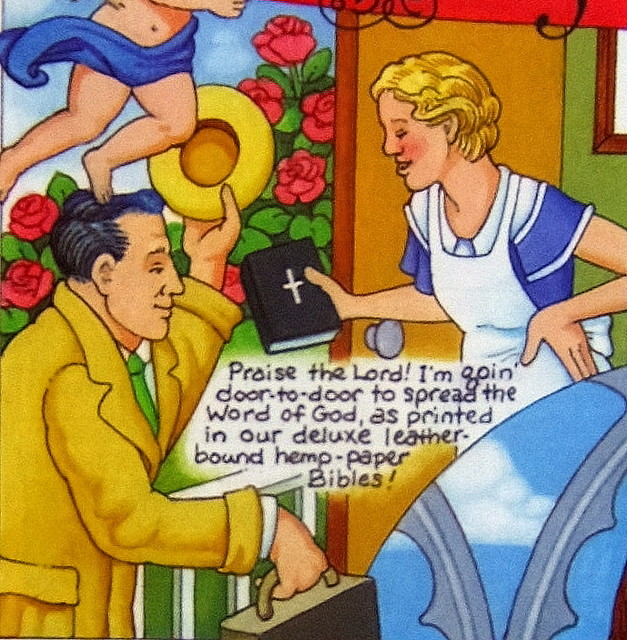
But back to my friend. She came across a site promising a free Bible, if you completed their online quiz. Well, she was up for that. A nice leather bound black Bible to replace her rather tatty paperback one.

She is not daft though- she e-mailed to ask if the organisation would then use/abuse her e-mail address in future- but was assured that this would not be the case. So she went ahead and submitted her details.

A few day later, she was having a duvet day- you know the sort of thing, getting up late, mooching around and watching crap day time TV, snacking and leaving the pots for a while- all the time wearing clothes that really should never see the light of the public day. We all need the odd day like this. Then came a knock on the door.

She lifted the net curtain, and there stood an African Pastor and his wife.

Holding a big black Bible.

Bible nasties 6- that thing called hell…

Returning to the series I began in April (If you want to read the others, you can also use the ‘search’ box on the right) trying to chew on all those difficult passages in the Bible. When you start doing this, you are confronted with some fundamental questions- about the nature of doctrine, the authorship of the Bible and the very stuff of belief itself.

Hmmm- perhaps I should not have started this.

It also brings you up against the apparent violence and wrath of God- ultimately stretched out in potential eternal torment in hell.

I liked what Francis Chan has to say here- (HT Robin Parry.)

Chan’s book looks like it is worth a read…

Bible nasties 4- that word ‘context’…

I was reading about a recent archaeological discovery at Fin Cop iron age hill fort, in the English Peak District, near where I grew up.

A mass grave has been discovered- full of the bones of women and children. The bodies appear to have been thrown into the surrounding ditch and the smashed remains of the fort thrown down on top of them.

To make sense of this story, we have to understand something of the context in which the events happened- the culture, the dynastic background, the history.

I read about the Fin Cop massacre at the same time as I was thinking about all that Old Testament bloodshed. The parallels are rather obvious.

In 500BC, most of the killing that the ancient Israelites indulged in with such apparent approval from God was over. They were then a defeated people, living under Babylonian rule. But what hit me again is the approach that many Christians make to the Bible, and the stories that it contains.

The stories tend to be imported into our context with a lot of fixed assumptions.

Firstly the assumption that they are ‘true’- in the sense of being 100% accurate factual historical records of real events.

Secondly, the assumption that God is speaking to us directly through these words, which then require no testing, no wrestling- rather our role is to be passive acceptors of heavenly revelation.

Thirdly the assumption that God himself wrote the words- each individual one, and therefore any challenge to either of the two assumptions above is a direct challenge of God himself, and is therefore heresy.

Perhaps you might think that these assumptions are just fine. I have struggled with them over the years- and coped by not allowing myself to ask questions.

Because once you start, it is impossible to stop.

One of the first questions that start to challenge the above assumptions is this one- context. The writings in the Old Testament concern events that happened around 2000 years before the birth of Jesus. The oldest evidence for Hebrew writing is around the 10th C BC, but most scholars believe that the books of the OT were first written down around the 6th C BC. What this means is that the stories were passed down by oral tradition for countless generations.

Many of these generations, like the people who lived at Fin Cop, were short and bloody.

So stories were told of Abraham, who started it all, and of Jacob who sustained the wandering tribe during slavery. Then there were the stories of the birth of a nation out of the years in the desert, and the rise of great kings and great kingdoms. Stories justified, sustained and unified- particularly during the hard times of exile and captivity.

And in the middle of it all- woven through the whole- is God. Hopes for God, encounters with God, fears cast on to God, prayers to God. A people whose stories are covered by the fingerprints of God.

What might we expect then of these stories, when we allow ourselves to consider something of the context?

Might we expect them to be historically 100% accurate- and ‘true’? Well, frankly no. That is not their point. They were living stories to bring breath to an exiled proud people- they were not eyewitness accounts of a traffic accident (which, come to think of it, are not necessarily ‘true’ either.)

Might we believe that God is speaking to us through the words, and that our role is just to accept them with no challenge, no test, no questioning?  To which I reply Yes, and no. Wrestling and questioning with textual meaning are spiritual practices, when done with honesty and integrity- and the certainty that whatever meaning we find will be partial, and certainly not the final version of truth that will emerge from the text.

Do we need to believe that God wrote/inspired every word, completed and whole, and that to question this is heresy? My answer to this is- no, we do not. But then perhaps I am a heretic. Because I have come to believe that this view of the text has more to do with the need that a modern context had for quantifiable, objective, rationalised evidence for God.

Context is important. As are at least 11 other ways of reading these ancient writings.

But there are many ways to approach this wonderful collection of writing- all of them flawed. Because the words are always filtered through the reader.

Bible nasties…

The Christian tradition that I grew up into stood firmly in the way of the Book.

Our understanding of faith was often reduced to an understanding of the Bible. We prided ourselves on taking it in whole- unaltered, un doubted, seamless, without contraction or error.

Except of course, the longer I have walked this path, the more I have struggled with this blinkered and partisan view of the Bible. It has been a regular theme on thisfragiletent– as I have returned again and again to chew on the words and the Word.

The position I start from these days is one of wonder and respect for the ancient writings, shadowed with other things- I do not doubt the inspiration or the revelation they contain, but what I thought I knew about the Book, I often find myself now not knowing. I find myself full of questions, to which there are often only more questions, rather than answers. For a while this seemed like a crisis of my very faith, but then became the very life of my faith- the adventure with God could begin anew.

One of the things I had to confront was the realisation that all those lovely life affirming and loving passages of the Bible that I know and love are not all that the Book contains. Rather there is much that greatly troubles me. To ignore (or at best to minimise) these passages is simply not honest. To claim that they are part of God’s plan- that all this death and suffering fits together in an organised whole- it lacks integrity with the way of Jesus- or so it seems to me.

To illustrate, here are twenty examples-

  1. God drowns the whole earth.
    In Genesis 7:21–23, God drowns the entire population of the earth: men, women, children,. Only a single family survives. In Matthew 24:37–42, Jesus appears to approve of this genocide and even to say it will be repeated when he returns.
  2. God kills half a million people.
    In 2 Chronicles 13:15–18, God helps the men of Judah kill 500,000 of their fellow Israelites.
  3. God slaughters all Egyptian firstborn.
    In Exodus 12:29, God kills all Egyptian firstborn children and cattle because their king was stubborn.
  4. God kills 14,000 people for complaining that God keeps killing them.
    In Numbers 16:41–49, the Israelites complain that God is killing too many of them. So, God sends a plague that kills 14,000 more of them.
  5. Genocide after genocide after genocide.
    In Joshua 6:20–21, God helps the Israelites destroy Jericho, killing “men and women, young and old, cattle, sheep and donkeys.” In Deuteronomy 2:32–35, God has the Israelites kill everyone in Heshbon, including children, and plunder the country. In Deuteronomy 3:3–7, God has the Israelites do the same to the people of Bashan. In Numbers 31:7–18, the Israelites kill all the Midianites except for the virgins, whom they take as spoils of war. In 1 Samuel 15:1–9, God tells the Israelites to kill all the Amalekites—men, women, children, infants, and their cattle—for something the Amalekites’ ancestors had done 400 years ago.
  6. God kills 50,000 people for curiosity.
    In 1 Samuel 6:19, God kills 50,000 men for peeking into the ark of the covenant.
  7. 3,000 Israelites killed for inventing a god.
    In Exodus 32, Moses has climbed Mount Sinai to get the Ten Commandments. The Israelites are left with too much time to wonder, so they invent a golden calf god. Moses comes back and God commands him: “Each man strap a sword to his side. Go back and forth through the camp from one end to the other, each killing his brother and friend and neighbor.” About 3,000 people died.
  8. Amorites destroyed by sword and God’s rocks.
    In Joshua 10:10–11, God helps the Israelites slaughter the Amorites by sword, then finishes them off with rocks from the sky.
  9. God burns two cities to death.
    In Genesis 19:24, God kills everyone in Sodom and Gomorrah with fire from the sky. Then God kills Lot’s wife for looking back at her burning home.
  10. God has 42 children mauled by bears.
    In 2 Kings 2:23–24, some kids tease the prophet Elisha, and God sends bears to maul them.
  11. A tribe slaughtered and their virgins raped for not showing up at roll call.
    In Judges 21:1–23, a tribe of Israelites misses roll call, so the other Israelites kill them all except for the virgins, which they take for themselves. Still not happy, they hide in vineyards and pounce on dancing women from Shiloh to take them for themselves.
  12. 3,000 crushed to death.
    In Judges 16:27–30, God gives Samson strength to bring down a building to crush 3,000 members of a rival tribe.
  13. A concubine raped and dismembered.
    In Judges 19:22–29, a mob demands to rape a godly master’s guest. The master offers his daughter and a concubine to them instead. They take the concubine and gang-rape her all night. The master finds her on his doorstep in the morning, cuts her into 12 pieces, and send the pieces around the country.
  14. Child sacrifice.
    In Judges 11:30–39, Jephthah burns his daughter alive as a sacrificial offering for God’s favor in killing the Ammonites. We remember the mercy God showed to Abraham and Isaac, but forget this one.
  15. God helps Samson kill 30 men because he lost a bet.
    In Judges 14:11–19, Samson loses a bet for 30 sets of clothes. The spirit of God comes upon him and he kills 30 men to steal their clothes and pay off the debt.
  16. God demands you kill your wife and children for worshipping other gods.
    In Deuteronomy 13:6–10, God commands that you must kill your wife, children, brother, and friend if they worship other gods.
  17. God incinerates 51 men to make a point.
    In 2 Kings 1:9–10, Elijah gets God to burn 51 men with fire from heaven to prove he is God.
  18. God kills a man for not impregnating his brother’s wife.
    In Genesis 38:9–10, God kills a man for refusing to impregnate his brother’s wife.
  19. God threatens forced cannibalism.
    In Leviticus 26:27–29 and Jeremiah 19:9, God threatens to punish the Israelites by making them eat their own children.
  20. The coming slaughter.
    According to Revelation 9:7–19, God’s got more evil coming. God will make horse-like locusts with human heads and scorpion tails, who torture people for 5 months. Then some angels will kill a third of the earth’s population. If he came today, that would be 2billion people.
Over the next few weeks, I will spend some time thinking about this a little more- considering again what we might make of these passages.
.
Reclaiming the Bible for what it is, not for what it never was.
.
Or at least trying to- I stand in a long tradition of others who have done the same.

Books from the very earliest followers of Jesus…

Did anyone see this on the news yesterday?

(There are more pictures here.)

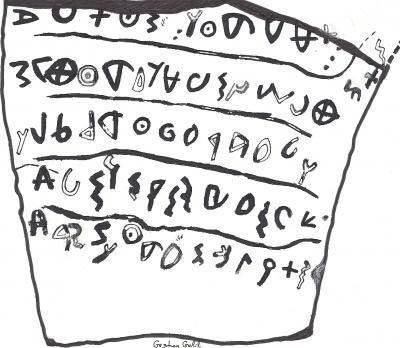
They could be the earliest Christian writing in existence, surviving almost 2,000 years in a Jordanian cave. They could, just possibly, change our understanding of how Jesus was crucified and resurrected, and how Christianity was born.

A group of 70 or so “books”, each with between five and 15 lead leaves bound by lead rings, was apparently discovered in a remote arid valley in northern Jordan somewhere between 2005 and 2007.

A flash flood had exposed two niches inside the cave, one of them marked with a menorah or candlestick, the ancient Jewish religious symbol.

A Jordanian Bedouin opened these plugs, and what he found inside might constitute extremely rare relics of early Christianity.


The director of the Jordan’s Department of Antiquities, Ziad al-Saad, says the books might have been made by followers of Jesus in the few decades immediately following his crucifixion.

“They will really match, and perhaps be more significant than, the Dead Sea Scrolls,” says Mr Saad.

“Maybe it will lead to further interpretation and authenticity checks of the material, but the initial information is very encouraging, and it seems that we are looking at a very important and significant discovery, maybe the most important discovery in the history of archaeology.”


One of the few people to see the collection is David Elkington, a student of ancient religious archaeology who is heading a British team trying to get the lead books safely into a Jordanian museum.

He says they could be “the major discovery of Christian history”, adding: “It’s a breathtaking thought that we have held these objects that might have been held by the early saints of the Church.”

It remains to be seen whether these books are indeed what they appear to be, and what their pages might reveal. But as Elkington said above, the thought of these books being handled, passed around and treasured by people who had known Jesus- perhaps even his disciples- this brings a tingle to the spine.

Will there be material here that will challenge, and puzzle? I suspect so.

There will almost certainly be a scramble to ‘make it all fit together’.  To preserve the illusion (or delusion) of those of us whose faith rests on a particular view of the Bible- as an organic, seamless whole ‘without error or contradiction’.

I do not mean to be critical- but it is just that the more I look, the more I see questions, uncertainties, paradox, cultural and contextual bias. And to deny these is for me deny faith, and replace it with religion.

Faith remains- and the journey of engagement- with the Spirit of God encountered in all sorts of ancient text, but also in the sunrise, and the shared cup of tea.


Ways of reading the Bible…

Some time ago, I posted some questions about how we understand and encounter the Bible. Someone asked me to post some answers to my questions, so I had a go at this here.

It has been quite a journey for me over the last few years- trying to come to terms with a faith that I no longer had faith in, and then discovering along the way that I was not alone, and that there were different ways to approach an understanding of God, and in particular, different ways to approach our primary source material on the life of faith- the Bible.

This process has been painful, and at times I have wondered whether my faith will survive. But the outcome has been one of renewal. The Spirit of God was once again stirring the waters…

The process of change has involved a period deconstruction- a doubting and shaking loose things that had previously seemed unassailable and absolute. This is the painful bit- when everything seems to go into freefall.

The ’emerging church conversation’- carried out largely through blogs and websites- seemed to me to be comfortable with unanswered questions. In fact after every truth and every tenet, we added a question mark.

But then there comes a time when something new starts to emerge and it is time to construct again. It feels to me that this is where we currently stand. We do not need bombastic pronunciations or new religious structures- rather it feels that our heads have come out of the clouds, and we can see further.

Along the way, I have found Brian McLaren’s writing to be a life giving. I know others have a different experience- for some his style can drag, for others his aim is too low brow, as the are more used to the theological arguments than I am- but he has taken me places that I had not dared to go alone.

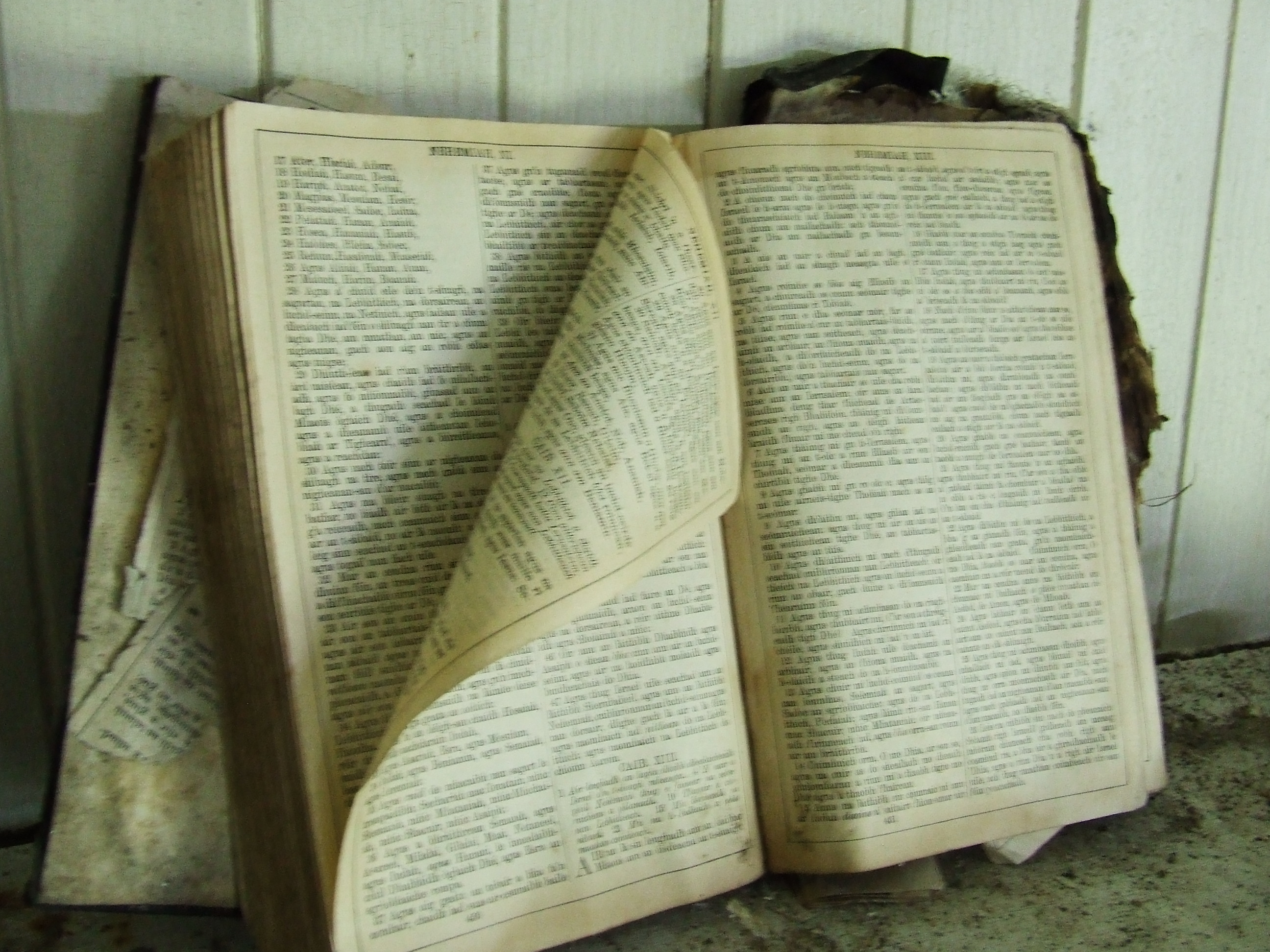
(Photo taken in a semi-ruined abandoned croft house on the island of Bernera, off Lewis, Western isles. A family bible left open above an empty fire place…)

In reading his new book (slowly and in small chunks) I came across a study guide he had written, which focussed on different ways of reading scripture, and found it so helpful that I wanted to give it a plug.

You can download it here.

But here are a few highlights-

We have been shaken loose from our previous ways of reading the Bible- the ‘modern’ way- which seemed to be all about using the text as a blueprint so that we can categorise and systematise faith. McLaren compares this to the ways that the Americans use their constitution- where each word is given equal legal weight, and is enforceable in a way divorced from emotion or wider ethical considerations.

But having shaken loose- what other ways of reading the Bible are left?

McLaren lists 14 possible ways of encountering Scripture-

  1. Narrative reading- where we get into the story, the context and history from which the words emerge from.

  2. Converstional reading- where we engage with the different conversations across the generations embraced in the Bible- for example Jesus with the religious powers of his day, the Priests and the Prophets, the Jews and the Gentiles.

  3. Missional reading- in which we ask we ask, in each passage of Scripture, how is God extending God’s overarching mission of blessing all nations through a called and commissioned community of people.

  4. Political/Economic reading- the skew of God’s attention towards those who suffer injustice at the hands of earthly empire involving money, sexuality, power, violence, and law.

  5. Rhetorical reading- in which we look for what the text it trying to do, rather than just what it is saying.

  6. Literal reading- “…when readers of the Bible develop sensitivity to the ways poets, protesters, storytellers, activists, priests and mystics use language, the Bible is liberated from its constitutional captivity to be the wild, inspired, and impassioned collection of literary artifacts that it is.” McLaren suggests that people who say they are taking the words literally often are doing the very opposite- approaching the test through a very narrow hermeneutic.

  7. Close reading- better readings of scripture will fit in with the small details of the narrative- the bits that we easily miss that the writer chose to include in the text, which is rich in culture and traditions that we easily miss.

  8. Communal reading- the Bible is complex and hard, and the only way we can really engage with it is through the broader community- firstly in terms of “the community of the dead” where we listen respectfully to how previous generations have understood scripture, whilst understanding their skew towards a western, wealthy, white, male perspective. Secondly we look for the voices of minorities- those who have been forced to the margins. It is not ONE perspective, but rather both/and.

  9. Recursive reading- understanding of the Bible, and emphases within it change, ebb and flow across generations, and within lifetimes. This might be one of the ways that the Holy Spirit brings renewal.

  10. Ethical reading- text applied without ethics have allowed our faith to justify slavery, genocide, anti-Semitism, oppression of women and gay people- therefore we have to accept that interpretation is a MORAL ACT, so we should test an interpretation by reason and scholarship,using our rational intelligence, and a sense of justice and ethics. How might I treat people if I follow this interpretation? Whom might I harm? What unintended socialconsequences can we predict if this interpretation is widely embraced? Could people be vilified, harmed, or even killed because of this interpretation? McLaren points to those in Scripture who have wrestled with God in the face of his seeming injustice… Job, Moses, Abraham.

  11. Personal reading- “the reader is himself or herself in the predicament the text addresses. So faithful readings are habitually humble, expectant, open, and hungry and thirsty to encounter the Living God. Even the “professional” reader and teacher of the Bible must remain forever an “amateur” too …”

  12. Mystical reading- we must “…develop the habit of mystical openness, receptivity not only to understanding from the text but to enlightenment from the Holy Spirit, not only to interpretation but to revelation, not only to intelligent engagement with the text but also to personal abduction by its message.”

.

Finally McLaren points to one further reading, and makes clear that he believes this one to be the most controversial of his readings.

It is the one that might make people worry about the undermining of Biblical authority

Christo-focal reading

McLaren proposes that we no longer approach the Bible as a collection of words of equal weight- but rather that we approach all other words through those of Jesus.

He suggests we need to leave behind three old ways of reading the Bible that have perhaps dominated-

  1. Flat reading- where we see all Jesus’ life and words pressed down and flattened to the same level as those of Abraham, Moses,David, Isaiah, Paul, and Jude. This results in the raising of the Bible above Christ- which is a kind of idolatry. For example, it might be biblical to commit genocide by quoting Deuteronomy 7, but one could never claim it is Christ-like.
  2. Descending reading- where we start with an ideal state in Genesis, and then it all goes wrong, leading to a time when God is going to destroy everything, and Jesus is but a lifeboat for a few. Or the other decent comes from the fall too- “the problem is sin and the solution is law-keeping, with sacrifice-making as a back-up plan. The rest of the story descends from this high point, so that the life and ministry of Jesus have value to the degree that they solve the problem.”
  3. Ascending reading- “Moses’ teaching was good, David’s perspectives were better, Isaiah rosehigher still, John the Baptist ascended even higher, and Jesus was really wonderful andunique, but the crowning revelation comes with Paul and his writings.”

What McLaren proposes is something more radical- “When Jesus is the focal point of the story, he is the climax, the hero, the summit, the surprise, the shock, the revelation that gives all that precedes and all that follows profound and ultimate meaning. If we follow this approach, we’ll speak less about the Bible as the supreme Word of God and more about Jesus as the supreme Word of God. We’ll let the person of Jesus –including and integrating his birth, life, teachings, miracles, death, resurrection, abiding presence, and ongoing mission through the Holy Spirit – become the light in which all interpretations are evaluated, the key in which all interpretations are played, the leader behind which all interpretations arrange themselves as followers, and the meaning in which all interpretations have meaning.”

If we start to apply these ways of reading the Bible, how might our understandings change?

This my friends, is our work-in-progress…

Bible Sunday…

CSL047

Today is ‘Bible Sunday‘- a celebration co-ordinated by the Bible Society, with the title ‘Living in the certainty of God’s Word’.

We are pointed in the direction of that wonderful passage in Isaiah 55– which begins ‘Come all who are thirsty…

I very much agree that the Bible is something to celebrate, so I have been reading some of the information about Bible Sunday. However, I find myself in a familiar uncomfortable place. I have posted before about some of these issues- here and here for example.

Some of it might relate to the language used in this celebration- the assumptions and presumptions inherent. The very title- ‘Living in the certainty of God’s word’- what this means for many is a closing down of debate, a final understanding of Truth– the Bible says it, I believe it, end of story. We are encouraged to approach the Bible as we would a mathematical formula- to engage with the different elements, order them correctly and so arrive at the only logical reasonable outcome.

But I have become increasingly aware that in doing this, we diminish the words. Indeed, we are in danger of recreating God in our own image.

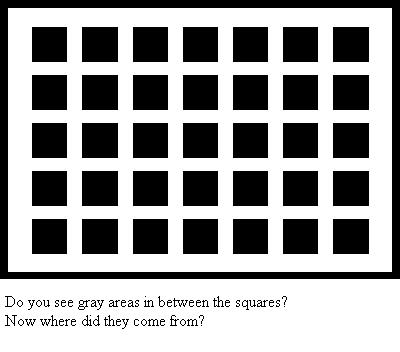
Another image I have used before is this one

gray areas

The Bible is full of truth, wisdom, poetry, history, prophecy and mystery. We humans are logical orderly creatures, who are made to look for patterns. However, we look through at things through a perspective formed by presumptions- it is much easier that way, and it is very hard (if not impossible) to approach any issue afresh without the influence of time and place and heritage. Most of the time this stands us in very good stead. It allows us to be what we are. It allows us to build logical portable and replicatable blocks of truth. It allows us to find commonality and build Church.

But then there are those elusive dots.

We can try to ignore them, but they keep popping up- like those passages in the Bible that just do not fit very well… Or others who have understood a passage in a different way, and God seems to be blessing them. Or the realisation that what we have regarded as fixed and absolute, is suddenly- shifting…

We can regard them as irrelevant and but then they still irritate. Or we can outlaw them, suggest that they are heretical distractions- but then we find that they are increasingly difficult to ignore.

But my humble experience of the Bible suggests that they will always be there. Because the Word of God can not be contained in a book. Neither can God be reduced to a formula. God will simply not be contained.

Does this diminish the Bible for Christians? Perhaps for some, it does. For these folk, the theological blocks hewn from the huge quarry of Scripture are so rigid, that to suggest a different perspective is to bring the whole edifice crashing down. In this, we are in danger of worshiping an idol of our own construction.

But for many others, the Bible is a cherished gift- one that shines light, but also contains many shadows cast by our lack of understanding, and the assumptions made by previous generations.

So I am going to celebrate Bible Sunday by reading the passage from Isaiah 55, and reminding myself that this wonderful poetry points us not at the words, but at the word giver.

Isaiah 55

1 “Come, all you who are thirsty,
come to the waters;
and you who have no money,
come, buy and eat!
Come, buy wine and milk
without money and without cost.

2 Why spend money on what is not bread,
and your labor on what does not satisfy?
Listen, listen to me, and eat what is good,
and your soul will delight in the richest of fare.

6 Seek the LORD while he may be found;
call on him while he is near.

7 Let the wicked forsake his way
and the evil man his thoughts.
Let him turn to the LORD, and he will have mercy on him,
and to our God, for he will freely pardon.

8 “For my thoughts are not your thoughts,
neither are your ways my ways,”
declares the LORD.

9 “As the heavens are higher than the earth,
so are my ways higher than your ways
and my thoughts than your thoughts.

10 As the rain and the snow
come down from heaven,
and do not return to it
without watering the earth
and making it bud and flourish,
so that it yields seed for the sower and bread for the eater,

11 so is my word that goes out from my mouth:
It will not return to me empty,
but will accomplish what I desire
and achieve the purpose for which I sent it.

12 You will go out in joy
and be led forth in peace;
the mountains and hills
will burst into song before you,
and all the trees of the field
will clap their hands.

13 Instead of the thornbush will grow the pine tree,
and instead of briers the myrtle will grow.
This will be for the LORD’s renown,
for an everlasting sign,
which will not be destroyed.”

The Epic of Gilgamesh and ancient scripture…

gilgamesh_louvre

I have been thinking a little about ancient times recently- so humour me while I scratch a familiar itch- that of the relationships between culture, history and the formation of faith through the interpretation of Scripture.

I heard some of the ancient poetry from the Epic of Gilgamesh read out on a TV programme recently. It was beautiful…

‘Gilgamesh, where are you hurrying to?
You will never find the life for which you are looking.
When the gods created man
they allotted to him death,
but life they retained in their own keeping.
As for you, Gilgamesh,
fill your belly with good things;
day and night, night and day, dance and be merry,
feast and rejoice.
Let your clothes be fresh,
bathe yourself in water,
cherish the little child that holds your hand,
and make your wife happy in your embrace;
for this too is the lot of man.’

But Gilgamesh said to Siduri, the young woman,
‘How can I be silent,
how can I rest,
when Enkidu whom I love is dust,
and I too shall die
and be laid in the earth for ever.’

One translation of the full text available here.

A summary of the text, and discussion about some of the themes is available here.

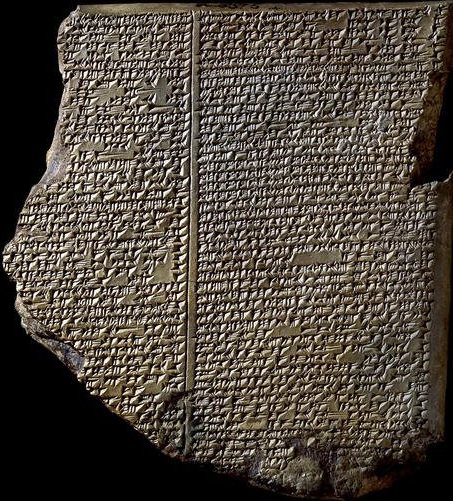
The Flood Tablet, relating part of the Epic of Gilgamesh -Nineveh 7th Century BC

I had heard of this ancient writing before, but knew little of it, so set off to find out more. It interested me for several reasons-

  1. As far as I can understand, this poetry is amongst the earliest literature known to have been written down, emerging from a little known civilisation that pre-existed the Ancient Assyrian and Babylonian empires- back to the earlier Sumerian peoples.  The poetry was held as significant to cultures for the next 3000 years, before being lost into history until tablets telling the story began to be unearthed in the 19th Century AD. The amazing endurance of the story, and it’s survival on tablets of stone is fascinating and intriguing.
  2. These civilisations occurred in the middle east, in the areas now known as Iraq and Iran, and the more understanding we have of middle eastern culture in this time of war and the ‘demonisation of the other’ the better.
  3. The Epic of Gilgamesh is a poetic recording that pre-exists the recording of the oral tradition that became the Hebrew Bible. There are many parallels between the creation stories in Genesis and those described in the Epic, as well as an account of a great flood. Clearly there are many differences too, but I find myself once again interested in the origins of Scripture- and its relationship with the culture and context that it was inspired within.
  4. There are also echoes of what appear to be perennial human pre-occupations- the origin and meaning of life, friendship, courage, and the approach of death. Consider again the poetry of Solomon from the book of Ecclesiastes- and compare this with the words from the Epic above…

7 Go, eat your food with gladness, and drink your wine with a joyful heart, for it is now that God favors what you do. 8 Always be clothed in white, and always anoint your head with oil. 9 Enjoy life with your wife, whom you love, all the days of this meaningless life that God has given you under the sun— all your meaningless days. For this is your lot in life and in your toilsome labor under the sun. 10 Whatever your hand finds to do, do it with all your might, for in the grave, [c] where you are going, there is neither working nor planning nor knowledge nor wisdom.

11 I have seen something else under the sun:
The race is not to the swift
or the battle to the strong,
nor does food come to the wise
or wealth to the brilliant
or favor to the learned;
but time and chance happen to them all.

12 Moreover, no man knows when his hour will come:
As fish are caught in a cruel net,
or birds are taken in a snare,
so men are trapped by evil times
that fall unexpectedly upon them.

(Ecclesiastes 9, NIV)

King-Solomon-Russian-icon

So the question on my mind, is whether this has any significance for how we Christians might engage with ancient Scripture, and in turn, encounter the Living God?

I have written some things before about my own struggles with these issues-  I asked a series of questions, which I tried to give my own incomplete answers to here.

But I find myself increasingly divorced from the way of understanding scripture that I grew up with in the left-of-centre-charismatic-evangelical-fundamentalist churches that gifted me with faith.

This is because the assumptions through which they appeared to approach scripture no longer make sense to me. They seem to include these-

  • The Bible is complete, sufficient, without error or contradiction, and was given to the Church complete as a gift from God.
  • Any challenge to the absolute authority of the Bible has to be resisted at all costs.
  • Any sources outside the Bible- be they writings of other early Christians, or the spirituality of other cultures- all these things are at best dangerous, or at worst, deceptions of the devil.
  • Appreciation and interest of history is highly selective, and should be focussed on the agenda and issues emerging in the 200 years following the Reformation.

I now find myself drawn into new areas of adventure- based on a new set of questions and assumptions. These are not my own, but rather ones that have ‘emerged’ into my experience of faith through a process of re-engagement. They include some of these things-

  • We stand on the shoulders of many other people of faith, who have been drawn by God into incomplete but inspired understandings.
  • Some of this was written down, and some of this writing survived and endured.
  • Over the period of one and a half thousand years, and after much deliberation, some this has been gathered together to form what we know as the Bible.
  • The original meaning of some of these words is lost to us.
  • But the words are still an amazing gift to us, as the Holy Spirit makes them sing again in our context.
  • Let us never pretend to understand fully or finally, or to restrict God to our narrow context or viewpoint.
  • Our ultimate engagement with the God is through the person of Jesus, and the promptings of the Holy Spirit.
  • But we too will fall short.
  • And others  that follow us will need to find their own adventure.

God bless them as they write their own Epics.

Lazarus laughs again…

There are many people mentioned in the margins of Bible stories… some by name.

There is the Gentile-convert-to-Judaism-convert-to-Christianity called Nicolas of Antioch, chosen as one of the seven stewards in Acts chapter seven- along with Stephen, the first martyr. Nick from Antioch- what was his story then? Spiritual gypsy perhaps? A bit of a hippy? But considered trustworthy enough to be given a role as a servant of the embryonic church, and mentioned by name for thousands of years to come…

Later recorded though (By Irenaeus- see here) as starting another Gnostic sect and getting his doctrine all Hippy-shaken.

Then there is Simon the Leper. Mentioned a few times, including as providing a feast for Jesus in his house in Bethany (Mark chapter 14)- you may remember this as the time when a woman broke an alabaster jar of expensive perfume and poured it on the head of Jesus- almost as if she had some idea that soon he would be anointed for burial… who was she- and what motivated her towards this act of excess- what had she seen in Jesus- how had he touched her life?

But back to Simon the Leper. How did he get his name? Was it because he was an extremely spotty kid and the cruel nickname stuck?

Or perhaps he really had been a leper?

If so, why was he mingling with people and not away in a leper colony with the other unclean people, outcasts, not party throwing?

Could it be that Jesus healed him? And after he showed himself to the priests, and was declared clean, he returned home, and his story was known far and wide?

We know that Jesus had some other friends in Bethany, whose story is more well known- the wonderful story of Lazarus, perhaps the most hen-pecked of people in the Bible, sandwiched between Mary the starry eyed dreamer, and Martha the houseproud (if grumpy) hostess.

It is the stories behind the stories that are fascinating- the filling out in three dimensions of these half glimpsed characterisations. Mary, who in many traditions was the same woman who broke the jar of perfume, and was known as Magdelene, from whence she had returned to live with her brother, under some kind of shameful cloud.

And after the events of the story- what happened to these people? Did they make the journey to Jerusalem to watch the triumph and tragedy and then glory of what we now know of as the Easter story?

Were they in the upper room when the Spirit came in power?

Was Lazarus the same man who went as a missionary to what is now Cypress, and whose bones still lie in a shrine there? Did his sisters go with him? Did Martha give those Cypriots what for when they trod dirt onto her clean floors?

So here is something I stumbled on that retells some of Lazarus’ story again- enjoy!