how you respond to violence depends on how you choose to understand it…

A quote from some bloke interviewed on radio 4 in relation to the latest terror attacks in India…

Inevitably, the media have been calling this awful event ‘India’s 911’.

The awful thing is that India is not unused to terror attacks- they seem to have been a constant throughout the post-Raj history. Most of these terrible things pass almost unnoticed in the west. Who remembers this from 2006 for example-

A series of seven explosions killed at least 174 people on crowded commuter trains and stations Tuesday evening in the Indian financial capital of Mumbai, police said.

Officials said at least 464 people were injured in the blasts in the city’s western suburbs as commuters made their way home. All seven blasts came within an 11-minute span, between 6:24 and 6:35 p.m. (12:54 and 1:05 p.m. GMT).

Analysts are comparing the attack with the mass transit bombings in Madrid in 2004 and London last year, saying they all involved a series of mutiple blasts and were well-coordinated.

Check out the details here…

These attacks are a little different, as they strike at the heart of India’s elite- the seat of financial power in Mumbai.

Who was responsible? No-one is sure. Al Qaeda has been suggested, although they always are. Religion and it’s power to convince people that the ends are justified by the terrible means always seems to have a part to play (check out earlier post about religious fundamentalism.)

India will blame Pakistan. They always do. And the whole world watches them looking at each other down a nuclear barrel…

Which brings me to my point. What should our response be to such dreadful violence- our personal response, and our collective response?

_41138268_bus_bomb_pa_416

Britain too has had it’s share of terrorism. For the past 40 years or so, it was related to Ireland. Now we seem to be a breeding ground for a new generation of terrorists who grow up as part of a disaffected  ethnic underclass.

When terrible things happen, there seems that governments have to be seen to ACT. This is one of the ways that democracy works. We want our governments to be active and decisive in the protection of our way of life- or at least governments think we want them to do this.

The debate becomes simple. We are under attack, we must fight back. We must not let them get away with this.

The outcome of this seems to be that Governments in turn are able to justify terrible acts in REACTION.

Almost like revenge. Payback.

A whole language set evolves- that ludicrous term ‘the war on terror’ is but part of this.

America had it’s own dreadful day of terror-

911

It was a day when the whole world held its breath, and in that instant, history found a fulcrum.

What happened next? Wars in Afghanistan, which once started will now go on, and on.

A war in Iraq, which was sold to members of the public on a set of fears that have now been found to have no basis in truth.

And a suspension of human rights, in the name of international security. State sponsored torture and detention without trial.

Shortly after 911, Brian McLaren wrote an open letter to President Bush. I remember reading it, and feeling proud that Christians-followers in the way of the King of peace- could raise their voices for justice and love and understanding, even in such a time as this. I think that this is our calling.

Never to condone, but always seek to understand. Never to accept that violence is the answer to violence. And that healing is possible, even for the most broken.

I have searched for a copy of Brian McLaren’s letter, to see how what is to be made of it with hindsight, but can’t find it (anyone out there know where I can find it?)

I think that we can already guess what history will remember most about Bush and Blair, and the stain of Guantanamo in a time when imperialism was resurgent.

Global crisis and local Christianity…

We live in an age of perceived crisis.

Not necessarily real ones you understand in the way that our grandparents may have known- in the age of Hitler’s (anf Churchill’s) bombs falling on cities, of concentration camps, and nuclear proliferation.

Instead we have the perceived crises of;

Terrorism– the so called war on ‘global terror’- which we fight using as a weapon, global terror. International policy is formed out of the elevation of fear in a general population- fear of an unknown evil, mixed in with a dose of racism, and religion…

The credit crunch– do you get the impression that there is some kind of hidden hand holding economic strings that we are powerless to influence? Almost as if the burst in the artificial credit bubble was a natural disaster? Meanwhile stock brokers ‘feel the pinch’ and lose the odd sports car, whilst in more marginal places where debt has become a the only option, survival is harder. (Check out this post for more discussion on this issue)

Knife crime- reported as an ‘epidemic’ in the UK, despite at best marginal rises within particular demographic groups in our cities. Anyone would think we did not live in one of the safest societies in one of the safest country in the world!

Energy crisis- oil prices soaring, leading to uncertainty and fear all over the world’s economy. Suddenly oil fields previously politically unacceptable are opened up. And people buy cars with smaller engines, to sit in the same traffic jams…

And so on- house prices, food prices, natural disasters, global warming, etc etc…

I am not a conspiracy theorist. I am always much more prepared to believe in a certain kind of chaos that results in some opportunist winners, and some unfortunate victims.

However, I am more and more convinced that our system of free market capitalism should not stand uncriticised. That far from being the answer to the complex problem of human economic organisation, instead it has become an animal that, once fed, is as likely to bite off the hands of the zoo keeper as it is to pull his cart.

My friend Ali sent me this link today. He tends towards relish of a good conspiracy, but I agree that this critique makes interesting watching…

This is propaganda, but propaganda when used by the powerless can become protest- if not a check on the actions of the powerful, perhaps at least it can lead to a reformulation of their strategy. It reminded me again of Thatcher, the most unpopular British prime minister ever, until the Falklands war. Then she was the unassailable economic saviour of western capitalism…

And also of Moazzim Begg, and his experience at Guantanamo bay.

Which brings me to the point of this post. I am a Christian. I am part of a small local community. What should be the local response to all this stuff that fills the airwaves? Which voices should I listen to that are beautiful and true?

Global communication networks allow us to connect with people thousands of miles away, but there is so much information out there, how would you ever make anything heard, or know that what you hear is good?

The old adage of think globally, act locally often just seems like an empty statement. A bit like ‘global village’. For some the world may have shrunk- but the gap between those who have, and those who have not is larger than ever.

But I think that we Christians do recognise truth when it hits us between the eyes. It comes at us when we see one person who transcends the times, and speaks up for beauty and peace, and love.

I remember reading an open letter that Brian McLaren wrote to George Bush just after the attack on the World Trade Centre. Warning against vengeful and angry responses that will result in more victims, more broken lives and families.

Check this out for more discussion about how we might respond to crisis.

The other way that we encounter truth, is through the words and stories of Jesus.

Blessed are the peacemakers.

And blessed are those for whom crisis (perceived or real) commands compassion, and love.

(link here to beatitudes)

Greenbelt 08- a Goan review…

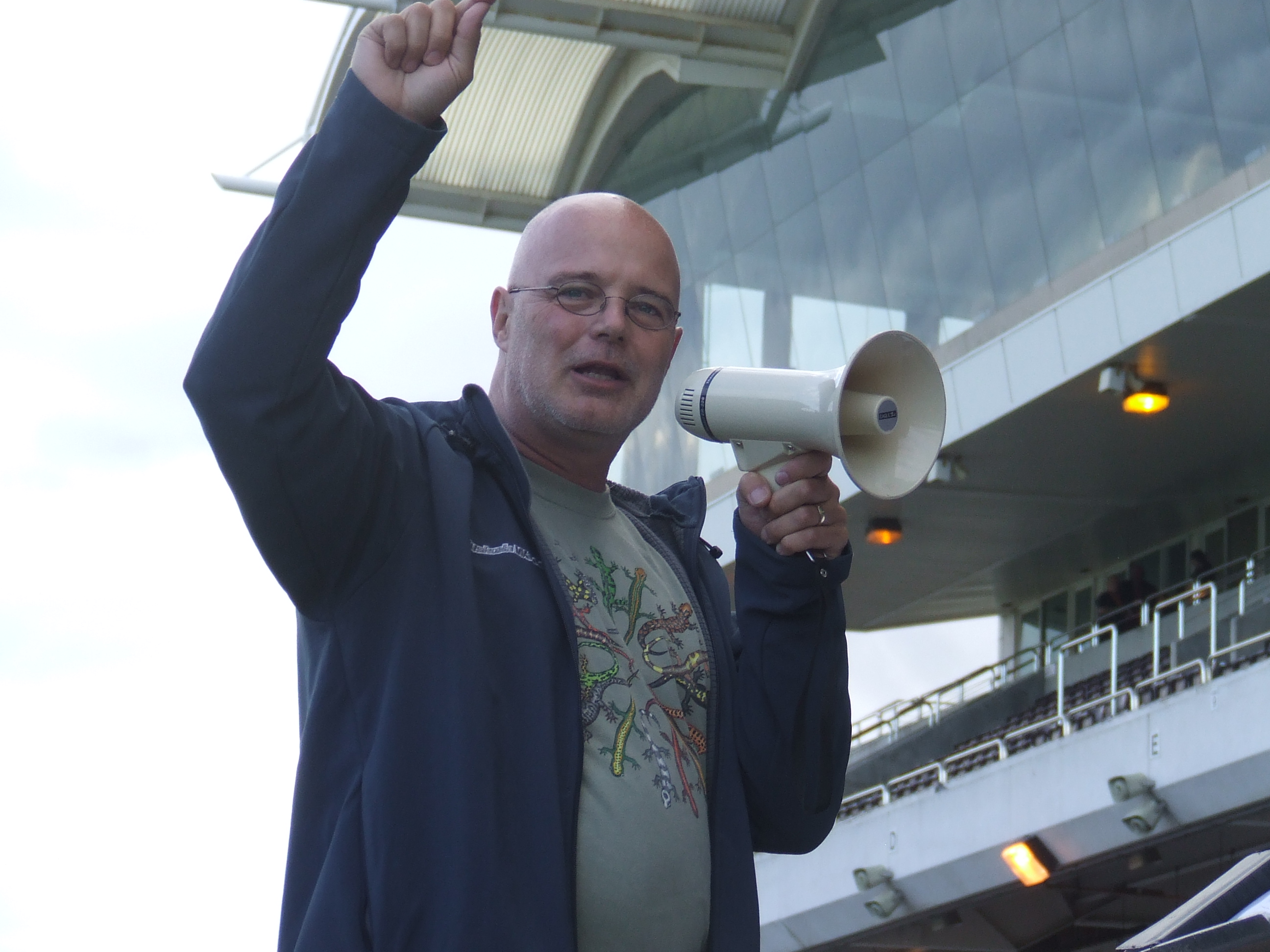
Brian McLaren makes do with a bullhorn after power failure...

Brian McLaren makes do with a bullhorn after power failure...

We are back.

Greenbelt 2008 was great- it was Michaela and the kids’ first time, and I think it was a bit of a culture shock for M at least. Will took it all in his stride, nintendo in pocket for the boring bits, and we only saw Emily every now and again- she had a ball.

M struggled with the crowds, the thousands of tents with guy ropes akimbo, and, of course, the questionable hygiene arrangements. But we all had highlights that we brought away as memories.

For Michaela, I think it was the communion service, visiting a spiritual director, and some of the talks.

For Emily, it was meeting new friends, a hard core screemy-teeny band called Fightstar and having the freedom to be herself in a large setting.

For William, who knows? Bless him, he is so easy with life. He seemed to really enjoy some of the ‘Children’s Greenbelt’ activities- particularly the chance to hold a snake, and to sing some songs. He badly needed some partners in crime- but seemed quite happy to hang out with the adults.

For me- a mixed bag really.

I loved Seth Lakeman’s set on Saturday evening- he made me proud- not sure what of exactly- perhaps that English-ness thing again.

I really enjoyed Brian McLaren, but more in agreement than revelation.

I also enjoyed hearing Philip Yancey- he is a really good speaker, and it was good to put a voice to the books. His combination with the Saltmine theatre company made me cry several times (in a good way!)

I somehow missed loads of stuff I wanted to see- partly because of family things that mean that time is shared in different ways, and partly because you just get overloaded at festivals like GB, and the effect this has on me is to make me wander aimlessly, sticking my head through tent doors and then moving on…

I missed out on a planned beer with Simon Smith because he was mad-busy doing some very impressive art stuff, and likewise Gail Findlay and Stephen Tunnicliffe, who were engaged on other Greenbelt business. I did manage to spend some time with old friends Mark and Denise from the Rhondda Valley, along with John, who is always great company. It was really good to see them again.

Along with fellow Dunoonite and Aoradh member Alistair (who had been volunteering the week before constructing various weird arty things) we performed a short version of 40 at the Proost lounge event on Saturday evening. Not sure how it went down, but it seemed to hold peoples attention, and feedback was good. Mark did us proud by reading the part of Jesus in a lovely rich Welsh accent (He asked if we wanted him to perform as Richard Burton or Uncle Bryn… I think he opted for the former in the end!)

The Proost lounge thing clashed with a discussion about whether there should be a Scottish Greenbelt (Scot belt? Tartan belt? Thistle Belt? You decide!) This was led by Doug Gay, and seems an interesting proposition. Huge amounts of work though- step forward the masochists!

Anyway- attached are a few more photies…