Church abuse

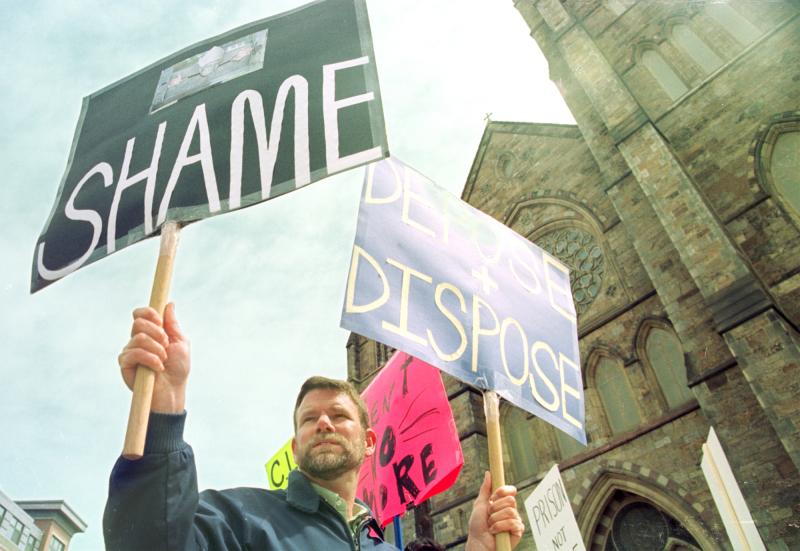
The scandals that threaten to tear apart the Catholic Church over sexual abuse by priests continue. The religious authorities have to answer to claims that they were complicit, or at best incompetent, in the way they dealt with allegations against clergy who abused their position.

The rest of us should not kid ourselves that vulnerable people have only been abused within Catholic churches though. Most of us have our own stories of abuse- emotional, spiritual, sexual, even physical within churches. Churches are human institutions, and so we bring in all of our human characteristics- for good and ill.

In churches, we add an extra power to some individuals- we give them an authority that seems all the more unassailable, as it comes from God. There will always be some for whom power corrupts, or opportunity gives too much temptation. Perhaps there is something in the entrepreneurial, risk taking spirit of our charismatic leaders that makes them particularly vulnerable to these sometimes spectacular falls from grace.

It it tempting too to demonise these people- see them as less than human. But I believe that few people start out on a path that seeks to manipulate and abuse. Instead, we start out with lofty intentions, seeking achievement and evidence of our gifting to validate life and ministry. Most of us have dark cupboards in which we hide the dark stuff, hoping that it will never see the light of public scrutiny.

What happens then? Why do apparently good men (and good women) go bad?

The shock to most of us is that we have come to think of church as a place set apart from the world around us. We spend our energy trying to get others to become like us, to join our movement of enlightened folk who are better than the world about them- holier, wiser and equipped with the Scripture and the Spirit to prove it.

But perhaps, just like the field of wheat in Mathew 13, the Church has a mix of wheat and weeds, just like the world around us.

If we assume that the church is full of folk who are already fully (or mostly) sanctified- apart from ourselves of course- then we potentially create an institution in which weakness is unwelcome and secret. We fool ourselves into a dualist situation, where the external profession of holiness is more important than humility and honesty.

And this seems to me to be a situation that breeds abuse.

Scottish religion?

As an incomer to this, my adopted land, it is impossible not to compare and contrast things ‘tartan’ from what I have known elsewhere. As a follower of Jesus, the greatest focus of this introspective examination has been how we do religion up here.

There is a great discussion about these issues on Brodie McGregor’s blog- which is on this link; http://viewfromthebasement.typepad.com/my_weblog/2007/04/emerging_or_sub.html
Brodie wrote a paper on Emerging stuff in Scotland, that I found really helpful- it is broken into digestible segments in his blog…

But what forms the character a place? Is there a convergence in the nature of the people? Perhaps we learn more than accents, taking on our style of communicating- of relating and of loving- from our environment. Are we also formed by landscape, by the mountains or the flat lands, or our closeness to the sea? Or is it the economy- those that have and have not, those in poverty or plenty?  Perhaps it is also about history, and ancestry, and our place in the story of ages?

Back to the spiritual dimension- of faith and belief, and how we express these things. Does our chosen expression of faith emerge from our own cultural heritage, or does it shape the way we are? I wonder if the way religion is understood and celebrated within any given culture becomes as influential to the formation of our towns and streets and institutions as DNA within our blood streams? Certainly, sometimes it seems that a bit of John Knox, along with a slice of Calvin and a hint of Iain Paisley can be found in every squared away, sensible building and every official institution.

As you travel up the west coast things change again…

But a few years ago, before we lived up here, I was walking through the lovely little town of Gairloch, in Wester Ross. I came across two little churches- so close, they were almost (but not quite) touching. They were separated by a few inches of clear air, but I imagined these inches to be stuffed full of inpenetrateable doctrinal difference.

I do not know the history of these churches, and certainly do not mean to criticise what I have no knowledge of. There may be very good reasons for having two such buildings- each one may be full on Sundays, and they may exist in harmonious fellowship.

But for me- this photograph has come to symbolise something of our Scottish religion.

I have said enough- here is the photograph, it can speak for itself.

Blogged with the Flock Browser

Tags: , , ,

Church?

Over the past few years I have had repeated conversations about Church. The themes of these discussions are as follows;

What is it?
Not a building? (But they are useful- particularly in our climate!) Not an institution? (But we easily organise and concrete ourselves into one.) Is it a movement? (And if so- where is the movement?)

What does it look like?
Not a club that exists for the members interests? (But what energy is left for others because of the demands made to service the club?) Do we all have to look the same? (And if not, why do we?) Not a Lecture hall/concert hall? (Where we gather mainly to receive pieces of knowledge, or to worship from afar?)

What should it look like?
Family? Community? Revolutionary cell? Monastery? Soup Kitchen? Therapy centre? Light on a hill? Circus act?

What is it for?
To defend the faith, and nurture the faithful? Or to does it exist solely to bless and serve those who are not members? Is it to make disciples of Jesus and set them loose on the winds of the Spirit- or is it to control and make safe the flock so doctrine and practice remain pure and unsullied by error or heresy?

What should be it’s priorities?
Preaching and teaching of truth- and the moral yardstick for culture? Social justice and looking after the poor and needy?
The Kingdom of God, in all its glory and majesty- in the future tense, but also NOW?

Mixed in with this talk are a load of sub themes- the death of Christendom, and the winding down of the modern age to be replaced with something fluid and undefined called ‘post-modernity‘, and the desperate need to find both old and new ways to bring refreshment to our communities of faith, so that we might be a blessing to others.

Any of you who loosely wear the ’emergent’ label will be well familiar with these debates- in fact you may be heartily sick of them!

I have spent hours deconstructing Church as I have known it. Through circumstances- geography, theology, difficulty and (I hope) following after God, I now find myself outside institutional church. This position is a gift and a burden all at the same time.

The gift is freedom. Freedom FROM a lot of the things that I have come to reject within churches, and freedom to choose new ways, in small community, looking to the the Holy Spirit for guidance.

The burden is isolation. A need to find new disciplines because the structure given by a wider organisation is no longer there. What about the kids?

I am also aware that at times I have been too keen to reject and harshly criticise what I have found freedom from. There is such a danger of arrogance and pride. As if they were wrong, and I am right- which is clearly nonsense.

So-any conclusions? Perhaps none- but a few working hypotheses…

Church happens when people follow Jesus. It dies when we follow institutions.

Church is seen in the visible marks made by the imperfect agents of the Kingdom of God.

Church is fluid and moving, like water. Place it in a pond and it stagnates- no matter how much is spent on artificial aeration projects.

Church is not me, it is us. It is never mine, always ours. Always HIS.

Blogged with the Flock Browser