A postcard from our community…

dscf36141

Another piece of heaven.

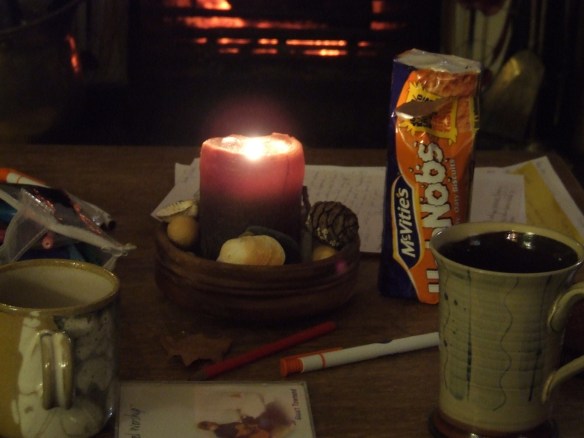
Housegroup has just finished again tonight. Just 9 of us, a log fire, and a packet of hobnobs.

And this evening, we shared with a friend who had finally made contact with a long lost daughter, we laughed a lot, and cried a little.

We shared our struggles with all the stories of God ordering genocide in the OT (Check out 1 Samuel chapter 15.)

And we wrote letters to some friends.

Lovely. And I am so grateful.

Friendship and the internet…

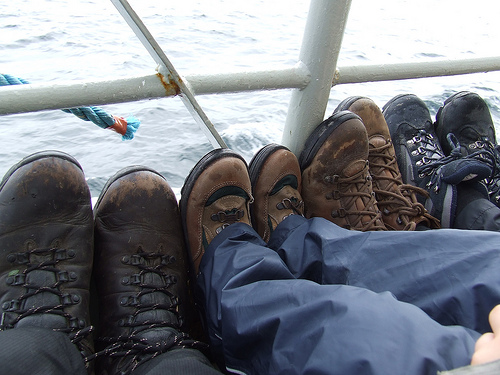
boots

Friendship- it just might save your life.

Not just in the obvious roped-together-climbing-up-the-Matterhorn kind of way, but in a thousand more subtle ways.

I have benefited enormously from all this on-line networking and blogging. But have long been concerned that online friendships lacked something vital to human experience. For us, they were expedient- given our somewhat isolated geographical location, but in my mind can never fully replace flesh on flesh contact.

I would go a little further (although I am hesitant to be categorical) and wonder if the real community that Jesus called us to (and modeled for us with his traveling companions) can only be experienced in close contact. I say this with some trepidation, as this kind of community is rarely comfortable, tidy or easy. I liked what Mark Berry had to say here about this.

On-line communication seems to have something of the autistic spectrum about it. It allows for the sharing of lots of informational data, but for the most part lacks the nuanced, multi-layered complexity that characterises human face to face exchanges. to extend the analogy, people who have autistic spectrum difficulties can find techniques that might help manage some of the contradictions and complications life brings to them. They might also have real strengths that are revealed in a capacity to perform some non-social tasks extremely well.

In the same way, on-line networking (such a recent phenomenon) does some things very well, and might yet develop techniques that make the interface more human. Before we rush to condemn, we should bear in mind that each step-change in communication technology has been greeted with much suspicion- the printing press, the railroads, television. These things result in change and adaption as they penetrate deeper into the human experience.

But I remain convinced that communication at a distance will never be enough. At present, I think the autistic analogy remains a good one.

jordrel-bank-2

I came across an article from the journal ‘Biologist’ the other day, which was quoted by the Dranes on their 2churchmice’s blog. It makes some startling statements.

Britons now spend approximately 50
minutes a day interacting socially with
other people (ONS, 2003). Couples now
spend less time in one another’s company
and more time at work, commuting, or in
the same house but in separate rooms using
different electronic media devices. Parents
spend less time with their children
than they did only a decade ago. Britain
has the lowest proportion of children in
all of Europe who eat with their parents
at the table. The proportion of people who
work on their own at home continues to
rise.

Britain’s disinclination for togetherness
is only equalled by her veneration of communicating
through new technologies. The
rapid proliferation of electronic media is
now making private space available in
almost every sphere of the individual’s
life. Yet this is now the most significant
contributing factor to society’s growing
physical estrangement
. Whether in or out
of the home, more people of all ages in the
UK are physically and socially disengaged
from the people around them because they
are wearing earphones, talking or texting
on a mobile telephone, or using a laptop
or Blackberry.

Does this matter?

Well the study goes on to list the benefits of close human contact and friendship. Here are some highlights;

  • Measurable genetic and immunological benefits.
  • Biological changes as a result of physical contact- hugs for example.
  • Increased incidence of cardiovascular problems in people with lower amounts of social connections.
  • Lower general morbidity associated with higher amounts of social contact.
  • A study finding lower incidences of strokes on women
  • Lower blood pressure in men, and a faster return to normal blood pressure after stress.
  • Measured differences in the narrowing of arteries.
  • The unexpected fact that if you have contact with more people, you are LESS likely to have colds.
  • Memory loss in old age declines at twice the rate in those poorly integrated.
  • General links between enhanced cognitive performance and social interaction.
  • A reduction in mortality for those who attend regular religious services! (But not just to ‘warm the pew’.)

The review ends with a description of an old study (10 years ago) which may or may not have been prescient.

While the precise mechanisms underlying
the association between social connection,
morbidity and mortality continue to be investigated,
it is clear that this is a growing
public health issue for all industrialised
countries. A decade ago, a detailed classic
study of 73 families who used the internet
for communication, The Internet Paradox,
concluded that greater use of the internet
was associated with declines in communication
between family members in the
house, declines in the size of their social
circle, and increases in their levels of depression
and loneliness. They went on to
report “both social disengagement and
worsening of mood…and limited face-toface
social interaction … poor quality of life
and diminished physical and psychological
health” (Kraut et al, 1998).

So, what can we make of all of this? The study clearly takes the view that on-line contact is not enough, and indeed may be problematic.

I still hope however, that when used well and purposefully, on-line connections might facilitate community building. This is where I still place my energy, and why I started out trying to establish this ‘Emerging Scotland’ thing…

It is almost as if we humans were made to find our highest expression in community. As if we were wired and plumbed for this.

So for now, my own conclusion is like this;

The internet is great. It gives me access to loads of great stuff (and lots of rubbish too I suppose!) It also allows me to connect with others. But it does not allow me to commune with others in the way that I think Jesus intended. In order for this to happen, the whole of me has to be engaged in this process, in all of my contorted brokenness, aware that in the joys of serving and loving will also be pain and suffering.

There is no other way.

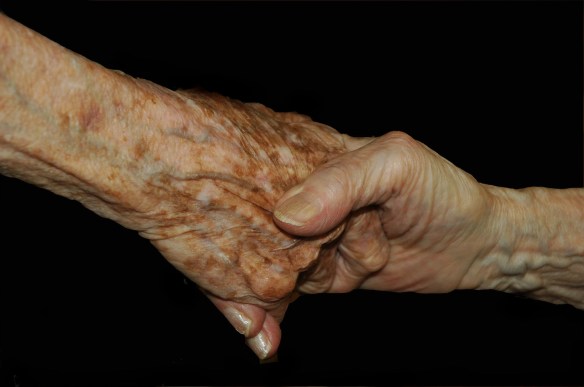
old-hands

Communing in the overlap…

Just Mooching Around (geddit?)

A story;

A man called Isaac grows and lives in a small village. He works hard on his farm, rising with the sun and tending the garden God gave him, tilling the rich brown earth. Rains come and water the green growth and plumps the ripening fruit. Life is good.

Next door lives his great friend Joseph. In the evenings they sit in the light of the harvest moon and share their hopes and dreams. They drink toasts to the future and laugh and joke and dream.

God looked upon them and smiled.

One day, Joseph inherits money from a long lost relative- just enough to buy a cow. And he walks it home up the hill and the evening light shines on its hide like velvet. He runs over to Isaac and invites him over to see the cow in its green pasture, solid and big and bountiful. “Look…” he says, “Look what God has brought to us- now we can have milk in the mornings- butter, cheese!”

But the cow became a shadow between Isaac and Joseph.

And one day, God visited Isaac and asked him what was wrong. Isaac said “It is the cow Lord- it has made Joseph into someone else. He used to be my friend.”

And God was sad.

“Isaac,” he said quietly, “If I can do anything for you- if I can grant you a wish, what would it be?”

Isaac looked up at God with cunning eyes.

“Kill the cow” he said.

Community.

As followers of Jesus, it is our calling, our aspiration, our tranforming power, and the very characteristic of the children of the living God.

Oh… and it can be hard.

Because real community implies closeness to those around us. It suggests relationships that go beyond the surface into the deep, undefended vulnerable parts of us.

And in doing this we are beautiful- as we serve and support, as we learn to love and let go our selfish stuff for the sake of the beautiful other. As we break bread and share wine.

But in doing this- we also are ugly- as we compete and squabble, as we dominate and oppress in the small things of a day, as we take in information and filter it through a screen of past hurts. As we nurse wounds and pick at the stitches until they burst and bleed on our communal table.

What was Jesus thinking of when he threw together his own band of disputing disciples? When he cautioned them that others will know that they are his followers by the love they had for one another?

Perhaps, just perhaps if we survive the examination of the stuff that we hide most carefully from the other- and we do not run away to build our own ego’s from bricks formed out of the manifest failings of our perceived inquisitors…

Perhaps then we might find that community is possible.

Because we Christians live in the overlap of what life is, and what we long for it to become.

Community… the journey into we

For much of my life, I have longed for community.

I have experienced flickers of what this might mean- but only in shadow, and sometimes only in hindsight.

The motivation for community comes through my understanding of the way Jesus called us to live- a collaboration of imperfect people who make a decision to love and to lay down self in order to serve others. And in doing this, others might see the Father God reflected in their gathering and their living.

If I look honestly at myself, this longing for community also arises from my own need to find a place of acceptance and security. A home from which to adventure, and a place to return to for healing and encouragement. (Perhaps in this longing, community starts again to be about ME?)

And mixed in with this is a sort of unexpressed idealistic theory that tells me that if we are able to move towards a pure community- then all things will be possible. Broken people will find healing, creative people will find expression. Needs will be met through sharing and burdens will be carried together. And because this community will shine like a beacon into its context, then it will become infectious- missional.

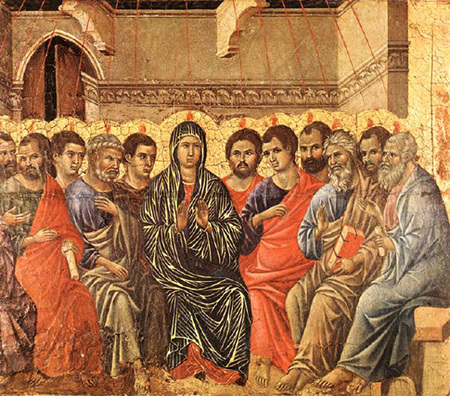
Kind of reminds you of the stories in the book of Acts? These stories have always been my inspiration. The homes opened up, the holding of things in common, the motivation towards the poor. Above all, the resting and the working of the Holy Spirit…

So, what gets in the way?

I know from my own experience that community is not always benign. Sometimes, the closer we get to one another, the more damage we do- the old hedgehogs analogy. The more we open up our lives, the more our facades of niceness are eroded, and the inner grasping kids emerge into the gathering.

Some people bring a toxicity with them that most communities will struggle to contain. There were people like that in the early church- Paul mentions them, and advises his friends to have nothing more to do with them. I bear the scars of broken and hurtful relationships- like we all do. I still torture myself in the making of decisions to walk away.

Then there is the issue of leadership and power. It will always become an issue at some point. Some take power deliberately, and use it indiscriminately for their own ends. Others are surprised to find that something of themselves has become oppressive to others almost unwittingly.

But perhaps above all, in Christan communities, we have lost the meaning of WE, and allowed our spirituality to be centred on the ME. WE have allowed our connections to one another, our way of living, and our spirituality, to be indistinct from the world about us.

I have spoken elsewhere about Kanyini, and how the original Australian people understood community. Once lost, this community is in danger of loosing themselves. We Christians began as people defined by community. It was out identity, and the beauty of it changed the world for ever.

But now, we see an overwhelming emphasis on personal morality, private experience, and even the accumulation of personal wealth, health and happiness. The danger is that people come to gather together in churches that are removed from the dirty messy stuff of life, to celebrate an abstract form of collectivism that is almost like a fossil version of the real thing. We forget our calling, our identity as people defined by our communality, our communion together, with God.

I have no answers of course- this would imply that I have sorted this out, and I certainly have not. But neither am i prepared to let go of my idealism.

I will lay down again for friends, knowing that I will be trampled on at times.

I will open wide the doors of my house, even though I resent the intrusion.

I will believe that this network of people God placed me within has a transformative power- not just for the community itself- but for all who are blessed by contact with it. And where the contrary is true- I will ask forgiveness for my own imperfection.

And I will chose to believe that where we gather, there is God in the midst of us…