Reverend Billy on ‘What would Jesus buy?’

Screenshot-2_0

I love people who create a holy row.

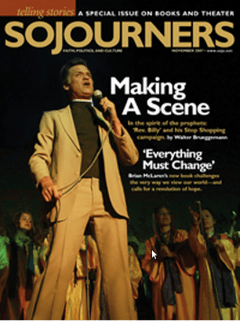
Such a man is Reverend Billy, the alter ego of Bill Talen. Check out this article in Sojourners magazine- I have pinched a few quotes as below…

Reverend Billy, also known as Bill Talen, has gotten the strange idea that the Big Corporations, notably Disney, Starbucks, Nike, and Wal-Mart—and their shameless commitment to profit at the expense of human infrastructure—constitute a destructive force in our society. He has, moreover, reached the critical judgment that such a negative ideological force in our society must be resisted, and can best be resisted from a self-aware theological perspective that operates with parody and irony. The purpose of such parody and irony is to expose what seems like an economic operation as an ideological force of totalizing scope in our society. This force seeks to situate U.S. consumers in an uncritical way in the “life world” of consumer capitalism.

Rev. Billy began to take his preaching into the Disney Store, and later into Starbucks, often joined by supporters who would help him stage “shopping interventions,” during which he might, for example, perform an “exorcism” of the cash register. In the process, the Church of Stop Shopping was born, a performance activism nonprofit staffed almost entirely by volunteers, including many professional musicians, singers, and actors who turn up as they’re able at actions and rallies promoting free speech, local communities, and anti-consumerism; tour with Rev. Billy as the Stop Shopping Choir; and help lead periodic “revival” productions.

For a flavour of his ‘preaching’-

Or check out this ‘choir raid’ on a shopping centre…

Preach it brother. 

Christmas is free…

It is you know-

It is not owned by Hallmark, or Tescos, or Amazon.

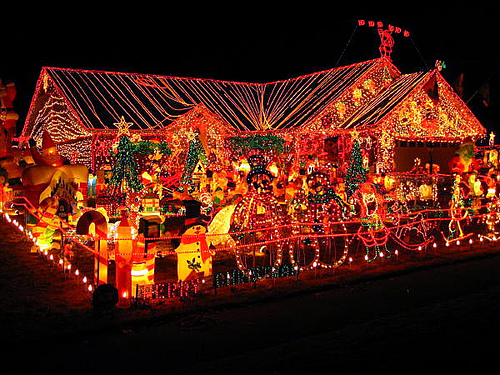
You do not have to fill your house with expensive tat for it to be special. Or cover your house with flashing lights.

You do not have to eat your way through Marks and Spencer nor drink your way through Asda to feel as though it has been worth while.

In order to share it with family and friends, you do not need to load your credit card.

Gifts are not expensive mutual obligations- and they can be of huge value whilst still costing nothing.

Last year, we decided we wanted to do things differently at Christmas.

So we sent this letter to our friends and family-


Dear friends

Last year many of you bought us so many lovely things for Christmas. We are so grateful that you think so much of us that you would take the time to buy gifts.

We know that it is good to receive, and even better to give, but the most important thing to us is your friendship, and in this we are blessed.

But this year, we want to try to make Christmas a little bit different- for these reasons-

We have so much, and others so little

We think that the meaning of Christmas as a festival has been lost under all the commercial madness

Christmas can be so stressful for people- the pressure to shop and spend money at a time when things are very tight

We have talked about wanting to do something different, but have decided that it is now time to actually time to do something

So we would like to humbly suggest that you do not buy us gifts this year.

Some of you are very organised (and very kind,) so may already have bought things with us in mind. If so, it might be possible to give these things to other people, or if not- give them to us anyway!

If some of you would still like to give some kind of gift, then we are intending to make a collection for Oxfam- purchasing some ‘Oxfam unwrapped‘ gifts in the new year.

We really hope to find a way back to a more simple way of doing Christmas- and so most of the gifts we give this year will be things we have made, or commitments/promises. Please know that we think very highly of you, and hope that this Christmas is your best yet.


Love


Chris and Michaela


And our friends respected our decision. We had a lovely time, and ended up gathering some money that might have made a difference to some people whose relationship to the earth is more immediate.

It felt like a start.

Because our house was still full of stuff. Presents still loaded out our Christmas tree.

This was partialy because we have kids- and applying the above set of principles is a very different challenge when you are 9 years old.

It was also because it is so hard to step off the Christmas merry-go-round.

But this year, we are determined to try again. And in discussion with friends, it seems we are not alone.

The current state of the economy might push us in this direction- but this is not really about tightening belts because of macro economics- rather (for us least) it is about trying to find an alternative way to celebrate Christmas.

Because we really love Christmas- as a chance to share, laugh, love and wonder. But those words ‘the true meaning of Christmas’ are perhaps so over used that they are worn out. It is for you to decide what meaning the festival brings into your life, and the life of your friends and family, but the one thing that we might agree on is that Christmas is not about money. It is not about debt. It is not about over consumption.

To this end, I have been experimenting with a Posterous site, entitled ‘Christmas is free’- here.

I will be posting a few things on there over the next weeks- please give it a shout and the odd visit if you think this is a message worth spreading.

Poverty and debt in the UK…

I have just been reading some research by the Institute for Public Policy Research (IPPR) on UK poverty.

Poverty? In the UK? This from an article in the Church Times- here

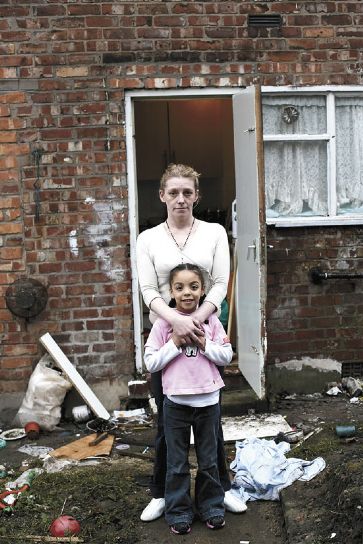
What does it mean to be poor in the UK today? For many of us, the Victorian notion of poverty may still persist in our minds: ragged, barefoot chil dren, malnourished, overworked par ents, and slum housing. Yet in 21st-century Britain it is possible to be in poverty and own a mobile phone.

Poverty is a relative concept, explains Chris Goulden of the Joseph Rowntree Foundation. Where once it was measured on the basic principle of the “basket of goods”, the official poverty line is now set at 60 per cent of the national median income (currently £377 a week), i.e. £226.

For children who are classed as disadvantaged, it is as much about their participation in society as about their diet and clothes. While it may be possible to buy cheap tech nology such as mobile phones, these children may still not be able to af ford to go on the school trips, which can be relatively expensive, Mr Goulden says.

The number of people officially in poverty is increasing in the UK; and they are most likely to be children, pensioners, the disabled, or single-parent families. While New Labour made inroads into cutting poverty when it first came to office, this has now gone into reverse. According to the latest figures, after housing costs are taken into account, there are 13.2 million people in poverty today — about one in five of the population.

Of these, two to three million are thought to be in extreme poverty, living on just 40 per cent of the average income.

We live in a time when our obsession with ownership- of houses, of shiny electronic devices, of constructed and packaged experience- is at an all time high. This addiction to consumption has received some closer examination in the wake of recent economic upheavals, but the trend remains.

The IPRR research followed 58 low-income families in London, Newcastle, Nottingham and Glasgow aimed to understand what the expansion of household debt has meant for them. The research found that many low income families have become increasingly vulnerable and exposed because of debt, which has increased substantially in the last decade- from 93 to 161 per cent of disposable income over the last decade.

The study found that the main reason that families got into trouble was because of a reduction in income- the loss of a job to one of the working members, or the reduction of a benefit. The effects of this were often catastrophic.

Poverty, once some basic human needs are satisfied, is always relative.

Our sense of security, of personal value and of mental wellbeing is fuelled by lots of things, but in this world of shiny consumption, it is certainly influenced by our ability to make the same consumer choices that those around us are making.

It is very hard to resist the truth of this. Particularly for those whose finances are marginal. Choices that we make to stand aside from the consumer madness- to make decisions to live a simpler life- these may feel like middle class indulgences to many people when faced with kids who are fed a relentless stream of advertisements for gaming consoles, mobile telephones and expensive clothing.

This kind of poverty is no less brutalising.

Poverty is still the main predictor of lower life expectancy, poor educational outcomes, health problems, mental illness, family dysfunction, poor housing etc etc.

What is the answer?

I suspect that this relates to the need for much wider societal change- the need to find a different way of experiencing human society that breaks with the economic enslavement that our capitalistic system demands of us. To find meaning and relationships in other things.

Is this possible?

I think that it ought to be possible for the people of Jesus, if for any of us- despite our tendency to forget our call to be in this world, but not of it.

And I still hope that there will be enough of us prepared to live extraordinary lives, so that the huge loaf that is society will have a different leaven.

Or to put it a different way, we would learn to live up to the business of being salt to bring out the flavour in our communities, or light to illuminate the beautiful and small.

But- for me, there is the seduction of middle class security, and the accumulation of more stuff. It may yet be the end of us- and what a sad way to go…

Consumption 2- Advent conspiracy…

Thanks Stewart for this link to the Something Beautiful podcast which has an interview with Greg Holder about a campaign called Advent Conspiracy

Check it out.

(There’s loads more interesting stuff on the Something Beautiful podcast too for those of you with long journeys and an MP3 player!)

Here’s the low down in visual form…

Which kind of set me thinking again…

Christmas and consumption- can we really turn this around?

For us it will not be easy. Friendship and relationship is very important. As Christians we care called to prioritise both- and the more connections and relationships you have of any depth, then the more present-giving you will find yourself in the middle of.

We have tried various measures over the years to break the consumption-obligation cycles that this can place on both us and friends. These have included-

Making stuff
I have painted, hammered, written and made a million jars of pickle (the house has just recovered from the smell of the last lot!)
Michaela is really good with her hands, and makes cards and all sorts of other things. She usually tries to bring other ‘crafty’ friends together and they have a communal session around the table, which always seems great to me.

But this requires a lot of that precious commodity called TIME- and as Christmas approaches, we tend to be very short of this. Kids plays, church services, carol singing, friend and family visiting and (of course) shopping…

Agreeing not to give gifts
With some close friends we have come to arrangements not to give stuff- but then we often weaken, We say “just the kids”, and then end up giving ‘a token’, simply because we like each other…

Giving stuff to people who need it most!
A lot of charities now allow you to give presents to a third party on behalf of someone else. Check out Oxfam unwrapped– we use this at work rather than giving cards and presents.

The advent conspiracy folk suggest these things;

The other thing that we can do is to organise some time for ourselves and our community to focus on Jesus during Advent– before the Christmas business fills all the diary space.

Think about the business of WAITING. Of anticipating the coming king. Think about the giving of God, and the beautiful pregnancy of a season that will give birth to grace…and peace…and truth.

Consumption

shopping

Consumption.

Not the coughing theatrically into a stained handkerchief kind- but rather the acquisition of stuff.

We took a day out today to do a whole load of consuming. We went Christmas shopping. Michaela has this list that she does on the computer, complete with reference information and tick boxes. I go along as the bag man really. But hey, I get a day out with my wife.

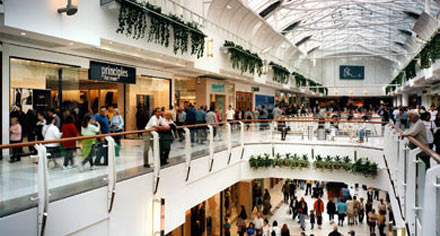
Today we decided to brave a large ‘mall’ at Braehead near Glasgow. I have been there once before, and Michaela reminded me that I swore I would never ever go there again. But as I could not remember having said it, away we went.

What a place.

It has two polished levels of shopping- lines of every shop you would expect to be there, and not a single surprise. Each shop seems to be selling almost identical items, at almost identical prices. There is a ‘food hall’, in which awful food is sold, at very high prices. The place has not originality, no sense of place- as you walk through it, you could be in anywhere in the UK, or even anywhere in Europe.

What is it about these places that makes me so uncomfortable?

I think it comes from a constant feeling that I am being manipulated.

And that awareness of this manipulation does not help me avoid it.

I find myself a participant in a system that would convince me that it is normal to fill my life with all of this stuff- which as soon as I remove from it’s box will be worthless.

A system that depends on me buying ever more stuff, because any measurable change in the numbers of us who buy it, or the frequency by which we buy it, will send ripples through the economic systems of the world.

And should any caution or fear produce a slight reluctance to continue with this in enough of us, then stock market values plummet, financiers get nervous and banks start to tighten their credit lines. After all most of us depend on this thing called credit to buy our stuff…

Then businesses start to find that there is less need for their goods, and so they in turn slow their production, and people lose their jobs. And these people are no longer earning money, and so can buy less stuff.

And the whole thing starts to wind down into… recession!

So I had better spend more in this mall right? It is my duty to the world…

Oh but every year we say the same. Christmas is defined by this round of acquisition every year. Don’t get me wrong, I like to give stuff to my friends and family, but it seems that what I give them is so… useless, for the most part.

Is there no other way?

Well, not for us this year. We have spent the day consuming after all. But there is always next year…

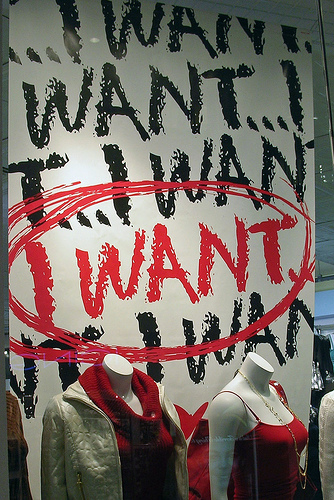
I think these make the point quite well…

(You can see more of this, and some suggestions as to alternatives here.)

Squeezing my stuff through the eye of a needle 2

Good old Laurie Taylor. He presents a radio programme called ‘thinking allowed’ on radio 4, looking at pieces of social research that say something about British society.

A recent programme had an article about possessions. He spoke to a sociologist who, building on earlier research into our relationship with the things we own, had spent a year speaking to people on a London street, getting to know something about them, the spaces the occupy, and the stuff they fill these spaces with.

I don’t know about you, but I have always had an uneasy relationship with the things I own. I follow Jesus, and he seemed to advocate freeing ourselves from the accumulation of things. He suggested that his followers did not even need two shirts on their backs. However, he also feasted and shared life with his friends (Lazarus for example)in their own houses, and so clearly he was able to appreciate some of the uses to which we can put the things we own.

My hero’s are often people who leave behind ’stuff’, in favour of life that is for God. I have quoted Mother Teresa- “We rob our brothers by all that we own.”

But I know that I can easily be motivated by the getting of, and the enjoyment in, the gadgets and gear that fills my life. It is always something that I have resisted, but I know it is there.

Back to the research. What it seemed to indicate was surprising. There seems to be a direct relationship between the accumulation of precious things- books, photos, treasures etc, that clutter our homes, and the strength, depth and number of our connections to PEOPLE.

If your home is empty and barren, then it is at least possible that your life will lack connections and significant relationships.

Where your treasure is, there is your heart also…? Is it possible that we value most objects because of their MEANING- and this meaning ultimately only has significance in relationship?

Perhaps it might be an interesting exercise to think about a list of your favourite things- a bit like the song. can we measure these things in terms of the degree to which they bring us into relationship with others?

Does this make them good?

I am not sure. Perhaps this idea is seductive- like the possessions themselves. Ultimately, we leave them behind…

But here, almost like a confession- is some of the stuff I value highly. Perhaps it says more about me than I would like!

Musical instruments- the ability to make something lovely out of strung wood.

My laptop- the creativity and connection this brings to me.

The house– space to be alone, and to be with my family and my friends.

Pictures- that record the growth of the kids and the years with Michaela

Books- for obvious reasons

Gadgets- all sorts of clever ways to achieve very little

Cricket balls- I love the feel of the leather in your hand…

The TV remote– It is mine. Step away from the remote control. It is mine.