Land ownership and climate justice here in the UK…

If you are UK based, you can not have missed the dominance of one story in the news of late- the (re)imposition of inheritance tax on farming land by the new Labour government. This has led to a howl of protest from farmers who say that this will be the end of their family farms. There has been a lot of discussion about how this works- the way that farms below 250 acres are almost unviable economically, and how farmers are often ‘asset rich and cash poor’.

The story that comes through strongest in these discussions is how hard working farmers, who often trace their linage back many generations, are being forced off the land by city lefties, or venture capitalists who are driving up land prices, both of whom have no understanding of what the countryside is or needs. Farmers, in this story, are the heroes of nature. Their toil is what preserves the brightest and best of our heritage and out nationhood. Many do this with very little recompense other than a love of the soil and a deep abiding relationship with the land that they live upon. Whilst this story is one we should pay heed to – there are real people whose lives and ways of living are at stake here – this is another story that I have heard almost nothing about during this debate, and that is the issue of land ownership in this country.

1 percent of this country owns half of the land in England. Mostly this ownership has not changed for a thousand years. The same elites have continued their lines of ownership which has preserved their hold of wealth and power for generation after generation.

If you want to find out more, then I very much suggest watching this vid;

In Scotland, this is unequal division of land ownership is even more pronounced. 432 private land owners own 50% of the private land in rural Scotland. The latest estimate of Scotland’s population is 5,327,000 , so this means that half of a fundamental resource for the country is owned by just 0.008% of the population.

Given that the baseline for so much of our nations widening inequality is not about income so much as wealth – particularly property wealth – then land ownership matters.

Ownership of land is in itself a problem that sooner or later we will have to grapple with, given the fact that the current ownership patterns have continued to oversee a catastrophic decline in biodiversity.
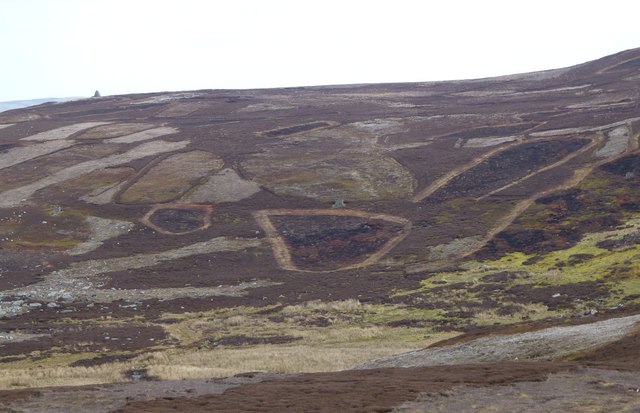
Grouse moor with butts by Russel Wills is licensed under CC-BY-SA 2.0

Grouse moors, as discussed in the video above, are an illustration of how bad things have become. Half a million acres in England, two and a half million acres in Scotland. Vast amounts of land, covering the most sensitive parts of our uplands, are kept in a state of dessecration simply for the entertainment of a wealthy elite. We have ceded ownership of a vital carbon store to people who have demonstrated very clearly that they are not safe or responsible stewards. Everything that affect the sport is killed- even at the potential threat of imprisonment- goshawks, mountain hares, weasels. Everything that should live in our uplands is gone. The once-vibrant ecosystem has been degraded to the point where it is invisible, and what is worse is that we have been so blinded by the power structures that keep these abominations in place that we think that these places are ‘wild’.

The weight of pheasants released into the wild – non native invasive species – as shotgun fodder (50 million birds) is greater than the mass of all native birdlife in the UK. Think about that!
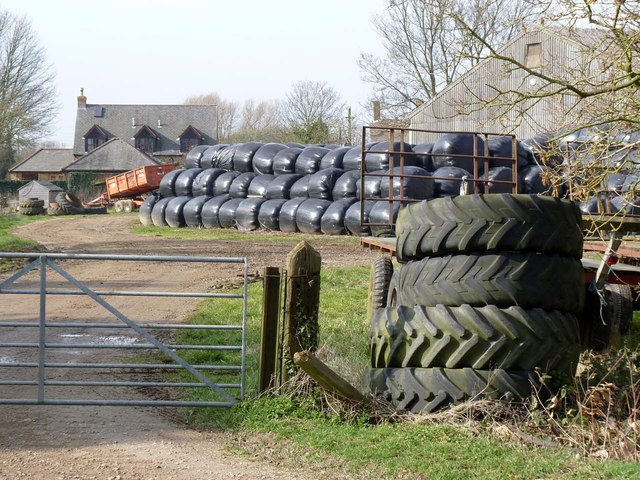
Modern farmyard by Alan Murray-Rust is licensed under CC-BY-SA 2.0

So let’s retuen to the family farm. People who work harder than most of us can imagine and deeply love what they do. If changes to inheritance tax are really going to impact them so severely, then surely this can’t be right?

The problem is that we are highlighting the wrong problem.

Farming in this country is in crisis. It is uneconomic because of a whole set of global and local fiscal rules.

It does not constitute a safe and secure food chain.

It is unsustainable.

Rather than safeguarding our land, it has destroyed almost everything that once lived on it.

If there was just one ‘brexit benefit’ that I have been able to identify it is the end of the common agricultural policy subsidies. For the first time, we have an opportunity to pay farmers (and land owners who have never farmed in thier lives) to change entirely the way they use the land. To grow food in sustainable ways. To increase wild land, to make room for biodiversity recovery which we need so desperately.

I think this should be done by government action. We should pay farmers from taxation where it is needed, because this is needed not just to save family farms, but to save our land itself – not least, from the farmers.

But what do I know- I’m just a lefty townie.

Blog action day- land and food…

This is my contribution to Blog Action Day 2011…see here for more details.

The theme of this years action day is- food.

But I wanted to talk about land. And poverty. And I want to do this via a lesson from history, and using the voice of a dead poet. (What else would you expect?)

Because the land and food (and poverty) are rather linked- it is from the land that we are sustained.

Most of us have no connection to the land any longer. We westerners live in an artificial urbanised world, in which all provisions, all groceries, all produce, are available all year round no matter what the season- all courtesy of huge supermarket companies, and a fleet of containers, aircraft and road miles.

Increasingly, as the current economic dysentery is stirring the belly of capitalism, we are asking questions about how this insulation from the blood  and dirt of food production might be making fools of all of us. It is resulting in a kind of sickness- in which we are addicted to instant, processed imitation food, in which taste has to be added chemically. We are getting fatter and more sclerotic with each mouthful, and once hooked, kicking the habit is near impossible.

Sure, there are dissenting voices- like shiny red apples in a burger bar. The slow food campaigners and those wonderful allotmenteers and land sharers- but despite the rising food costs and increasing poverty gap in the West, for many of us, these choices are about lifestyle, not necessity.

Most of the people in world have a different connection to the land- one of absolute dependency. If this connection is broken- they have a choice- starve, or become refugees. Either way, communities are broken and culture is scattered. The very stories of these people are submerged and silent.

Most news reports focus on drought, or war, or corruption as the cause of these events- and all of these things play their part. Mostly as symptoms rather than the cause however. I am not one for oversimplifying things as a rule, but the issue is really about-land.

Ownership of the land

Stewardship of the land

Access to the common land

Use of the raw materials from the land

I mentioned a lesson from history- and it concerns our own diaspora- sent out from these shores as a result of the greed of land owners and the separation of a whole culture from the land.

As I write this, I expect that many of you will be thinking of the Highland clearances. Lamented in story and song, so much so that something of it has entered into the consciousness of not only modern Scotland, but also into the new cultures spawned from this exodus- in the USA or Canada or Australia.

But this is not the story I want to remember. Rather it is another one, forced on communities the length and breadth of these islands over a period of around 200 years and known collectively as ‘The Enclosures’.

Battle was joined around the Tudor times- land owners started to make ‘improvements’ to the land- enclosing common pasture in order to grow cash crops in fields. Stripping away the ancient rights of those who lived hand-in-soil.

There were riots, and for a while economic circumstances preserved the status quo. But progress was unstoppable. Money was to be made.

And so through the 18th and 19th centuries, a whole series of ‘Inclosure Acts’ were passed by Parliament. These enclosed the common land, often to the benefit of the landowners, and compensated other land users with parcels of inferior land- which they had to enclose, or lose. Many could not afford to enclose, so lost.

Between 1700 and 1890 over 20% of the total land area of England and Wales enclosed by Acts of Parliament- of which 2 million acres were common lands.

And so the connection was broken. And a new kind of slavery was born- to the machines. On the back of this removal from the land, working people found themselves working in the factories of the land owners- and a new industrial age was born, with all its black shadows and shiny new product, from mechanised spinning and tin soldiers to i-pads and sports cars.

This is our history- that of Great Britain. It is a history of an enforced removal from the land, and a replacement of this with something else. And in doing this, we have lost all respect for the place that holds us. Economic necessities govern our food production, and those who still seek to make a living from the land are under incredible pressure.

The rest of us know little about food- for us, land is only important in as much as having a large driveway is a good measure of personal success.

And it is happening anew.

In South Africa, in India, in Brazil, in Haiti.

This is not meant to be a rant against supermarkets, or the evils of capitalism. Rather it is an attempt to find again some connection to where we come from, and what still we look to feed, clothe and sustain us.

We might do this by planting some seeds, or finding out more about the origins of the food we eat. But I am a poet, so I look for connections through the stories and songs that emerge from who we were, and what we have become.

Has anyone heard of John Clare?

John Clare, our most remarkable poet of the English countryside, was born in the village of Helpston, Northamptonshire and raised as an agricultural labourer. Clare’s genius was his ability to observe and record the minutiae of English nature and every aspect rural life, at a time when enclosures were transforming the landscape and sweeping away centuries of traditional custom and labour. 

Following great success with his first published poems (outselling even John Keats) Clare quickly became unfashionable, falling quickly into literary obscurity. The magnitude of Clare’s achievement and poetic genius was not fully appreciated until the recent publication of a first complete edition of his poetry, much of which had remained neglected in manuscript archives for 150 years. Now scholars worldwide regard him as one of our leading poets gradually affording the same status as reputed poet contemporaries such as William Wordsworth and S.T.Coleridge. 

(from here.)

John Clare began as a poor labourer, cursed and blessed with the sensitivity of a poet- at a time when everything he knew was changing. He went mad, alienated by his gift and his broken connection with the land that he loved, living out his final years in an asylum.

And he wrote like this-

The Gipsy Camp

The snow falls deep; the Forest lies alone:
The boy goes hasty for his load of brakes,
Then thinks upon the fire and hurries back;
The Gipsy knocks his hands and tucks them up,
And seeks his squalid camp, half hid in snow,
Beneath the oak, which breaks away the wind,
And bushes close, with snow like hovel warm:
There stinking mutton roasts upon the coals,
And the half roasted dog squats close and rubs,
Then feels the heat too strong and goes aloof;
He watches well, but none a bit can spare,
And vainly waits the morsel thrown away:
‘Tis thus they live – a picture to the place;
A quiet, pilfering, unprotected race.

But, back to the enclosures- here is another of his poems

Accursed Wealth

Oh who could see my dear green willows fall
What feeling heart but dropt a tear for all
Accursed wealth o’er bounding human laws
Of every evil thou remainst the cause
Victims of want those wretches such as me
Too truly lay their wretchedness to thee
Thou art the bar that keeps from being fed
And thine our loss of labour and of bread
Thou art the cause that levels every tree
And woods bow down to clear a way for thee

I first came across John Clare thanks to hearing Chris Wood’s song, ‘Mad John’- from the Album ‘Trespasser’.

Here is the only version of the song I could find. May the spirit of John Clare call us back to the land, and remind us to listen to the voices of the dispossessed wherever they may be heard.