Over on proost.community, the lent collaboration continues- an invitation for creatives of all disciplines to share some of their work in order to mark, celebrate, protest, pray, engage with meaning as this season unfolds.
I have just listened to the whole (superb) album, wondering again how we allowed this history to be almost erased in the overwhelming telling of the story of the war in Gaza.
As Jonny asks below – who is the terrorist? What does this word even mean in an age in which terror is edited out by an AI interface, whilst simultaneously being used as a justification for genocide?
There is another way, but it requires peaceful, determinded, creative confrontation with Empire. We are grateful that art provides a means for us to do this.
Backbone was an album recorded by me (Jonny Baker) and Jon Birch after I had been on a trip to visit Israel/Palestine with Amos Trust in 1998. It was a protest album really with a mix of anger, lament and a tinge of hope telling stories of what I had witnessed. Since the Hamas attack in October 2023 and the completely disproportionate razing of Gaza to the ground and the genocide of its people, we have both watched with horror both at what has unfolded and the complete lack of intervention by the international community. Those songs we wrote back then have been on both our minds and seem sadly poignant now. So Jon has stripped back the album and completely remixed and remastered the whole thing. It stands the test of time we think but is much better sounding. We have set up a Jonnys in the Basement band camp page (jonnysinthebasement.bandcamp.com) and would love you to go and have a listen – see what you think. Do buy the album or make a donation – every single penny will go to Amos Trust for their work in Gaza.
This video of me doing an acoustic version of Terrorist was me incensed at the American and Israel bombing of Iran and the disgusting rhetoric about Epic Fury whilst wearing baseball hats sounding like teenagers playing video games. No mandate from the American people, no international mandate. Just the violence of Empire.
Feeling powerless in the face of such egregious injustice can result in a loss of trust or faith, not just in governments and institutions but also in the moral order of the world, and its ability to protect children. I wonder what the impact of this will be: will it, as certain politicians no doubt hope, result in a numbness that presents as indifference? Traumatic events can result in a lack of affect – millions more people should be marching and raising their voice – but they can also be channelled into righteous anger.
I certainly feel a profound loss of faith. Something I felt to be true about humanity – that people are fundamentally good, that we owe it to children to protect them – has shifted because of this conflict. I walk around with a feeling of heaviness that I cannot seem to shake. Thousands of miles from Gaza, I am changed by the past 18 months. I have learned that, for some people, compassion for children has political limits. What does one do with that terrible knowledge once it sits inside you like a leaden stone? I don’t seem be able to find an answer.
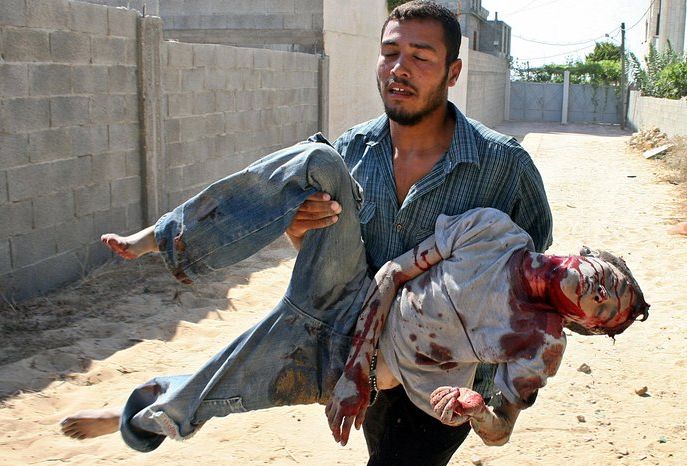
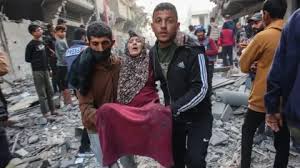
Whilst, I refuse to join her on her loss of faith in the goodness at the heart of humanity, It is impossible not to agree with the seeming numbness we feel towards the on going horror unfolding in Gaza. Like the photo above, we look from distance – worse than this, we look only through the goggles we are given.
A channel 4 news report yesterday made the rather sobering point that the images of dead and starving children in Gaza are NOT SHOWN in Israeli media at all.
This is shocking, right? Can it really be true that in this so-called bastion of democratic liberal western civilisation, media outlets are so compliant as to generally not show the consequences of Netanyahu’s vengeful war crimes?
But what about the rest of us? How is it possible to see reports like this and ignore the human suffering – to demote it to something less important than OTHER human suffering, or even worse, render it as necessary for the pursuit political or economic expediencies?
Or even worse than that – obscure it behind religious doctrines, like Zionism?
We are all living in the shadows cast for us by algorithms made from our search histories, our viewing habits, our social media connections. To pretend any of us are free from influence or constructed sectarianism is foolish indeed. However, what is happening just now is more than just the consequences of our media bubbles. In the face of such horror, we have switched off.
Some of us have stopped looking, others never looked at things like this in the first place.
Let me tell you a story. I must be careful how I tell it, because I do not want to create more hurt and division. It is a story in which I am certainly not the hero – in fact it is one that ends in defeat. Perhaps I should have titled this piece ‘How not to speak to Zionists.’
In the early days of the current Israeli invasion of Gaza, I posted this on a forum I was hosting. It was a discussion about using art, spirituality in the service of social justice, and I was interested in the fact that a church in London had hosted this gathering.
I then found myself in an extended discussion via message and e-mail with a friend who saw things very differently than I did. Their concern was firstly about Roger Waters, who they felt was a proven antisemitie.
As the discussion went on, it became clear that my friend also believed strongly that the protests against the war in Gaza within the progressive Christian circles we had both moved in were also antisemitic, and that the use of words like ‘apartheid’ and ‘genocide’ in relation to Israel’s necessary war – triggered as it was by the horror of October the 7th – placed Jews all over the world at risk.
Our discussion was always polite, but we were never able to find much common ground, despite having so much else in common. My friend shared how, when the October the 7th events were unfolding, they had felt a huge collective wave of fear, related to the past persecution and present uprise in antisemitic attacks all over the world. The very present need for a modern state of Israel as a home for Jews was a holy, Godly pursuit in this context. It was Shiloh.
In return, I tried to talk about the generations of injustice and increasing oppression of the Palestinian people, and how Zionism has had terrible consequences for indigenous residents of the Holy Lands. I raised the issue of the West Bank settlements and abandonment of the rule of law. The shooting of children throwing stones. The forcing of people from their homes and ancestral lands. The unequal health and educational outcomes and so on.
I tried to talk about those cases in which war crimes by the IDF had been investigated – for example the terrible case of Hind Rajab, the 6 year old killed beside her family whilst on the phone to the emergency services – and the ambulance staff killed trying to reach her. My friend became quite irritated, saying that ‘we can all find terrible stories’ and anyway, ‘the IDF is the most humane army in the world’.
In the end, all we could do was agree to differ, and to go our seperate ways as the terrible war continued to get worse and worse. As thousands more children died under the rubble.
I often found myself thinking about our conversation though. I even wrote this poem in an attempt to process it all in my head;
.
Victims
.
My victims are more victimised than yours
She said, pointing to the blown-out bus
And the young bodies under blankets
Swimming in pools of broken glass
.
My genocide is more genocidal than yours
She said, pointing to a pile of scuffed shoes
To empty wooden huts behind rusted wires
And a yellow star on a stained jacket
.
The prejudice we experience is more prejudicial than yours
She said, pointing out the broken synagogue windows
The graffiti and the students protesting peacefully
In a public park
.
She must not know about Ahmed’s beautiful little sister
There was a time when it seemed like the war in Gaza might be over. A very unequal ceasefire was negotiated and prisoners were being exchanged for hostages. Bodies were being pulled out from beneath the rubble of hospitals, schools and mosques. People were making the long walk home, or at least to the pile of rubble that had once been their homes.
Meanwhile I was still wondering about my friend and feeling uncomfortable with how our discussion had ended. I was also wondering if they had changed their position at all, so I reached out again and asked if they wanted to talk. This time it would be face-to-face, via Zoom. My friend graciously said they would like to do this, and suggested that we start by watching this video;
I watched this video twice. I have a background within the social sciences, so have spent a long time thinking about prejudice, racism and scapegoating. Antisemitism seems to me to come from the very worst of what we are and can be as humans, and I have no argument with almost all of what Sachs has to say in this video. We need to understand how people from a Jewish background feel in the face of rising antisemitism across Europe.
This fear seems to be a big part of my friend’s desire for people like me to stop using pejoritive terms like ‘genocide’ in relation to Gaza. As far as they are concered, this produces direct results in the form of antisemitic attacks.
But there is more we have to talk about in relation to this ugly phenomenon. Firstly, it is not just antisemitic attacks that are increasing, but also anti-islamic violence, which has grown three times more, according to this report by Hope Not Hate.
Tell MAMA, the leading agency on monitoring anti-Muslim hate, has recorded a 335% spike in hate crimes from 7th October 2023 to 7th February 2024 compared to the same time period the previous year, a record high since the charity began in 2011.
British Jews have also faced similar consequences, as events in Israel and Palestine frequently drive increased antisemitism in the UK. The Community Security Trust (CST) recorded reports of 4,103 anti-Jewish hate incidents in 2023, a rise of 147% compared to 2022. Two-thirds of incidents happened on or after 7th October, a 589% increase in reports from the same time period in 2022.
It seems to me that we are now in a strange new world in which the far right – previously the political engine for so much antisemitism – are confused by the fact that Netanyahu’s governement is also on the far right. A lot of that hatred has been redirected towards Muslims, but a lot still remains. Add to that the way that the concept of antisemitism has arguably become a political weapon to silence dissent – used with no sense of irony by right wing newspapers such as the Daily Mail (despite its own shameful record of antisemitism.) There are also the murky waters of Labour party politics, in which the labour left has been silenced in the face of its apparent antisemitism. What we are left with is a new landscape in which hate is rising and old politics are being destablised and undermined. VIolence is always likely in these circumstances.
Where does this take us in relation to Zionism and the war in Gaza, which has now entered a new phase in which ethnic cleansing is being openly talked about as a military aim? In which starvation is talked about by Israeli ministers as a legitimate tactic to drive Gazans out of their land? This was all yet to kick off again when I was talking to my friend, so instead I tried to ask what might be the common ground we could find. I also wondered whether their position had shifted at all – if their views had changed in the face of such overwhelming slaughter and destruction.
It seemed clear that there had been no change at all in the views of my friend. I was genuinely perplexed at this, as I felt them to be a good person, full of spiritual depth and insight. How could the scale of death and destruction not have evoked some kind of empathetic response, critical of the actions of the perpetrators of such slaughter?
The first problem was how to agree on the nature of this death and destruction when you can not agree on the validity of sources of information. My friend made it clear that he no longer consumed any media sources apart from The Times of Israel, because all other sources of information – including the BBC – were biased. This newspaper does seem to be fairly centrist in its approach, but a centre media bias rating does not necessarily mean a source is totally unbiased, neutral, perfectly reasonable, or credible, just as Left and Right don’t necessarily mean extreme, wrong, unreasonable, or not credible.
The only defense against limiting our perspectives is surely to do our best to read outlets across the political spectrum. This is a hard lesson for us all, as we tend to look for articles that confirm our bias or become ways to point out the ‘wrongness’ of the other but without this effort, it is perhaps no surprise that my friend had made no journey of discovery.
The next problem was a religious one, in which my friend said something like this;
Here’s a thought. I wonder if my perspective is a big picture one, yours a close focus. Both of which are important, both of which can learn from the other?
Your perspective is particularly focussed on the misbehaviour of the state of Israel, tiny but in comparison with its close neighbours strong. So the reactions of the IDF in Gaza loom large.
Mine is a big picture, long-term view, shaped by the Shoah and centuries of antisemitism, seeing the current conflict as just the latest example of ongoing concerted attempts to kill Jews and to destroy their place(s) of safety. We are in a struggle for existence.
Was it about the fear we mentioned earlier, leading to a kind of bunker mentality in which survival seems to justify such punitive violence, even for good people like my friend? I can only speculate as pretty soon, our conversation ground to a halt. In the face of the comment above, I found myself writing this rather harsh, angry reply;
I honestly find the idea of it incredulous. I cant go with the big picture/close picture split, no matter how neatly this might enable us to place things.
The ‘big picture’ you describe is entirely one sided. It does not engage with the complex history of the Palestinian people, or the history of violence, displacement, breaking of international laws that have stemmed from that.
My exasperated and rather unkind response- via e-mail too, rather than face to face – was the end of the discussion.
I wish we have been able to talk about a different kind of common ground- after all, we are both followers of Jesus, and yet we spent no time at all seeking to place the teachings of Jesus into this dreadful context. I think I felt like this would have been to use Jesus as a stick to beat my friend with – Jesus as a dialectical debate weapon – which did not feel apprporiate, but in hindsight, I still find myself wondering why this was not our common ground.
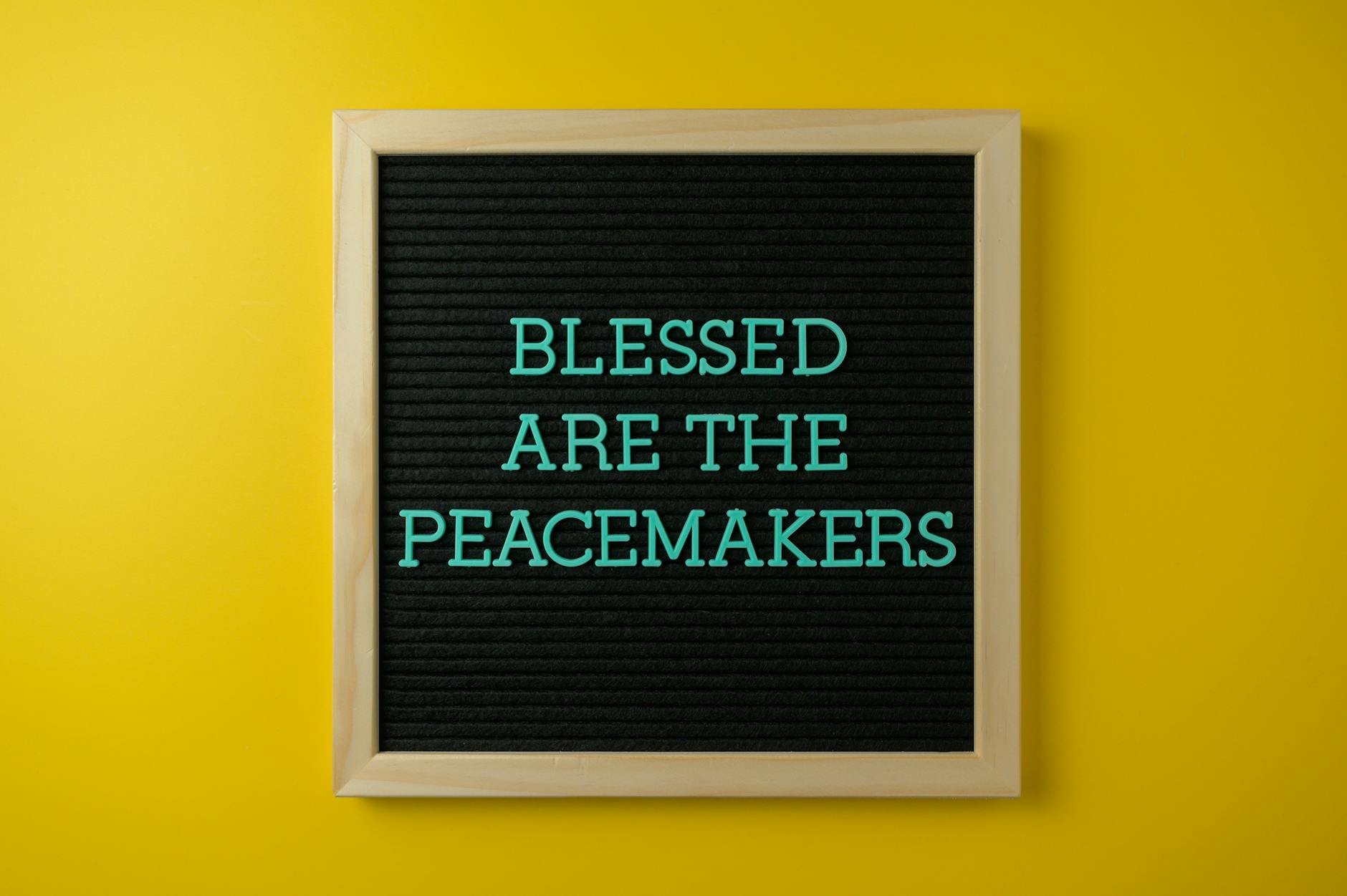
Might talking about Jesus have made us think about what loving our enemies or seeking to be peace makers in this context might have looked like? We will never know I suppose. We missed out on this particular blessing.
Clearly I am not the person to answer this question, but talk to them we must.
We have to understand each other, to humanise and seek compassion, particularly with those with whom we have a disagreement. Particularly in a world in which violence is increasingly seen as a legitimate response to political, religious or geographical difference.
Perhaps we have to start too by understanding the way fear works, particularly the legacy of such global hate as the Holocaust. How it is weaponised by people like Netanyahu and his media machine. How it is fostered and monetised by the algorythm.
But we must go beyond fear, back towards compassion. We must name those who are victims on both sides, not just the Israelis. Not just the Gazans.
We must call out the war makers for what they are – on both sides…
…and we must grieve for the children, who grow in this polluted, toxic rubble we have made for them.
The background to this advent is horror in the holy land. We all know this, but it has become almost impossible to talk about freely. Even the words we use to describe what is happening in Gaza (not to mention the West Bank and Lebanon) are contested.
Genocide.
Aparthheid.
Terrorism.
Antisemitism.
In part this appears a deliberate consequence of the propoganda war, but it leaves many of us exposed, angry and fearful. The internet algorythm then plays the polarisation game and we find ourselves divided against each other, each with a different version of the ‘truth’.
There are sensitivities here that we have to acknowledge – the terrible history of the Jewish people and the horrific attack that was the catalyst to this event, but we now must call the Israeli military response what it is – the most brutal attack on an urban population in modern history, desctived as genocidal by the International Criminal Court.
There is no equivalence here, no proportionate response. It is violence unleashed, and almost 70% of those killed have been women and children. There is no justification for this kind of slaughter.
Amnesty International agrees. The 297 page report makes for harrowing reading.
“Our damning findings must serve as a wake-up call to the international community: this is genocide. It must stop now.”
– Agnès Callamard, Amnesty International
They are in no doubt what needs to happen.
Meanwhile the rest of us feel powerless, or complicit even. After all, our government continues to offer broad and unflinching support to a regime that is infliciting unimaginable suffering on a whole people. Hundreds of companies in the UK make items used by the Israeli war machines. Our media is oddly compliant, despite the exclusion of journalists from the war zone and the 146 journalists and media workers killed by Israeli bombs.
This powerlessness impacts us like a moral injury – it becomes an unresolvable cognitive dissonance which means that most of us have to just switch off to it all, because what else can we do?
Many, including many of our friends, caution us against outright opposition to Israel’s genocide. After all, do they not have a right to defend themselves? It all seems so complicated, so let us just offer up prayers for peace and leave it to higher powers to sort out. But there is no peace in light of such on-going brutality, and there can be no peace without justice, without restoration and a rolling back of the violent jugernaut that has been cruhing the Palestinian people for so long.
Thoughts and prayers are not enough.
A few weeks ago, Michaela and I joined an Iona Community zoom call to hear from a man who had lost 19 members of his family to a bomb strike in Gaza. He has know idea why they were targeted, but it may be because he is a journalist. One of the participants in the call started to offer words of compassion, but he stopped them.
I don’t want your sympathy, he said. It means nothing to me. I don’t know you and you don’t know me. I just need you to do something.
This stayed with us for weeks. But what could we do? How can any of us respond to what is going on?
We tried informing ourselves- finding out as much as we could about the history, from the mess the British left after they left and the massacres of 1948 right through to all those himan rights violations followed by the ebb and flow of violence and counter-violence.
We noted in particular the role played by Christians in this mess – how Christian Zionists seem to outnumber Jewish ones for instance, and the hold that a certain myth of Israeli ‘specialness’ has even within mainstream churches, which blinds us to so much brutality. If you want to know what this looks like in the West Bank for example, listen to this…
We looked to see if we could support organisions working for peace like the Amos trust because perhaps getting money into the right hands is the answer… how much it is needed after all!
Then Michaela woke up with an idea in her head.
What if we could put something in the hands of the CEOs and politicians that have power and influence. Something simple but beautiful.
An object of meaning that they had to choose to either keep or throw away.
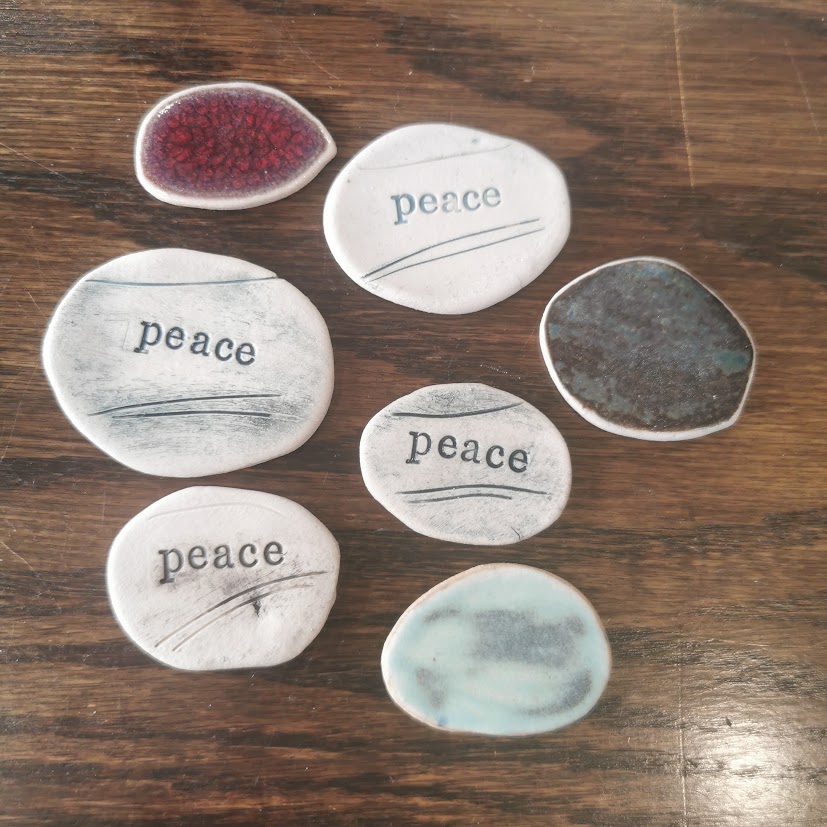
So far she has made 413 of these ceramic stoneware pebbles, with a glaze on one side and the word peace on the other.
Friends have helped with the making and glazing, and we intend to post them out to CEOs of UK companies who make items used in the Israeli war machine, and to our politicians and to those conpanies on the boycott list who support the Israeli government or military financially.
We are calling them pebbles of peace.
Want to get involved?
Each envelope will cost around £1.50 to post. Already we have posted out about 300, and these costs have been covered by a community of people who have chipped in to add their voice to the outrage. There are still a couple of hundred to go (we will fire another batch in the kiln in a week or so) so it you want to help out, either by supporting some postage, or even by taking a batch and posting them yourselves, then let me know.
We wrote this to go along with the pebbles.
Pebbles of peace
We are a group of friends longing for peace in the middle east. We represent no big organisation or interest other than that of our own.
We feel overwhelmed by the scale of the hurt and pain being caused by the war – on all sides. The thousands of dead children and the hundreds of thousands whose bodies will carry wounds in body and soul for generations to come.
When will it stop? Who will be the peace makers?
We think that change happens through brave people like you making hard decisions towards peace, even at personal and collective cost.
We send you this little token of peace and invite you to pick it up.
What you do with it is up to you.
You can keep it…. or throw it away.
If you keep it, our hope is that you will be doing so as a commitment towards using whatever power or influence you have – big or small – to make peace.
We know these things are complicated, so we make no other request.
I was watching some footage of the violence in Gaza on the news today.
A house destroyed by a tank shell. A mother and three children still in the rubble.
Two small bays covered in blood and concrete dust carried into a hopelessly overwhelmed hospital, staffed by western volunteers. Lacking crucial supplies because of a blockade imposed by the same people who now send the bombs.
Ali posted a link to this film below. If you have any interest- sit down with a coffee and watch it through…
What are we to make of this?
There are two main perspectives it seems;
Israel the defender of the free against the forces of terror.
Israel came into being as a rag tag group of survivors of a Nazi Holocaust took control of their own fate. The Jewish Diaspora was called home, to the land promised by Yahweh.
From the very beginning, they faced overwhelming odds- first the British ‘peacekeeper’ force, who were overcome by the gallant Zionists (albeit using terror tactics.) Then, outnumbered several times, they fought back attacks from every point of the compass by the surrounding Arab nations.
These surrounding nations could not accept the reality of a re-established Jewish nation, and so set themselves on a war footing- committed to driving Israelis into the sea, and returning Palestine to the Palestinians.
But Israel got tough. It’s fighters tenacity and idealistic strength were more than a match for anything the Arabs could throw at them, so the Arabs turned to terrorism.
So Israel fights on still- sending planes and tanks into the hills and streets of Lebanon, and Gaza- in measured, professional response to the missiles launched and the suicide bombers sent.
Israel the victim, striking back.
This view of Israel seems to find a ready home within some Christian groups- most notably, right wing Evangelicals. I have always struggled to understand this. As far as I can make out, this seems to be for a lot of reasons;
Theological reasons- Modern Israel is seen through a set of Old Testament goggles. Israel is the promised land of the Jews, and so God will always favour Israel.
Escatological reasons- there are understandings of the ‘end times’ predicted by the book of Revelation that centralise Israel- as a necessary stage for the final dramas of the Human Race. As such, the watchers and readers of the coming great tribulation seem to value their understanding of this Biblical prophetic work more highly than human life- or at least, Arab human life.
Political reasons- the American Religious Right has become a powerful political force. Mingled in with this is a strong bias towards Israel- perhaps for the reasons above- perhaps also because of other business interests- that familiar relationship between political and economic power. The accommodation with the spirit of the age that the Book of Revelation may also be understood to be commenting on.
A lack of understanding because of a media bias. The film above makes this point very strongly. To hear a journalist of the stature of Robert Fisk describe just how strong the media blackout has been on any critical news reports describing Israeli aggression gives more than a little pause for thought.
A willingness to believe ‘Christian’ sources, and discount any information that emanates from contradictory sources- such as Amnesty International, the Red Cross, or even Christian Aid.
So- to the second understanding…
Israel the aggressor, the war criminal.
Here a different Israel can be seen.
A people formed in terrible adversity who went from the victims of genocide, to the perpetrators of terrible human rights abuses within a single generation.
This is a story of UN resolutions ignored. Of internationally recognised borders ignored. Of property and land destroyed and violated. Of thousands of women and children murdered.
And of an allegiance with the worlds only remaining superpower, with an unlimited supply of armaments.
Of thousands killed in the refugee camps of Lebanon. Rockets and shells fired into densely populated slums- full of civilians.
Of an on going occupation of the West bank, and Gaza- against specific UN resolutions. Whose brutalised young people, raised on stories of martyrdom and oppression, lacking opportunities for work, or the hope of any kind of stable life. Lacking all the advantages of a people who live the other side of the fences and walls that surround them- these young people then turn to the very violence employed by zionist terrorists only 50 years ago.
They put bombs on buses and in hotels. They strap explosives to their bodies and walk into school yards.
What should our response be?
I am a follower of Jesus. In his name, we stand as peace makers, healers, chain breakers and bringers of sight to the blind.
No-one carries a sword in the name of the Prince of Peace. Even if many (starting with Peter in the garden) have made that terrible mistake.
So let us stand with Jesus with the poor and oppressed- wherever they are, and whomsoever is the oppressor. Let us seek to understand, and never call this weakness. Let us seek to love, and never call this treason. Let us seek to reconcile and never call this surrender to terror.
And let us raise voices that hold to account those who wield the sword over the weak. Let us be never accommodate and excuse evil- even when it is wrapped in a flag, or the ideology of freedom.
Let us also remember some of the followers of Jesus who remembered the way of the Kingdom under terrible oppression.
Have we not come to such an impasse in the modern world that we must love our enemies – or else? The chain reaction of evil – hate begetting hate, wars producing more wars – must be broken, or else we shall be plunged into the dark abyss of annihilation.
Like an unchecked cancer, hate corrodes the personality and eats away its vital unity. Hate destroys a man’s sense of values and his objectivity. It causes him to describe the beautiful as ugly and the ugly as beautiful, and to confuse the true with the false and the false with the true.
The church must be reminded that it is not the master or the servant of the state, but rather the conscience of the state. It must be the guide and the critic of the state, and never its tool. If the church does not recapture its prophetic zeal, it will become an irrelevant social club without moral or spiritual authority.



 this fragile tent