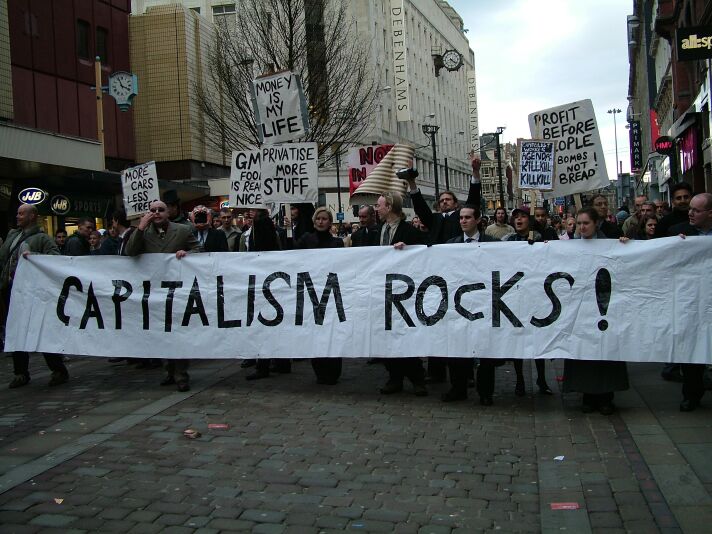
Capitalism, and Church as supermarket…

super_market

In a recent post on his Missional Tribe blog ‘beyond missional’ Frank Viola asked some questions about the effect of the current financial global crisis on Churches, and indeed the Kingdom of God. You can read his post here.

It has been a regular theme of my pondering, and of course, my blogging! See here and here.

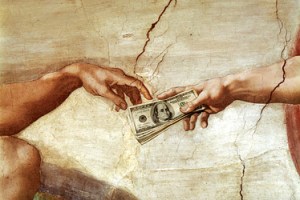
It seems that many Church groups and organisations, built as they are on a financial platform that depends on a stable prosperous Western capitalist economy, are beginning to feel the pinch. Church, in this form, is embedded within the dominant economic realities of the day. In it’s organisation at least, it is no different from any other business or institution- it has mortgages, profit and loss, staffing costs and maintenance costs.

Some suggest that the Western world is undergoing a massive shift. Capitalism is reforming, in the face of a crisis as big as it has ever faced before. Some are even asking again whether a system based entirely on expanding the ways in which people can be made to want MORE is sustainable. Particularly as the system also depends on huge inequalities between the consuming countries (in the West) and sweatshops and mines of the South,

Crisis has this way of holding up a mirror through which we can see ourselves from a different perspective. Some Christians are starting to ask again whether this really is the only way to live- and how this reflects our calling as agents of the Kingdom of God.

Perhaps this challenge also falls on our institutions. Has the way that we have done church easily become based on a consumer choice?

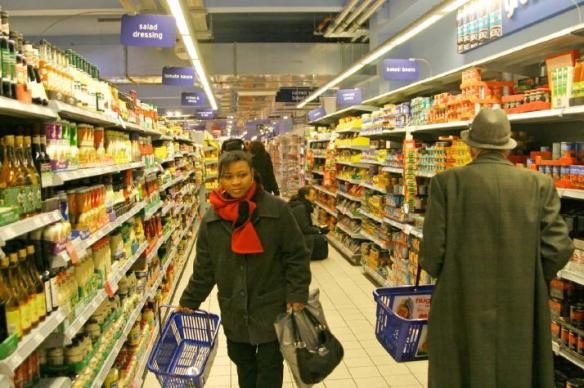
Church, becomes a shiny supermarket, at which we buy spirituality- packaged to be portable within our context.prosperity0909

In my country (Scotland) this is less and less relevant, as people simply no longer visit our spiritual supermarkets. For some this is because they have lost their market appeal. I wonder if this is also time for people of faith to stop stacking product, and hoping customers will come to buy. It is time to remember that the church that Jesus loves is built of flesh, and has no steeple…

And to remember again the words of Jesus from Matthew chapter 5, where he calls us to a radically different way of living…

Lest I descend any further into polemic, I am forced to confess my own dependence on this context- my mortgage, my car, my gadgets. And buildings- they have their uses, particularly in our climate!

But I no longer feel the need to put my resources (money time and energy) to sustaining an earthly institution.

Frank Viola quotes Beuchner;

“I also believe that what goes on in them [support groups] is far closer to what Christ meant his Church to be, and what it originally was, than much of what goes on in most churches I know. These groups have no
buildings or official leadership or money. They have no rummage sales, no altar guilds, no every-member canvases. They have no preachers, no choirs, no liturgy, no real estate. They have no creeds. They have no program. They make you wonder if the best thing that could happen to many a church might not be to have its building burned down and to lose all its money. Then all the people would have left is God and each other.”
~ Frederick Buechner, Quoted on pg. 277 of Reimagining Church.

I have found myself part of such as small group as described above, called aoradh. We meet in houses, or village halls, or pubs. We have no paid staff, and things can be pretty chaotic, as we do not have any leaders either. We look for partnerships and create spaces where we can, seeking to be a community who are faced outwards.

This way of being is strangely credit-crunch proof I find!

The spiritual discipline of no longer coping…

not-coping

If any of you wants to be my follower, you must put aside your own pleasures, your own ways of coping, and follow the way of the cross.

Walk close with me…

If you insist on saving your life- you will just end up losing it.

You will just end up WASTING it.

Only those who are prepared to lose it all for my sake, and for the sake of my Kingdom, will ever know what it really means to LIVE…

From Mark 8:34-35.

Heres a question: Is it possible that the things we do to enable us to survive, or to socialise-even to succeed- easily become the seeds of our downfall? Perhaps the stuff that insulates us from one another, and from God?

I have thought about this a lot. It is one of those many areas where my understanding of God has been enhanced by my work with people who have mental health problems.

You see, perhaps the most influential therapeutic approach today is Cognitive Behavioural Therapy (CBT). CBT encourages us to look at the way our thoughts, emotions, actions and physical sensations interact to form repetitive feedback loops that can be enslaving and extremely difficult to escape.

That is not to say that these loops are always dysfunctional. The truth is, much of how we engage with the world about us seems to be built on these things. We find ways, sometimes at a very early age, of managing the interface with the stresses and strains of life, and these tend to just continue into adulthood. For most of the time, this is just how it is- we do not need to examine this in any detail.

One of the things that CBT therapists will look for as we try to help people are ‘safety behaviours’. These are the things we do to enable us to get through. Of particular significance, and introducing the most complication, are those things we get into to cope with SOCIAL risks- that most subtle of human response to the risk of exposure, ridicule an embarrassment.

For some people, the safety behaviours may be highly damaging- drugs, alcohol, dependency on sex, or imprisonment in abusive relationships. For some, violence and anger become their defining emotion- enabling them always to be right.

For many of us, they may include more manageable, but still potentially unhelpful ways of keeping the world at bay- food, stuff that makes us feel good for a while, possessions, the pursuit of recognition and significance…

Then there are even more of us who appear to be doing OK. We have our things, our successes, and our projects. We know where we are going, more or less, and who we are going there with. We can cope with most of what life throws at us, because we are moving on our own tram lines- we have bought a ticket, and the only way is forward…

For those of us in the latter group, it is often only CRISIS that makes us take stock.

That makes us look at the safety behaviours we wrap ourselves in, and ask whether they are worth holding on to.

When I look at the passage above from Mark’s gospel, I wonder if Jesus knew all about this. I wonder if he understood that life lived for nothing is no life at all. That life insulated from people and from God is a lesser existence. That life where safety-comes-first will only ever be half life.

So I wondered about the need for us all to STOP coping.

To stop being in control.

To step outside the treadmill of the expected, the predictable, the manageable.

Into the great glorious unknown.

Where God is.

The universal declaration of human rights, and Jesus…

udhr_colour

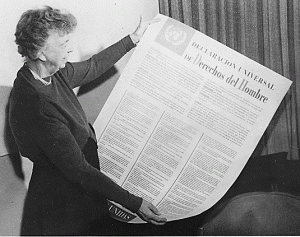
On December 10, 1948 (60 years ago today) the General Assembly of the United Nations adopted and proclaimed the Universal Declaration of Human Rights.

This incredible document was written as a response to the horrors of the second world war, and brought the hope of a

Eleanor Roosevelt with a Spanish Language version of the UNDHR, 1949

Eleanor Roosevelt with a Spanish Language version of the UNDHR, 1949

council of nations who would regulate the governance of the people of the world by a new, commonly agreed yardstick.

I have heard and read several discussions about whether this document has really made any difference to the people of the world. After all, the imperative to support and to enforce it remains the prerogative of the superpower of the age- and at present, we have only one- the United States of America.

For the past 60 years, the tradition of convenient alliances and an acceptance of all sorts of injustices for the sake of political expediency has continued in a way that seems indistinguishable from the preceding 60 years.

And even if the world was willing to unite behind a military solution to uprooting a despotic regime- and after all there are still plenty of these around, even if only a few ever make the media front pages- do we think that violence is the answer?

Does violence not only ever bring legitimacy to more violence?

And then, of course, the lawyers get involved. The UN declaration found it’s place alongside other other national and federated law- the European Convention on Human Rights for example. A huge machinery of sophistry was the inevitable, if necessary, outcome.

So, is this anniversary to be celebrated?

outlawed_guantanamo

One discussion I listened to brought me up sharp. A commentator said something like this;sermon-on-the-mount
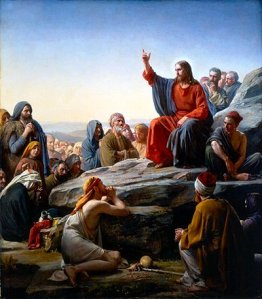
…of course, the declaration is a bit like the sermon on the mount- it is aspirational. No-one ever expects that it will work in the real world.

Of course, I beg to differ on the sermon on the mount.

I think the words that Jesus left us with from Matthew 5 are far more than aspirational, they define for humanity the very best of what we are, and could ever be. They set a direction of travel and a yearning for better things. And they start from a heart to heart connection with something blessed and eternal. Something undefinably GOOD.

And in that moment a Kingdom like no other finds it’s foundations.

Of course, we fail. And the systems that try to organise a response to these words in the form of church and state- well they fail too.

They fail because of legalism, and because of indifference. They fail because of the idolatry of accommodation and compromise.

They are very different documents- the words of Jesus as quoted by Matthew, and the great humanistic declaration drafted by Canadian Lawyer John Peters Humphrey .

But perhaps their application might find some commonality.

Here are the words in full- you decide!

Article 1.

All human beings are born free and equal in dignity and rights.They are endowed with reason and conscience and should act towards one another in a spirit of brotherhood.

Article 2.

Everyone is entitled to all the rights and freedoms set forth in this Declaration, without distinction of any kind, such as race, colour, sex, language, religion, political or other opinion, national or social origin, property, birth or other status. Furthermore, no distinction shall be made on the basis of the political, jurisdictional or international status of the country or territory to which a person belongs, whether it be independent, trust, non-self-governing or under any other limitation of sovereignty.

Article 3.

Everyone has the right to life, liberty and security of person.

Article 4.

No one shall be held in slavery or servitude; slavery and the slave trade shall be prohibited in all their forms.

Article 5.

No one shall be subjected to torture or to cruel, inhuman or degrading treatment or punishment.

Article 6.

Everyone has the right to recognition everywhere as a person before the law.

Article 7.

All are equal before the law and are entitled without any discrimination to equal protection of the law. All are entitled to equal protection against any discrimination in violation of this Declaration and against any incitement to such discrimination.

Article 8.

Everyone has the right to an effective remedy by the competent national tribunals for acts violating the fundamental rights granted him by the constitution or by law.

Article 9.

No one shall be subjected to arbitrary arrest, detention or exile.

Article 10.

Everyone is entitled in full equality to a fair and public hearing by an independent and impartial tribunal, in the determination of his rights and obligations and of any criminal charge against him.

Article 11.

(1) Everyone charged with a penal offence has the right to be presumed innocent until proved guilty according to law in a public trial at which he has had all the guarantees necessary for his defence.

(2) No one shall be held guilty of any penal offence on account of any act or omission which did not constitute a penal offence, under national or international law, at the time when it was committed. Nor shall a heavier penalty be imposed than the one that was applicable at the time the penal offence was committed.

Article 12.

No one shall be subjected to arbitrary interference with his privacy, family, home or correspondence, nor to attacks upon his honour and reputation. Everyone has the right to the protection of the law against such interference or attacks.

Article 13.

(1) Everyone has the right to freedom of movement and residence within the borders of each state.

(2) Everyone has the right to leave any country, including his own, and to return to his country.

Article 14.

(1) Everyone has the right to seek and to enjoy in other countries asylum from persecution.

(2) This right may not be invoked in the case of prosecutions genuinely arising from non-political crimes or from acts contrary to the purposes and principles of the United Nations.

Article 15.

(1) Everyone has the right to a nationality.

(2) No one shall be arbitrarily deprived of his nationality nor denied the right to change his nationality.

Article 16.

(1) Men and women of full age, without any limitation due to race, nationality or religion, have the right to marry and to found a family. They are entitled to equal rights as to marriage, during marriage and at its dissolution.

(2) Marriage shall be entered into only with the free and full consent of the intending spouses.

(3) The family is the natural and fundamental group unit of society and is entitled to protection by society and the State.

Article 17.

(1) Everyone has the right to own property alone as well as in association with others.

(2) No one shall be arbitrarily deprived of his property.

Article 18.

Everyone has the right to freedom of thought, conscience and religion; this right includes freedom to change his religion or belief, and freedom, either alone or in community with others and in public or private, to manifest his religion or belief in teaching, practice, worship and observance.

Article 19.

Everyone has the right to freedom of opinion and expression; this right includes freedom to hold opinions without interference and to seek, receive and impart information and ideas through any media and regardless of frontiers.

Article 20.

(1) Everyone has the right to freedom of peaceful assembly and association.

(2) No one may be compelled to belong to an association.

Article 21.

(1) Everyone has the right to take part in the government of his country, directly or through freely chosen representatives.

(2) Everyone has the right of equal access to public service in his country.

(3) The will of the people shall be the basis of the authority of government; this will shall be expressed in periodic and genuine elections which shall be by universal and equal suffrage and shall be held by secret vote or by equivalent free voting procedures.

Article 22.

Everyone, as a member of society, has the right to social security and is entitled to realization, through national effort and international co-operation and in accordance with the organization and resources of each State, of the economic, social and cultural rights indispensable for his dignity and the free development of his personality.

Article 23.

(1) Everyone has the right to work, to free choice of employment, to just and favourable conditions of work and to protection against unemployment.

(2) Everyone, without any discrimination, has the right to equal pay for equal work.

(3) Everyone who works has the right to just and favourable remuneration ensuring for himself and his family an existence worthy of human dignity, and supplemented, if necessary, by other means of social protection.

(4) Everyone has the right to form and to join trade unions for the protection of his interests.

Article 24.

Everyone has the right to rest and leisure, including reasonable limitation of working hours and periodic holidays with pay.

Article 25.

(1) Everyone has the right to a standard of living adequate for the health and well-being of himself and of his family, including food, clothing, housing and medical care and necessary social services, and the right to security in the event of unemployment, sickness, disability, widowhood, old age or other lack of livelihood in circumstances beyond his control.

(2) Motherhood and childhood are entitled to special care and assistance. All children, whether born in or out of wedlock, shall enjoy the same social protection.

Article 26.

(1) Everyone has the right to education. Education shall be free, at least in the elementary and fundamental stages. Elementary education shall be compulsory. Technical and professional education shall be made generally available and higher education shall be equally accessible to all on the basis of merit.

(2) Education shall be directed to the full development of the human personality and to the strengthening of respect for human rights and fundamental freedoms. It shall promote understanding, tolerance and friendship among all nations, racial or religious groups, and shall further the activities of the United Nations for the maintenance of peace.

(3) Parents have a prior right to choose the kind of education that shall be given to their children.

Article 27.

(1) Everyone has the right freely to participate in the cultural life of the community, to enjoy the arts and to share in scientific advancement and its benefits.

(2) Everyone has the right to the protection of the moral and material interests resulting from any scientific, literary or artistic production of which he is the author.

Article 28.

Everyone is entitled to a social and international order in which the rights and freedoms set forth in this Declaration can be fully realized.

Article 29.

(1) Everyone has duties to the community in which alone the free and full development of his personality is possible.

(2) In the exercise of his rights and freedoms, everyone shall be subject only to such limitations as are determined by law solely for the purpose of securing due recognition and respect for the rights and freedoms of others and of meeting the just requirements of morality, public order and the general welfare in a democratic society.

(3) These rights and freedoms may in no case be exercised contrary to the purposes and principles of the United Nations.

Article 30.

Nothing in this Declaration may be interpreted as implying for any State, group or person any right to engage in any activity or to perform any act aimed at the destruction of any of the rights and freedoms set forth herein.

Poverty in the UK- Blog action day

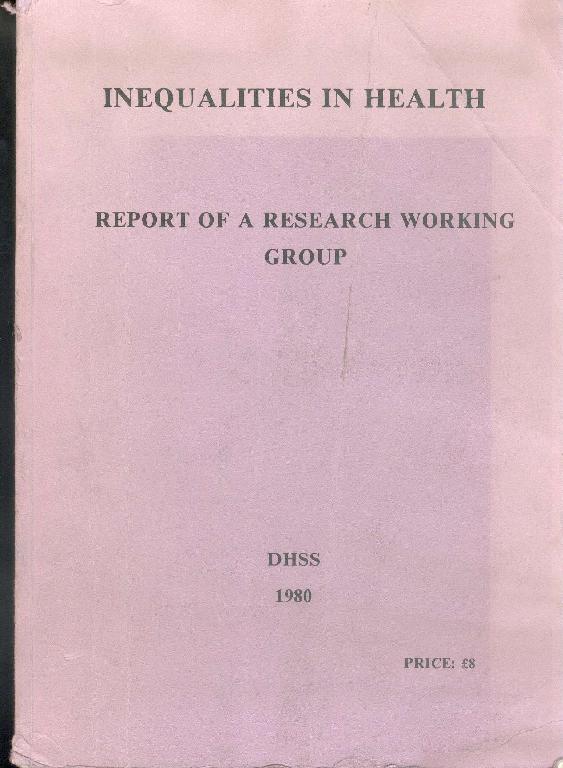
In the dying days of the ill fated Labour government in the late 1970’s, a report was commissioned from Sir Douglas Black into the causes and potential solutions to the inequalities in the health of the people of Britain.

This report, known as the Black report has become infamous amongst political and social scientists.

By the time the report had been completed, Thatcher had been swept into power on a platform of promises to break the power of the Unions, and to cut and control public expenditure. The report must have landed on her desk like an old kipper The Government wanted to bury it, but eventually released it on a bank holiday Monday, with a minimum of publicity. The report was never published- instead 260 photocopies were made available.

What was so controversial?

Black provided convincing figures that showed what many suspected—that the poorest had the highest rates of ill health and death. He argued that these rates could not be explained solely by income, education, mobility, or lifestyle, but were also caused by a lack of a coordinated policy that would ensure uniform delivery of services. He recommended health goals, tax changes, benefit increases, and restrictions on the sale and advertising of tobacco. Patrick Jenkin, the social services secretary, estimated with a shudder that Black’s proposals, which he hinted were little short of outrageous, would cost an unthinkable £2bn a year.

Excerpt from Sir Douglas Black’s obituary in the BMJ- here.

Leaving aside the economic questions raised by the cost of Trident nuclear weapons systems, or a war in the Falklands, the real political dynamite of this report was simply this- poverty makes people ill, and many of them die young.

This report was not talking about people who living marginal existences in sub-Saharan Africa- it was describing families living in one of the richest countries in the world- the worlds first industrialised country- Great Britain.

The Black report was not alone in reaching this conclusion. 28 years later World Health Organisation figures record a gap of 10 years between affluent Kensington and Chelsea, and post industrial Glasgow. Check out this article from the BBC.

This hides the real issues though- the figures represent areas, not individuals at risk. For example, if you are a homeless rough sleeper, your life expectancy is 42 years.

There have been many discussions about how poverty leads to poor health in Britain. Poor diets, obesity, poor education, poor housing, unequal access to health services, stress- all these no doubt play a part- but the common issue that even the New Labour administration are not happy to dwell on is… poverty.

I do not intend to get into a discussion about how we define poverty- the whole relative or absolute thing. Poverty, once seen, is recognised by most of us. It is easy to blame. It is easy to be repelled and repulsed by squalid living.

Because poverty brutalises.

I have worked as a social worker for all my adult life. I have seen people living in conditions that are hard to believe. A man who lived in a house with a broken overflowing toilet for 15 years. A young woman whose body was broken by drug use and prostitution to the extent that she simply forgot to eat. A woman who was so caught up in her need to escape that she drinks the alcohol based handwashes in the hospital. And many many people who live in fear of a loss of benefit, because life is so marginal- with choices to be made over whether to feed the electricity meter, or the cat, or sometimes- the kids.

These people are not described as poor. We now talk about ‘social exclusion’. Almost as if we stopped inviting them to parties.

There are no easy answers. This, I think, is the reason that Jesus said the the poor would always be with us– and why the early church seemed to have at it’s very heart a desire to serve the poor. Strange then to hear these words of Jesus spoken as justification for inaction.

There are some national policy decisions that will always impact the poor. Progressive taxation, as opposed to the imposition of tax on food or fuel. Public transport, good social housing, employment opportunities and support, adequate benefits- particularly to single parents or vulnerable older people. These things are all good- and we might raise our collective voices in support… but for me there is also a personal dimension.

Because those of us who are paid to try to make a difference soon realise that all we do is administrate. We may have some small success- and this keeps us trying- but ultimately, we bring only sticking plaster to road traffic accidents.

But I believe in redemption and renewal, and lives transformed. And for this to happen- this brings humanity and hope to my own brokenness- and richness to my own poverty. As Jean Vanier put it

Jesus came to bring good news to the poor, not those who serve the poor! … The healing power in us will not come from our capacities and our riches, but in and through our poverty. We are called to discover that God can bring peace, compassion and love through our wounds.

Some more links to poverty issues in the UK

Child poverty

Save the Children

Health inequalities, Scotland

Greed, Capitalism and Gordon Gekko…

I had an early start this morning- leaving the house at 7.30 am for a two hour drive. As ever, BBC radio 4 was my faithful companion on the road…

And of course, the morning news was full of the current world financial crisis, brought about by the so-called ‘credit crunch’ and the collapse of an American bank sending shock waves round the world’s stock markets.

We await to see whether the giant insurance firm AIG, responsible for trillions of dollars investments, will topple and fall over also.

We are finding out that when a butterfly flaps in the windows of a wall street office, then not even a post office account in sleepy Argyll is unaffected by the resultant tidal waves of monetary insecurity.

And no-one seems to have any clear idea of what happens next. It is almost as if the animal that we created now has a will of its own, and a malevolent will at that… The radio carried interviews of doom mongers, and other folk seeming to suggest that the worst was over, and we just needed to stop the panic, which was the cause of the whole thing in the first place.

And then there was this other discussion- about the nature of the capitalist system itself, and the greed at the heart of it all.

And we remember again the words uttered by the fictional stock broker Gordon Gekko in the 1987 film ‘Wall Street’ (played brilliantly by Michael Douglas)- Greed is good…

Gekko has become an iconic figure, acting as an archetypal capitalist, but in the process asking questions about the meaning and nature of a culture built on the pursuit of MORE, always MORE. Capitalism, and neo-liberal economics rule the economic roost at the moment, and no-one seems to be able to challenge the ideological truth of ‘trickle-down’ benefits of the creation of wealth, and the release of entrepreneurial aspiration, red in tooth and claw.

This morning, world renowned economists were asked whether they thought that this crisis had been brought about by greed. Both replied that they thought that it had. They thought that some greed was needed- but there had been too much!

They described how a long period (16 years) of economic growth had resulted in complacency and increased risk taking on the part of bankers, stock brokers and financiers. And how ‘rocket scientists’ (a euphemism for people who design ever more complicated financial products in order to seek out profit) have designed complicated financial processed that are not understood by most of the people whose companies are selling them.

Many of the huge profits generated by the banks have been made by selling and buying products with borrowed money. Sometimes, the borrowing ratio to the assets of banks can be 30-40-even 50 to 1. This is fine as long as there is lots of money sloshing around the system, but it only takes a few variables to change- interest rates, commodity and fuel prices, economic slow down, the rise of the Far East, etc etc, and suddenly, apparently impregnable banks are dreadfully exposed and vulnerable.

These are, after all, human institutions, made after our own image.

But we are made in the image of God are we not? And as a Christian, I find myself experiencing dissonance with any system that depends on greed and grasping as the engine of its very survival. Is there really no other way? Do I have to be complicit with this way of living?

I have a mortgage and a car loan from the Bank of Scotland. This bank has lost 40% of it’s share price in the last two days. Who knows what the future is for the BOS, and for my accounts?

But, is this the most pressing economic reality pressing in on our culture? Is Capitalism really working? Or is it serving only the narrow interests of people like me, who experience many of its benefits at the expense of those who do not?

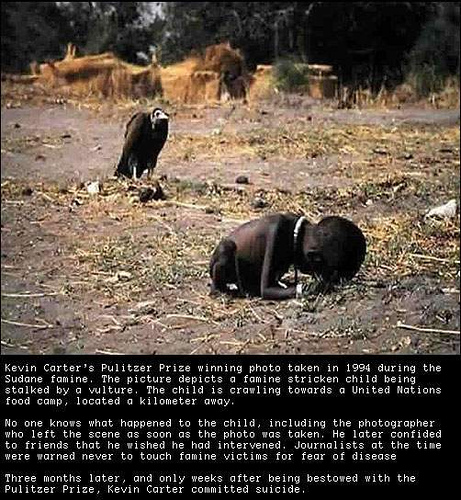
Is the real economic crisis to be found in a world in which things like this are ever present;

So what on earth can be, or should be our response?

I am humbled again. Reminded that my storehouse is not on earth, but in heaven.

And that when I serve the least of these, I serve Jesus.

The Bible- and how we read it 2- my answers!

OK- I’m a sucker for a smart-ass challenge, but Jeffrey reckoned I should have answered the questions I asked here

So, I’ll have a go.

But I have to say that these are working notes, not complete answers. If you want complex theology- go elsewhere…

Question 1- ‘Disputable matters’ (From Romans 14) can we agree to disagree, or is truth more important?

Strange beginning I suppose- it is just one small verse in the middle of one of Paul’s longest letters. But this letter is the one in which he repeatedly circles around the issue of reconciling the legalism of the Jewish people (and his own background as a legalist-in-chief) with the New Kingdom, and life amongst the gentile believers. But I had missed this verse until recently, and I it suggests a tolerance and respect for different views and emphases does it not?

So for may answer to this one- narrow understandings of anything should always be subordinate to LOVE.

Question 2- How did people manage in the pre-modern era, when the Bible as we know it either did not exist, or was not available?

Well who knows? They seemed to have their fair share of sects and heretical groups I think? Perhaps too theological power was very centralised- Rome and the rise of Christendom…

But it seems clear that faith was the meaningful centre of lives and communities WITHOUT universal or even widespread access to the Bible. Was faith less real, or less true? I do not think so- it just existed in a different time and place.

That is not to say that reform was unnecessary, or that the medieval world is what we want to get back to!

Question 3- Can you be a Christian and never have read the Bible?

Clearly you can. It does not say in the Bible that you need to read it to be a Christian does it? Even Paul talks about scripture being ‘useful’ for teaching and instruction- not necessary.

But why would you not read and study the Bible if you could, and you had any interest in God?

Question 4- Who decides/rules on interpretation of scripture? Do we look to history, and God’s revelation to Christians before us? Do we allow particular theological experts to make executive decisions in relation to Christian history? Or should the emphasis be on our own engagement with the text- and it’s life in our lives?

I think I kind of implied my answer in the way I framed the question! I feel skewed towards small theologies, worked out in community, according to the leading of the Holy Spirit, and in the respectful shadow of those people of faith who went before us.

Question 5- Is there a FINAL version of biblical truth? Did modernity almost get us there, with perhaps a bit of tinkering required, or is there a need to start again with some basics? Does every generation need to wrestle anew?

Again, I think you could guess where I am going. I do not think that we have any right to claim a final version of truth- any more than Calvin, or Luther could have done- or for that matter, Augustine. How about Paul then? Did he have everything sorted? (Sorry, not meaning to ask yet more questions…)

Question 6- Systematic theology- good or bad?

I am not really qualified to answer this- I am no expert. I suppose it depends on the system, and on the theologian. But most systems are sooner or later tested to destruction, unless they are adaptive and responsive. Does that make the syncretic, and thus heretical? I do not think so- again, if we read the modernist reforming fathers like Calvin and Luther- do we agree with everything they said?

Question 7- Truth- what did Jesus mean by this? Lessons from the Pharisees?

I do not think I can do justice to this one. He clearly had no time for the way the Pharisees did the truth thing- and what they did has always looked a lot like highly elaborate systematic theology to me. But he did say that ‘They shall know the truth and the truth shall set them free’. I can only ask more questions again…

Question 8- Scripture- ‘God breathed’? Does this mean the Bible, or something else, that we have TAKEN to mean just the Bible?

Paul was obviously not speaking about the Bible as we know it today, as this collection of books simply did not exist- it took another 1700 years to sort this out, more or less.

He was clearly talking about the OT- but this too appears to have had a variable canon. He may well have been talking about other books now lost to us, and others soon appeared to regard his letters as Scripture.

The view that God ordained the Canon of Scripture as a complete, harmonious and unified whole, without error or contradiction, sent down from heaven on golden cushions (like the Mormon golden plates) simply has never made sense to me. This is partly because the Bible is shot through with contradiction and mystery- it is this that often makes it so compelling, and what theologian have spent millions of hours trying to resolve.

The Bible also makes no such claims for itself.

Don’t get me wrong- I do not mean to devalue the Bible, just value it honestly and completely, not by creating a mystical distance that leads to placing it in a glass case, not your back pocket.

Question 9- CONTEXT- where you start from- does this affect what you see, even (or particularly) in the Bible? Are there contextual ways of understanding the words- for example in relation to divorce, or women covering their heads, or homosexuality- or is this a slippery slope to heresy?

Oh dear- the danger of Syncretism again…

I think though, I have come to a view that it is impossible not to read the Bible contextually- in both obvious and more subtle ways. The critique made of Christianity arising from modernity and the enlightenment is a powerful one- the suggestion that we needed the Bible to be a blueprint, measurable and dissectable- because this was the only way to contextualise it.

The question that is gaining so much air time is whether or not the new post modern context demands a new reading- a new understanding, or whether this should be resisted and defended against as accommodation to the spirit of the age.

I think we need both new and old readings- and the freedom to pursue both.

Question 10- AUTHORITY- what does this mean in terms of the Bible? Is the authority given to us, to interpret and understand in the light of the Spirit, or to the words themselves?

I am clear that the words have authority only as given to them by the Spirit of God. We revere the words in as much as they bring God closer to our understanding, and ope ourselves to letting him speak to us through them.

Jesus promised that he would send the Holy Spirit- he did not promise to send us a rule book that would be our guide for all things, for all time, did he? Was the promise of the Holy Spirit as a comforter and a guide just a temporary one until the Bible Canon was agreed? (There I go again with the questions….)

Question 11- When the Bible talks about the ‘Word of God’- what does it mean? Jesus, or the written words themselves?

I think it is clear that one of the names given to Jesus in the Bible is ‘Word of God’. The Bible never claims to be that- although some of its words are accredited directly to God. Some are clearly the words of men, in worship of God, or even questioning of God. Much is written in the forms and convention of Hebrew poetry, and the meanings conveyed by these forms, and the imagery intended, has not been passed into our understanding.

Using the term ‘God’s word’ to describe the Bible is a modernist thing. When it is called this thunderously by preachers wishing to imbue their own words with a heavenly authority, I am afraid I find myself wincing.

So- these are may working notes in answer to the questions. If you disagree- then you are right to. I am not suggesting that I have these things sorted out. I am engaged on a journey towards the origin of all things. How could I ever have grasped everything that is to be known about him- or even written about him in the Bible?