

The weaponisation of racist tropes – a long and inglorious history…

Over the weekend, over 300 people marched through my home town of Sutton-in-Ashfield in a protest against… well that is not quite clear. Immigration? Sexual assault of a minor? A hotel that might/might not be taking in asylum seekers? A loss of white male identity?

What we do know is that it all started with this post from the local MP, Lee Anderson.
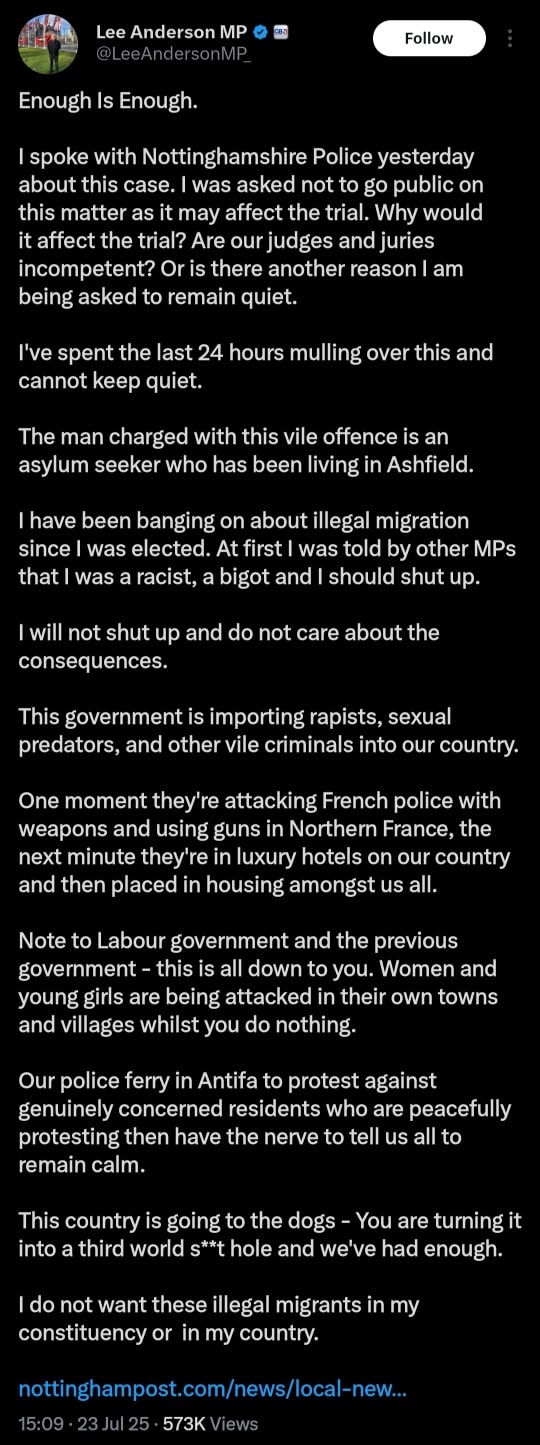
There is so much about this post that is misinformation, intended to fuel a particular narrative. It worked.

There is a real question of whether Anderson broke the law in revealing this information – if indeed it is true. Truth Against Hate (an organisation that seeks to work against racist amd hate) puts it this way;

…the individual in question has been charged, which means the case is now active under UK law. That means public statements which risk prejudicing the trial could be in breach of the Contempt of Court Act 1981.

Anderson also links the case to immigration and asylum policy, which some legal experts say could inflame tensions or risk stirring up hostility. We are not accusing anyone of a crime, this post simply asks whether his actions are appropriate or lawful.

If you believe this should be looked into, you can report it to your local police or via the national service:

https://report-it.org.uk/your_police_force

This story has not been picked up (as far as I can see) by national news outlets – apart from a story in the Mail and the Express who have chosen to focus on the fact that a woman wearing a union jack dress was denied entry to a Wetherspoons pub in the middle of the town as police were trying to reduce tensions and alcohol intake. Of course, the right-wing red tops chose to depict this in a rather different kind of way.

As I watched the march unfolding via facebook, and messages from Michaela’s relatives who still live there, one thing that seemed obvious is that most of the people on the march – apart from a few drunk thugs – thought they were doing a good thing. They have been fed so many lies and half truths by Anderson and countless news and social medial outlets – often funded by shady ultra right wing sources – that they feel themselves to be the good guys in the face of some kind of liberal conspiracy. One sign being waved on the march read ‘Not far right, just concerned’.

The idea that the ‘hoards’ of young men ‘flooding’ into the country via the small boats constitute an existential threat to our country, particularly to our young women, has been pushed relentlessly via outlets such as GB news. This exchange is rather instructive;

The thing is, this is not new.

A certain kind of politics has ALWAYS sought to portray ‘the other’ as ‘the problem’. We know this of course, but yet it works anyway. The question I find myself asking is WHY does it work? How are we so easily taken in?

The answer is partly to do with fear. Firstly the fear of the black and brown outsider, secondly the great fear of those who already feel left behind and excluded of someone else replacing them, getting hold of those things that are scarce and almost out of reach. Housing, the NHS, benefits, jobs, education- exactly the themes that much of the narrative on GB news cycles through over and over again. They know that if people who feel already disadvantaged are presented with information that others are getting what they can not have for free, this will create a reaction – whether or not it is true.

I will not link to any of the news articles or videos, but you do not have to look hard to find articles and social media videos with titles like ‘Immigration is obliterating our communities’. It is all the same fear mongering, targetted at people who already feel excluded and worried about their futures. It is like spraying petrol at a hundred candles. Most commentators feel that this will inevitably lead to violence.

There is more though – for this to be believable, Anderson, Farage and their chums on GB news need ‘experts’ who can back up their outrageous claims with ‘research’ and apparently informed opinion. Much of this is filtered through so called ‘think tanks’ of the Tupton street variety.

The point of this piece though was to connect this post with the one I wrote yesterday. Ther report in The Guardian revealing the work to understand the links to racism and slavery at Edinburgh University.

Today, another article concerned itself with information released about the use by the far right of long ago discredited pseudo-science such as Phrenology and Eugenics.

The advent of modern genetics and human population data has shattered the idea that there are biologically distinct groups, or that humans that can be neatly categorised based on skin colour or external appearance. Genetic variation between populations is continuous and does not align with social, historical and cultural constructs of race. Race, as a genetic concept, does not exist.

Yet, says Angela Saini, author of a book on the return of race science, “people don’t stop believing falsehoods just because the evidence suggests they are wrong”. As IQ testing became the metric of choice for those seeking to draw conclusions about racial differences – often based on biased or fraudulent datasets – old, discredited arguments resurfaced.

In other words, the ways our Empire ancestors justified conquest and colonisation are still being used to justify the ‘othering’ and dehumanising of black and brown people – this time to gain political advantage.

With the recent rise in ethnic nationalism and the far right globally, a resurgence of interest is under way into theories of racial exceptionalism. Last year, the Guardian revealed that an international network of “race science” activists, backed by secret funding from a US tech entrepreneur, had been seeking to influence public debate. Discredited ideas on race, genetics and IQ have become staple topics of far-right online discourse.

“The ideas have absolutely not changed at all,” says Prof Rebecca Sear, an anthropologist at Brunel University of London and president of the European Human Behaviour and Evolution Association. “If you can provide a measurement – IQ, skull size – that helps give racism a respectable gloss.”

I had a conversation with a dear friend recently about how we might approach information or facts on some of this material. I suggested to her that the word ‘hermaneutic’ is important. (There is more about the word here.)

We look at everything through a set of goggles – most of the time ones we don’t even know what we are wearing. This means that how we read things is distorted in ways that we are often only partially aware of.

It also means that information that we (and others) give out – including this blog – is shaped by the hermaneutic of the person or organisation that provided it. In this case, it then becomes important to try to understand this as a means of understanding what is being sold. Facts are dangerous things, easy to use in ways demanded by a particular hermaneutic. If we can understand the nature of that hermaneutic, then perhaps this might enable some compensational caution when these facts become too convenient for a partucular narrative- particularly when this create victims out of victims and suits the ends of people who already have too much power.

Bible nasties 5- a little discussion about ‘truth’…

OK, I have been avoiding this a little, but perhaps it is time to dig into a few philosophical ideas about the nature of truth.

It is a long time since I studied philosophy as a student, so this may well be a little low rent- but I hope it’s relevance to our discussion about the nature of the Biblical truth will be obvious.

Correspondance theory

Thirteenth Century philosopher/theologian Thomas Aquinas said this “A judgment is said to be true when it conforms to the external reality”, which is a posh way of saying that if what you say of an object is correct, it is true.  Truth is a matter of accurately copying what was much later called “objective reality” and then representing it in thoughts, words and other symbols.

This kind of truth is the common sense kind- the see it, touch it, smell it kind. It is the kind of truth that we assume that the Bible uses.

Coherence theory

Truth is primarily a property of whole systems of propositions, and can be ascribed to individual propositions only according to their coherence with the whole. In other words, truth is only testable when understood within a wider system of ideas and concepts. To understand what is true, we have to approach it from within a set of wider propositions.

Which is exactly what we do with the Bible, even if we do not always acknowledge it. We read the book of Revelation not with the cultural assumptions of a first Century Jewish follower of Jesus, living under oppression and well used to the literary format of apocalyptic writing, but rather from the truth system of a 21st C people, in the shadow of all those end times theories.

Or we read the Gospel of John and the book of Romans, then reinterpret the rest of the Bible from a perspective gained just from an understanding of these two books.

Constructivist theory

Truth is constructed by social processes, is historically and culturally specific, and that it is in part shaped through the power struggles within a community. So the truth we encounter is an amalgam of the culture and context we live and walk in, and is rarely neutral- rather it tends to be shaped by those who have the most power.

So we see the the Bible used to justify war, slavery, racism, oppression of minority groups.

Consensus theory

Truth is what ever is agreed upon by a specific group.

There have always been groups whose readings of the Bible have been idiosyncratic and sometimes downright loony. The Westboro Baptist Church come to mind for example.

Pragmatic theory

Truth is verified and confirmed by the results of putting one’s concepts into practice. So it is only when we test our ideas and concepts in real life situations, or scientific method that we can engage with truth. In this way, truth is self corrective over time.

A recent refinement, known as ‘negative pragmatism’- “We never are definitely right, we can only be sure we are wrong.”

These two ideas of truth as also closely mirrored in theological approaches to the Bible. The 19th C enlightenment sought to prove God, with the Bible as it’s source material. CS Lewis and his huge intellect might be seen as a logical outcome of Pragmatic theory applied to theological truth.

More recently, apologetics have become less fashionable. We have been forced to accept that arriving at a final understanding of truth is always going to be problematic. Alfred North Whitehead,  said: “There are no whole truths; all truths are half-truths. It is trying to treat them as whole truths that play the devil”.

Next, a wee trip through some of the philosophical heavyweights to see what they have to say about truth-

Descartes

Truth is available to us as we apply our reason to external objects. But the ultimate arbiter of this external truth is- God. I think, therefore there is God.

Kant

Kant suggested that the problem with correspondence theory is that if an external object is to be ‘true’ then it has to be recognised, and considered internally- at which point it is no longer external, no longer objective. So our encounters with truth are changed by our own interaction with them- by the person that we bring to that truth.

Kierkegaard

For Søren Kierkegaard, objective truth has real limitations, in that it cannot shed any light upon that which is most essential to a person’s life- Objective truths(mathematical, scientific, physical) are concerned with the facts of a person’s being, while subjective truths are concerned with a person’s way of being.

He is also strong on the division between objective and subjective truth- objective truths are final and static, subjective truths are continuing and dynamic. Values, faith and ethics, according to Kierkegaard, can only be understood when filtered through an individuals subjective experience.

Some inconclusive conclusions…

So- where does all this take us to, in relation to the Bible?

For me, the philosophical approaches to truth open up the idea that any ‘facts’, when viewed from a human perspective are likely to be nuanced, complex and to serve hidden human purposes. If we believe that the Bible is a human document- even allowing for heavenly inspiration- then we have to accept that it is laden with these same questions.

There will continue to be those who will assert that the truth of the Bible belongs to God- and as such it is not contingent on our engagement with it, or understanding/belief of it- it just is. The trouble is that people who assert this often appear to be willing to commit themselves to a claim to understand this truth.

As for me, I am left with two useful starting points-

Karen Ward differentiates between ‘small theologies’ (or you could say small truths)- worked out in community, and ‘big theologies’ (big truths)- belonging to academia and the church hierarchy. In this way, I think that an idea of truth can be negotiated with your friends, in humility, and in respect of the tradition. Getting it all 100% ‘right’ is not an option, or even an aspirational goal. Rather we should expect to be teachable and open to transformation by the Spirit within us.

Then there is also that bit in Romans 14 where Paul talks about ‘disputable matters’-

1 Accept the one whose faith is weak, without quarreling over disputable matters. 2One person’s faith allows them to eat anything, but another, whose faith is weak, eats only vegetables. 3 The one who eats everything must not treat with contempt the one who does not, and the one who does not eat everything must not judge the one who does, for God has accepted them. 4 Who are you to judge someone else’s servant? To their own master, servants stand or fall. And they will stand, for the Lord is able to make them stand.

5 One person considers one day more sacred than another; another considers every day alike. Each of them should be fully convinced in their own mind. 6 Whoever regards one day as special does so to the Lord. Whoever eats meat does so to the Lord, for they give thanks to God; and whoever abstains does so to the Lord and gives thanks to God. 7 For none of us lives for ourselves alone, and none of us dies for ourselves alone.8 If we live, we live for the Lord; and if we die, we die for the Lord. So, whether we live or die, we belong to the Lord. 9 For this very reason, Christ died and returned to life so that he might be the Lord of both the dead and the living.

Paul is speaking to a church in the middle of a truth war, and he says, more or less- there are more important things to be getting on with…

Descartes, time, and God.

Time for some schoolbook philosophy!

I read something recently about the philosopher Rene Descartes – who was fascinated by what it meant to be, what it was possible to know and what could be described as truth?

Descartes decided to begin by doubting everything he possibly could – to see if he could reduce the knowable to an essential core. He found he could doubt everything – God, the existence of the world about us (which could be an elaborate deceit placed on our consciousness by some demon – a kind of precursor to The Matrix), the rules of science and gravity – all these were dependent on our perception, and perception was ultimately unreliable and subjective.

This led him to his ultimate point of truth – his own ability to ask these very questions – it was not possible to doubt this, as in order to doubt, then this too involved thought. Hence, his famous phrase, “I think, therefore, I am.

Descartes then turned his mind back to time. We live our lives in the passing of time – in a finite space. We have our beginning, and our ending, and find our existence in between. He was convinced that God was infinite – outside our understanding of time. However much we might think we know of God, we must equally realise that there is so much more. He concluded that as our experience is formed in our finite world, then the very fact that we could imagine the infinite must be proof in itself of the very existence of God – for no finite being could, of itself, think of the infinite.

Descartes thinking influenced an age. Whether or not you agree with his conclusions, the very questions he asked have dominated modernity. They are perhaps being asked again as we stand on the brink of a new age.

What am I?

What can I know, and how do I know it is true?

Perhaps for we Christians, there remains another set of questions – perhaps the greatest ones of all;

Who is God?

Can God be known?

Can God ever know me, in the vastness of this apparently infinite universe?

If so, what should be my response?

Are we all heading home anyway, one way or another?

Or is there a responsibility that we are called to – a way of life that is more vital, more blessed, more beautiful?

In the Bible, we read of generations of people of faith – from the nomadic wanderings of the people of Abraham, to the subjects of the mighty (but ultimately fragile) Roman Empire – asking these questions.

The amazing thing about all these stories was that apparently, God, as well as existing in infinite space, was also always there.

There he was, moving across the face of the waters when all was formless and void.
Walking in the garden in the quiet of the evening.
Speaking out of burning bushes (and resting on people with tongues of fire later.)
Even being willing to dwell inside a tent, or an unwanted temple building.
Ultimately, coming himself, in fragile human form. Walking amongst us, revealing something of his heart – inviting participation in a new way of being.

Then promising that the eternal will dwell within us.
That we would become temples of his Spirit – capsules containing something uncontainable, immeasurable, unfathomable.

Kind of amazing, ain’t it?