
Protestant sectarianism and emerging church…

The history of Protestantism is littered with division and conflict.

Reformation of what has already been reformed.

Schisms of schisms.

Battles over whose truth is truer and whose understanding of scripture is most enlightened.

The legacy of these truth wars can be seen in the countless Protestant descriptive labels/denominations. Here are but a few as they occur to me;

Lutherans, Wesleyans, Reformed Weslyans, Methodists, Free Methodists, Primative Methodists, Baptists, Southern Baptists, Reformed, United Reformed, Assemblies of God, Anglican, Church of Scotland, Episcopal, Quaker, Shaker, Amish, Menonite, etc etc.

This list is in part a noble one. We have learned much from the men and women of God who have celebrated faith within these organisations. Such variety speaks of the freedom that people felt to follow after God in the way they understood him, away from the central powerful control of older forms of religion. It also is a story of fervency, of revival, of movements of the Spirit across whole communities, of great leaders who were bold and true.

But there is a dark side, measured by truth promoted over love and grace, and in a serial fracturing of the unity of the Spirit. Such division can be seismic in terms of the violence done to community in the name of Jesus.

I wonder if this kind of spiritual development can become addictive and even infectious. Almost as if all new Protestant church movements carry a destructive gene within their DNA…

Scotland has had more than a fair share of this splintering and fragmenting. Take the recent very public difficulties seen in the Free Church of Scotland, which splintered as recently as 2000.

I have used this picture before- taken in a small West of Scotland town about 7-8 years ago. Two churches so close that they are almost touching- but separated by a chasm of doctrine. I should add the proviso that I do not know either of these churches, and the image may miscommunicate entirely. But I think it makes a valid point about a certain characteristic of Protestantism…
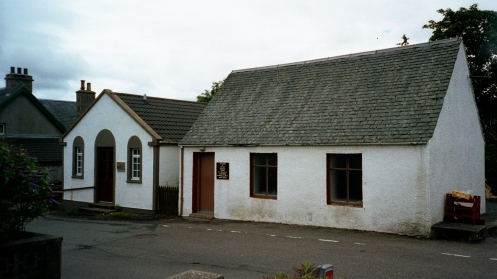
two-churches

How did we come to this, we followers of Jesus?

How did Agents of the Kingdom of God, sent out into a broken world to form revolutionary cells characterised by love, somehow sign up instead to be driven towards such segregated exclusivity?

Is this more about psychology than it is about theology? Our tendency to seek a point of expansion and accomplishment, and to measure it against others around us- elevating ourselves by finding others wanting.

I wrote this poem in an attempt to understand these things in myself-

Diplomacy

We meet and move about one another
Probing, exploring borders
Negotiating
Presenting our petition
And revealing this badge of office-
Sewn on sleeves whilst our hearts stay hidden
Revealing carefully edited glimpses
Of whom we want to be
But are not yet.

Then begins the measuring
Of the size of armies
The bore of canon
And the reach of your rockets
As we carefully deploy our camouflaged troops
To occupy the high ground
To hide uncertainty behind
A cloak of accomplishment
And capability.

Sometimes it seems that who I am is only revealed
In understanding what you are not
In seeing you
And finding you wanting
In mapping out your strongholds
And avoiding them
And raising up my tattered flag
Above this uncomfortable alliance.

Why is this important now?

Because I think that this is a real challenge to those of us who are part of the ’emerging church’ discussion, particularly here in Scotland. Some questions-

Is ’emerging church’ just another Protestant reformation- another fractious denomination in the storming and the forming- throwing stones at those whose truth is not our truth, looking around and finding others wanting.

Or are we a break from modernist Protestantism- a more generous, open, embracing movement that seeks unity, not uniformity and is willing to learn humility and to value the other.

Are we Protestant at all? Where are the emerging Catholics?

If something new and hopeful continues to emerge, in all its flawed beauty- how do we(or even SHOULD we) nurture and sustain whatever we become without following a familiar pattern of splinter and schism?

From my point of view, the story is mixed.

Emerging church has no form and no structure- at least in Scotland. It is not a descriptive definition of any way of doing church- rather it is a loose affiliation of malcontents and hopefuls, defining themselves rather by the fact that they are prepared to question and seek.

And because we are human, friction is inevitable. People compete for prominence, and justify themselves by the rightness of their cause, or the small success of their activity.

But brothers and sisters- I find myself longing for something else. Something a little more of the Kingdom, and a lot less of the Empire.

Something characterised by tolerance and love. (Even as I am intolerant and unloving.)

On forgiveness rather than defensiveness. (Even as I defend and find it hard to forgive.)

Of a willingness to enjoy one another without the need to compete. (Even as my own insecurity drives me to do the opposite.)

And a determination to see community as the origin and the means for all things- with one another and with Jesus. And that the quality of these interactions should become the measure of our success. (Even with my own history of broken community, and the wounds I carry because of this.)

This is the church I long to see emerging.

I have not desire to be part of another schism.
Choosing my religion


I was thinking today about the huge variety of Christian groupings and denominations. I get so tired of the antagonism and suspicion that we have for one another…

One of the inescapable facts that those outside the faith hit us with is the divided, sectarian nature of our denominations. Many of them split, then split again. Always there is the spectre of TRUTH looming over discussions- we share so much, but the devil (if you see what I mean) is in the detail.

Even within a particular denomination, it seems that there is considerable variation in emphasis from group to group, church to church.

So, assuming that we are looking for a spiritual home, how do we choose? What influences our eventual choice?

I suppose you have to return to TRUTH- but, beyond the core tenets of our faith, what might be true for me might not be so for you. Either we accept that most of us have got our choice of faith community WRONG, or perhaps God is prepared to deal with variation. Perhaps he even likes it!

So there must be other factors that influence our choice of church and its associated theology.

  • Background/upbringing? We are all someone’s children. Perhaps we follow, perhaps we reject and forge a rebellious path…
  • Influential friends? People we admire and are influenced by will of course leave their marks on the way we think about faith.
  • Past baggage? Most of us have had some bad as well as good experiences of church- either through leadership issues, or broken relationships. With this baggage on board, we are less likely to get on a similar train (to mix a terrible metaphor!) Neither are we likely to look favourably on the opinions of those who may have hurt us.
  • Personality type? We are all so different in the way we are wired. Some of us are more confrontational and risk oriented, and may thrive in a dynamic noisy atmosphere. Others are more contemplative, or organised- and will look for environments that fit.
  • Convenience/lack of alternatives? If you live in an isolated area or have limited mobility, then I suppose your choice is made for you! Locality locality locality…
  • Special interest? I think many of us look for something fairly narrow- a social or sociable agenda, the presence of lots of single available men/women, or good music. The rest, well so long as it is not too intrusive…

Increasingly, it seems that people are less likely to remain loyal to any particular brand. Everything is global, and the right to CHOICE is trumpeted everywhere. It remains to be seen what implication this will have to our churches.

What is clear though, is that diversity is here to stay.

Blogged with the Flock Browser

Scottish religion?

As an incomer to this, my adopted land, it is impossible not to compare and contrast things ‘tartan’ from what I have known elsewhere. As a follower of Jesus, the greatest focus of this introspective examination has been how we do religion up here.

There is a great discussion about these issues on Brodie McGregor’s blog- which is on this link; http://viewfromthebasement.typepad.com/my_weblog/2007/04/emerging_or_sub.html
Brodie wrote a paper on Emerging stuff in Scotland, that I found really helpful- it is broken into digestible segments in his blog…

But what forms the character a place? Is there a convergence in the nature of the people? Perhaps we learn more than accents, taking on our style of communicating- of relating and of loving- from our environment. Are we also formed by landscape, by the mountains or the flat lands, or our closeness to the sea? Or is it the economy- those that have and have not, those in poverty or plenty?  Perhaps it is also about history, and ancestry, and our place in the story of ages?

Back to the spiritual dimension- of faith and belief, and how we express these things. Does our chosen expression of faith emerge from our own cultural heritage, or does it shape the way we are? I wonder if the way religion is understood and celebrated within any given culture becomes as influential to the formation of our towns and streets and institutions as DNA within our blood streams? Certainly, sometimes it seems that a bit of John Knox, along with a slice of Calvin and a hint of Iain Paisley can be found in every squared away, sensible building and every official institution.

As you travel up the west coast things change again…

But a few years ago, before we lived up here, I was walking through the lovely little town of Gairloch, in Wester Ross. I came across two little churches- so close, they were almost (but not quite) touching. They were separated by a few inches of clear air, but I imagined these inches to be stuffed full of inpenetrateable doctrinal difference.

I do not know the history of these churches, and certainly do not mean to criticise what I have no knowledge of. There may be very good reasons for having two such buildings- each one may be full on Sundays, and they may exist in harmonious fellowship.

But for me- this photograph has come to symbolise something of our Scottish religion.

I have said enough- here is the photograph, it can speak for itself.

Blogged with the Flock Browser

Tags: , , ,

Theology, encapsulated?

I was thinking the other day about how incredibly difficult it is to have theological discussion with people outside your particular circle. The language that we use to describe our experience and understanding of God can be so prescriptive.

It is almost as our liturgy and our doctrines become mutually incompatible if they vary from each other by more than, say 3-4%.

Having said that, it may be easier to find common grounds for discussion if there is greater variance! We might be talking at cross purposes, but we are less likely to shout “Heretic!”

My friend and former neighbour Terry sent me this recently, which kind of makes the point nicely.

Its just for a laugh- enjoy!

Several centuries ago, the Pope decreed that all the Jews had to convert to Catholicism or leave Italy. There was a huge outcry from the Jewish community, so the Pope offered a deal. He would have a religious debate with the leader of the Jewish community. If the Jews won, they could stay in Italy ; if the Pope won, they would have to convert or leave.

The Jewish people met and picked an aged and wise Rabbi to represent them in the debate. However, as the Rabbi spoke no Italian, and the Pope spoke no Yiddish, they agreed that it would be a ‘silent’ debate.

On the chosen day the Pope and Rabbi sat opposite each other.

The Pope raised his hand and showed three fingers.

The Rabbi looked back and raised one finger.

Next, the Pope waved his finger around his head.

The Rabbi pointed to the ground where he sat.

The Pope brought out a communion wafer and a chalice of wine.

The Rabbi pulled out an apple.

With that the Pope stood up and declared that he was beaten, and that the Rabbi was too clever. The Jews could stay in Italy .

Later the Cardinals met with the Pope and asked him what had happened?

The Pope said, ‘First I held up three fingers to represent the Trinity. He responded by holding up one finger to remind me there is still only one God common to both our beliefs. Then, I waved my finger around my head to show him that God was all around us. He responded by pointing to the ground to show that God was also right here with us. I pulled out the wine and wafer, to show that God absolves us of all our sins. He pulled out an apple to remind me of the original sin. He had beaten me at every move and I could not continue.

Meanwhile, the Jewish community gathered to ask the Rabbi how he had won.

‘I haven’t a clue’ said the Rabbi. First he said to me that we had three days to get out of Italy, so I gave him the finger. Then he tells me that the whole country would be cleared of Jews and I said to him that we were staying right here.

‘And then what?’ asked a woman.

‘Who knows?’ said the Rabbi. ‘He took out his lunch so I took out mine.’