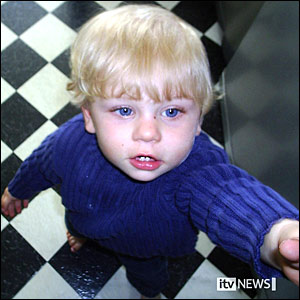
One of the heatbreaking picture of baby P shortly before he died.
I am off work today- a return of an old problem with cluster headaches. Dreadful things- a conveyor belt of Migraines. I think I am over it, and then the vision goes, the sickness and nausea kick in, and the head starts to split…
In between, I am functioning, but not very well.
Almost by way of penance, I have been catching up with some information about the dreadful story of baby P, whose tragic death at the hands of his mother and mother’ boyfriend has been all over the news these past couple of weeks.
I am a social worker, and once again I find that my whole profession appears to be on trial by media and politicians.
There seems no doubt that something went badly wrong with the plan to support and protect this little boy. His body bore the marks and scars of a dreadful litany of injuries. Faced with this information, it seems so simple- he should have been rescued much earlier- at one of the many point of contact. Here is a list of contacts with services;
78 contacts with health workers, doctors, social workers and police
2 health visitors
3 doctors
1 mental health worker
1 policewoman
4 social workers
1 family friend;
1 childminder
10 hospital visits (to at least 3 hospitals)
4 visits to clinic
5 parenting classes (the last two weeks before his death)
Seen by GP 14 times
Seen by health visitor 7 times
Mother seen by mental health worker 4 times(figures taken from Times online- see detailed breakdown of these visits- here.)
The fact is, society needs someone to blame. Despite all the different agencies involved- and despite the fact that all child protection decisions in England are taken by multi-disciplinary conferences, the finger of blame has fallen on social workers. All the other contacts listed above count for little…
Large numbers of us, in the face of this shock, have mutated into mere gobs on legs, iterating and reiterating the last plausible prejudice that sat on us. A terrible thing has happened, it’s all down to X (fill in the prejudice) and someone’s head should bump bloodily down the steps of the Temple of the Sun, to save us from the wrath of the gods.
Our process presumes that it is normally better for a child to stay with the family, even in a household which falls far below the ideal, and social workers who go to their managers with a recommendation to commence care proceedings know that they will have to put up a very strong case.
When you consider the outcomes of the 60,000 looked-after children in our care, this is hardly surprising. Almost threequarters of them will leave care with no formal qualifications. Only one per cent will go on to enter any kind of university education. One fifth of looked-after children are homeless two years after leaving care; 25 per cent of our prison population has been through the care system. Things have to be really bad at home before care looks like a better option.
Yet in other countries the picture is very different. In Germany looked-after children do extremely well, with 95 per cent of children in the German care system going on to vocational education. Crime committed by looked-after children in Germany runs at 5 per cent of the rate of crime committed by those in our care.
Money is important. In Germany most looked-after children live in small community homes, with fewer than 16 residents. By contrast, more than two-thirds of our looked-after children are placed in foster families which cost less than a quarter of a residential placement in Germany.
Money also hangs in the air at case management meetings, and sets up serious conflicts of interest. It is the local authority managers who decide whether to go for care proceedings. They are also the people who will have to find the money to pay for care.
When budgets are tight, the best interests of the child are not always aligned with the best interests of the local authority. In fact the two can often be contradictory. And in those crucial meetings the social worker, the main advocate for the child’s welfare, is often the most junior person in the room.
As a society we need to look again at our priorities. Unsurprisingly, the current social work witch hunt following baby P’s death has already seen a rise in the numbers of kids being removed form parents. Practitioners will almost certainly take less collective risks. Given the pressures on the systems looking after kids in care, this may well be unsustainable.
Is this what we want?
I think the focus on BLAME masks a societal failure to put the needs of kids first. But given the current financial crisis, I fear that finding a scapegoat or two will be the preferred option…
As for me, I will say a prayer for this baby, and his parents. And for the imperfect workers (like me) who work in an imperfect system, and hope that we can make things better.
 this fragile tent