
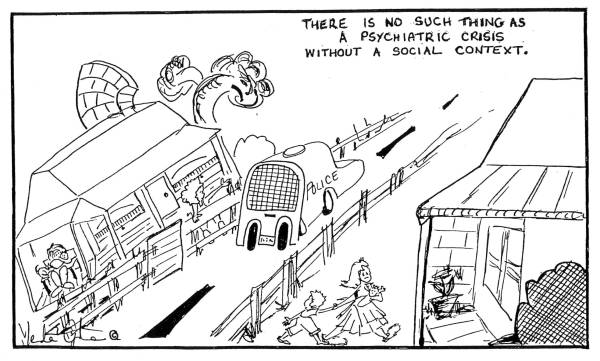
I had a good chat with our friend Kathryn tonight about spirituality and mental health problems.
Kathryn has been studying with ICC in Glasgow and has a passion for working with people who have problems with mental illness. To this end, with her husband Bobby she has been running a furniture recycling/reallocating project- in her spare time that is, as well as her day job!
She also has this idea for a kind of friendship group where people who have mental health problems (and lets face it, this is many of us at some point in our lives.) This has formed part of her studies, and tonight was a chance for us to talk through some of this stuff- which was great, not just because it was good to see Kathryn again, but also because this subject kind of beats in my heart.
The bias that I feel Jesus had towards the poor and broken, and the hope that we feel for a new way of being- categorised by grace, and radical inclusion, according to the rules of the New Kingdom- these things are all in there for me.
As part of her project, Kathryn asked me to consider some questions- which I found surprisingly hard to answer given that this is an area of constant reflection. In particular she was interested in how church might provide help and assistance to people experiencing mental ill health.
Here are some of the things that I was chewing on-
I want to suggest that all of us are potential sufferers of mental ill health- including many people within church. We too easily start with an ‘I’m OK, you are not OK’ way of thinking- which leads us to believe that we have the answers to other people’s problems. Perhaps in part, we might actually be part of the cause!
We often fail to acknowledge MH difficulties amongst people within church- the stigma is as strong, if not stronger, against mental ill health within church as without- because we add assumptions about spiritual weakness to all the other negative assessments.
Another assumption we tend to make is that our job as Christians is primarily to bring people inside the club by making them realise that they are outside. Our job then easily becomes to invite people into our buildings, and hope they will then become like us. The support available within church for people who have MH problems has often been far from perfect, and very poorly integrated with other community resources.
Christian groups/churches seeking to support and provide care for people experiencing mental ill health easily fall into lots of traps. I would include some of these-The evangelical trap- Our real (covert) motivation is to convert. Most folk see this coming and run a mile. Some may indeed convert- repeatedly. The difficulty is that conversion does not make the illness go away, and we may find ourselves being dishonest and conditional in the way we offer love and support.The therapy trap- Christians tend to do bad therapy. Bad therapy often does more damage. It is easy to inadvertently be the ‘expert’ and then let people down when we fail to deliver.The dependency trap- Sustaining relationships with people who have experienced real damage can be extremely hard. If people find something that is helpful and supportive, it can easily become a full stop. The dependency that begins can be an impossible burden for those running groups also, leading to broken promises and further alienation and rejection.
My strong feeling is that Christians ought to be attracted to failure, rather than being seduced by success. I also believe that Jesus calls us to the poor in spirit.
But I am not sure that he calls us to ‘rescue’ people- rather that he asks us to practice a form of radical inclusion.
I think too that all streams of ‘therapy’ have a thing at the heart of them- for CBT it is about therapeutic allegiance, for person centred counselling it is ‘unconditional positive regard’ and for psychoanalysis it is ‘transferance’. All these seem to me to carry something of Jesus about then- they are related to LOVE. They are in some senses a Christian heresy.
I wonder whether we might yet work out how better to understand the relationship between Spirituality and mental health problems? Is this something that Emerging Church might yet do better?
To accept that our fallability is not a sign of individual weakness, or spiritual corruption, or demonisation. It is just part of who we are.
Part of what it is to be human. Even extra-human.

 this fragile tent