
Kindness- as a measure of spiritual maturity

Another great collection on Radio 4’s start the week programme. Listen again to it here.

There was this fascinating discussion about KINDNESS, relating to this new book, co written by a psycho analyst Adam Philips  and Historian Barbara Taylor.

on-kindness

They appear to take the view that our society has retreated from kindness as a way of interacting and engaging with the people around us. We assume that we are no longer inter-dependent and needful of others, and so kindness becomes identified with a kind of weakness and vulnerability.

They go as far as to suggest that we tend naturally towards kindness, but learn to suppress this as we grow into our culture. All Kindness, suggests Philips, is a RISK- but a risk that is transformative in the taking.

There is a review of this book in Guardian by Mary Warnock where she says this

Kindness to others arises out of sympathy. As the authors note, there is much evidence that other animals besides human beings (or “men” as they properly designate them) can enter into the sufferings and fears of others of their kind. But it is human animals alone who, because of their imaginative powers, can enter into the feelings of other people far removed from them, whom they cannot see or touch, but whose plight as fellow-humans they can share

In the Gospel of St Luke, a lawyer is told by Jesus that to live well he must love his neighbour as himself and, when he further asks who is to count as his neighbour, Jesus answers with the story of the good Samaritan, for many the very essence of Christianity. Kindness here arose spontaneously, not in obedience to any rule, in fact in defiance of convention. But as Christianity became increasingly ecclesiastical and hierarchical, with the consequent corruption of the priesthood, the good Samaritan was forgotten.

The new Protestantism declared man to be fundamentally sinful, such good actions as he could do dependent on the grace of God; and so the possibility of natural kindness disappeared.

So we come back to Jesus, and his call to live for a radically different agenda, according to the rules of a New Kingdom. And one of the watch-words of this new kingdom- is kindness.

It is one of those fruit listed by Paul as evidence of the indwelling of the Holy Spirit. (See here for some more ponderings on this.)

When we come into contact with kindness at a point of real need, we rarely forget it. It lives on in our souls. As Paul said in 1 Corinthians- all sorts of other loud and visible manifestations of faith will clang like gongs and then fall silent- but love will last for ever.

Which makes me think again about the myth of the super-Christian. I am interested in the stature aquired and the adoration we give to some of our leaders- perhaps for their charisma, their vision or their oratory power. When one of these paragons of Christianity falls from Grace, how dreadful it seems… how shocking.

Might this be because we measure spirituality according to a strange criteria? We equate knowledge with understanding, declaration with practice and power with ordination from on high.

Might we best return to a simple measure- of kindness shown, and a skew towards grace in all things. These are the leaders I look for. Jesus has ruined the others for me!
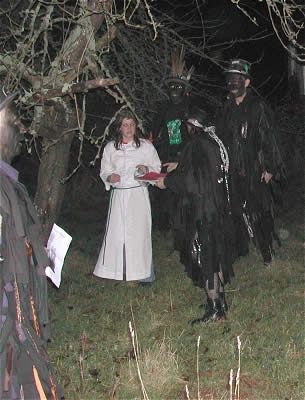
Why should the Devil have all the good apples?

wassail3

Apparently, in the old orchards of Somerset and Devon, we are entering Wassailing season- traditionaly 12th night (5th January.)

A lovely word is wassailing- thought to be from the old Norse influenced English- meaning ‘good health’. It rolls on the tongue like scrumpy.

Which is kind of appropriate, as the most common use of the word concerns an old tradition of ceremonies of song and dance and drinking to bless the apple trees, warding off evil spirits and willing the tree to produce a crop for the coming year.

Wassailing also is a word used to describe carol singing in the streets, around new year, and also seems to have been a time when feudal masters were celebrated by their subjects, in response to their seasonal munificence.

The origins of these ceremonies have all been lost in time, but they seem to have more than a whiff of the Pagan about them. The old festivals of the passing of the winter equinox, and the hope of a coming spring. The early Church, as with other festivals, embraced it, and made it Christian. The songs of the wassailers became ones seeking the blessing of God.

So the most well known Wassailing song is this one;

Here we come a wassailing
among the leaves so green,
Here we come a wandering
So fair to be seen.

Chorus:
Love and joy come to you
and to your good Christmas too
And God bless you and send you a happy New Year
And God send you a happy New Year.

We are not daily beggars
that beg from door to door,
We are your neighbor’s children
whom you have seen before.

Chorus

We have got a little purse
of stretching leather skin;
We want a little money
to line it well within.

Chorus

God bless the master of this house,
likewise the mistress, too,
And all the little children
that round the table go.

Chorus

So- why on earth am I going on about this, I hear you ask?

Well, I have been part of groups of charismatic Christians who have tended to understand spirituality as a warfare, first and foremost. So all things come to be measured according to what significance they might have within this unseen war.

This insight is an important one. In Pauls letter to the Ephesians, we read this famous passage-

Finally, be strong in the Lord and in his mighty power. Put on the full armor of God so that you can take your stand against the devil’s schemes. For our struggle is not against flesh and blood, but against the rulers, against the authorities, against the powers of this dark world and against the spiritual forces of evil in the heavenly realms. Therefore put on the full armor of God, so that when the day of evil comes, you may be able to stand your ground, and after you have done everything, to stand.

An understanding flowing from these passages has led to a rejection of anything that has a hint of alternative spirituality- whether this comes from other religions, or perhaps even more so when Pagan traditions are invoked.

People seemed to express real fear that exposure to such things could in some way corrupt or damage us- we could be affected by a ‘Spirit-of….’, which could only be dealt with by those who practice deliverance ministry-releasing us from the bondage of evil influence on our lives.

This view of the world and the many things within it can lead to an intense exclusivity and isolation. Whatever the truth of the spiritual powers understood or suspected (and I should confess to a skepticism in some cases at least!) then I think it important to remember that like the festivals noted above, the early church seemed to have a very different way of working with the traditions and cultural symbols that they encountered.

Paul and the temple to the unknown God, recorded in Acts.

Peter and the Gentiles- the sheet from Heaven etc.

The establishment of early Christian shrines on pre-Christian religious sites that appears to have been common practice.

The example of the early Celtic Church and the use of pre-Christian images and symbols and practices to celebrate the new faith.

Is this corruption or syncretism? I do not think so. Accommodation with a spirituality that is damaging is indeed something that we should guard against- but boxing ourselves into fearful religious enclaves- this seems to me to be even more damaging.

We live in a post-Christian world here in the west, and increasingly, the world around us draws it’s spirituality from outside the Christian tradition. Like those early Celtic missionaries, we have no choice but to engage with this reality. The question that should concern us is how we bring Jesus with us as we move into an alien landscape. How do we live as Agents of the Kingdom in this foreign land?

So on this 12th night, let us put on the armour of the Living God and walk tall- secure in the knowledge that before Him, nothing will stand.

Why should the Devil have all the good apples?