A new kind of Christianity…

I finally got round to ordering a copy of this book today.

I have found McLaren’s remarkable writing transformative to my own understanding of faith for a number of years. I very much appreciate his willingness to be radical and controversial in his theological thinking, whilst remaining humble and graceful in his response to the tirade of abuse he has been subjected to.

However, I have found myself avoiding this book. Perhaps because I wonder if he is really saying anything new- all the reviews seem to suggest that it is a gathering together of ideas he has been developing in his previous writing. As I read the ’10 questions that are transforming the faith’ I suspect I know what his answers will be, more or less.

To be honest, the hype around the release of the book repelled me a little too…

But then again- perhaps this shows just how much the theological landscape has shifted over the past 10 years. Questions that would once have been as welcome as a trump in a spacesuit are now increasingly part of a the popularist mainstream.

Does this mean that we are seeing the development of a new kind of Christianity?

I am not sure. I hope so though.

In the meantime- I am going to read the book…

By the way- you can watch 10 videos and download study material for group discussions around the themes raised in the book from The Ooze.

Here is a taster- on that difficult questions of relationships with other faiths…

Vodpod videos no longer available.

more about “A New Kind Of Christian- Brian McLare…“, posted with vodpod

The Varieties of Religious Experience…

Another interesting discussion on the radio this morning courtesy of Melvin Bragg’s programme ‘In Our Time’.

It centred around the work of Doctor, psychologist and ‘natural theologist’ William James– brother of novelist Henry James.

In 1901 William James began a series of lectures in Edinburgh, which came to be collected together as a book entitled ‘The Varieties of Religious Experience’.

It seems to me that James is of our time more than his. The modern obsession with logic and scientific reason- as the proper object and arbiter of all human endeavour- has been eroded by the events of the end of the 20th Century. Perhaps above all the fact that science has not delivered answers to the human condition, but rather has brought  us huge environmental, moral and ethical problems that we all live in the shadow of- Ozone holes, radiation, global warming, the failure of free market economics etc.

In a world where the Zeitgeist was (and perhaps still is) overwhelmingly concerned with the rational and logical, even our approach to religion, James stood out as proposing a totally different way to understand faith. Rather than focus on doctrine and dogma, solidified and codified within religious texts, or in the institutions of faith, he suggested that only valid way to understand faith was in individual subjective experience. He went further and suggested that the faith experience was at the heart of what it meant to be human- and to understand this was to understand better who we are.

This led James to investigate mystical experiences, including by using hallucinogenic drugs. He was less interested in whether faith was ‘true’, or whether God existed, but more in the effect and usefulness that transcendent experience had on those who experienced it. This individualistic and self-centred version of religious seeking feels very post modern.

“Not God”, James states, “but life, more life, a larger, richer, more satisfying life, is, in the last analysis, the end of religion.”

James was also interested in how personality and ‘spiritual health’ interacted with our choice of faith (which resonates with this post) and he spent a lot of his time in the lectures discussing people who had undergone conversion experiences.

A couple of quotes from here

James recognized a pattern in conversion experiences. It tended to happen when people were so low that they just ‘gave up’, the vacuum of hope providing space for revelation. The religious literature is full of stories along these lines, in which the constrictions and negative aspects of the ego are finally discarded; one begins to live only for others or for some higher goal. The compensation for becoming dependent upon God is a letting go of fear, and it is this that makes conversion such a liberating experience. It is the fearlessness and sense of absolute security in God that gives the convert their breathtaking motivation. An apparently perfectly normal person will give up everything and become a missionary in the jungle, or found a monastery in the desert, because of a belief. Yet this invisible thing will drastically change their outward circumstances, which led James to the unavoidable conclusion that for such a person, their conversion or spiritual experience was a fact, indeed more real than anything which had so far happened in their lives.

James acknowledged that science would be forever trying to blow away the obscuring mists of religion, but in doing so it would totally miss the point. Science could only ever talk in the abstract, but personal spiritual experience was the more powerful precisely because it is subjective. Spirituality is about the emotions and the imagination and the soul – and to a human being these are everything.

I find myself both in sympathy and at odds with James- in much the same way as I am with the pluralist times we live in. For him, religion was about personal transformative experience, a little akin to a piece of remarkable cognitive behavioural therapy. God became portable and useful- perhaps even something to be cherished as a way of giving life direction and meaning.

But I have this feeling that the Lion of Judah is no tame lion…

That old trickery called theology…

Regular readers of this blog will know my interest in reading some of the ancient poets of the middle east. One name often stands above all the rest- Jelluladin Rumi. Rumi reminds me that we Christians would do well to be a lot more careful about our instant rejection and condemnation of anything that comes from a different faith perspective.

(Incidentally, lest we stay all highbrow about Rumi- some of the subjects he wrote poems about were, shall we say, rather fruity!)

An old friend sent me this quote today- which was so good I will repost it here… He had seen it on Maggi Dawns blog.

Those who don’t feel this love pulling them like a river
Those who don’t drink dawn like a cup of spring water
or take sunset like supper
Those who don’t want to change
let them sleep…
This Love is beyond the study of theology that old trickery and hypocrisy
If you want to improve your mind that way sleep on.
I’ve given up on my brain I’ve torn the cloth to shreds and thrown it away.
If you’re not completely naked wrap your beautiful robe of words
around you and sleep.

Muslim followers of Jesus…

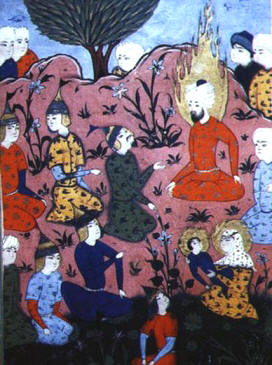
There has been a bit of a buzz around the blogosphere triggered by this article (HT TSK!)

It points us to a long tradition of followers of Jesus within the Muslim faith. Many of us kind of know something of the fact that Jesus is regarded as a messenger sent by God within Islam. The Qu’ran makes direct reference to Jesus around 25 times.

It records his miraculous birth to the Virgin Mary.

His mission to point people back to God.

His death and resurrection.

And a promise of his second coming.

But even if we knew something of this, we also knew that Islam denies the deity of Jesus, or that he might have been the Son of God.

And most Christians, for thousands of years, have sought to demonise all followers of the Prophet- not just as misguided, but as something darker and more scary.

In this time of war and terror, an examination of the engine of faith on the actions of individuals and whole societies has never been more urgent- certainly not in our life times.

Back to the article.

What Joseph Cumming dared to do was to ask whether it was possible to be a follower of Jesus AND a Moslem. He makes a specific comparison to Messianic Jews, who are able to reconcile their Jewish identity with a faith in Jesus. He points to a movement in the 1980’s of Muslim believers who sought to live out their faith in Jesus within their Islamic context- some even facing persecution along the way.

Now this debate will no doubt trigger many polarised responses- and a whole lot of technical theological debate. What is interesting to me is that this article was placed on the Lausanne Movement website– staunchly Evangelical, with it’s roots in the life and work of Dr Billy Graham.

But what remains for me out of this discussion  is a fragile bridge that may allow the passage of pilgrims who are prepared to work for peace and justice- that may allow again discussion, mutual appreciation and respect between the great ideological faith blocks that oppose one another across the ‘Bethlehem curtain’ (to coin a phrase.)

Many of my friends will recoil in horror. A watering down of faith! An allegiance with the Devil! Syncretism! (I suspect that there are many on the Islamic side of the debate who would use exactly the same phrases.)

Well you know what- If I err, I am going to try to make sure that my error is on the side of grace, and peace, and forgiveness.

Isa would have it no other way.

Melvin does Calvin…

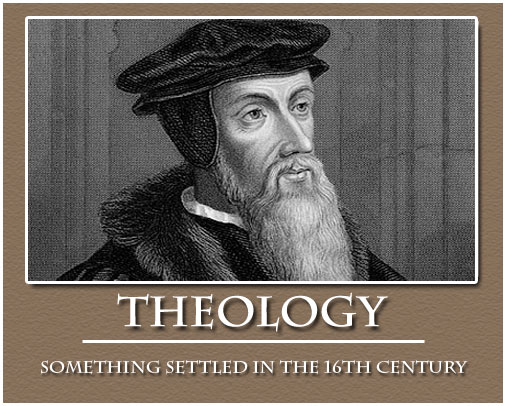
This morning Melvin Bragg’s programme ‘In our time’ discussed the life and influence of John Calvin, Protestant ‘guard dog’ of the reformation. You can listen again here.

Highly recommended for those of us who need to engage with some of the big theological ideas in bite sized chunks. And all the more important for those of us who perhaps stand as part of a new reformation.

It is all there- the passion, the seeking after the purity of truth distilled from correct study of the Bible, the desire to release people from what were regarded as empty superstitions fed by the Roman Catholic church.

But also the austere, sometimes brutal regime that emerged in Geneva around his teachings- the rigid inflixible and systematised faith. And the persecution of anyone who dared to hold a different view.

It also dealt quite well with the way that Calvin’s teaching fitted in with, and perhaps even inspired enlightenment thinking, and was able to spread and flourish via the new information technology of the printing press.

Oh- and the pre-destination thing.

Definitely worth a listen with a cup of coffee…

Lessons on community and theology from the Africans…

Following on from earlier posts digging into the issue of community, I have been thinking about Ubuntu.

No, not the open source software package (although it may well be good- anyone using it?)

Ubuntu derives from a Bantu word from Southern Africa, but seems to be regarded as describing a classical African world view. It interested me because of this man

Desmond Tutu- an eccentric, playful, humble statesman whose way of following after Jesus will be remembered in history. For him, the idea of Ubuntu entered into his understanding of theology- in this way-

One of the sayings in our country is Ubuntu – the essence of being human. Ubuntu speaks particularly about the fact that you can’t exist as a human being in isolation. It speaks about our interconnectedness. You can’t be human all by yourself, and when you have this quality – Ubuntu – you are known for your generosity.

We think of ourselves far too frequently as just individuals, separated from one another, whereas you are connected and what you do affects the whole world. When you do well, it spreads out; it is for the whole of humanity.

Archbishop Desmond Tutu, 2008.

Another quote I liked was this one-

Louw (1998) suggests that the concept of ubuntu defines the individual in their several relationships with others, and stresses the importance of ubuntu as a religious concept. He states that while the Zulu maxim umuntu ngumuntu ngabantu (“a person is a person through (other) persons”) may have no apparent religious connotations in the context of Western society, in an African context it suggests that the person one is to become by behaving with humanity is an ancestor worthy of respect or veneration. Those who uphold the principle of ubuntu throughout their lives will, in death, achieve a unity with those still living.

Dirk Louw- from here

Here is the man himself-

Is there a lesson here for us in the west during our ongoing post modern transition into… whatever we will become? Bill Clinton thinks so-

What interests me is not so much the large scale, international challenges of this word- but rather the small scale, individual person to person way of understanding it. Because this seems to me to be of crucial importance to us. As a culture, we value individualism, personal choice, self actualisation, the democratisation of every minute of life. These things may be good, but like many good things, too much of them may well damage our health.

Because the push for these things can make a god out of ‘me’.

And it can so easily build barriers and create distance between the ‘we’.

How might this be happening? I would contend that increasingly we communicate via machines. We collectivise on line, we form ‘community’ that has no real cost as it can dissolve at the click of a computer key.

We followers of Jesus have a different calling on our lives- characterised by the word ‘love’ and the fruiting and flowering of the Spirit- not just in our narrow lives, but in our relationships.

Perhaps our calling in this changing time is to rediscover a simpler, older way of living, characterised by Ubuntu.

I loved this quote from a recent TV programme about Desmond Tutu-

” I am not an optimist, but I am a prisoner of hope…”

Amen Bishop, amen.

Bible Sunday…

CSL047

Today is ‘Bible Sunday‘- a celebration co-ordinated by the Bible Society, with the title ‘Living in the certainty of God’s Word’.

We are pointed in the direction of that wonderful passage in Isaiah 55– which begins ‘Come all who are thirsty…

I very much agree that the Bible is something to celebrate, so I have been reading some of the information about Bible Sunday. However, I find myself in a familiar uncomfortable place. I have posted before about some of these issues- here and here for example.

Some of it might relate to the language used in this celebration- the assumptions and presumptions inherent. The very title- ‘Living in the certainty of God’s word’- what this means for many is a closing down of debate, a final understanding of Truth– the Bible says it, I believe it, end of story. We are encouraged to approach the Bible as we would a mathematical formula- to engage with the different elements, order them correctly and so arrive at the only logical reasonable outcome.

But I have become increasingly aware that in doing this, we diminish the words. Indeed, we are in danger of recreating God in our own image.

Another image I have used before is this one
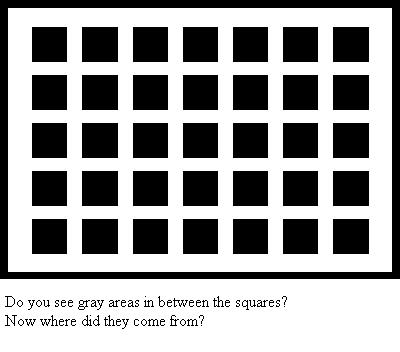
gray areas

The Bible is full of truth, wisdom, poetry, history, prophecy and mystery. We humans are logical orderly creatures, who are made to look for patterns. However, we look through at things through a perspective formed by presumptions- it is much easier that way, and it is very hard (if not impossible) to approach any issue afresh without the influence of time and place and heritage. Most of the time this stands us in very good stead. It allows us to be what we are. It allows us to build logical portable and replicatable blocks of truth. It allows us to find commonality and build Church.

But then there are those elusive dots.

We can try to ignore them, but they keep popping up- like those passages in the Bible that just do not fit very well… Or others who have understood a passage in a different way, and God seems to be blessing them. Or the realisation that what we have regarded as fixed and absolute, is suddenly- shifting…

We can regard them as irrelevant and but then they still irritate. Or we can outlaw them, suggest that they are heretical distractions- but then we find that they are increasingly difficult to ignore.

But my humble experience of the Bible suggests that they will always be there. Because the Word of God can not be contained in a book. Neither can God be reduced to a formula. God will simply not be contained.

Does this diminish the Bible for Christians? Perhaps for some, it does. For these folk, the theological blocks hewn from the huge quarry of Scripture are so rigid, that to suggest a different perspective is to bring the whole edifice crashing down. In this, we are in danger of worshiping an idol of our own construction.

But for many others, the Bible is a cherished gift- one that shines light, but also contains many shadows cast by our lack of understanding, and the assumptions made by previous generations.

So I am going to celebrate Bible Sunday by reading the passage from Isaiah 55, and reminding myself that this wonderful poetry points us not at the words, but at the word giver.

Isaiah 55

1 “Come, all you who are thirsty,
come to the waters;
and you who have no money,
come, buy and eat!
Come, buy wine and milk
without money and without cost.

2 Why spend money on what is not bread,
and your labor on what does not satisfy?
Listen, listen to me, and eat what is good,
and your soul will delight in the richest of fare.

6 Seek the LORD while he may be found;
call on him while he is near.

7 Let the wicked forsake his way
and the evil man his thoughts.
Let him turn to the LORD, and he will have mercy on him,
and to our God, for he will freely pardon.

8 “For my thoughts are not your thoughts,
neither are your ways my ways,”
declares the LORD.

9 “As the heavens are higher than the earth,
so are my ways higher than your ways
and my thoughts than your thoughts.

10 As the rain and the snow
come down from heaven,
and do not return to it
without watering the earth
and making it bud and flourish,
so that it yields seed for the sower and bread for the eater,

11 so is my word that goes out from my mouth:
It will not return to me empty,
but will accomplish what I desire
and achieve the purpose for which I sent it.

12 You will go out in joy
and be led forth in peace;
the mountains and hills
will burst into song before you,
and all the trees of the field
will clap their hands.

13 Instead of the thornbush will grow the pine tree,
and instead of briers the myrtle will grow.
This will be for the LORD’s renown,
for an everlasting sign,
which will not be destroyed.”

I am (not) inspired by Pete Rollins…

I have been reading another of Pete Rollins’ books on and off through this past year- this one- ‘The fidelity of betrayal’.

the-fidelity-of-betrayal

It has some great stuff in it, but to honest, I have struggled a bit more than I thought I would to get through it. This surprised me, as I devoured his last book- ‘How (not) to speak of God’.

Perhaps I did not give it a fair crack of the whip, as I read it in something of a piecemeal fashion.

But I think too I may have seen a bit too much of his gig. It goes something like this-

The life of faith is a life of contradiction. Therefore all things we think we know about God, when we really stop and think- we do not really know after all.

All the tenets of faith we were given as absolutes are (not) true.

Faith is formed as we learn to become faithful betrayers of our inherited traditions.

Faith is formed as we  learn our status as (A)theists.

Now I kind of see where he is going with this, and I think the commentary on faith is important and thought provoking. But I can not help feeling just a little weary with the ‘let’s turn this upside down and then see how it looks from the other side’ kind of style. I find myself kind of seeing it coming, then chuckling to myself when it surely arrives.

But then again, I do think this man is an important contributor to the theological and philosophical debate in our time. Let me quote a passage for you to kind of illustrate my dilemma with this book…

In a chapter called ‘forging faith communities with/out God’ (there he goes again- get it?) he has this to say-

…once this is understood, and people are invited to begin to deconstruct their religious systems, individuals will either be brought to a deeper understanding and appreciation of their faith, or they may find they never really had faith in the first place. In the former case the deconstruction will enable the individual to delve deeper into an appreciation of his or her faith, while in the latter the individual will leave such things behind. Both of these are preferable to either mistaking the true miracle of faith for a system of thought or of using that system as a way of hiding from oneself a lack of faith.

Well I guess… I certainly have found myself to be in the former case most of the time, although I have to acknowledge that some of the time I perhaps slipped towards the latter.

Rollins goes on to give some consideration to the creation of spaces that allow people to explore and deconstruct.

Following on from this there is a need to continue the long Christian tradition of forming spaces in which we collectively invite, affirm and celebrate the miracle that lies behind the miraculous, beyond magic, beyond the sacred, and beyond the secular. We need to continue forming places that can render these ideas accessible at an immediate level- a level that does not depend on the contingencies of one’s education or the ability to think in abstract ways (this from Rollins?!)

The question here is not “how do we make these ideas intelligible”, for the miracle itself can be rendered intelligible only as unintelligible. What this means is that the miracle of faith is a happening, an event, that defines reduction to the realm of rational dissection…

…In contrast to forming space that will make sense only to people who are highly educated, we must endeavour to form spaces that make sense to NOBODY, regardless of the level of education- spaces that rupture everyone and cause us all to rethink

Right.

Again- I get it. Faith discovered/encountered/inspired/agitated through performance art. Or as Rollins calls it- Transformance art.

And then I think of my own community, and our experiments with worship curation. The process that Rollins describes seems so far beyond us. It is too hip, too serious, too absorbed in it’s own rhythm somehow… and I find myself slightly and surprisingly alienated.

And I find myself longing for something much simpler- where deconstruction is not the only language we use, but we also construct things that are small, but beautiful.

But I still think we need Rollins- and I am looking forward to what Ikon have to offer at Greenbelt festival this year…

Happy 500th Birthday John Calvin!

So, this week marks the 500th birthday of John Calvin, something which, given the preoccupations of this blog, was something I did not think should pass unmarked.

Happy Birthday John.

You turned your world upside down, and we stand in your shadow.

Or at least we did. Some say it is time to walk out on our own adventure.

To make our own reformation.

Praying for patience and grace on our own modern versions of Michael Servetus.

calvin

You can listen to a radio programme called Beyond Belief here that reflects on the enduring legacy of Calvin- half an hour of theology and reflection- well worth a listen.

The Epic of Gilgamesh and ancient scripture…

gilgamesh_louvre

I have been thinking a little about ancient times recently- so humour me while I scratch a familiar itch- that of the relationships between culture, history and the formation of faith through the interpretation of Scripture.

I heard some of the ancient poetry from the Epic of Gilgamesh read out on a TV programme recently. It was beautiful…

‘Gilgamesh, where are you hurrying to?
You will never find the life for which you are looking.
When the gods created man
they allotted to him death,
but life they retained in their own keeping.
As for you, Gilgamesh,
fill your belly with good things;
day and night, night and day, dance and be merry,
feast and rejoice.
Let your clothes be fresh,
bathe yourself in water,
cherish the little child that holds your hand,
and make your wife happy in your embrace;
for this too is the lot of man.’

But Gilgamesh said to Siduri, the young woman,
‘How can I be silent,
how can I rest,
when Enkidu whom I love is dust,
and I too shall die
and be laid in the earth for ever.’

One translation of the full text available here.

A summary of the text, and discussion about some of the themes is available here.

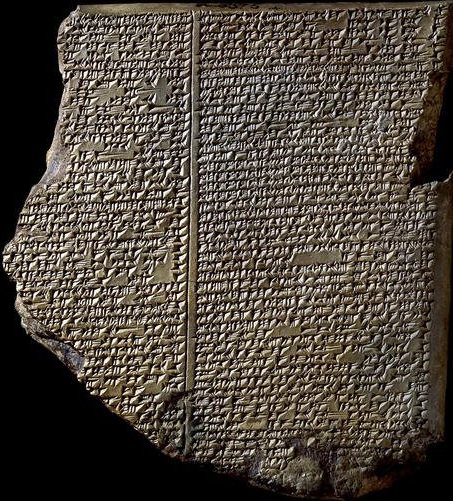
The Flood Tablet, relating part of the Epic of Gilgamesh -Nineveh 7th Century BC

I had heard of this ancient writing before, but knew little of it, so set off to find out more. It interested me for several reasons-

  1. As far as I can understand, this poetry is amongst the earliest literature known to have been written down, emerging from a little known civilisation that pre-existed the Ancient Assyrian and Babylonian empires- back to the earlier Sumerian peoples.  The poetry was held as significant to cultures for the next 3000 years, before being lost into history until tablets telling the story began to be unearthed in the 19th Century AD. The amazing endurance of the story, and it’s survival on tablets of stone is fascinating and intriguing.
  2. These civilisations occurred in the middle east, in the areas now known as Iraq and Iran, and the more understanding we have of middle eastern culture in this time of war and the ‘demonisation of the other’ the better.
  3. The Epic of Gilgamesh is a poetic recording that pre-exists the recording of the oral tradition that became the Hebrew Bible. There are many parallels between the creation stories in Genesis and those described in the Epic, as well as an account of a great flood. Clearly there are many differences too, but I find myself once again interested in the origins of Scripture- and its relationship with the culture and context that it was inspired within.
  4. There are also echoes of what appear to be perennial human pre-occupations- the origin and meaning of life, friendship, courage, and the approach of death. Consider again the poetry of Solomon from the book of Ecclesiastes- and compare this with the words from the Epic above…

7 Go, eat your food with gladness, and drink your wine with a joyful heart, for it is now that God favors what you do. 8 Always be clothed in white, and always anoint your head with oil. 9 Enjoy life with your wife, whom you love, all the days of this meaningless life that God has given you under the sun— all your meaningless days. For this is your lot in life and in your toilsome labor under the sun. 10 Whatever your hand finds to do, do it with all your might, for in the grave, [c] where you are going, there is neither working nor planning nor knowledge nor wisdom.

11 I have seen something else under the sun:
The race is not to the swift
or the battle to the strong,
nor does food come to the wise
or wealth to the brilliant
or favor to the learned;
but time and chance happen to them all.

12 Moreover, no man knows when his hour will come:
As fish are caught in a cruel net,
or birds are taken in a snare,
so men are trapped by evil times
that fall unexpectedly upon them.

(Ecclesiastes 9, NIV)

King-Solomon-Russian-icon

So the question on my mind, is whether this has any significance for how we Christians might engage with ancient Scripture, and in turn, encounter the Living God?

I have written some things before about my own struggles with these issues-  I asked a series of questions, which I tried to give my own incomplete answers to here.

But I find myself increasingly divorced from the way of understanding scripture that I grew up with in the left-of-centre-charismatic-evangelical-fundamentalist churches that gifted me with faith.

This is because the assumptions through which they appeared to approach scripture no longer make sense to me. They seem to include these-

  • The Bible is complete, sufficient, without error or contradiction, and was given to the Church complete as a gift from God.
  • Any challenge to the absolute authority of the Bible has to be resisted at all costs.
  • Any sources outside the Bible- be they writings of other early Christians, or the spirituality of other cultures- all these things are at best dangerous, or at worst, deceptions of the devil.
  • Appreciation and interest of history is highly selective, and should be focussed on the agenda and issues emerging in the 200 years following the Reformation.

I now find myself drawn into new areas of adventure- based on a new set of questions and assumptions. These are not my own, but rather ones that have ‘emerged’ into my experience of faith through a process of re-engagement. They include some of these things-

  • We stand on the shoulders of many other people of faith, who have been drawn by God into incomplete but inspired understandings.
  • Some of this was written down, and some of this writing survived and endured.
  • Over the period of one and a half thousand years, and after much deliberation, some this has been gathered together to form what we know as the Bible.
  • The original meaning of some of these words is lost to us.
  • But the words are still an amazing gift to us, as the Holy Spirit makes them sing again in our context.
  • Let us never pretend to understand fully or finally, or to restrict God to our narrow context or viewpoint.
  • Our ultimate engagement with the God is through the person of Jesus, and the promptings of the Holy Spirit.
  • But we too will fall short.
  • And others  that follow us will need to find their own adventure.

God bless them as they write their own Epics.