The answer to life the universe and everything- tomorrow!

42

Photo from Flickr- here.

So tomorrow is my birthday. Can you guess which one? Salutations and expensive gifts gratefully accepted.

For those of you do not get the reference- then this probably to your credit (but as a clue, it relates to a story from The Hitchikers guide to the galaxy. See below.)

Church attendance on the rise in the UK?

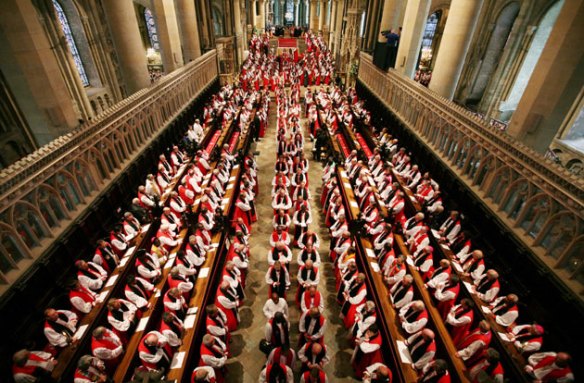
canterbury-cathedral_39564a

Well I never.

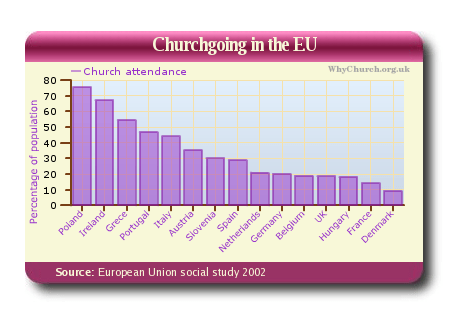
There has been a bit of a buzz around that church attendance figures in the UK are on the up! This after decades of dropping like a stone. These are the sorts of stats we have become used to (from here)

att_trend_chart

eu_church_att_chart

att_trend_chart

Of course, the picture was never simple- some individual churches are growing- the odd American imported super church, Black Pentecostal churches, and Orthodox churches- these have all been on the increase… albeit from a low base.

But statistics- they can be very misleading, so I did a bit of searching to see if I could find specific details of the studies.

The first one concerns a study done by Tearfund- mentioned in the Telegraph here.

A survey of 7,000 people by Tearfund found that 26 per cent say they went to a church service in 2008, up from 21 per cent the year before.

In addition, the proportion who say they attend church every month has risen from 13 per cent to 15 per cent, while one in 10 claim they go at least once a week, up from 9 per cent.

These are the highest figures recorded by the development agency for more than three years, contradicting research that has claimed churchgoing is in steady decline across Britain.

Young adults and pensioners are said to have taken up churchgoing in the greatest numbers, with a 10 per cent rise in attendance reported among the over-75s. Geographically, the biggest increase was seen in Wales (12 per cent).

It would mean that 7.3million adults now go to church – excluding weddings, baptisms and funerals – once a month. Official figures show that only 1.7m people attend Church of England services every month, while a further million attend weekly Mass at a Roman Catholic church.

The full details of the Tearfund study can be found on their website- here.

Another Telegraph articles makes the link with the deepening economic crisis- here.

Numbers of people attending Cathedral services have been on the increase for a while- see here and here.

So what are we to make of this? One swallow does not make a summer, but the numbers quoted in the Tearfund study are significant- as is the year on year 4% Cathedral attendance increase since 2000.

I think we people of faith should pay little heed to these figures. Let us instead remember some lessons learnt when church attendance figures looked like the charts above, which I think should include some of these-

  • We can no longer expect ‘attractional’ models of church to fill the pews.
  • Church is not about sacred buildings, but about letting loose the people of faith into the towns and cities about us.
  • The new context requires new ways of interpreting the gospel, and a re-examination of how the enculturalisation of church has contributed to a lack of relevance.
  • But the old mystical/contemplative traditions have much to teach us too.
  • Faith is discovered through action and interaction, not through didactic teaching.
  • Doctrine is not the most important thing.
  • Love is.

Saul of Tarsus- he was only human… wasn’t he?

Interesting discussion in housegroup the other night.

We are continuing with a study on Acts of the Apostles as part of the Exilio study, and we are up to chapters 25 and 26. It is in this passage that Paul manages to offend the Jews (again) and they get the Roman Governor to throw him into prison.

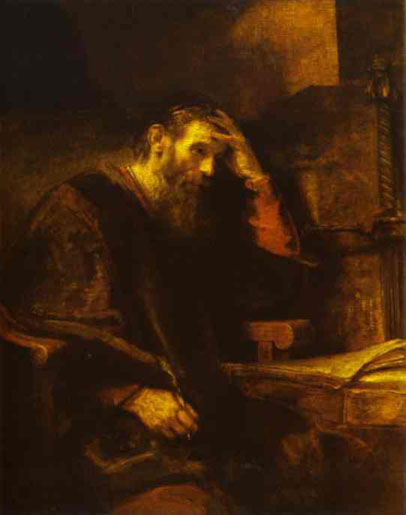
rembrandt-saint-paul-in-prison

This is not a new thing, Paul has been on the end of imprisonments and beatings in just about every town across the region. Each time, it works out for the best in the end.

But this time, when he is offered a trial, he does something he has not done before- he appeals to Caesar.

Paul was a Roman Citizen. We do not know how he acquired this status, but according to Wikipedia (so it must be true) citizenship was granted for one of the following reasons

  • Roman citizenship was granted automatically to every male child born in a legal marriage of a Roman citizen.
  • Freed slaves were given a limited form of Roman citizenship; they were still obliged in some aspects to their former owner who automatically became their patron.
  • The sons of freed slaves became full citizens.
  • Auxilia were rewarded with Roman citizenship after their term of service. Their children also became citizens.
  • Only Roman citizens could enlist in the Roman Legion. However an enlisted Roman legionary was deprived of many of his rights. He could not legally marry, and therefore all his children born during his military service were denied citizenship, unless and until he married their mother after his discharge.
  • Some individuals received Roman citizenship as a reward for outstanding service to Rome.
  • One could also buy citizenship, but at a very high price.
  • People who were from the Latin states were gradually granted citizenship.
  • Rome gradually granted citizenship to whole provinces; the third-century Constitutio Antoniniana granted it to all free male inhabitants of the Empire.

It iseems clear that in acquiring and then using  his rights as a full Roman Citizen, Paul was pulling rank. I wonder if in some way he was taking a step back- no longer being Paul, but rather reverting to Saul…

Citizenship seemed to involve swimming in some murky waters;

Roman citizenship was also used as a tool of foreign policy and control. Colonies and political allies would be granted a “minor” form of Roman citizenship, there being several graduated levels of citizenship and legal rights (the Latin Right was one of them). The promise of improved standing within the Roman “sphere of influence”, and the rivalry for standing with one’s neighbours, kept the focus of many of Rome’s neighbours and allies centered on the status quo of Roman culture, rather than trying to subvert or overthrow Rome’s influence.

The granting of citizenship to allies and the conquered was a vital step in the process of Romanization. This step was one of the most effective political tools and (at that point in history) original political ideas (perhaps one of the most important reasons for the success of Rome).

As a precursor to this, Alexander the Great had tried to “mingle” his Macedonians and other Greeks with the Persians, Egyptians, Syrians, etc in order to assimilate the people of the conquered Persian Empire, but after his death this policy was largely ignored by his successors. The idea was to assimilate, to turn a defeated and potentially rebellious enemy (or his sons) into a Roman citizen. Instead of having to wait for the unavoidable revolt of a conquered people (a tribe or a city-state) like Sparta and the conquered Helots, Rome made the “known” (conquered) world Roman.

There is the rather telling line in Acts 26 in which Festus suggests that Paul had done nothing wrong, and so would have been free to go, had he not have appealed to Caesar.

Paul was never free again after this point.

So- the question that hit me was whether in playing this political game, Paul got it wrong somehow. Perhaps he stopped relying on God, and the rollercoaster ride of following the Spirit into the missional life he was called to.

Because he was human. We easily forget this, I think as we read the accounts of his life in Acts, and as we live out doctrine based on his inspired writings. But there are enough hints of his human frailty despite the esteem in which he is described. The falling out with other people, the ‘thorn in his flesh’.

But if we can read the Roman Citizenship thing in this way- it seems harsh. Almost as if God is vengeful, merciless towards the mistakes of Paul, his faithful but imperfect servant. Is this a God you recognise?

It kind of reminds me of Pilgrims Progress, by Bunyan- a work that I have always disliked. Pilgrim has a road laid out before him, and should he step off this road- should he make the wrong turn, then he is in for trouble…

The fact is, this way of understanding the life of faith is just too deterministic. Almost as if Paul lived out a life of micro cause and effect, making choices like moving chess pieces, leading to sacred or profane consequences.

Almost as if God has mapped out a plan- a pre-determined track for each of our lives, and our task in life is to find it, and stumble along taking the utmost care to stay on this path at all costs…

footrpints

If this is not true, then how does God interact or respond to our choices? Is he just a (mostly) benign presence watching from afar as we, the ephemera, live out our little lives?

I think that this view of God neither matches the account from the Bible, nor my own experience.

I have come to believe that life is indeed about choice- decisions made in the presence of the Spirit of God, as we move through the difficult terrain of life. Some things go bad. But the Spirit is still there, still prompting and calling us on to a higher deeper way of loving others and serving the Kingdom.

And some decisions have consequences that go beyond the immediate situation. Does that mean that we can count on miraculous intervention by Angels to rescue us? I do not think so. But then again…

But if not, it is perhaps good to remember that the mission of Paul began anew- on a journey to Rome, and through the wonderful letters written to early outposts of the Kingdom that survive today.

Snow…

dscf3490

Manna

Overnight the spoors of snow had sown the fields and lined the winter branches white
It lay heavy wet, like a fragile crop that should be rushed to market
Lest it be wasted
But like manna, it has no shelf life
No possibility of air miles

And by afternoon, it is already old
And the surface of the hills, like an old mushroom
Once a splendid pregnant puffball
Is now shrunken and hollow
Leaching into the cold old ground.

dscf3492

Communing in the overlap…

Just Mooching Around (geddit?)

A story;

A man called Isaac grows and lives in a small village. He works hard on his farm, rising with the sun and tending the garden God gave him, tilling the rich brown earth. Rains come and water the green growth and plumps the ripening fruit. Life is good.

Next door lives his great friend Joseph. In the evenings they sit in the light of the harvest moon and share their hopes and dreams. They drink toasts to the future and laugh and joke and dream.

God looked upon them and smiled.

One day, Joseph inherits money from a long lost relative- just enough to buy a cow. And he walks it home up the hill and the evening light shines on its hide like velvet. He runs over to Isaac and invites him over to see the cow in its green pasture, solid and big and bountiful. “Look…” he says, “Look what God has brought to us- now we can have milk in the mornings- butter, cheese!”

But the cow became a shadow between Isaac and Joseph.

And one day, God visited Isaac and asked him what was wrong. Isaac said “It is the cow Lord- it has made Joseph into someone else. He used to be my friend.”

And God was sad.

“Isaac,” he said quietly, “If I can do anything for you- if I can grant you a wish, what would it be?”

Isaac looked up at God with cunning eyes.

“Kill the cow” he said.

Community.

As followers of Jesus, it is our calling, our aspiration, our tranforming power, and the very characteristic of the children of the living God.

Oh… and it can be hard.

Because real community implies closeness to those around us. It suggests relationships that go beyond the surface into the deep, undefended vulnerable parts of us.

And in doing this we are beautiful- as we serve and support, as we learn to love and let go our selfish stuff for the sake of the beautiful other. As we break bread and share wine.

But in doing this- we also are ugly- as we compete and squabble, as we dominate and oppress in the small things of a day, as we take in information and filter it through a screen of past hurts. As we nurse wounds and pick at the stitches until they burst and bleed on our communal table.

What was Jesus thinking of when he threw together his own band of disputing disciples? When he cautioned them that others will know that they are his followers by the love they had for one another?

Perhaps, just perhaps if we survive the examination of the stuff that we hide most carefully from the other- and we do not run away to build our own ego’s from bricks formed out of the manifest failings of our perceived inquisitors…

Perhaps then we might find that community is possible.

Because we Christians live in the overlap of what life is, and what we long for it to become.

Baby P- Sharon Shoesmith’s story…

sharon-shoesmith-415x275

See also previous posts on this subject here and here.

In the wake of the tradgic death of the small boy known as ‘baby P’ in Haringey, director of Childrens Services Sharon Shoesmith found herself in the middle of a media storm. This well respected former teacher (who had an impressive track record in turning around education in the local authority) did not resign, but was eventually sacked from her post by the council leadership. Given the pressure, they perhaps had little choice- someone must be responsible for this dreadful thing- and as Shoesmith was the boss, the buck stopped with her.

This despite an unprecedented letter of support from many of the head teachers within Haringey for Shoesmith.

Yesterday, as the dust begins to settle, and those in the media looking for scapegoats have moved on to the next media feeding frenzy, we begin to have a chance to consider what really happened in this case, and what actions may be necessary to try to avoid it happening again.

Things have already changed in relation to the protection of children across the UK. Quite simply, the threshold for removing children from home and placing them in care has shifted. We now remove one third more that we were doing a year ago. Society (and no doubt the media) has a decision to make as to whether this is acceptable.

Sharon Shoesmith herself was interviewed on BBC radio 4 womens hour. It was a fascinating interview- she was put under considerable pressure by Jenny Murray the interviewed, but made some telling points.

You can listen again to the interview for a while on this link.

Here’s a summary of some of the detail;

April 2007, concerns raised about parenting. Investigations started, child placed on at risk register

June- SWer raised concerns about injuries. Suspicion that these were non-accidental, but no evidence. Specialist medical assessments not conclusive. ‘Fell on stairs.’

Hv’s Swer visits- not enough to meet threshold for care proceedings- three multi-agency child protection conferences. Robust discussion (police later said ‘we told them to take action’) but course of action agreed by all.

CPS- not enough evidence for charge for neglect- this decision made the week the child died. Baby P seen Monday be SW, Wed(medics), Thurs, SWer again, Friday, dead.

At some point over last 48 hours, there was a brutal attack on the child. No-one has been charged with murder. Swers had no knowledge of the two men living in the home- partner and lodger. Boyfriend hid when professionals visited- in a wardrobe and also in a trench in the back garden! Went to great lengths to hoodwink professionals.

The mother gave the impression that she was willing to work with staff- leading to optimism.

Then the media stuff exploded. The story became about Shoesmith- she was the visible presence. No other photos released of family, or child at first.

Ofsted and government departments knew what had happened days after- they were informed. Serious case reviews happened, made recommendations. Months later (as the press and political response gathers like a storm) ofsted chose to make another inspection, which can be read here. They gave no prior warning of the contents of the report or opportunity to discuss the accuracy of the findings to Shoesmith prior to publishing- very unusual. The report was in stark constrast to earler finding by the same agency.

There was then an interesting discussion as to whether Shoesmith, as the leader of a service that failed to protect Baby P was responsible in some way for the death of the child. Shoesmith answered the question very well, asking searching questions about the role of leadership in public life. She described sleepless nights, long days from 6AM to 10PM dodging the media. How she had even considered suicide. But she did not kill this child. She was responsible for a service who tried to protect, but failed.

She also made a point about the low status that our society awards to staff trying to protect kids- and Social workers in particular- asking which other profession would have been at the brunt of this treatment from the press?

Finally, she made this point, which we all should bear in mind-

Each week, at least one child is killed by a member of family in the UK.

Many many more are saved following interventions. In many of these cases, we can never be sure whether actions to protect were proportionate and necessary- we rely on multi diciplinary discussion and decisions. We will NEVER be able to save all the people we work with.

Should Shoesmith (or other staff) have been subjected to the trial-by-media (a notoriously inaccurate judicial process?) I think not.

Should they have lost their jobs? Perhaps this is a response commensurate with the awful loss of a child’s life. But if this applies to Shoesmith- then should it apply to many other directors of social services across the country?

Or is this issue more to do with how we as a society manage the care of our children and allow media generated hysteria to fuel our decision making?

ER does post modern Christianity- apparently!

Michaela is a big fan of ER. You could say she watches it religiously.

So when I came across this clip on you tube I had to have a listen. Apparently the painfully trendy ER staff had to call in the chaplain to speak to some bloke who was seeking forgiveness for his crimes at the end of life.

Evangelical shock jock radio station Way of the Master Radio enjoyed it, and took the opportunity to take a pop at liberal post modern trendy folk who they see as populating the ’emerging church’. Have a listen- its fun!

It kind of raises the question of how Christians are portrayed in the media. In the UK, for the most part- they are not. It is perhaps a different story in the USA…

There was another programme this week on Radio 4 called ‘God and the movies’. You can listen again on this link.

Apparently Hollywood has woken up to the marketing opportunities of targeting the 200 million or so Evangelicals in middle America.

So Mel Gibson’s film ‘The passion of the Christ’ spawned a line of other movies- many of them very bad… some quite good.

There seems to be a move towards low budget ‘Godsploitation fims’ (I kid you not!) Check this out- BIBLEMAN!

bibleman

But there is this other return to films that contain strong moral themes- films like Iron Man or Superman, which seem shot through with references to Biblical themes- redemptive messianic moments set to stirring music, and displayed by beautiful polished people…

Is this a good thing? Surely using mass media to convey something truthful about God is a good thing?

I confess to cynicism. Hollywood is about manipulating images for profit. Do we really want to sell Jesus in this way?

But then movies remain the shapers of mass consciousness perhaps like nothing else…

I think I will steer clear of Godsploitation movies- unless to suck from them some emerging-post-modern humour. Call me shallow if you will!

Conflict and the nursing of wounds in small communities…

dscf3386

I live in a small town. One of the first things that you learn when you move into town is that everyone has history, and the history is known to others. In fact it might even be what passes for entertainment in such places- the stratification of fellow residents according to all sorts of criteria-

  • family background
  • Place of origin
  • Interesting snippets of gossip
  • Achievements and failures.
  • Association with other people who are known
  • Jobs- particularly high profile ones, and so an opinion is necessary as to how the well the role is performed
  • Membership of local groups and churches

These things are true in any community- but they are accentuated in small towns. The thing is, that this concentration of examination can mean that conflict in particular is corrosive and damaging, and potentially long lasting. There is little to divert or dilute, and it is likely that contact will still continue at some level within the communal spaces of the town.

Some conflicts are legendary- played out in the local courts, and the local paper. Once the solicitors get involved things rarely go well.

There seems to be a particular personality type that is associated with such things- someone who sees complex issues as black and white, and is motivated to seek first vindication and then perhaps, revenge.

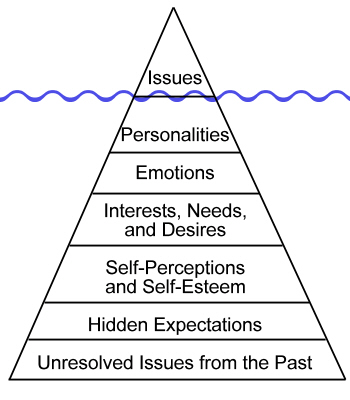
There is always more to an issue than meets the eye;

iceberg-of-conflict2

By way of a case study- about three or four years ago, I was involved in a disciplinary hearing of a member of staff who worked for a local voluntary organisation. To cut a long story short, he was later dismissed in relation to another matter (in which I had some involvement in as well.) This process was long and protracted, and the man concerned showed no willingness or ability to understand or engage with any perspective but his own. It was clear that he saw himself as a victim of a malicious campaign led by myself.

At one point of this process, a window was smashed on a car on our drive, and then on two occasions, wheels mysteriously worked loose on the car- at considerable risk to myself and my family. There is of course, no evidence whatsoever to suggest who was responsible.

The man later appealed to an industrial tribunal, and defended himself successfully, in the sense that the organisation was found to have failed in it’s handling of the matter- mainly because a former chairperson admitted to the tribunal that he lied- having claimed not to have been in possession of information which it later transpired that he had, but had not acted upon.

It was a messy, difficult business, with the future of a vital local resource, employing a number of staff at stake. Hopefully over and done with…

Except it is not.

The man concerned has now engaged a solicitor to pursue his vindication. They have made formal complaints to the director of social work about me, and suggested that my lack of integrity means that I should be disciplined. This has been rejected, so I await his next moves…

What should be my response? He is unlikely after all this time to change his perspective. Too much depends on this view of himself persisting.

I could get lawyered up myself and prepare to do battle- it might yet come to this.

I could simply punch him on the nose. But although I am twice his size, I simply would not know how to start.

He has thrown my faith at me on several occasions- you know the way of it- ‘Bible basher!’, ‘Call yourself a Christian?…’

Well yes- I do. I follow Jesus, who had much worse accusations leveled at him. So I am going to do nothing at present. I hope that the man will find his way out of the destructive cycle that he is caught within. I will try my hardest to relax in grace, knowing that difficult people are usually people in difficulties.

And when we meet in supermarkets, I will look him in the eyes and offer what reconcilliation I can, lest we become another story of embattled and embittered small town life.

Principles… Groucho and theological formation.

groucho-marx

Those are my principles, and if you don’t like them… well, I have others.

Groucho Marx.

A funny guy, was Groucho.

But it seems to me that for thousands of years men and women have tried to find a platform for living that promised something solid and good and true.

In this way, perhaps we can guarantee a life of prosperity for ourselves and our children.

Perhaps too the sum of our days might then come to mean something. And the Gods above us might cease their indifference, and cause the sun to shine on our ripening corn.

And then perhaps we might live out long lives, and see the flowering of our children’s children…

old-man

So the story of wandering nomadic middle eastern people recorded in the Bible, seeking a code for life- this is not just ancient mythology- but it is the story of who we are too.

We follow their journey into the desert, where the wind blows and the wild animals are. We camp with them at the foot of the mountain, and pray for laws for life to be given to us on tablets of stone, and mediated by men of wisdom and strength.

If we can only learn what is required of us, and follow the code of the road that we travel together with our friends, through bandit country…

But then comes the twistings and turnings in the long road. The failings of our leaders, the fickle following of the flock, the empty promises of a distant God who appears to have forgotten his people.

The impossibility of these laws- which always place goodness beyond the reach of mortal man, and condemn us for what we can never be.

But then into the story steps the man called Jesus.

He walks with us for a while, and stands in the gap between being and becoming that we humans always seem to stumble in.

And though he is not a law-breaker, neither is he enslaved by it.

Everything about him calls us to a deeper level of being- back to core of who we are…

We once again find ourselves to be Children of the Living God.

serving-hands

Which brings me back to the point of my post.

If I am right, and there seems to be a universal desire to find spiritual truth and meaning in our existence, then what parts of our understanding do we bring to this search?

Cognitive behavioural psychologists suggest that there are three main levels to our mindfulness. I wonder if there may be clues within this that might help us to consider how we form our thoughts towards God?

The first level concerns out feeling and our acting– those immediate reactions and responses that seem to pop into our consciousness in an almost automatic way. We react out of understandings and experiences that are driven by core beliefs which will be to a large part hidden from us.

These feelings and actions are fickle and changeable. We can modify them sometimes, but often it seems as if they happen to us and around us, and we have little control.

I know people who approach God (or I should say I have approached God) in this way.

The image we have of God arises from a set of inherited assumptions and half understood yearnings. We reach for him in times of immediate need, and try to shape our actions in line with the behaviour of these others who seem to know him better.

There is something of the child in this. It is good. But it is also incomplete. We are more than just the sum of how we act and feel.

The second level concerns the structure of obligations and rules we tend to apply to ourselves. Once formed, we cling to them tenaciously, and though we can act against them, they still govern our acting and feeling in subtle ways.

Some of these rules are well organised into structured hierarchies- and serve us well. However, these exist alongside other assumptions about ourselves and how we relate to the world which may be less helpful. Assumptions formed out of pain or dysfunction, or through incomplete information.

Such rules and assumptions on which we base actions and feelings are not easily accessible or necessarily understood. The reasons we then give for actions may well relate to hidden experiences and understandings that still become the engine for whole ways of being.

Much of my faith experience seems to have been lived in the shadow of guilt induced by me breaking rules. We Christians are very good at rules, even when they are not written down.

Rules of how to dress, how to speak, how to spend time, how to sing, how to love one another, how to shop, how to speak to God. Many of these rules are good- they have evolved out of the history of our faith community and those who went before us. We pore over scripture and refine or understanding of these laws. Some seem more important than others to different groups and at different times. They may then give priority to those laws, and subordinate the others, and the people who follow them.

And mixed in with this structured law keeping are all the other assumptions- that shape the way we act and feel in less predictable ways. Partial and incomplete understandings that still we concrete into a shape that we call truth…

The third level concerns the core principles which become the building blocks for who we are. It is on these principles that the rules are formed from- and in turn govern our acting and our feeling.

These building block principles are formed early, and then take some shifting. Again, we are unlikely ever to have a full understanding of what these are- we only get clues to them as they arise into our conscious interaction with the world around us.

They concern cherished ideas on which we can stand tall, but also other core beliefs that may be less positive- perhaps based on ideas of our lack of worth and value, taken on as children, and still shaping us as adults.

If faith does not live within us at this level- then what value has it? If our theology does not start with the beautiful principles we see lived out in the stories of Jesus, then what value have the rules we employ and apply, or the acting out and feeling that result from our experience?

These things seem to be the flowers that later the Spirit of God would turn into fruit in our lives.

It is not that the laws or the acting out are wrong necessarily. They may be wonderful. But they may also be missing something of the heart of the matter.

Love. Joy. Peace. Patience. Kindness, Gentleness. Self control. Against such there is no law.