Ah, that delicious first sight of a crisp new book…

listingcover

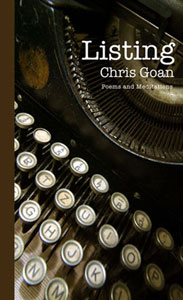
I got a box full of my new book from Proost today- the first time I had seen the hard copy of ‘Listing.’ It is published in small (but beautifully formed!) ‘pocket’ size.

Holding a book you have worked on for so long is such a self indulgent, narcissistic pleasure. It must be sinful… like lingering lustful glances or too much chocolate.

I hope people will like it, and find themselves drawn towards God. Otherwise it is just about fragile ego. And mine certainly is fragile!

Science/faith- apologetics worth chewing on?

Thanks to Jason Clark for this link to Test of Faith.

The site is another attempt to find that dangerous interface between science and faith. It is based around the thoughts of Scientists who are Christians.

I have mixed feelings about projects like this. I have spent some time in the past thinking about the whole creation/evolution thing (here for example) and more or less came to the conclusion that science asked different questions to those needed by people of faith- typically the scientific ‘how’ and the religious ‘why’.

I also worry that there is much BAD science that is being used by Christians to ‘prove’ the truth of their interpretation of the Bible. I find these dishonest and highly selective attempts to squeeze the world into a narrow set of prejudices repellent.

But then I am not a scientist, and never will be. I write poetry that celebrates mystery. Those with a different, more analytical and precise mind set will always need a different level of engagement with these issues.

This proposed set of resources and film seem to promise much…

Here is the trailer…

Vodpod videos no longer available.

more about “Science/faith- apologetics worth chew…“, posted with vodpod


Religion as poem…

Came across this poem recently, by Catholic poet Les Murray-

Religions are poems. They concert
our daylight and dreaming mind, our
emotions, instinct, breath and native gesture
into the only whole thinking: poetry.
Nothing’s said till it’s dreamed out in words
and nothing’s true that figures in words only.
A poem, compared with an arrayed religion,
may be like a soldier’s one short marriage night
to die and live by. But that is a small religion.
Full religion is the large poem in loving repetition;
like any poem, it must be inexhaustible and complete
with turns where we ask Now why did the poet do that?
You can’t pray a lie, said Huckleberry Finn;
you can’t poe one either. It is the same mirror:
mobile, glancing, we call it poetry,
fixed centrally, we call it a religion,
and God is the poetry caught in any religion,
caught, not imprisoned. Caught as in a mirror
that he attracted, being in the world as poetry
is in the poem, a law against its closure.
There’ll always be religion around while there is poetry
or a lack of it. Both are given, and intermittent,
as the action of those birds – crested pigeon, rosella parrot –
who fly with wings shut, then beating, and again shut.

Not quite sure what I think of this, but liked the fact that it made me think!

poetry-t

Cycling down the road to hell…

DSCF4047

I have been doing a fair amount of cycling recently in an attempt to up the fitness levels. I have taken the bike up some mountain trails- which has been fun as it is a ‘hybrid’- not a full mountain bike, and has no suspension.

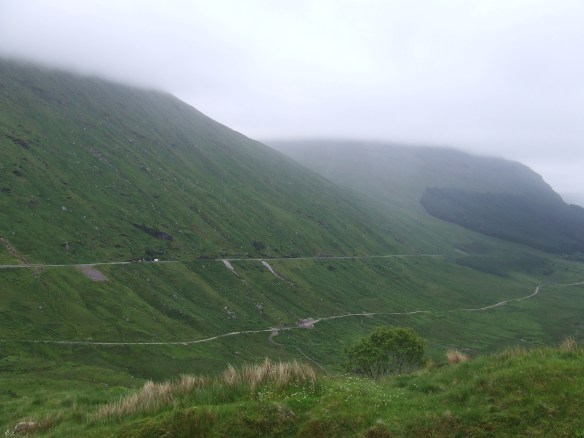
Today however, we were picking Will up from a cub scout weekend in Lochgoilhead, so I took my bike on the back of the car, and Michaela dropped me off to cycle up over the pass and down Hells Glen.

Hells Glen has a steep single track road that winds down through precipitous wooded slopes. Cycling down there is a white knuckle ride, with mouth firmly closed against the insect life. It is so named because it was a place once black with the fires of smelting and charcoal burning- impossible to imagine now, as few obvious traces remain.

The climb out of the Glen up to the A83 at the top of the ‘Rest and be Thankful’ is quite something. It starts out kindly- climbing through leafy Birch forest next to a lovely stream. But half way into the 700 foot climb the slope goes brutal.

Which kind of brings me to an Evangelical moment…

The road to hell is swift and seductive, but the climb in the other direction is very, very hard…

And by way of proof, a few photies;

DSCF4046

DSCF4052

DSCF4053

The Epic of Gilgamesh and ancient scripture…

gilgamesh_louvre

I have been thinking a little about ancient times recently- so humour me while I scratch a familiar itch- that of the relationships between culture, history and the formation of faith through the interpretation of Scripture.

I heard some of the ancient poetry from the Epic of Gilgamesh read out on a TV programme recently. It was beautiful…

‘Gilgamesh, where are you hurrying to?
You will never find the life for which you are looking.
When the gods created man
they allotted to him death,
but life they retained in their own keeping.
As for you, Gilgamesh,
fill your belly with good things;
day and night, night and day, dance and be merry,
feast and rejoice.
Let your clothes be fresh,
bathe yourself in water,
cherish the little child that holds your hand,
and make your wife happy in your embrace;
for this too is the lot of man.’

But Gilgamesh said to Siduri, the young woman,
‘How can I be silent,
how can I rest,
when Enkidu whom I love is dust,
and I too shall die
and be laid in the earth for ever.’

One translation of the full text available here.

A summary of the text, and discussion about some of the themes is available here.
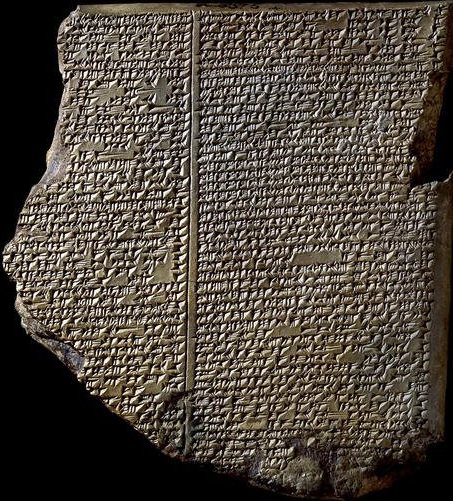
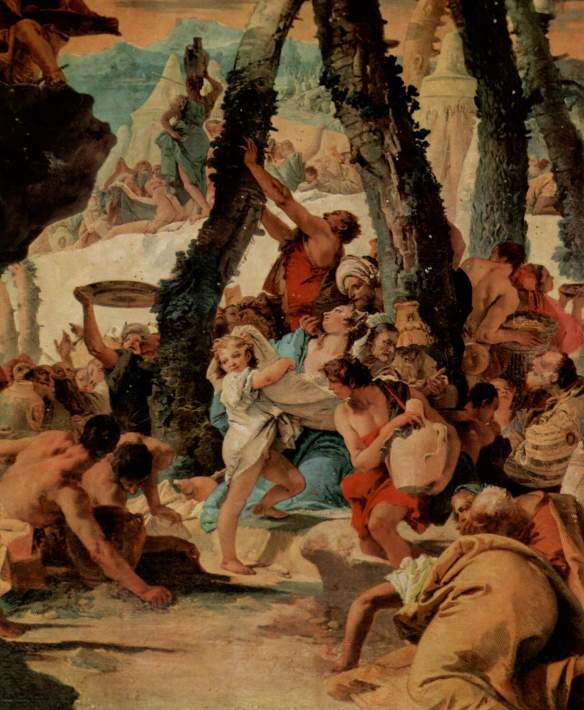
The Flood Tablet, relating part of the Epic of Gilgamesh -Nineveh 7th Century BC

I had heard of this ancient writing before, but knew little of it, so set off to find out more. It interested me for several reasons-

  1. As far as I can understand, this poetry is amongst the earliest literature known to have been written down, emerging from a little known civilisation that pre-existed the Ancient Assyrian and Babylonian empires- back to the earlier Sumerian peoples.  The poetry was held as significant to cultures for the next 3000 years, before being lost into history until tablets telling the story began to be unearthed in the 19th Century AD. The amazing endurance of the story, and it’s survival on tablets of stone is fascinating and intriguing.
  2. These civilisations occurred in the middle east, in the areas now known as Iraq and Iran, and the more understanding we have of middle eastern culture in this time of war and the ‘demonisation of the other’ the better.
  3. The Epic of Gilgamesh is a poetic recording that pre-exists the recording of the oral tradition that became the Hebrew Bible. There are many parallels between the creation stories in Genesis and those described in the Epic, as well as an account of a great flood. Clearly there are many differences too, but I find myself once again interested in the origins of Scripture- and its relationship with the culture and context that it was inspired within.
  4. There are also echoes of what appear to be perennial human pre-occupations- the origin and meaning of life, friendship, courage, and the approach of death. Consider again the poetry of Solomon from the book of Ecclesiastes- and compare this with the words from the Epic above…

7 Go, eat your food with gladness, and drink your wine with a joyful heart, for it is now that God favors what you do. 8 Always be clothed in white, and always anoint your head with oil. 9 Enjoy life with your wife, whom you love, all the days of this meaningless life that God has given you under the sun— all your meaningless days. For this is your lot in life and in your toilsome labor under the sun. 10 Whatever your hand finds to do, do it with all your might, for in the grave, [c] where you are going, there is neither working nor planning nor knowledge nor wisdom.

11 I have seen something else under the sun:
The race is not to the swift
or the battle to the strong,
nor does food come to the wise
or wealth to the brilliant
or favor to the learned;
but time and chance happen to them all.

12 Moreover, no man knows when his hour will come:
As fish are caught in a cruel net,
or birds are taken in a snare,
so men are trapped by evil times
that fall unexpectedly upon them.

(Ecclesiastes 9, NIV)

King-Solomon-Russian-icon

So the question on my mind, is whether this has any significance for how we Christians might engage with ancient Scripture, and in turn, encounter the Living God?

I have written some things before about my own struggles with these issues-  I asked a series of questions, which I tried to give my own incomplete answers to here.

But I find myself increasingly divorced from the way of understanding scripture that I grew up with in the left-of-centre-charismatic-evangelical-fundamentalist churches that gifted me with faith.

This is because the assumptions through which they appeared to approach scripture no longer make sense to me. They seem to include these-

  • The Bible is complete, sufficient, without error or contradiction, and was given to the Church complete as a gift from God.
  • Any challenge to the absolute authority of the Bible has to be resisted at all costs.
  • Any sources outside the Bible- be they writings of other early Christians, or the spirituality of other cultures- all these things are at best dangerous, or at worst, deceptions of the devil.
  • Appreciation and interest of history is highly selective, and should be focussed on the agenda and issues emerging in the 200 years following the Reformation.

I now find myself drawn into new areas of adventure- based on a new set of questions and assumptions. These are not my own, but rather ones that have ‘emerged’ into my experience of faith through a process of re-engagement. They include some of these things-

  • We stand on the shoulders of many other people of faith, who have been drawn by God into incomplete but inspired understandings.
  • Some of this was written down, and some of this writing survived and endured.
  • Over the period of one and a half thousand years, and after much deliberation, some this has been gathered together to form what we know as the Bible.
  • The original meaning of some of these words is lost to us.
  • But the words are still an amazing gift to us, as the Holy Spirit makes them sing again in our context.
  • Let us never pretend to understand fully or finally, or to restrict God to our narrow context or viewpoint.
  • Our ultimate engagement with the God is through the person of Jesus, and the promptings of the Holy Spirit.
  • But we too will fall short.
  • And others  that follow us will need to find their own adventure.

God bless them as they write their own Epics.
Fair trade and recession…

fairtrade

Michaela and I have been interested in fair and ethical trade practices for some time. As a student, my final year thesis dug into this area. For some time we were Traidcraft representatives also.

In earlier times, fairtrade production was low scale and marginal. Who can remember the early instant coffees that tasted slightly like a mixture of sludge and gravy?

Fairtrade produce has become much more mainstream in the last few years. The supermarkets use Fairtrade as a niche selling strategy, and large companies like Cadbury’s, later followed by Galaxy have bowed to pressure and started to use fairtrade materials in their produce. Whilst the edges of what constitute ‘fair trade’ seems to be as fuzzy as ever, these larger scale moves towards breaking down the power of the multi-nationals and giving producers in the South a fair wage are great.

And then came recession.

Logic would suggest that during periods of recession people look to make savings on household bills. They are less willing to pay premiums for quality, and more likely to buy budget products. We might expect too that people will give less to charity, and buy less fair trade produce.

It is encouraging then to read this report from the Ethical Corporation Institute, which suggests that interest in ethical and fairtrade products is soaring.

I wonder why?

Is it possible that the aftermath of the consumer driven credit crisis has led to people examining again the lack of sustainability of our lifestyle? And the inequalities we depend on to maintain it?

William’s birthday!

DSCF3979

It was my boy Williams birthday yesterday. He was 9.

What joy the lad has brought to our family. Watching him grow from a baby to a boy, with all the potential and ability in the world- this is such a wonderful thing.

So happy birthday Will my lad.

A party of Aliens/Jedi/Sith in our back garden

A party of Aliens/Jedi/Sith in our back garden

Shooting stomp rockets at Aliens!

Shooting stomp rockets at Aliens!

One minute guitar lessons…

Music kinds of ebbs and flows in my life. It is always there in the background, but at times, it moves centre stage.

For a long time, doing music (even doing bad music!) was one of the engines for life in me. I played whenever I could. I played worship music, I played in pubs, in studios, and in various collections of fellow musicians that I hesitate to call ‘bands’. Music and spirituality were intertwined- playing and singing was the way i worshiped, and the primary way I set myself to encounter the Living God.

But then something would happen to make me think that music was over for me. It may have been a constant awareness of my own limitations as a musician. Or when I moved away to Scotland. Or when I began to find ‘worship leading’ restrictive and one dimensional.

Each time, however, I found that music was not done with me.

The guitars would come out at a party and we would find something beautiful amongst all the mess of missed chords and background noise.

Or to my surprise, I would be invited to participate in other peoples events- leading to trips to the USA and Europe.

Or the loose collective of musicians that are part of ‘aoradh‘ will have another outing…

But it has been a while now.

So, time to makes some music.

Anyone else up for it?

By way of inspiration, I found these clips of some Canadian guitar players… enjoy!

Standing amongst Saints…

DSCF3919

I live in a lovely place.

Most days in the course of my work, I travel around Argyll- and I often visit the island of Bute.

Bute is an interesting place. It is the most populated of Argyll’s many islands- with a busy capital. It is not without it’s problems, like many small communities. The island has a rich history.

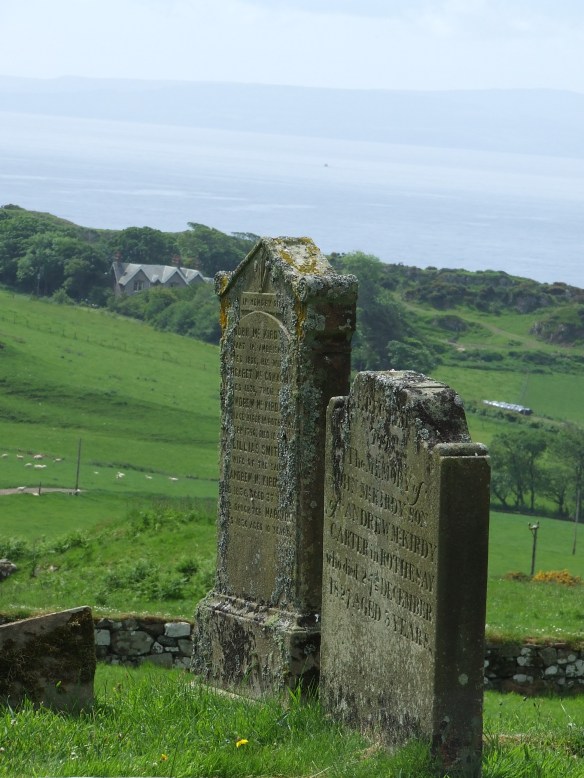
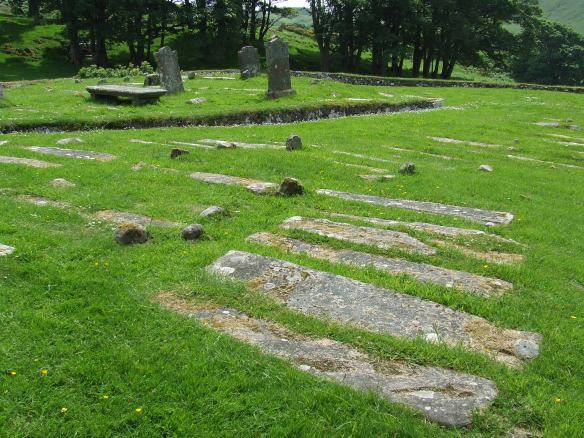
Last week I took a lunch break, and drove out to one of my favourite places- the church of St Blane.

It is a special place. Cupped in a south facing hillside on the south tip of the Island, overlooking the island of Arran, and its small neighbour, Holy Island, another early Christian site, now used as a Buddhist retreat .

The site was thought to be the location of a monastery established by St Catan, contempory of St Columba. He was one of the Ulster missionary saints who journeyed to Scotland to convert the wild Celts in the mid sixth century. St Blane was thought to be his nephew, who took over as abbot after Catan. Blane established other Monasteries, including one on the site of Dunblane Cathedral.

What might life have been like for these early saints? How did they make sense of life and faith and mission?

The site on Bute is rarely busy. It is surrounded by mature trees, full of the sound of rooks croaking. Centre stage is a medieval ruin, which fell out of use around the reformation. The story goes that the minister refused to have any truck with this new fangled religion…

In 1560 the parish priest, Sir James McWararty, refused to embrace the Protestant faith, and he also refused to relinquish his occupation of St Blane’s. He was still living in the nearby manse in 1587, and it seems that the response of the authorities was simply to leave the church to fall into disuse rather than tackle Sir James directly.

He must have been a formidable bloke.

And here we are, at another set of crossroads in the history of faith in Scotland. I wonder what marks we will leave that people might read in another 1500 years?

And if we make any- what they will make of us?

DSCF3920

DSCF3923