Reclaiming the spirituality of serving the other…

Another post about kindness…

I have written before about this issue– suggesting that I thought that kindness is a good measure of spiritual maturity. We talked a little around this the other night with my Aoradh chums.

Of course, being kind is not a universal sign of spiritual, or emotional health. The drive to please other people can be a destructive one. However, I still maintain that Christian spirituality that lacks kindness as one of its visible manifestations is likely also to be missing the point.

Which of course- is love.

The kind of love that is patient, kind and does not envy, boast, act proudly or haughtily. The sort of love that is not rude, or self-seeking, is not easily angered, and keeps no record of wrongs. A love that does not delight in seeing evil in others but makes partnerships of truth. A protective, trusting, ever-hopeful kind of love that just does not give up. (1 Corinthians 13.)

The idealism of this kind of love defeats me at times- but it is an idealism that I will not let go.

So, if we Christians are called to be a blessing on the world around us because of the distinctiveness of our loving,  the way that this will be revealed is in this simple thing called kindness– expressed between ourselves in community, but also looking outwards into the places where we live work and play.

Here are links to a couple of resources that dig into this issue.

Firstly- Generous. This is an opportunity for Christians to sign up to acts of generosity- for the sake of the environment, and for the sake of others around us. There are whole categories of suggested actions that you can consider putting time/energy towards.

I came across Off The Map recently- a group trying to encourage us to reimagine evangelism- together they designed an approach to evangelism that “rescued it out of program prison, made it doable for ordinary Christians and restored it back to the spiritual practice Jesus modeled in his interactions with Outsiders.” They called it Doable Evangelism. This led to a book called Evangelism Without Additives and an organization called Doable Evangelism.

Here is some thing that they produced that resonated with me for its simplicity- and it’s kindness.

Vodpod videos no longer available.

more about “The spiritual discipline of serving“, posted with vodpod

Rollins on leadership…

Alistair pointed me at this clip.

A bit more of the familiar Rollins technique of taking a concept and saying it’s only value is in rejecting it.

But in this case, I think I agree with most of what he says.

There are still a lot of BUTS though. The absence of Leadership leaves a vacuum that requires- leadership. (Note the subtle lack of a capital letter!) It is not whether we have leaders that exercises my thoughts at the moment, but rather what kind, and how they lead- particularly in the way of church.

Rainbows and the promise of healing…

IMGP6294

We have had a full on week- lots of great social stuff- Audrey and Alistair’s birthdays, a bonfire night celebration, an Aoradh planning meeting- as well as the usual family/housegroup/work business.

This morning Emily has some kind of lurgy, and so I am waiting for Michaela to bring some work home in order to allow me to go and do mine.

Which gives me time to reflect a little on the week that was, and the week to come.

As ever, I find my mind drawn to the stuff of friendship and relationships, and how this interacts with the life and call of faith.

Aoradh is at an interesting point in our development. We have been going for a while, and have had some real highlights that we are all proud of. Of course in any such communal enterprise, there is a rich combination of friendship, creativity, energy- along with the usual minor frustrations and tensions that erupt from time to time.

We continue to function with no ‘leader’- and at present, this feels slightly less comfortable, as we are in a process of deliberately reforming and rethinking the what?/whom?/why? questions. There has been a little whiff of storming in the forming, and I think there is likely to be more to come.

One of the tensions has been the issue of COMMUNITY. To me, this is central to everything we do as Christians. To others it is something that requires time- and as such is a pleasant addition to the real business and tasks that we engage in. For others, ‘community’ seems too tame, and the words that fit better are more subversive ones- band of gorilla/pirate/counter-cultural Christians. I think we can be all of these things, but we need to learn to respect one another’s different needs, and affirm one another by constantly re-learning the Jesus way of love.

Written like this- it sounds easy doesn’t it? But of course, this is the harder road to travel. It is a discipline that we learn, and practice imperfectly. Some have greater gifting, but for we followers of Jesus, it is not optional- but commanded.

One of the issues that we spoke about the other day is our differing needs for overt communication of respect/affirmation/assurance of value. We all need this at some level of course, but so much of it depends where we start from- our degree of herited vulnerability perhaps.

One of the interesting issues for anyone who spends time amongst artistic folk, is that many of us exhibit a high level of such vulnerability. The resultant introspection and the drive for artistic expression are sometimes related of course.

There is a beautiful promise on life offered by encounters with the Living God. This promise is for the hope of transformation. Those of us who carry wounds- and lets face it, most of us do- our prayer is for them to be taken away- like some kind of cosmic conjuring trick.

But this has never been my experience. Rather than a magic wand being waved, something altogether more hopeful is possible, that I can only describe in this way- the polarity of the thing subtly changes- from negative, to positive.

What was once a burden can become a place of blessing for others.

Kind of like the promise of the the rainbow- that is after all, only rain, mixed up with light to arc above the moment in something transcendent.

In this way, brokenness leading to social vulnerability (mixed up with light) can become deep sensitivity to others, or wonderful artistic expression.

Or obsessional task centredness (mixed up with light) can become a willingness to help others towards structure and organisation.

Or the instincts that set us on the cynical outside looking in (mixed up with light) can become a way of seeing things in unique and insightful ways.

But how is this promise made possible?

My conviction remains that the hope is to be found in community- and the subordination of all things to a higher principle called- LOVE. This is the Jesus blueprint.

“I’ve told you these things for a purpose: that my joy might be your joy, and your joy wholly mature. This is my command: Love one another the way I loved you. This is the very best way to love. Put your life on the line for your friends. You are my friends when you do the things I command you. I’m no longer calling you servants because servants don’t understand what their master is thinking and planning. No, I’ve named you friends because I’ve let you in on everything I’ve heard from the Father.
John 15:10-12

Remembrance Sunday- and our capacity to destroy…

DSCF3751

Today is Remembrance Sunday.

Old men will cry

Women will open up old cupboards of loss and let the sepia light leak out a little

Young kids will be distracted by brass bands for a while then fidget through silence that seems much longer than a minute

Politicians will assume a pose of media-appropriate sombre dignity

Most of us will feel a familiar ambivalence-

War is terrible, but we continue to make war. Peace is a blessing, but we are stirred by stories of gallantry and self sacrifice that only seem possible in the context of brutality and slaughter.

Our inherited memories of the last war are of a nation forged together in terrible adversity in heroic struggle against the rise of pure evil. The fact that we triumphed at terrible cost is for ever something that makes us proud. Those that died so that we might have escaped the fate of so many other countries deserve our deep respect.

But we also know that the story of war is rarely one of good and evil. It is about evil and still more evil.

And evil has a history- it has the big scale history of previous armistice and forced accommodation and compromise. The sort of history that we can read about in books- Empires rising and falling.

But there is also small history that tells the story of how we as humans seem to have such a propensity to breed hate for one another.

How we look at difference and see danger. How we segregate so easily into ‘insiders’ and ‘outsiders’. How we demonise those people whose prominence threatens our own.

Most of us will have little influence on big histories- and my generation have been blessed to see few of ours names on war memorials. But if we are honest, those same engines for hate and war work within is all.

So this Remembrance Day, let us remember those who fought and died.

But let us also stand in examination of our own failures to follow the way of peace.

DSCF3749

A time to hate

There is a time for all things under heaven…

One summer evening I lay on my back as the light leached from the passing day
And watched the stars slowly flicker into the frame of the darkening sky
At first one here, another there
Then all of a sudden the sky was infinite
Full of fragile tender points of ancient light
Some of which started its journey towards us before there was an ‘us’
And I wonder
Is there someone up there
Raising his tentacles to the night sky
And using one of his brains
To wonder about me?

And should this unseen and oddly shaped brother across the huge expanses
Seek contact
What would he make of us?

I heard an astronomer speak once about the possibility of life elsewhere
In this beautiful ever expanding universe
He had come to believe that intelligent life will always
Find ever more ingenious ways
To destroy itself

And I fear the truth of this
That somewhere in the messy beauty of humanity
We nurture an evil seed –
Grow it in an industrial compost of scientific creativity
Water it with greed and avarice
And hot house it in a mad competition for the first fruits
Lest our neighbours get to market first
And once we work up production
There is no going back
No squeezing back the genie into the oil can
There is only the need for bigger, better

And the defending and defeating
And the ranging of rockets
Exploit whoever
Denude wherever
And if anyone should get in the way
Dehumanise
Overcome
Or destroy
Set up barb wire borders
Teach one another
To hate

So for the sake of green men
And Scottish men
May we yet stand before the eternal night
And decide that truth and beauty and grace will be our legacy
In this fragile passing place that God gave us

May we decide that now is not
The time
To hate

From ‘Listing’- here.

The Siege of Münster and the Anabaptists, via Melvin Bragg…

The cages hanging from a church in munster which held the corpses of the anabaptist leaders

Another great programme on Radio 4 the other day- available as a podcast for your listening pleasure here.

This one digs into the story of the Anabaptist attempt to create a New Jerusalem in the city of Munster during troubled times in 1534.

I had not heard about this tragic part of church history before- and am grateful to old Melvin for waving it at me through the ether. It is a case study from the beginnings of the protestant experiment- in the early days of the old reformation. Much of what we children of this reformation have come to accept as the bedrocks of faith can be seen in the various sects and streams of the Anabaptists. They were the pioneers.

Indeed if you will forgive me for being partisan for a moment- they were the radical activists of the ’emerging church’ of their day.

But as this programme points out, they were a disparate bunch, who regarded persecution as signs of God’s election- so justifying some pretty odd wacky ideas too. So alongside adult Baptism, the leading of the Holy Spirit, the authority of Scripture (now widely available of course thanks to the technological revolution of the printing press) there were leaders who claimed to be the Godly ordained successors of David, or Gideon, and to claim Biblical justification for polygamy.

Oh- and the Anababtists of Munster thought that the world was about to end- and in such a context, murder, despotism and all sorts of evil became legitimate means to an end…

As ever, we grasp some things of the Kingdom of God, whilst confusing and even perverting others.

Perhaps above all, this is case study of what happens when Jesus (or at least his most fervent followers) and politics are thrown together in troubled and changing times.

Add in a dose of charisma, a dollop of religious zealotry, and the result is bloodshed and destruction.

I think one of the biggest lessons we children of a new unfolding reformation need to learn is that Christians are called to lay down power in the name of love and service.

Or the funeral fires of Munster will have burned for nothing.

Bonfire night…

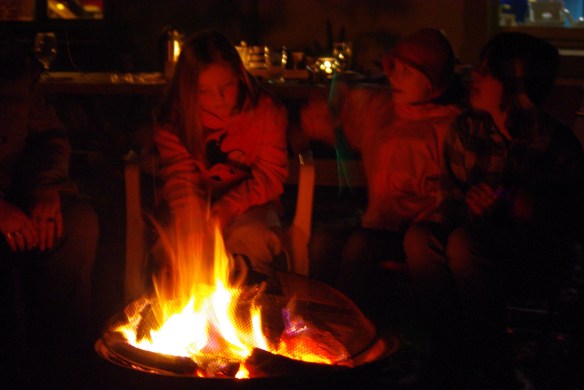
IMGP6880

What a lovely night.

The rain that was hammering down this evening was gone, and the moon and stars were out for bonfire night.

I have always loved bonfire night. Not quite sure what we are celebrating- something to do with one set of religious bigots being glad that they were not blown sky high by a different set of bigots I think…

But to spend a night outside with friends around a warm fire, eating good food and sharing some real ale- this is always good.

And then there are the fireworks. All I can say is that we got away with it again. No serious maimings. No popping of eyeballs. There was a moment when a poorly sited roman candle tilted over to become a canon, firing explosive shells at random angles. Fortunately, they all missed.

In fact the only slight injury was from a neighbours firework- that showered some embers over our gathering, and one of them landed on Sandra’s hand. Hope she is OK


The Firth of Clyde at night…


firth of clyde, night time

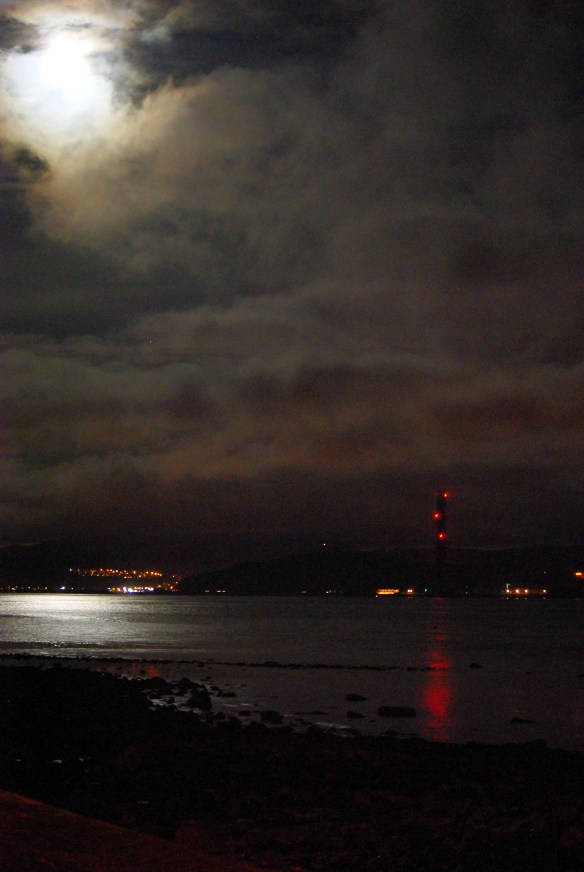
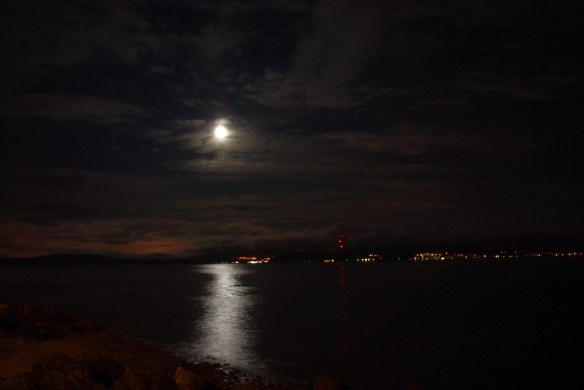
The moon was out on the old river again tonight. It is hard to resist the click of the shutter…

I think it time to re-post this poem too-

Firth of Clyde

Broad estuary
Flowing coal black
Flecked with the streetlight
Lines of amber combed out by the current
Moving
Yet standing still

The Clyde is running clean now
Rich in all manner of living things
Yet somehow
Sterile

Like the fresh paint
On a mothballed dockyard crane
Masking the memories
Of an age of smoke and steam
Now gone

No more slap of paddles
Or thump of ships moving in the night
No more bulging holds
Of Empire plunder
No more sugar, no more spice

A thousand ships have carried off the morning tide
Past Bute and beyond the Cumbraes
Beckoned by Paddies Milestone
And drowned by Sirens on some distant shore
Now flotsam
Of this mighty River

firth of clyde, night time 2

Church- moving forward to the 1930’s?

1930s

Just read this really interesting post by TSK.

The comparisons of the economic circumstances of the ‘naughties’ with the great depression of the 1930’s are not new, but the implications for church in this context offered by TSK certainly are (to me at least!)

Partly this is because the erosion of funding experienced by faith based organisations has passed me by- the church things I am involved in require no external funding- and the ‘missions’ that we have been involved in have all been done on a shoestring. I suppose that as long as members of my group have had collective personal resources that we can use together, we are pretty recession proof.

And this is what TSK seems to be saying. He makes the following predictions/comments about the likely moves in church over the next ten years-

The church in the West will use up much of this coming decade to rebound from the financial recession and to restructure in a more sustainable way, much like the church did in the 1930’s after the Great Recession which started about 1929.


In a concerted effort to get church ministry on a solid financial footing, or to start new ministries with a diminished budget, many traditional churches will offer their buildings mid-week as micro-business enterprise labs and will become micro-credit unions for their local communities. The word “fellowship” will regain its meaning of sharing and risk-taking. Emerging church energies will be re-directed from creative worship arts to creative social enterprises which will enable long term sustainability. In both realms, women will come to the front as some of the most successful missional entrepreneurs.

This seems very important. The activities of many of the small ‘alternative worship/missional/emerging groups that I am aware of have tended towards re imagining worship- in terms of what is meaningful and authentic, but perhaps has also have had more than a whiff of exclusivity. We are starting to build community, but my conviction is that the strength and vitality of our enterprise has to be found in deeper and more loving community- and there is nothing like adversity to forge us together! I have noticed that in the middle of most of these groups is a person gifted with the spiritual gift of hospitality. they are the glue, and the oil, and the heart of the thing. Many of these people are women. In this new context- this feels like the most appropriate way to ‘lead’.

Creative social enterprises may well be the way to go- But I work for the public sector here in the UK, so I am not best placed to comment.

1930′ s writings from theologians Barth and Bonhoeffer will continue in their popularity (no-brainer) but we will also revisit Dorothy Day (USA) and Dorothy Sayers (UK).

Barth and Bonhoeffer I know, but Day and Sayers- must do some reading…

Having already “re-traditioned” and “re-sourced” our theological and missiological base for church and mission, we will feel more confident to launch out further into the world with transformational models that will change the world without draining the next generation’s resources. The next decade will be a time of sustainable outreach, measurable by a far more holistic criteria of success.

So this sounds like the possibility of church offering models of intervention- in the same way that social change happened in the 1930’s through small scale social projects and missions. Big, corporate level stuff is no longer viable, or no longer trusted. The alternatives are local, community generated and sustainable within local resources.

I hope TSK is right in this. It remains to be seen whether church can really make an impact for good in these rather troubled and vacuous times.

It is my impression that the 1930’s also saw a dominance of a form of Christianity that could be seen as ‘liberal’, left wing, socially motivated and engaged. This seems another echo with today.

Hmmmm…

TransFORM- missional community formation…

Look past the impossibly hip language, and plethora of piercings friends, as this stuff could spell the future of church- particularly this side of the Atlantic.

Check out what is all about here.

Vodpod videos no longer available.

more about “TransFORM- missional community format…“, posted with vodpod